

What are the best facebook.com alternatives right now?
The short answer: it depends on what you actually want from a social network. Privacy? Mastodon or Diaspora. Professional connections? LinkedIn. Quick news and public debate? X (formerly Twitter). Niche communities? Reddit. No single platform replaces everything Facebook does, but several do specific things far better.
Here is a fast-scan breakdown of the top alternatives and who each one suits:
- Mastodon — Decentralized, ad-free, chronological feed. Best for users who want algorithm-free social interaction and full data control.
- Diaspora — Pod-based self-hosting, open source, no ads. Best for users who want to own their data completely.
- Reddit — Forum-style communities organized by topic. Best for interest-based discussion and niche groups.
- LinkedIn — Career networking, business content, B2B connections. Best for professionals.
- X (formerly Twitter) — Real-time news, trending topics, public conversation. Best for fast information and public discourse.
- Telegram — Encrypted messaging, large group chats, broadcast channels. Best for private communication and community channels.
- Instagram — Photo and video sharing with a massive audience. Best for visual creators and lifestyle content.
- YouTube — Long-form and short-form video with monetization tools. Best for video creators building an audience.
- Nextdoor — Neighborhood-level community alerts and local events. Best for hyperfocal connection.
- Snapchat — Ephemeral photos and videos with AR filters. Best for casual sharing with close friends.
- Vero — Chronological feed with fine-grained audience controls. Best for users who want post visibility without algorithmic interference.
- Minds — Open-source, crypto-enabled, community-moderated. Best for privacy-focused users who want token rewards.
- Trust Cafe (formerly WT.Social) — Ad-free, Wikipedia co-founder initiative. Best for quality conversation without engagement-bait algorithms.
- Disciple — Private community app builder for brands and creators. Best for controlled, branded community environments.
- Forums — Classic threaded discussion boards. Best for deep, permanent topic-specific discourse.
The best social media sites beyond Facebook are not trying to be Facebook. The ones worth your time have made a deliberate choice about what they will and will not do, and that choice is usually the reason to join them.
How do these platforms compare on privacy, features, and pricing?
Every platform on this list handles data, moderation, and monetization differently. Those differences are the real decision criteria.
| Platform | Best For | Privacy Level | Key Features | User Base | Pricing Model |
|---|---|---|---|---|---|
| Mastodon | Algorithm-free social | High | Chronological feed, server governance, ActivityPub | Decentralized, global | Free (self-host or join server) |
| Diaspora | Self-hosting, data ownership | Very high | Pod-based hosting, no ads, open source | Smaller, privacy-focused | Free |
| Niche communities | Medium | Subreddits, upvoting, AMAs, awards | 765 million monthly users | Free; Reddit Premium subscription available | |
| Professional networking | Medium | Job listings, B2B content, endorsements | Career-focused professionals | Free; Premium subscription tiers | |
| X (formerly Twitter) | Real-time news | Low–Medium | Trending topics, threads, Spaces | 557 million monthly users | Free; X Premium subscription |
| Telegram | Private messaging, groups | High | End-to-end encryption, channels, bots | 1 billion monthly users | Free; Telegram Premium available |
| Visual content creation | Low | Reels, Stories, shopping, influencer tools | 3 billion monthly users | Free; ad-supported | |
| YouTube | Video creation, monetization | Low–Medium | Long/short video, monetization, community posts | 2.58 billion monthly users | Free; YouTube Premium subscription |
| Nextdoor | Local community | Medium | Neighborhood alerts, local events, classifieds | Geo-verified neighbors | Free; ad-supported |
| Snapchat | Casual close-friend sharing | Medium | Ephemeral content, AR lenses, Stories | 932 million monthly users | Free; Snapchat+ subscription |
| Vero | Controlled post visibility | Medium–High | Chronological feed, audience tiers, no algorithm | Smaller, design-conscious | Free (subscription model planned) |
| Minds | Privacy with token rewards | High | Ethereum tokens, community moderation, open source | Smaller, privacy-focused | Free; optional paid boosts |
| Trust Cafe (WT.Social) | Quality conversation | High | No ads, user-funded, community moderation | Small, curated | Free; donation-supported |
| Disciple | Branded private communities | High | Custom app builder, member management, monetization | Brands and creators | Paid subscription tiers |
| Forums | Deep topic discussion | Medium–High | Threaded posts, topic categories, archives | Varies by community | Varies; many free |
Platforms worth a closer look
Reddit sits at a genuinely useful middle ground. With 765 million monthly active users, it has the critical mass that most alternatives lack, and its subreddit structure means you can find a community for almost any interest. The tradeoff is that Reddit’s privacy posture is closer to mainstream social media than to Mastodon or Diaspora.
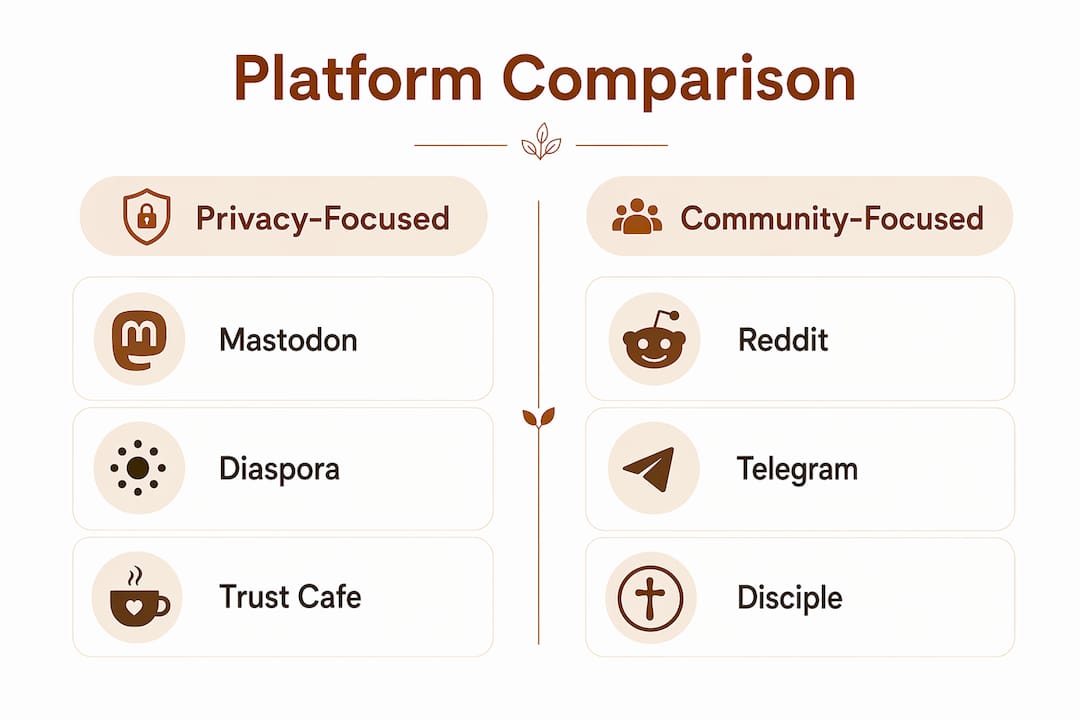
Telegram has grown into something more than a messaging app. Its channel and group functionality supports communities of thousands, and its 1 billion monthly users make it one of the few privacy-leaning platforms with genuine scale. For anyone who needs secure health messaging or sensitive group communication, Telegram’s encryption model is worth understanding before you commit.
Vero solves a specific frustration: the inability to choose who sees what. Its audience tiers (close friends, friends, acquaintances, followers) give you granular control that Facebook once promised but never delivered cleanly. The feed is chronological, there are no ads, and the interface is genuinely well designed. The catch is a smaller user base, so you may be building from scratch.

Disciple is a different category entirely. Rather than joining an existing network, you build your own private community app with your own branding, rules, and monetization. It suits creators and brands who want to own their audience relationship without relying on a platform that can change its algorithm or terms at any time.
Trust Cafe (formerly WT.Social) was created by Wikipedia co-founder Jimmy Wales as a direct counter to engagement-driven social media. It does not collect or sell user data, and advertisers have no presence on the platform. The community is small, but the quality of conversation reflects that intentional design.
Pros and cons at a glance:
Mastodon pros: no ads, no algorithm, full data control, interoperable with the Fediverse. Mastodon cons: smaller user base per server, requires choosing an instance, content discovery takes effort.
Reddit pros: massive existing communities, strong niche discourse, high engagement. Reddit cons: moderation quality varies by subreddit, data collection similar to mainstream platforms.
Minds pros: open source, token rewards for creators, community governance. Minds cons: smaller audience, crypto economy unfamiliar to many users.
Diaspora pros: maximum data control, no ads, self-hosting option. Diaspora cons: very small user base, interface feels dated compared to modern platforms.
How do you choose the right social platform for your needs?
The most common mistake people make when leaving Facebook is looking for a single replacement. Most people who successfully move away from Facebook end up using two or three platforms for different purposes, managing professional networking, personal community, and content discovery separately.
Start by defining what you actually use Facebook for:
- Staying in touch with family and close friends? Telegram or a private Nextdoor-style group.
- Following news and public debate? X (formerly Twitter) or Reddit.
- Career and professional content? LinkedIn, full stop.
- Creative work and visual sharing? Instagram or Vero.
- Privacy-first social interaction? Mastodon or Diaspora.
- Building a community around your brand or content? Disciple or a dedicated forum.
Before committing to a platform, check these things:
- Are the people you want to connect with already there, or willing to join?
- Does the platform’s moderation style match your tolerance for content you disagree with?
- Is the pricing model sustainable? Privacy-centered platforms often rely on subscriptions or donations rather than advertising, which means you may pay a fee instead of trading your data.
- Does the mobile app work well on your device? Most of these platforms have iOS and Android apps, but quality varies.
On migration: moving your social graph can be difficult. Exporting your Facebook data is possible through Facebook’s settings, but most alternatives cannot import it directly. Your contact list, photos, and posts stay on Facebook unless you manually move them. The practical approach is to announce your move on Facebook, share your new profile link, and give people a reason to follow you there.
Pro Tip: Moving as a group is often more effective than moving alone. If you run a Facebook group or community, propose the migration to your members together. Communities that move as a unit maintain their social dynamics better than individuals rebuilding from scratch.
Expect a period of adjustment. Platforms like Mastodon and Diaspora have no algorithmic feed, which means content discovery works differently. You follow people and topics deliberately rather than having a feed curated for you. That shift feels quiet at first, but most users who stick with it report that the experience becomes more intentional over time.

What are decentralized social networks and why do they matter?
Decentralized social networks are platforms where no single company owns or controls the infrastructure. Instead of one corporation running all the servers and setting all the rules, the network runs across many independently operated servers, each with its own community guidelines and governance.
The Fediverse is the umbrella term for this ecosystem. Mastodon, Diaspora, and several other platforms are part of it, connected through an open standard called ActivityPub. Because they share this protocol, a single account can interact across decentralized instances, eliminating the walled-garden problem that keeps you locked inside one platform.
Here is what that means in practice:
- You create an account on a Mastodon server that matches your interests or values.
- You can follow and interact with users on other Mastodon servers, or even other Fediverse platforms, from that single account.
- If your server shuts down or changes its rules, you can migrate your account and followers to a different server without losing your social graph.
- The server owner sets community rules, but cannot monetize your data the way Facebook does.
Why this matters for privacy:
Decentralized platforms prioritize user agency by offering chronological feeds over engagement-driven algorithms. Facebook’s model is built on keeping you on the platform as long as possible, which means the algorithm surfaces content designed to provoke reaction. Decentralized platforms have no financial incentive to do that.
Open-source platforms like Mastodon and Diaspora publish their code publicly, so anyone can inspect how they work. That transparency is a meaningful check on the kind of opaque data practices that have made Facebook controversial.
The real challenges of decentralized platforms:
- Smaller user bases per server, which can make the experience feel quiet compared to Facebook’s three billion users.
- Content discovery requires more effort. Without an algorithm surfacing content, you find people by searching, browsing hashtags, or following recommendations from people you already know.
- Technical setup for self-hosting requires comfort with server administration. Most users join an existing server rather than running their own.
- Moderation quality depends entirely on the server you choose. Some servers are well-run; others are not.
Subscription-based and donation-funded platforms reflect a different social media economy: users pay for privacy and ethics instead of trading data for free use. That shift is not just philosophical. It changes what the platform is incentivized to build.
Pro Tip: Before joining Mastodon, spend ten minutes browsing the server list at joinmastodon.org. Choosing a server whose community focus matches your interests makes the early experience much richer than joining a generic instance.
The open-source model also changes how platforms evolve. Features are built by communities of contributors rather than product teams optimizing for engagement metrics. That produces different software, sometimes rougher around the edges, but built around what users actually want rather than what keeps them scrolling.
Breathefree offers a different kind of break from the scroll
Those social media alternatives above are worth exploring if you want more control over your digital life. But sometimes the urge to scroll is less about which platform you’re on and more about the habit itself.
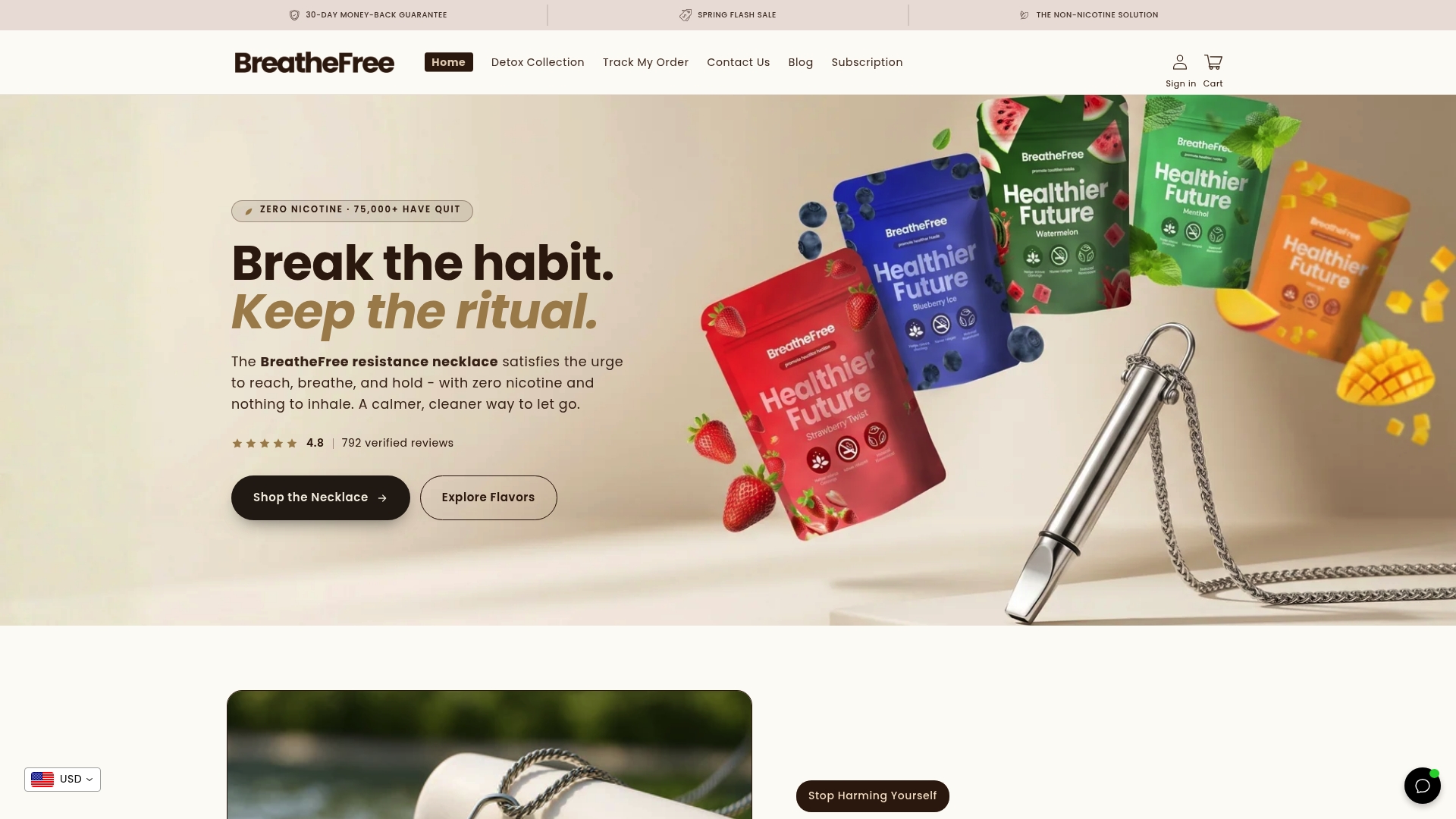
Breathefree takes a different angle. While the platforms above address where you spend your time online, Breathefree addresses the physical habits that keep you reaching for your phone in the first place. Its flagship product, the Breathefree resistance necklace, is a nicotine-free tool designed to satisfy the oral fixation that drives both smoking and compulsive phone-checking. Over 75,000 users have reportedly used it to break the reach-and-grab cycle, replacing a harmful reflex with a calming physical ritual instead.
If you’re rethinking your relationship with social media, it’s worth pairing that with a look at the habits underneath it. Breathefree’s Nicotine Detox eBook and Habit Tracker is a practical companion for anyone working on behavioral change, whether that’s quitting nicotine, reducing screen time, or both. It’s a different kind of alternative to the scroll.
Key Takeaways
The best facebook.com alternatives serve different needs: privacy, community, professional networking, or content creation, and most users benefit from combining two or three rather than seeking one replacement.
| Point | Details |
|---|---|
| No single replacement exists | Choose platforms by purpose: Mastodon for privacy, LinkedIn for careers, Reddit for communities. |
| User base size varies widely | Instagram and YouTube each reach billions; Mastodon and Diaspora serve smaller, more intentional communities. |
| Decentralized platforms use ActivityPub | Mastodon and Diaspora connect across servers via open standards, giving users data control and portability. |
| Migrate as a group, not alone | Communities that move together maintain social dynamics far better than individuals rebuilding from scratch. |
| Breathefree addresses the habit layer | For users rethinking digital habits at a deeper level, Breathefree’s necklace and habit tracker target the physical reflex behind compulsive scrolling. |