

When someone offers you a cigarette tonight, say this: “I’m not smoking anymore — I’m good, thanks.” Then immediately grab your drink, a piece of gum, or your Breathefree resistance necklace. That two-step move — say it, occupy your hands — is the single highest-leverage action for staying smoke-free in a social situation.
Here are three alternate lines you can pick from right now:
- “No thanks, I quit.”
- “I’m good — I’ve got something else going on.”
- “Not for me tonight, but you go ahead.”
- “I’m taking a break from it.”
Pro Tip: Write your chosen line in your phone’s notes app before you go out. Reading it once before you walk in the door makes it feel natural, not rehearsed.
Table of Contents
- Why social pressure makes quitting so much harder
- Ready-made scripts to refuse a cigarette without awkwardness
- What to carry: non-nicotine oral-fixation aids for social situations
- In-the-moment tactics for parties, bars, and smoke breaks
- How to rehearse refusal skills so they work under pressure
- What to do when friends or environments keep pushing
- Key Takeaways
- The part nobody talks about enough
- The Breathefree resistance necklace fits right here
- Useful sources and where to get help
Why social pressure makes quitting so much harder
The offer moment is the highest-risk moment in your quit. Behavioral research consistently shows that being offered a cigarette by someone nearby is the single most reliable trigger for a lapse on any given day. The mechanism is almost automatic: an offer fires a craving cue, which activates the old smoke-and-socialize routine before your conscious mind catches up.
This is where refusal self-efficacy matters. It’s the confidence that you can say no in the moment, and research confirms it’s one of the strongest protective factors against relapse. The problem is that confidence doesn’t show up automatically under social pressure. It has to be built through practice before the live moment arrives.
The good news: cravings don’t last. Mayo Clinic guidance is clear that most urges peak within a few minutes and ease on their own if you wait them out. A 10-minute delay, paired with a distraction or breathing exercise, is enough to let the surge pass. That’s the window your script and your replacement object are buying you.
Ready-made scripts to refuse a cigarette without awkwardness
The strongest single line is the one from the opening: “I’m not smoking anymore — I’m good, thanks.” Short, final, no lecture. It works because it doesn’t invite a debate.
Here are eight more options, sorted by social tone:
Casual (friends):
- “Nah, I’m done with those.”
- “I quit — trying to keep it that way.”
- “I’m good, seriously.”
Neutral (coworkers, acquaintances):
- “Not for me, thanks.”
- “I’m working on quitting, so I’ll pass.”
- “I’ve got something else — I’m all set.”
Firm (persistent pressure):
- “I appreciate it, but no. I mean it.”
- “I’m not going to, but thanks.”
The key with all of these: say it once, then redirect. Change the subject, take a sip of your drink, or shift your position in the group. Refusal skills research shows that a firm, brief statement followed by a topic change is more effective than a long explanation, which tends to invite pushback.
Roleplay drill: Ask a supportive friend to offer you a cigarette three times in a row, using different tones (casual, persistent, slightly guilt-trippy). Practice your chosen line each time without changing it. Five minutes of this before a high-risk event builds the kind of automaticity that holds under real pressure.
Pro Tip: If someone keeps pushing after your second refusal, you don’t owe them a reason. “I said no thanks” is a complete sentence.
What to carry: non-nicotine oral-fixation aids for social situations
The oral-hand ritual is a big part of why smoking feels social. You need something in your hands and mouth that isn’t a cigarette. Here’s what actually works, and how each one fits a social setting:
- Breathefree resistance necklace with flavor refills — worn around your neck, so it’s always accessible. The flavored refill satisfies the oral fixation without nicotine or inhalation, and the tactile ritual of holding it mimics the calming part of smoking. Discreet enough that most people won’t notice.
- Sugar-free gum — cheap, pocket-sized, and socially invisible. Works best for short bursts of craving.
- Mints or hard candy — similar to gum, slightly longer-lasting oral engagement.
- Toothpicks or cinnamon sticks — old-school, but effective for the hand-to-mouth habit specifically.
- Lung detox gummies — designed to support the body during cessation; less about the immediate craving and more about the longer recovery process.
- Essential-oil nasal sticks — inhaling a calming scent (like peppermint or lavender) during a craving moment can interrupt the urge cycle and reduce anxiety.
For a fuller breakdown of how physical objects support quitting, Breathefree has a dedicated guide worth bookmarking.
| Aid type | Ease of use | Socially discreet | Portable | Immediate effect |
|---|---|---|---|---|
| Resistance necklace | High | High | High | High |
| Sugar-free gum | High | High | High | Moderate |
| Mints / hard candy | High | High | High | Moderate |
| Toothpicks | Moderate | Moderate | High | Moderate |
| Lung detox gummies | High | High | Moderate | Low |
| Essential-oil nasal stick | Moderate | Moderate | High | High |

Pro Tip: Pack two types for any event: one for your pocket (gum or mints) and one that stays on you at all times (the necklace). Redundancy matters when you’re in a high-pressure moment.
Pro Tip: If you’re at a bar or party, holding a glass of water or a mocktail occupies both hands and gives you something to do during the offer moment. It’s a simple parallel action that keeps you socially included.
In-the-moment tactics for parties, bars, and smoke breaks
The first 60 seconds after an offer are the hardest. Here’s the sequence:
- Say your line. One time, calmly.
- Immediately put something in your hand (drink, gum, necklace).
- Shift your position — take one step, turn slightly, or move toward another person in the group.
Once you’ve done those three things, set a 10-minute alarm on your phone. Mayo Clinic recommends this timed-delay approach specifically because most cravings ease before the alarm goes off. While you wait, breathe: 4 seconds in through the nose, 6 seconds out through the mouth. That ratio activates the body’s calming response and gives the craving somewhere to go.
- Stay in the group when you can. Stepping away entirely can feel like punishment. Parallel actions (holding a drink, joining a different conversation) keep you socially present.
- Step away briefly when the pressure is persistent or the environment is saturated with smoke. A two-minute walk to get water is a tactical choice, not a retreat.
- Avoid alcohol during the first few weeks if possible. It lowers the threshold for impulsive decisions, including smoking.
Pro Tip: Before you arrive at any event, send one short text to a supportive friend: “Going to [event] tonight — remind me I’m not smoking if I check in.” That single message creates accountability without drama.
How to rehearse refusal skills so they work under pressure
Confidence under pressure comes from repetition in low-stakes settings. Here’s a simple weekly practice structure:
Daily (2 minutes): Say your chosen refusal line out loud, alone, once in the morning. It sounds trivial. It works.
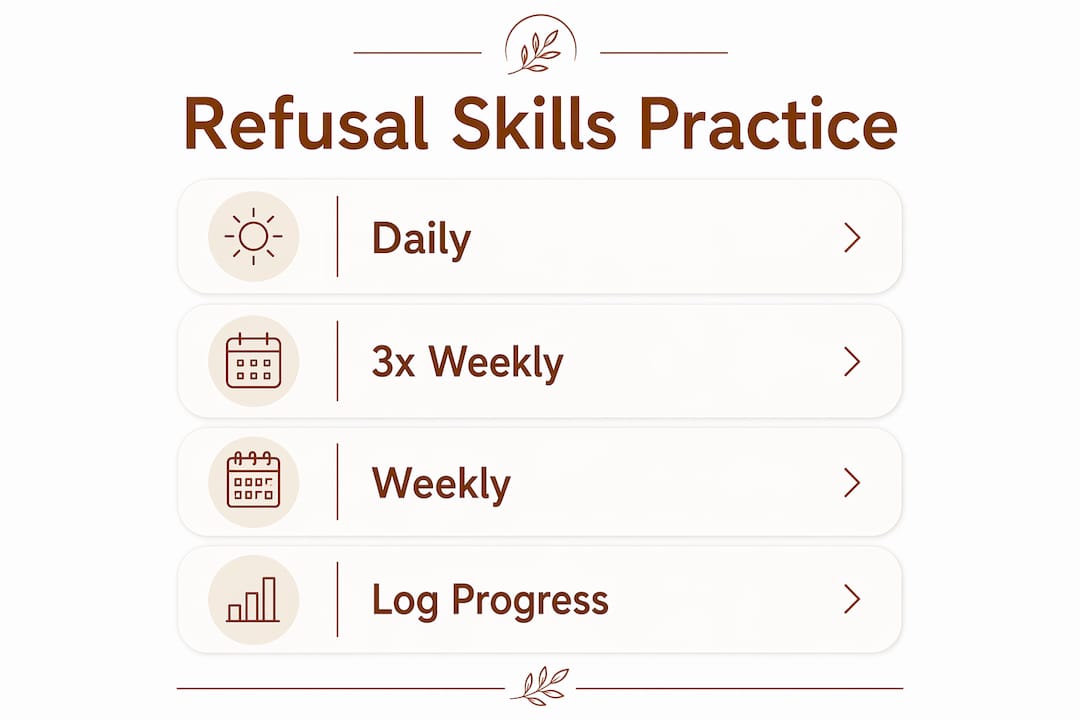
Three times a week (5 minutes): Run the roleplay drill from the scripts section with a friend or in front of a mirror. Vary the pressure level each time.
Once a week (10 minutes): Do a full scenario: friend offers a cigarette at a “party” (your kitchen counts), you respond, you use your replacement object, you set the 10-minute timer. Log one line afterward: what happened, what you said, how it felt.
That one-line log is the most underused tool in cessation. Avoidance self-efficacy research shows that confidence to avoid smoking strengthens over time when it’s paired with perceived risk awareness. Tracking your wins, even small ones, feeds that loop.
Pro Tip: Use the Breathefree habit tracker to log your refusal practice alongside your cravings. Seeing the pattern over two weeks changes how you think about your progress.
What to do when friends or environments keep pushing
Some people won’t respect your quit on the first ask. That’s normal, and it doesn’t mean you need new friends. It means you need clearer boundaries and a short script for each situation.
For roommates or partners: “Can you keep your cigarettes in your room and smoke on the balcony? I’m serious about quitting and visible packs are a trigger for me.”
For regular social groups: “I’m not going to smoke at these things anymore. I’d appreciate it if you didn’t offer — I’ll ask if I change my mind.”
Environment design matters as much as the scripts. Practical quit guidance recommends removing visible cues (ashtrays, lighters on counters), establishing one smoke-free zone at home first, and skipping the highest-risk events during the first 28 days of your quit. You don’t have to avoid your friends forever. You’re just protecting the window when your quit is most fragile.
When the pressure is persistent or your own anxiety is making it hard to hold the line, bring in extra support. The SAMHSA National Helpline (1-800-662-4357) connects you with free counseling and local resources. The 1-800-QUIT-NOW quitline offers free coaching from trained cessation counselors. For peer support options and behavioral coaching resources, Breathefree’s support guide is a practical starting point.
Hypnotherapy is another option worth considering for people whose anxiety around social situations is a persistent trigger. Reset Your Mojo offers behavioral and hypnotherapy support specifically for habit change.
Key Takeaways
Handling social pressure to smoke comes down to one pre-planned sentence, one replacement object, and the discipline to wait 10 minutes before deciding anything.
| Point | Details |
|---|---|
| Use one fixed refusal line | Choose a short script before any event and say it without variation or explanation. |
| Set a 10-minute alarm | Most cravings ease on their own; the timer gives the urge somewhere to go. |
| Carry a replacement object | A resistance necklace, gum, or mint occupies the oral-hand habit without nicotine. |
| Practice before pressure arrives | Weekly roleplay drills build the refusal confidence that holds in real social moments. |
| Breathefree resistance necklace | Worn discreetly, it satisfies oral fixation with flavored refills and no nicotine. |
The part nobody talks about enough
Social pressure to quit smoking gets framed as a willpower problem. It isn’t. It’s a timing problem. The offer arrives faster than your conscious decision-making can respond, which is exactly why a pre-planned script and a physical object in your hand matter so much. By the time you’re standing in front of someone holding out a cigarette, it’s too late to figure out what to say.
What I find genuinely encouraging about the behavioral approach here is that it doesn’t ask you to be stronger than your cravings. It asks you to be faster than them. A two-second script and a piece of gum beat a five-minute internal debate every time. The 75,000+ people who’ve used Breathefree’s approach didn’t succeed because they had more willpower. They succeeded because they had a plan that worked before the pressure hit.
If you’re in the early weeks of your quit and social situations feel like the hardest part, that’s not a sign you’re failing. It’s the most common friction point, and it’s exactly what these tools are built for.
The Breathefree resistance necklace fits right here
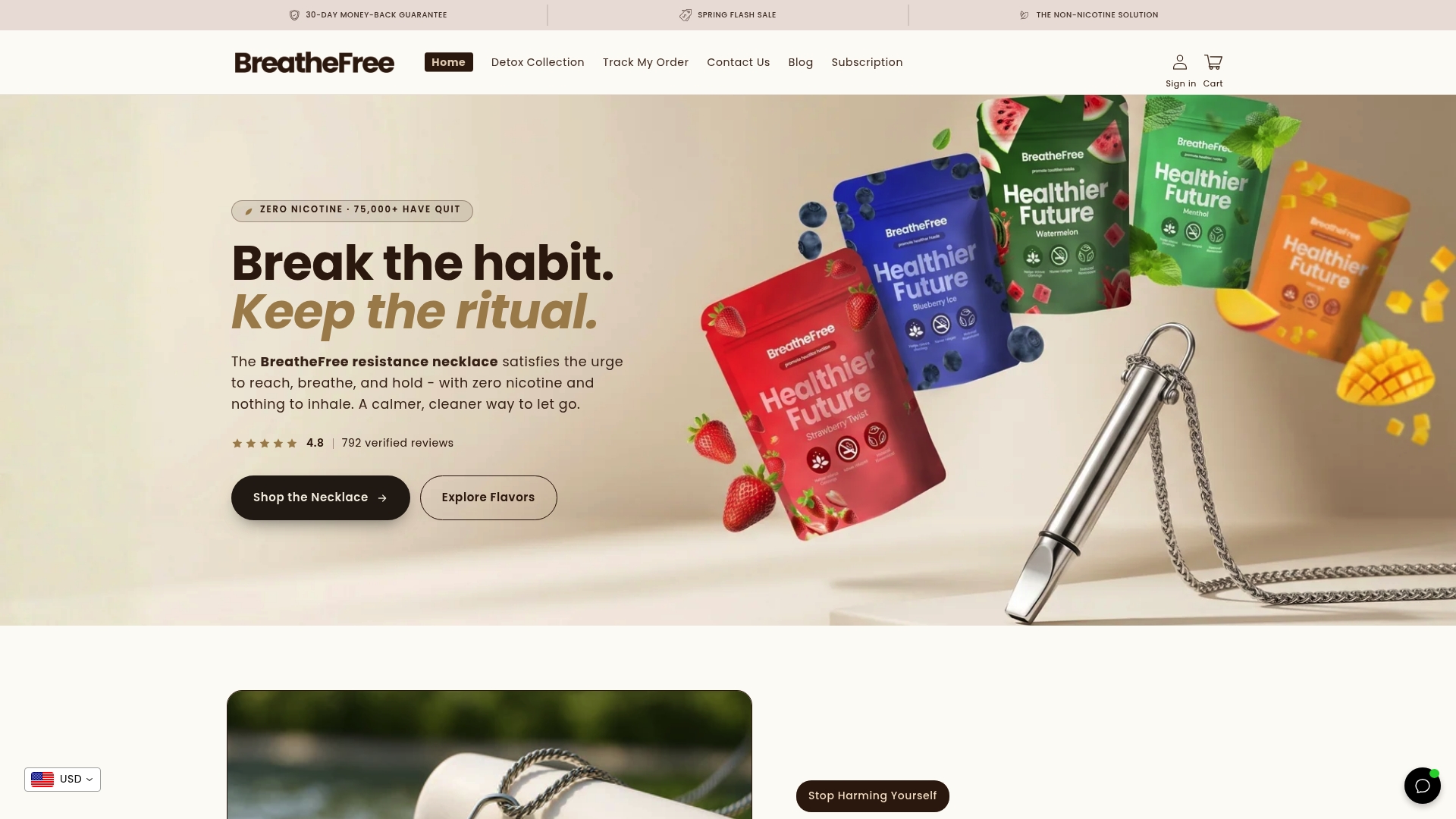
The Breathefree resistance necklace was built for exactly the moments this article describes: a party, a smoke break, a dinner where everyone else lights up. You wear it, you reach for it when the offer comes, and the flavored refill gives your mouth and hands something to do that isn’t a cigarette. No nicotine, no inhalation, no awkward explanation needed.
Many people have used it as part of their quit. Pair it with the Nicotine Detox eBook & Habit Tracker to log your refusal practice and track cravings over time. Both ship directly to your door. If you’re serious about your quit, this is the practical next step: grab the necklace, pick your refusal line tonight, and go into your next social situation with both.
Useful sources and where to get help
The guidance in this article draws on behavioral research, clinical quit resources, and practical cessation guides. Here’s where to go deeper or get immediate support:
| Source | Type | Why it’s useful |
|---|---|---|
| Mayo Clinic — Resisting tobacco cravings | Clinical guidance | Craving timelines, 10-minute delay technique, breathing exercises |
| Refusal self-efficacy research | Behavioral study | Evidence base for rehearsal and confidence-building |
| Quit When Others Smoke | Practical guide | Scripts, environment design, boundary-setting |
| Quit It — Social situations guide | Practical guide | Pre-event prep, parallel social tactics, cue removal |
| Smokefree Teen — Social life | Government resource | Social dynamics, identity, and staying smoke-free with friends |
| NICHD — Peer influence and smoking | Research summary | How social competence and support reduce smoking risk |
U.S. support resources:
- 1-800-QUIT-NOW — free state quitline, connects you with a trained cessation counselor
- SAMHSA Helpline: 1-800-662-4357 — free, confidential referrals to local treatment and support
- Smokefree.gov — free text and online coaching programs
- Breathefree’s quit support resources guide for a curated list of tools and programs
This article is general information, not medical or clinical advice. For personalized guidance on quitting smoking, consult a healthcare provider or contact a certified cessation counselor.