

Essential-oil nasal sticks can ease cigarette cravings within minutes and, for certain smokers, improve the odds of quitting when paired with other treatments. That’s the honest read on the clinical evidence, drawn from randomized trials and a systematic review. The catch: benefits concentrate in smokers with strong behavioral dependence, and they tend to fade fast without reinforcement. Nicotine-free options like inhalers fit into that picture as a supporting tool, not a solo fix.
TL;DR:
- Nasal inhalers provide short-term relief primarily for smokers with strong behavioral dependence who respond to sensory and ritual cues.
- Rotating pleasant scents like black pepper or angelica helps maintain craving relief and prevent tolerance buildup over time.
- Inhalers are most effective when combined with nicotine replacement or counseling, especially for smokers with severe physical dependence.
- Mild side effects such as throat tickle or taste changes are common, but long-term safety data remains limited.
- Proper technique involves slow inhalation during cravings, tracking triggers, and pairing inhaler use with delay tactics for better results.
Table of Contents
- How Nasal Inhaler Benefits Work: Mechanism and Immediate Effects
- What the Research Says About Inhalers for Smoking Cessation
- Who Benefits Most From a Nasal Inhaler for Cravings
- How to Use a Nasal Inhaler for Cravings the Right Way
- Combining Inhalers With Nicotine Replacement and Counseling
- Nasal Inhaler Side Effects and Safety Considerations
- A Realistic Take on Using a Nasal Inhaler to Quit
- Why Breathefree’s Nicotine-Free Tools Fit This Approach
- Sources
How Nasal Inhaler Benefits Work: Mechanism and Immediate Effects
The appeal of a nicotine-free inhaler comes down to two things happening at once. First, there’s sensorimotor replacement. Your hand moves to your mouth, you draw air in, and something touches the back of your throat. That’s the physical choreography of smoking, minus the smoke. Trials on airway-sensation devices found that people who felt a stronger throat or airway sensation from the inhaler had noticeably better short-term quit outcomes than those who barely felt anything, according to research on airway sensory replacement.
Second, there’s the smell itself. Pleasant odors measurably cut craving intensity for several minutes compared to neutral or tobacco-like scents, and a large majority of participants in that research said they could picture using a pleasant scent to manage cravings in real life. Black pepper and angelica oil show up often in these studies, though personal preference matters as much as the specific plant.
What this adds up to, practically:
- A few minutes of real relief when an urge hits hard
- A short delay before the next cigarette, which compounds over a quit attempt
- A physical ritual to replace the one you’re giving up
- Low cost and no prescription needed
Pro Tip: If one scent stops working after a week or two, switch it. Some people build a tolerance to a single fragrance, and rotating between two or three pleasant scents keeps the craving-relief effect from going flat.
What the Research Says About Inhalers for Smoking Cessation
A systematic review and meta-analysis of herbal and essential-oil interventions found a potential increase in continuous abstinence rates at 12 weeks compared to control groups, though confidence intervals were wide, indicating uncertainty about the true effect size. What the same review found consistently was tolerability: no major adverse events, just occasional minor sensations like numbness or a taste change.
Individual trials tell a more textured story. One randomized trial of a nicotine-free inhalator found no overall difference in quit rates at 24 weeks across the whole study group. But when researchers split participants by behavioral dependence, smokers with high scores quit at 66.7% versus 19.2% in the comparison group, a gap too large to write off as noise.
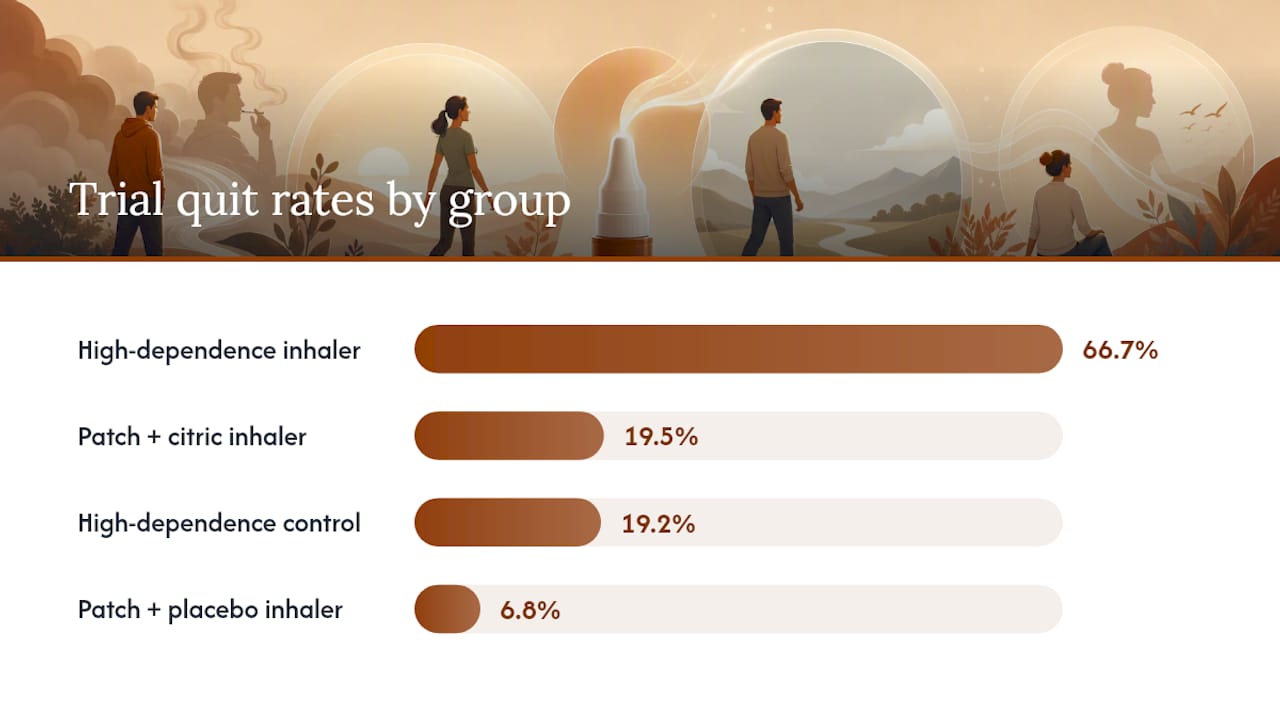
Another trial combined a citric-acid inhaler with a nicotine patch and found 19.5% continuous abstinence at 10 weeks, versus 6.8% for a placebo inhaler paired with the same patch.
A few things limit how far you can extend these findings:
- Studies use different devices, scents, and outcome measures, which makes head-to-head comparison hard
- Most follow-up windows stop at 10 to 24 weeks, so long-term data is thin
- Effect sizes are often small and short-lived when the inhaler is used alone
The realistic takeaway: inhalers are evidence-supported for short-term craving relief and work best stacked on top of another method, not standing in for one.
Who Benefits Most From a Nasal Inhaler for Cravings
Not every smoker gets the same payoff. The research draws a sharp line between nicotine dependence, which is your body’s physiological need for the drug, and behavioral dependence, which is the habit loop built around holding, lighting, and puffing. Researchers measure the second kind with a tool called the GN-SBQ, and it turns out to predict who responds to an inhaler far better than nicotine dependence alone does.
In the PAIPO trial mentioned above, high GN-SBQ scorers were roughly nine times more likely to quit successfully with the inhalator than similar smokers without one, an odds ratio of 8.88.
You’re probably a good candidate if:
- You reach for a cigarette out of habit more than physical need, especially around coffee, driving, or stress
- Certain triggers (a phone call, a break at work) set off an urge almost on cue
- You’ve noticed the “hand-to-mouth” motion feels like part of the craving, not just the nicotine
If your withdrawal symptoms are severe, or you’re a heavy, long-term smoker with strong physical dependence, prioritize a clinician conversation about medication or nicotine replacement first. An inhaler alone probably won’t carry that weight.
How to Use a Nasal Inhaler for Cravings the Right Way
Technique matters more than most people assume. Here’s a simple approach based on how these devices performed in trials:
- At the first sign of a craving, hold the inhaler near your nose and take slow, deep breaths for 1 to 2 minutes.
- Repeat as needed, but count how many times you use it per day. That number itself tells you something about your craving frequency.
- Pick a scent you actually like. Black pepper or angelica have trial support, but a scent you find pleasant will always outperform one you tolerate.
- Pair it with a delay tactic. Use the inhaler, then wait five minutes and do something else. Combined, these two moves stretch out the time between cravings.
- Track it. Keep a short log of craving intensity (1 to 10) and how long the relief lasted. After a week or two, you’ll know whether it’s actually working for you.
Pro Tip: Write down the time of day your cravings hit hardest. Most people find one or two predictable windows, like right after meals or during a commute, and can have the inhaler ready before the urge even lands.
Combining Inhalers With Nicotine Replacement and Counseling
Inhalers are built to handle one job: the sensorimotor and behavioral side of craving. Nicotine replacement therapy and prescription medication handle the chemical dependence. Counseling handles the behavior-change piece. Used together, they cover more ground than any one tool alone. The citric-acid inhaler plus patch trial is a solid example: combining sensory replacement with a patch outperformed the patch by itself over the first 10 weeks.
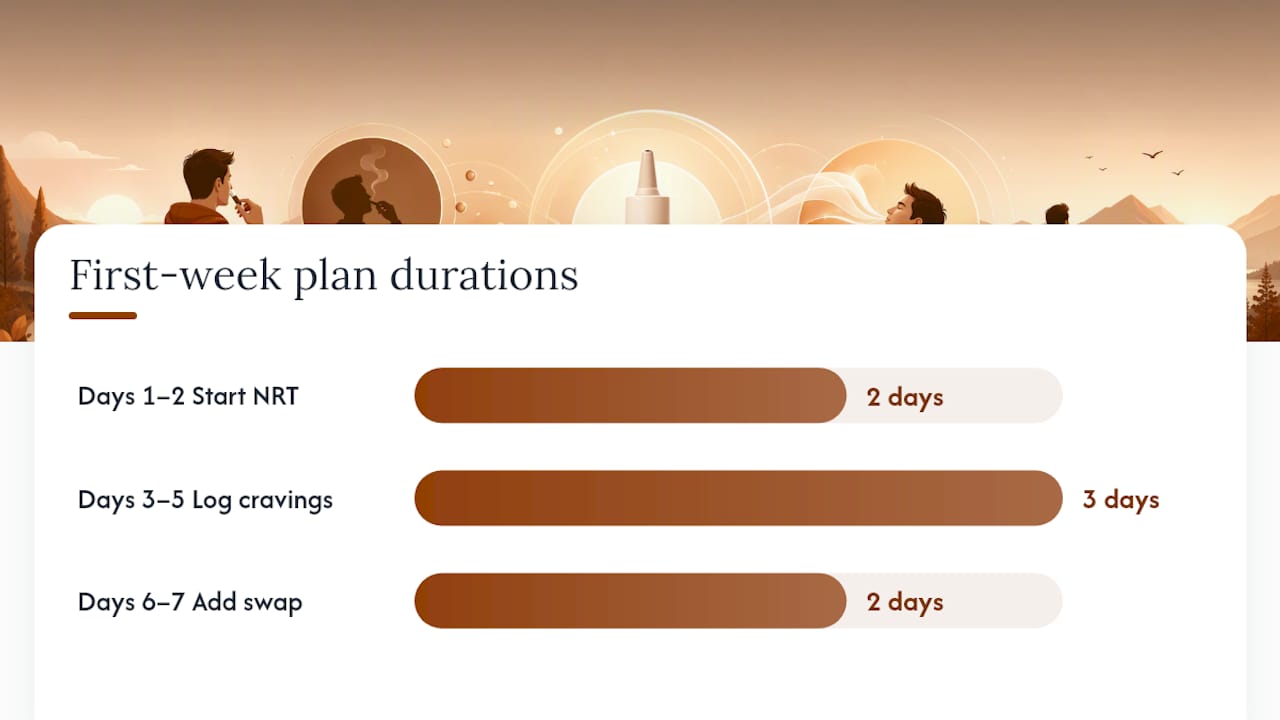
A simple first-week plan looks like this:
- Days 1 to 2: Start your chosen NRT or medication as directed, and carry the inhaler everywhere.
- Days 3 to 5: Log every craving and every inhaler use to spot your trigger windows.
- Days 6 to 7: Add one behavioral swap (a walk, a call to a friend) at your worst trigger time.
Talk to a clinician before combining methods if you’re pregnant, have cardiac issues, live with a mental health condition, or have a long history of heavy smoking.
Nasal Inhaler Side Effects and Safety Considerations
Reported side effects across trials are mild and short. The most common are a brief numb feeling, a temporary change in taste or smell, or a slight throat tickle. No major adverse events turned up in the systematic review, but long-term safety data past a few months simply doesn’t exist yet.
Before you start:
- Check the ingredient list for any oil you know you’re sensitive to
- Stop immediately if you notice swelling, hives, or trouble breathing, and seek care
- Buy from a manufacturer that lists ingredients clearly and follow the instructions on the label
A detailed breakdown of aromatherapy inhaler side effects covers what to watch for in more depth.
A Realistic Take on Using a Nasal Inhaler to Quit
Most people who try an inhaler expect either a miracle or nothing, and neither is right. The honest experience is a few minutes of real relief, over and over, that adds up if you stack it with something else, whether that’s a patch, counseling, or Breathefree’s broader user base built around oral-fixation tools. Don’t judge it after one bad craving. Track it for two weeks before you decide it isn’t working.
— Tommy
Why Breathefree’s Nicotine-Free Tools Fit This Approach
Some products give you a way to cover the sensorimotor and ritual side of quitting without adding nicotine to the equation. Some product lineups include essential-oil nasal sticks for cravings, resistance necklaces with flavor refills for the oral-fixation piece, and supporting resources built for the behavioral side of quitting, not the chemical side.
Positioned honestly, this is an adjunct, best used alongside counseling or NRT if your dependence runs deep, and strongest for smokers whose cravings are tied to habit and ritual more than raw nicotine need. One customer’s account of quitting after her four-year-old copied her smoking habit shows how the ritual-replacement piece plays out in daily life. If you want the full picture on why people reach for a tool like this, five reasons smokers switch to Breathefree lays it out plainly. Pick a scent, start tracking your cravings today, and see how the first week feels.
This article is general information, not a substitute for advice from a qualified doctor. Consult a qualified healthcare professional about your own circumstances before acting on anything here.
Sources
- Pleasant olfactory cues can reduce cigarette craving
- Effect of a nicotine-free inhalator as part of a smoking-cessation programme
- Airway sensory replacement combined with nicotine replacement for smoking cessation - CHEST