

What actually drives relapse after quitting smoking or substance use
Relapse after quitting is not a character flaw or a sign that recovery is impossible. It is a predictable response to specific, identifiable pressures. Research shows that emotional states account for roughly 80% of relapse situations, with positive emotions like relaxation triggering about 43% of cases and negative emotions like anger driving around 37.2%. Physiological cravings tied to dependence account for the remaining roughly 19.8%. That split matters because it tells you where to focus your energy.
The main causes of relapse cluster into a few clear categories:
- Emotional triggers: Both good and bad moods create vulnerability. Celebrating a win can feel like a reason to reward yourself with a cigarette just as much as a stressful argument can.
- Physiological cravings: Nicotine rewires the brain’s reward system. Even after weeks of abstinence, the body can send powerful urges in response to familiar cues.
- Social pressure: Being around people who smoke, especially at work or in social settings, raises relapse risk considerably. Social interaction needs accounted for 34.5% of relapse reasons in one cross-sectional study of smokers with prior cessation experience.
- Withdrawal discomfort: Abstinence-related physical symptoms drove 29.1% of relapses in that same study, particularly within the first six months of quitting.
- High-risk situations: Alcohol, old routines, and environments tied to past smoking all act as powerful cues that can bypass conscious intention.
Understanding these causes is the foundation. Everything else, from managing triggers to building a prevention plan, builds on knowing which of these forces is most active for you.
How relapse unfolds in three stages
Relapse rarely happens in a single moment. It moves through three recognizable stages, and catching it early in the sequence is far easier than stopping it once physical use has begun.

Emotional relapse is the first stage, and the most overlooked. You are not thinking about using yet, but your behavior is setting the stage. Signs include isolating yourself, skipping meals, poor sleep, bottling up emotions, and neglecting the habits that kept you grounded. You might feel irritable or anxious without connecting those feelings to your quit attempt.
Mental relapse is where the internal tug-of-war begins. Part of you wants to stay quit; another part starts bargaining. Common signs include:
- Thinking about old smoking situations with nostalgia rather than caution
- Telling yourself “just one won’t hurt”
- Planning when and where you might smoke without fully admitting that’s what you’re doing
- Minimizing the consequences of a slip
Physical relapse is the act of using again. It can be a single cigarette or a full return to regular smoking. The distinction between a one-time slip and a full relapse matters enormously here, and it is covered in detail below.
Relapse causes also shift over time. Early in recovery, chemical dependence and anxiety dominate. Later, stress and social exposure to smokers become the bigger threats. Knowing which stage of recovery you are in helps you anticipate which type of pressure is most likely to hit next.
How to identify and manage your relapse triggers
A trigger is anything, internal or external, that activates the urge to use. Identifying yours specifically is more useful than a generic list, but common ones include stress, boredom, alcohol, social settings with smokers, certain times of day, and strong emotions of any kind.
Managing triggers starts with recognizing them before they escalate. Three approaches work consistently well:
- Urge surfing: Instead of fighting a craving, you observe it like a wave. You notice where you feel it in your body, watch it rise, and wait for it to peak and fall. Cravings typically peak and fade within 15–30 minutes, which means staying present through the peak is often all it takes.
- Environmental change: Remove yourself from the triggering situation when possible. Step outside, change rooms, or call someone. Physical distance from the cue interrupts the automatic response.
- Cognitive reframing: Challenge the thought driving the urge. “I need a cigarette to handle this stress” is a belief, not a fact. Replacing it with “I have handled stress before without smoking” is not just positive thinking; it is accurate.
Pro Tip: When a craving hits hard, try the 5-4-3-2-1 grounding technique before reaching for anything. Name five things you can see, four you can touch, three you can hear, two you can smell, and one you can taste. By the time you finish, the peak of the craving has usually passed.
Tracking your triggers in a journal or app also builds a pattern over time. You start to see that certain situations are reliably high-risk, which lets you prepare rather than react. The coping strategies for ex-smokers that work best are almost always the ones built around your specific trigger profile, not a one-size-fits-all plan.

Why a slip is not the same as a relapse
The difference between a slip and a relapse is not just semantic. It changes how you respond, and that response determines what happens next.
A slip is an isolated use: one cigarette, one moment of giving in, followed by returning to not smoking. A relapse is a return to regular use, a pattern rather than an incident. Treating a slip as a total failure is one of the most common ways a single mistake becomes a full relapse. The shame spiral that follows “I already ruined it” thinking is itself a relapse driver.
How to respond constructively to a slip:
- Stop immediately. Discard whatever you have. Do not finish the cigarette or tell yourself you will quit again tomorrow.
- Identify the trigger. What situation, emotion, or thought preceded the slip? Write it down while it is fresh.
- Re-engage your support system. Tell someone you trust. Isolation after a slip accelerates the slide toward full relapse.
- Adjust your plan. The slip revealed a gap in your strategy. Treat it as data, not defeat.
- Avoid self-punishment. Stress and guilt are themselves relapse triggers. Getting too hard on yourself after a slip can make the urge to smoke even stronger.
Clinically, viewing a lapse as a learning moment with corrective steps is the approach most consistent with sustained recovery. Many people quit several times before quitting for good. Each attempt, including the ones that include a slip, builds knowledge about what works and what does not.
Effective strategies to prevent relapse long-term
Prevention is not a single action. It is a system of overlapping strategies that cover the emotional, behavioral, and social dimensions of recovery.
Medication-assisted treatment plays a real role, especially for people with multiple quit attempts behind them. Extended use of cessation medications, typically across a 6–12 month window, increases long-term success rates and is particularly important when social and stress environments are high-risk. Separating physiological withdrawal from psychological craving is also critical: some early cravings need medical support before psychological coping strategies can fully take hold.
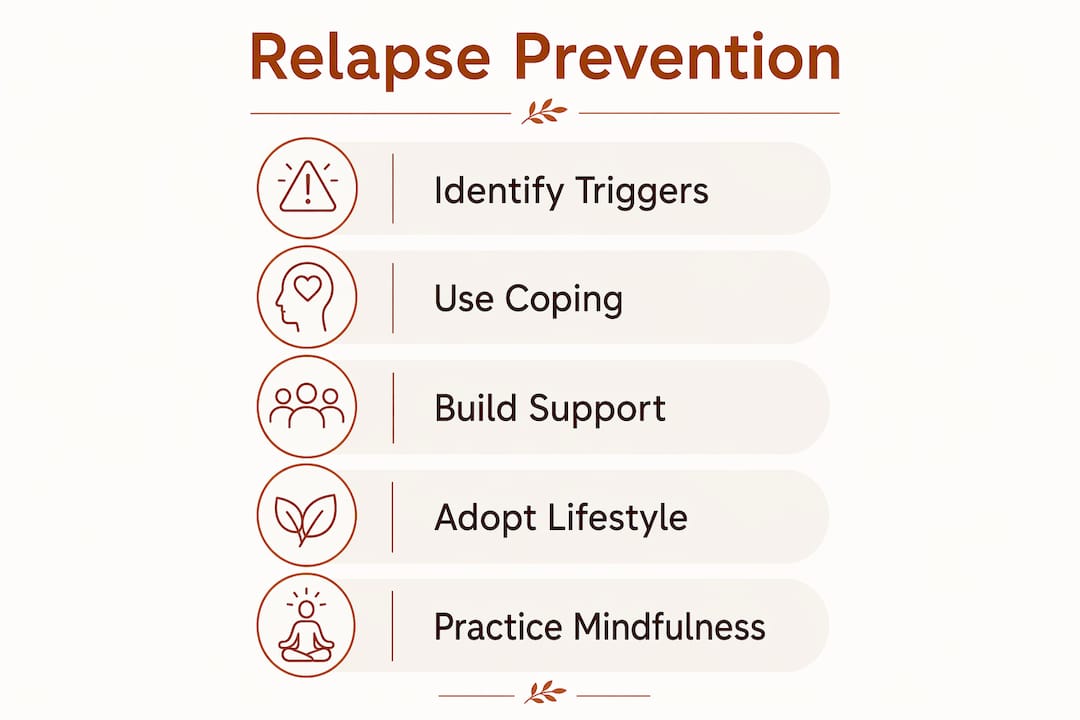
Behavioral strategies that consistently reduce relapse risk include:
- Building a daily routine that removes idle time in high-risk situations
- Replacing smoking rituals with deliberate alternatives (a walk, a glass of water, deep breathing)
- Practicing mindfulness regularly, not just during cravings, so the skill is available when you need it
- Keeping an emergency plan written down for high-risk moments, such as a list of three people to call and three physical actions to take before giving in
Support systems matter more than most people expect. Counseling, whether individual therapy, group programs, or a structured depression recovery plan when mental health is a factor, provides accountability and a space to process the emotional triggers that drive most relapses. Peer support from others in recovery adds a social dimension that medication and solo coping cannot replicate.
Long-term lifestyle changes are where prevention becomes durable. Regular exercise, consistent sleep, and reduced alcohol use all lower baseline stress levels, which directly reduces the frequency and intensity of cravings. The goal is not to white-knuckle through every urge. It is to build a life where the urges come less often and feel less overwhelming when they do.
What recent research reveals about cravings and relapse
The neuroscience behind why cravings return after quitting has become clearer in recent years, and it changes how you should think about the recovery process.
Nicotine enters the brain within seconds of inhalation and triggers dopamine release along the mesolimbic reward pathway. Over time, the brain builds strong neural associations between environmental cues and that dopamine hit. Those associations do not disappear when you quit. They get activated by triggers, which is why cravings can feel just as intense months into recovery as they did in the first week.
The good news is that urge surfing weakens these neural pathways through a process called extinction learning. Each time you ride out a craving without acting on it, the connection between the trigger and the urge becomes slightly weaker. The craving still comes, but it peaks lower and fades faster. This is why examples of cravings passing naturally become more frequent the longer you stay in recovery.
Pro Tip: To practice urge surfing effectively, sit with the craving rather than distract from it. Notice the physical sensations without judgment. Breathe slowly. The craving is not dangerous; it is just uncomfortable. Staying present through it, even for five minutes past the peak, is what builds the extinction response over time.
Understanding why cravings decrease over time is itself a coping tool. Knowing that the discomfort is temporary and that each wave you ride makes the next one smaller gives you a reason to hold on. Relapse is a stage many people pass through on the way to lasting recovery, not a verdict on whether recovery is possible for you.
Key Takeaways
Relapse after quitting is driven primarily by emotional states, social pressure, and physiological cravings, all of which are manageable with the right strategies in place.
| Point | Details |
|---|---|
| Emotional states dominate relapse risk | Positive affect triggers (such as relaxation) account for 43%, negative affect (such as anger) for 37.2%, and dependence-related cravings for 19.8% of relapse situations. |
| Social pressure is a major late trigger | Social interaction needs drove 34.5% of relapses, especially among those who had quit for more than six months. |
| Cravings are time-limited | Cravings typically peak and fade within 15–30 minutes; riding out the peak without acting weakens the urge over time. |
| A slip is not a relapse | One cigarette does not erase progress; treating a slip as a learning moment and acting immediately prevents full relapse. |
| Prevention requires a layered plan | Combining medication, behavioral strategies, and support systems produces better long-term outcomes than any single approach alone. |
Ready to quit for good? Breathefree can help
Breathefree was built for exactly this moment: when you know why relapse happens and you want a tool that addresses the real drivers, not just the nicotine. The Breathefree resistance necklace targets oral fixation and the calming ritual that smokers miss most, without any nicotine or harmful substances. Over 75,000 people have used it to break free.
If you want a structured way to track your habits and understand your personal triggers, the Nicotine Detox eBook & Habit Tracker pairs behavioral education with daily tracking tools designed to keep you accountable through the hardest stretches of recovery.