

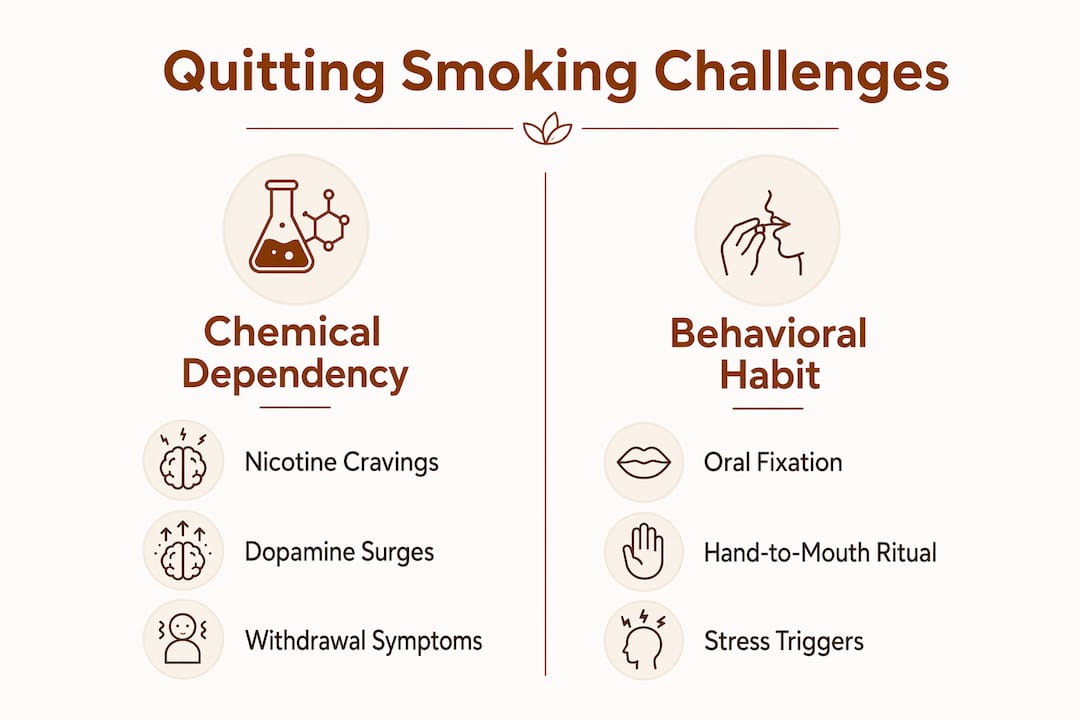
Quitting smoking is defined by two simultaneous battles: chemical withdrawal from nicotine and the collapse of deeply ingrained behavioral rituals. That dual burden is the core reason why smokers struggle without substitutes. Withdrawal symptoms like irritability, anxiety, difficulty concentrating, and disrupted sleep peak in the first few weeks after quitting. Most people only plan for the physical side. The behavioral side catches them completely off guard, and that gap is where relapse begins.
Why smokers struggle without substitutes: the dual addiction problem
Smoking addiction operates on two separate tracks, and both must be addressed to quit successfully.
The first track is chemical. Nicotine binds to receptors in the brain and triggers dopamine release. When nicotine disappears, the brain signals distress. The FDA confirms that these withdrawal symptoms are temporary, but “temporary” can still mean weeks of irritability, poor sleep, and difficulty focusing. That is a long time to white-knuckle through discomfort.

The second track is behavioral. Every cigarette involves a sequence of physical actions: reaching for the pack, the hand-to-mouth motion, the lip contact, the exhale. These actions repeat dozens of times a day for years. The brain encodes them as habits, and habits do not disappear just because the cigarette does.
Here is what makes quitting so hard without any support:
- Nicotine withdrawal produces irritability, anxiety, and concentration problems that feel unbearable in the first two weeks
- Oral fixation leaves the mouth and hands restless without the familiar ritual to satisfy them
- Conditioned cues like morning coffee, stress at work, or driving trigger automatic cravings with no chemical cause
- Dopamine deficit makes everyday activities feel flat and unrewarding during early cessation
- Impulse control weakens under stress, making it harder to resist reaching for a cigarette
Each of these factors compounds the others. Stress worsens chemical cravings. Chemical cravings make behavioral urges feel more intense. Without a substitute to interrupt the cycle, the pressure builds until most people give in.
Why does quitting cold turkey fail so often?
Cold turkey quitting fails because it removes both the chemical and behavioral reinforcement at the same time. That simultaneous loss creates a level of distress that most people cannot sustain.
- Day 1–3: Nicotine leaves the bloodstream. Physical withdrawal begins. The hands and mouth feel empty.
- Day 4–7: Cravings peak. Stress triggers feel overwhelming. Sleep is disrupted.
- Week 2–3: Chemical symptoms ease slightly, but behavioral urges remain strong. Boredom and routine cues keep triggering the urge to smoke.
- Week 4+: Most relapses happen here. The person feels “over it” and lets their guard down, then one stressful moment undoes months of effort.
The 95% failure rate for cold turkey quitting reflects this pattern. Removing nicotine without addressing the behavioral habit leaves a void that stress quickly fills.
Acute stress makes this worse in a specific, measurable way. Stress disrupts the prefrontal cortex, the brain region responsible for impulse control and decision-making. When that region goes offline under pressure, the automatic habit of reaching for a cigarette takes over. The craving is not a choice. It is a neurological reflex.
Pro Tip: If you are attempting to quit cold turkey, identify your three highest-risk stress triggers before your quit date. Write down a specific physical action to replace each one, such as a two-minute walk, a glass of cold water, or a breathing exercise. Having a pre-planned response reduces the moment when impulse control fails.
Understanding why cold turkey is so difficult is not discouraging. It is the first step toward choosing a strategy that actually works.
How does oral fixation keep smokers hooked after nicotine fades?
Oral fixation is a conditioned behavior, not a side effect of nicotine. It is a separate addiction loop that survives long after chemical dependency ends.
“The physical ritual of smoking, including the hand-to-mouth motion and lip contact, forms its own brain reward pathway, independent of nicotine. Smokers still crave the motion and oral sensations even after chemical dependency ends.”
That insight reframes the entire problem. Many people assume that once nicotine is gone, the craving is gone. The reality is that oral fixation triggers dopamine through a completely separate reward pathway. The act itself is rewarding, regardless of what is in the cigarette.
This is why nicotine patches alone often disappoint people. Patches address the chemical side effectively. They deliver nicotine transdermally and reduce withdrawal symptoms. But they do nothing for the restless hands, the empty mouth, or the urge to perform the familiar ritual after a meal or during a stressful call. The behavioral loop keeps running even when the chemical need is met.
- Hand-to-mouth motion activates muscle memory built over years of repetition
- Lip contact provides a sensory cue the brain associates with relief and calm
- The exhale ritual mimics deep breathing, which genuinely reduces stress through the nervous system
- Social context reinforces the habit when smoking is tied to breaks, conversations, or shared routines
Addressing behavioral habits in smoking requires a tool that satisfies the physical ritual, not just the chemical need.
How do nicotine-free oral substitutes help you quit for good?
Nicotine-free oral substitutes work by decoupling the behavioral habit from the chemical dependency. The person keeps the ritual while eliminating the drug. Over time, the brain unlearns the chemical need while the behavioral loop gradually fades on its own.
This approach contrasts sharply with nicotine-containing substitutes. Nicotine gums and pouches can become new habits rather than cessation tools. They satisfy the oral fixation and the chemical craving simultaneously, which feels like progress but often just shifts the dependency to a different delivery system. The goal is to break the chemical addiction entirely, not relocate it.
| Substitute type | Addresses oral fixation | Breaks chemical dependency | Risk of new dependency |
|---|---|---|---|
| Nicotine patch | No | Yes | Low |
| Nicotine gum or pouch | Yes | No | Moderate to high |
| Nicotine-free oral substitute | Yes | Yes | Very low |
| Cold turkey (no substitute) | No | Yes | None, but failure rate is very high |
Nicotine-free substitutes preserve the oral habit and reduce withdrawal distress by keeping the behavioral ritual intact while the brain slowly extinguishes its chemical dependency. This is the extinction model of cessation: the behavior continues, but the chemical reward is removed, and the brain eventually stops expecting it.
The Breathefree resistance necklace applies this principle directly. It gives the hands and mouth something to do, satisfying the physical ritual without delivering any nicotine. Over 75,000 people have used it to quit, according to Breathefree. The product works because it targets the behavioral loop that patches and gums leave completely unaddressed.
Pro Tip: When a craving hits, the urge typically peaks and passes within three to five minutes. Use a nicotine-free oral substitute during that window to interrupt the reflex. You are not fighting the craving. You are redirecting it.
For people exploring physical objects to quit smoking, the key is choosing something that mimics the ritual without reintroducing nicotine.
What practical strategies actually work for quitting smoking?
Successful quitting combines behavioral support, cognitive reframing, and social connection. No single strategy works in isolation.
- Reframe the goal. Psychologists recommend framing quitting as gaining benefits rather than losing a habit. “I am gaining clear lungs and better sleep” is more motivating than “I am giving up cigarettes.” This shift reduces the psychological sense of deprivation that drives relapse.
- Replace the ritual. Identify the specific moments when you smoke and assign a physical replacement to each one. A morning coffee craving might be replaced with a five-minute walk. A post-meal urge might be replaced with a nicotine-free oral substitute or a piece of gum.
- Build social support. Isolation makes quitting harder. Peer support from people who have quit or are quitting reduces withdrawal distress and increases accountability. Online communities, quit-smoking groups, and accountability partners all serve this function.
- Manage stress directly. Since stress links cigarettes with coping and makes cravings automatic, stress reduction is a cessation strategy. Exercise, controlled breathing, and sleep hygiene all reduce the neurological pressure that triggers relapse.
- Fade substitutes gradually. If you use a behavioral substitute, reduce its frequency over weeks rather than stopping abruptly. Gradual fading mirrors how the brain unlearns habits, which is far more effective than a second cold turkey attempt.
Sweden’s public health record shows what diversified strategies can achieve. Female daily smoking in Sweden dropped 49% since 2015, bringing the rate to 5.7%, well below the EU average. That result came from combining multiple cessation approaches rather than relying on any single method.
For anyone navigating the side effects of quitting suddenly, understanding that both chemical and behavioral symptoms are normal makes the process feel less like failure and more like recovery.
Key Takeaways
Quitting smoking requires addressing both nicotine withdrawal and the behavioral ritual of smoking, because neglecting either one dramatically increases the risk of relapse.
| Point | Details |
|---|---|
| Dual addiction is the core problem | Smoking creates both chemical dependency and behavioral habits that must be broken separately. |
| Cold turkey has a very high failure rate | Removing nicotine and ritual simultaneously overwhelms most people, leading to relapse. |
| Oral fixation outlasts nicotine dependency | The hand-to-mouth ritual triggers dopamine independently, so chemical aids alone are not enough. |
| Nicotine-free substitutes break both loops | They preserve the behavioral ritual while eliminating nicotine, allowing the brain to unlearn dependency. |
| Stress is a direct relapse trigger | Stress impairs impulse control, making pre-planned behavioral responses critical to staying quit. |
What most people get wrong about quitting cold turkey
I have watched a lot of people try to quit, and the ones who struggle most share one belief: they think willpower is the main ingredient. They treat every craving as a character test. When they relapse, they blame themselves instead of their strategy.
The truth is that cold turkey without any support is one of the hardest ways to quit, not because smokers lack discipline, but because the method ignores half the problem. You can have iron willpower and still fail if your hands do not know what to do at 9 AM with a cup of coffee.
What I have seen work consistently is treating the behavioral habit as its own project. Not as a side effect of nicotine addiction, but as a separate thing that needs its own solution. The people who succeed long-term are usually the ones who replaced the ritual with something specific, not just “kept busy.” They had a physical object, a routine, or a community that filled the exact space the cigarette used to occupy.
The other thing most people miss is the stress connection. Cravings do not come from nowhere. They come from moments when the brain is under pressure and reaches for its most practiced coping tool. If you have not built a replacement coping tool before your quit date, stress will find the old one every time.
Quitting is not about suffering through. It is about building a better reflex.
— Tommy
Breathefree tools that support your quit plan
Quitting works best when you have a clear plan and the right tools to execute it.
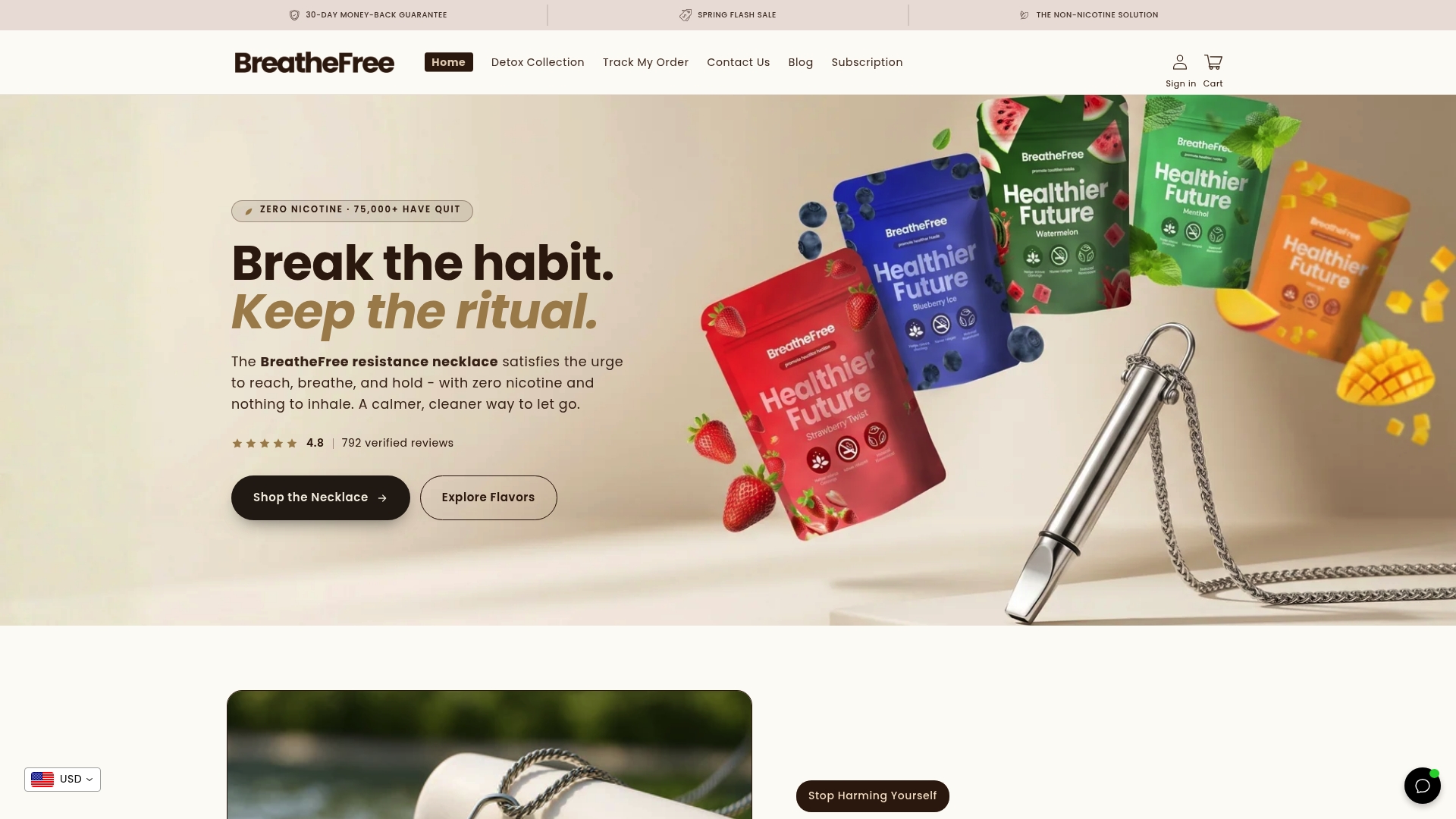
Breathefree’s Nicotine Detox eBook and Habit Tracker gives you both. The eBook walks you through the chemical and behavioral sides of cessation with practical, day-by-day guidance. The habit tracker helps you identify your trigger patterns, monitor your progress, and stay consistent when cravings hit hardest. Together, they complement the Breathefree resistance necklace, which addresses oral fixation directly without any nicotine. Over 75,000 people have used Breathefree’s approach to quit for good. The tools are designed to work together, covering the full picture of what quitting actually requires.
FAQ
Why do smokers relapse even after weeks without cigarettes?
Relapse often happens because behavioral cues and stress triggers remain active long after nicotine leaves the body. The brain’s conditioned response to those cues does not disappear on its own without a replacement habit.
What is oral fixation and why does it matter for quitting?
Oral fixation is the conditioned craving for the physical ritual of smoking, including the hand-to-mouth motion and lip contact. It triggers a dopamine response independent of nicotine, which is why patches alone often fail to satisfy the full urge.
Are nicotine-free substitutes better than nicotine gums for quitting?
Nicotine-free substitutes address the behavioral habit without continuing chemical dependency. Nicotine gums satisfy both the oral and chemical craving, but risk replacing one dependency with another rather than eliminating it.
How does stress make quitting harder?
Stress disrupts the prefrontal cortex, the brain region that controls impulse and decision-making. That disruption makes the automatic habit of reaching for a cigarette much harder to override, even in people who are strongly motivated to quit.
What is the most effective strategy for quitting smoking?
The most effective approach combines a nicotine-free behavioral substitute, cognitive reframing, stress management, and social support. Addressing both the chemical and behavioral components of addiction together produces the best long-term results.