

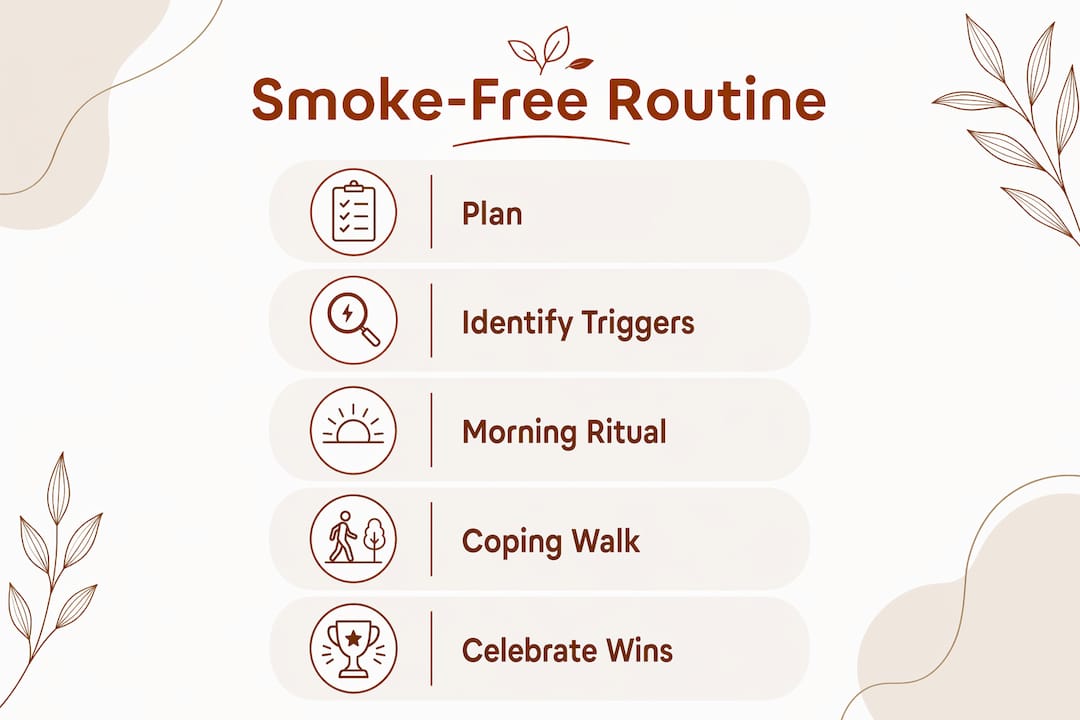
Quitting smoking works best when you replace the habit with a structured daily routine, not just willpower alone. The core components of a successful smoke-free daily routine are planned craving responses, structured meals and hydration, regular physical activity, trigger avoidance, stress management, and a support network you can actually reach when things get hard.
Here is what that looks like in practice:
- Planned craving responses: Use the 4 D’s technique (delay, deep breathe, drink water, do something else) every time an urge hits.
- Structured meals and hydration: Eat at consistent times and keep water nearby. Hunger and dehydration amplify cravings.
- Physical activity breaks: Even a 10-minute walk cuts nicotine cravings and eases withdrawal anxiety.
- Trigger avoidance: Identify your top three high-risk situations and plan around them before they happen.
- Stress management: Build in at least one daily reset, whether that is a breathing exercise, a short meditation, or a walk outside.
- Social support: Tell at least one person your quit date and ask them to check in on you.
Consistency matters more than perfection here. The goal is to make smoke-free responses automatic over time, so you are not making a fresh decision every time a craving appears.
Pro Tip: Use if-then planning to wire in automatic responses. Write it out: “If I finish lunch and feel the urge to smoke, then I will take a five-minute walk around the block.” Specificity is what makes this technique work.
How do you build a quit plan that sets you up to succeed?
Picking a quit date is the first concrete step, and Smokefree.gov recommends choosing one within the next two weeks. That window gives you enough time to prepare without giving yourself room to keep postponing. Avoid dates that already carry stress, like a work deadline or a family event.
Before your quit date, work through these preparation steps:
- Remove all tobacco products from your home, car, and bag. Throw away lighters and matches too.
- Do laundry so your clothes no longer carry the smell of smoke, which is a real sensory trigger.
- Tell your support network your quit date and what kind of help you need. Positive social support measurably increases quit success.
- Talk to a health professional about whether nicotine replacement therapy or counseling fits your situation. Combining counseling with quit aids produces better outcomes than either approach alone.
- Download a tracking app like quitSTART to monitor cravings and progress in real time.
- Write your reasons for quitting and keep them somewhere visible.
The 28-day milestone is a turning point. Reaching 28 days smoke-free dramatically improves your odds of quitting for good. Your first goal is not “forever.” It is four weeks.
A quit plan is not just a list of intentions. It is a structured action plan that tells you exactly what to do when things get hard, before they get hard.
How do you recognize and manage your smoking triggers?
Triggers are the situations, feelings, and routines that make you want to smoke without consciously deciding to. Common ones include the first cup of coffee in the morning, finishing a meal, driving, stress at work, and social settings where others smoke. The tricky part is that many of these are automatic. You light up before you even register the urge.

Changing your environment and routines is the most direct way to break those patterns. Swapping coffee for tea in the morning, taking a different route to work, or eating lunch somewhere new all interrupt the cue-response chain your brain has built around smoking. It sounds small, but rewiring those associations is exactly the point.
Your physical space matters too. Residual smoke residue on furniture, curtains, and clothing can act as a sensory cue that reignites cravings. Deep cleaning your home and car after quitting removes those hidden triggers from your daily environment.
Build a personalized trigger plan covering your top three high-risk scenarios:
- Identify the trigger: When does it happen, and what emotion or activity precedes it?
- Plan a substitute behavior: What will you do instead, specifically?
- Use if-then language: “If I feel stressed after a meeting, then I will step outside for two minutes of deep breathing.”
Coping with nicotine cravings gets easier once you stop treating them as emergencies and start treating them as predictable events you already have a plan for.
What should your quit day routine actually look like?
Quit day is not the day to wing it. The single most important rule is no tobacco at all, not even one cigarette. One puff restarts the craving cycle and makes the next 24 hours harder.
Structure your day around movement and activity from the start. Here is a practical quit day framework:
- Morning: Start with a short walk or light stretching instead of your usual smoking ritual. Eat breakfast at a consistent time.
- Mid-morning: When a craving hits, remember that cravings peak and subside within about 10 minutes. Delay acting on it. Drink a glass of water. Do something with your hands.
- Afternoon: Schedule a physical activity break, even a brief one. Brief low-intensity exercise reduces both craving intensity and withdrawal anxiety.
- Evening: Avoid high-risk trigger situations if possible. Eat dinner at a regular time. Wind down with a calming activity, not a screen binge that leaves you restless.
Stress management goes beyond breathing exercises. Mindfulness meditation, even five minutes with an app like Headspace or Calm, reduces the cortisol spike that makes cravings feel urgent. A short body scan before bed helps you process the day without reaching for a cigarette.
Pro Tip: When a craving hits hard, go for a walk around the block. You do not need to run. The physical movement interrupts the mental loop, and by the time you are back inside, the peak has usually passed.

Celebrate the small wins. Getting through your first morning smoke-free is worth acknowledging. Tracking progress, even just marking an X on a calendar, builds the sense of momentum that carries you through harder days.
How do you sustain a smoke-free lifestyle beyond quit day?
The first few days are the hardest, but the weeks that follow require their own strategy. Long-term success comes from building a life that does not leave a cigarette-shaped hole in it.
Healthy habits compound. Former smokers who maintain a healthy lifestyle reduce their risk of death from all causes by 27% compared to those who do not. That figure covers cancer, cardiovascular disease, and respiratory illness. The body’s capacity to recover after quitting is real, and new habits that last accelerate that process.
Here is what a sustainable smoke-free lifestyle looks like in practice:
- Balanced diet: Regular meals stabilize blood sugar, which directly affects mood and craving intensity. Rebuilding healthy eating routines after quitting supports both physical recovery and emotional regulation.
- Regular physical activity: Aim for movement most days, even if it is just a 20-minute walk. Exercise lifts mood, reduces stress, and gives your hands and body something to do.
- Structured sleep: A consistent sleep and wake time improves resilience against cravings. Poor sleep raises cortisol, and high cortisol makes urges harder to resist.
- Replacement rituals: Find something that fills the social or emotional function smoking used to serve. A tea break, a short walk, or a few minutes of journaling can replace the “pause” that cigarettes provided.
- Ongoing support: Counseling, support groups, and check-ins with a quit buddy all reduce relapse risk. The social benefits of smoke-free living extend well beyond health.
Relapse warning signs include increasing stress without a coping plan, social isolation, and skipping the habits that have been keeping you steady. When you notice those signs, reach back out to your support network before the urge becomes a decision.
How the Breathefree resistance necklace supports your quit routine
One of the most overlooked challenges in quitting is oral fixation. Smoking is not just a nicotine habit. It is a physical ritual: something in your hand, something to your mouth, a moment of pause. When that ritual disappears, many people feel restless in a way that willpower alone does not fix.
The Breathefree resistance necklace addresses that gap directly. It is a nicotine-free behavioral aid designed to satisfy the physical and ritualistic side of smoking without any inhalation or harmful substances. You hold it, breathe through it, and get the calming effect of a deliberate pause, which is exactly what a cigarette break used to provide.
- Nicotine-free: No chemicals, no dependency risk, no side effects.
- Oral and tactile satisfaction: Addresses the hand-to-mouth ritual that patches and gum do not touch.
- Mood support: The breathing resistance creates a slow, controlled exhale that activates the parasympathetic nervous system, the body’s natural calm response.
- Community: Breathefree reports that over 75,000 people have used this method to quit successfully.
Pro Tip: Wear the Breathefree necklace during your highest-risk trigger windows, like after meals or during your commute. Pairing it with a slow, deliberate breath gives your nervous system the reset it is looking for.
The necklace works best as part of a broader routine, not as a standalone fix. Pair it with the quit smoking tools and behavioral strategies covered throughout this guide for the strongest results.
Ready to make your smoke-free routine stick? The Breathefree Nicotine Detox eBook and Habit Tracker gives you a day-by-day framework for building the habits that keep you off cigarettes for good. Track your progress, manage your triggers, and stay on course with a plan built specifically for quitters.
Key Takeaways
Building a smoke-free daily routine requires planned craving responses, trigger management, consistent healthy habits, and a support system that you engage before cravings become decisions.
| Point | Details |
|---|---|
| Set a concrete quit date | Choose a date within two weeks, giving yourself time to prepare without room to delay. |
| Use the 4 D’s for cravings | Delay, deep breathe, drink water, and do something else every time an urge peaks. |
| Cravings last about 10 minutes | Riding out the peak with movement or distraction is enough to break the cycle. |
| Healthy habits reduce mortality risk | Former smokers who maintain a healthy lifestyle lower their risk of death from all causes by about 27%. |
| Reach 28 days smoke-free | Hitting the 28-day mark dramatically improves the odds of quitting permanently. |