

Essential-oil inhalers can reduce the intensity of short-term cravings for some people, and the evidence is specific enough to be worth taking seriously. Black pepper, peppermint, citrus, and lavender have all shown signals in small clinical trials and a meta-analysis pooling 12 trials with 762 smokers. They are not a cure, and they are not FDA-approved smoking-cessation treatments. What they are is a portable, nicotine-free adjunct that can interrupt a craving in the 10–20 seconds it takes to pass its peak. The practical recommendation: try a portable essential oil nasal inhaler as part of a broader craving-management plan. A tool like the Breathefree inhalable nasal stick fits that role well. Pair it with behavioral strategies, and you have a real toolkit. Use it alone and expect limited results.
Key Takeaways
Essential-oil inhalers can reduce short-term craving intensity for some people, with black pepper, citrus, peppermint, and lavender showing the most consistent signals across clinical trials and a meta-analysis of 12 trials with 762 smokers.
| Point | Details |
|---|---|
| Strongest evidence oil | Black pepper has the best clinical signal, with a 2024 RCT and campus study both showing craving reductions. |
| Dosing baseline | Fill a cotton wick with 15–25 drops; inhale for 10–20 seconds per nostril at the first sign of a craving. |
| Safety first | People with asthma, COPD, or pregnancy should consult a clinician before using any essential-oil inhaler. |
| Inhalers are adjuncts | Pair with behavioral strategies (delay tactics, habit stacking) for meaningful results; do not rely on inhalers alone. |
| Breathefree option | The Breathefree inhalable nasal stick and resistance necklace together address both the chemical and sensorimotor components of cravings. |
Table of Contents
- What research says about essential oil inhaler cravings and how they work
- Best essential oils to try for food and smoking cravings
- How to use an essential oil inhaler for cravings: drops, timing, and technique
- Safety, side effects, and who should avoid essential-oil inhalers
- What to look for when buying a craving-control inhaler
- Quick, safe DIY steps to fill a personal inhaler at home
- A simple, evidence-aligned 7-day plan to test aromatherapy for cravings
- Why a portable inhaler belongs in your quitting toolkit
- Breathefree’s inhalable nasal stick and habit-support tools
- Sources
What research says about essential oil inhaler cravings and how they work
The most cited mechanism is the olfactory pathway. Inhaled aromatic compounds travel through the nasal epithelium and stimulate the olfactory bulb, which connects directly to the limbic system, including the amygdala and hippocampus. Those structures govern emotion, anxiety, and reward. That is why a smell can shift your mood in seconds, and it is the plausible biological route by which inhalation aromatherapy influences anxiety and perceived stress.
Limonene, the dominant compound in citrus oils, has been linked in animal and small human studies to increased brain dopamine levels. Dopamine is the same neurotransmitter that nicotine hijacks, which gives citrus oils a plausible biochemical route for reducing reward-seeking cravings. Peppermint and lavender appear to work more through anxiety reduction and respiratory sensation. Black pepper’s mechanism is partly sensorimotor: the throat sensation from inhaling it mimics the feeling of a cigarette draw, substituting the physical habit without the nicotine. For more on what happens to your brain without nicotine, the neurochemistry of withdrawal explains why that substitution matters.
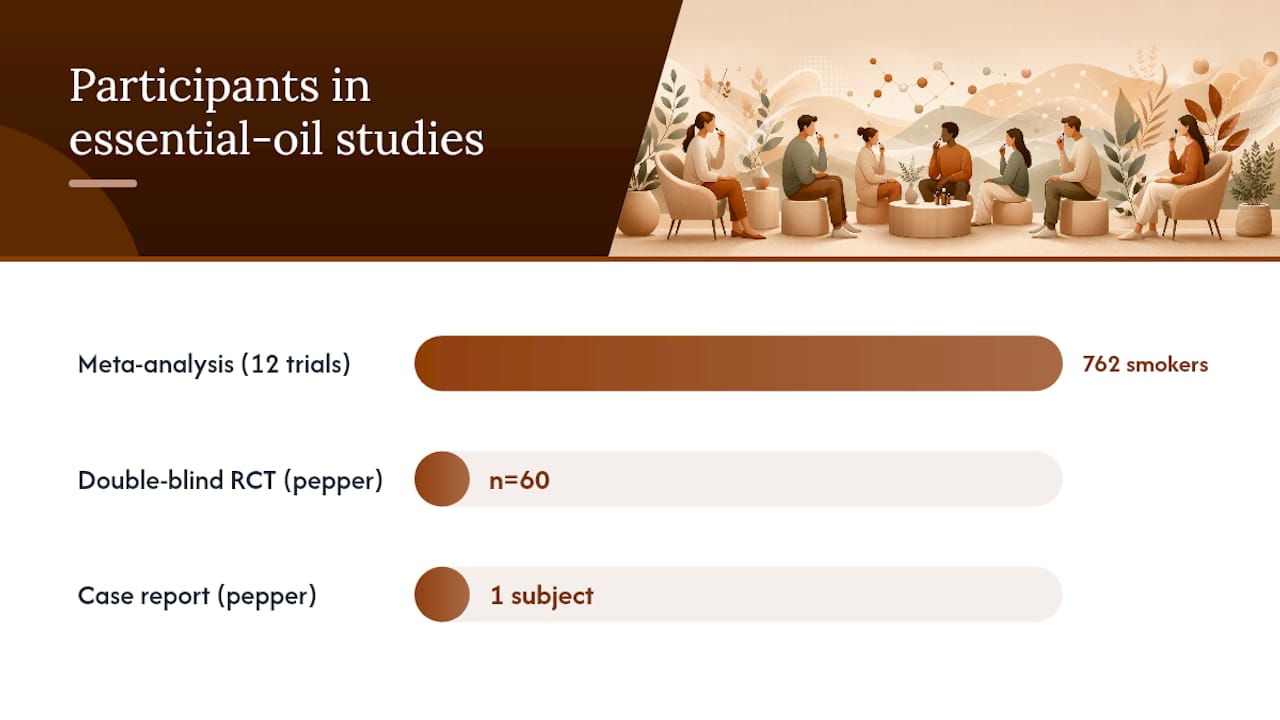
The evidence base is promising but genuinely limited. A 2024 double-blind RCT with 30 participants per group found statistically significant reductions in daily cigarette consumption and Fagerström Test for Nicotine Dependence (FTND) scores in a black pepper aromatherapy group over four weeks. A separate campus study found that one drop of black pepper oil inhaled for two minutes reduced self-reported craving ratings and increased the delay to next tobacco use more than a control oil. A PMC case report documents individual-level craving reduction with black pepper inhalation and flags the sensorimotor substitution effect as a key driver.
| Study type | Oil(s) tested | Main finding | Limitation |
|---|---|---|---|
| Double-blind RCT (2024, n=60) | Black pepper | Reduced daily cigarettes and FTND scores over 4 weeks | Single setting (correctional), small sample |
| Campus controlled trial | Black pepper, angelica | Reduced craving ratings, longer delay to next use | Short duration, self-report only |
| Meta-analysis (12 trials, 762 smokers) | Black pepper, lavender, lime | Signals favoring herbal preparations for abstinence and craving | High heterogeneity, variable quality |
| Case report | Black pepper | Craving reduction, withdrawal symptom relief | Single subject, no control |
The honest summary: the signal is consistent enough to justify trying an inhaler. It is not strong enough to replace nicotine replacement therapy (NRT) or behavioral counseling.
Best essential oils to try for food and smoking cravings
Not all oils are equal, and the evidence varies considerably across them.
- Black pepper: The strongest clinical signal for nicotine cravings. Sensorimotor substitution plus mild anxiolytic effects. Supported by an RCT and multiple smaller trials.
- Peppermint: Used in appetite and food-craving research. The cooling menthol sensation creates a brief sensory interruption that can displace a snacking urge. Anecdotal and small-trial support.
- Grapefruit and lemon (citrus): Limonene-rich, with a plausible dopamine-modulation mechanism. Used in aromatherapy-for-smoking protocols. Particularly relevant for sugar and snacking cravings.
- Lavender: Primarily anxiolytic. Useful when cravings are anxiety-driven rather than reward-driven. Appears in the meta-analysis as one of the oils with favorable signals.
- Bergamot: Citrus-adjacent with mood-lifting properties. Less studied for cravings specifically, but included in several aromatherapist-formulated cessation blends.
For sugar and snacking cravings: A blend of grapefruit, lemon, and peppermint gives you limonene-driven dopamine modulation plus the sensory interruption of menthol. Rationale: the citrus component addresses the reward-seeking drive; peppermint creates a palate-cleansing effect that reduces the appeal of sweet food.
For nicotine and cigarette cravings: Black pepper as the base, with lavender to address the anxiety component. Black pepper handles the hand-to-mouth sensorimotor habit; lavender reduces the stress-triggered urge to reach for a cigarette.
Pro Tip: Start with a single-oil inhaler before trying blends. Inhale, rate your urge on a 1–10 scale before and two minutes after, and note which oil moves the number most. That personal response data is more useful than any general recommendation.
How to use an essential oil inhaler for cravings: drops, timing, and technique
A standard personal inhaler tube holds a cotton wick that absorbs 15–25 drops of essential oil. That concentration is enough for roughly 30–60 uses before the scent fades noticeably. The clinical trial protocol for inhalation aromatherapy describes planned use three times daily plus additional use at craving moments, which is a sensible framework.
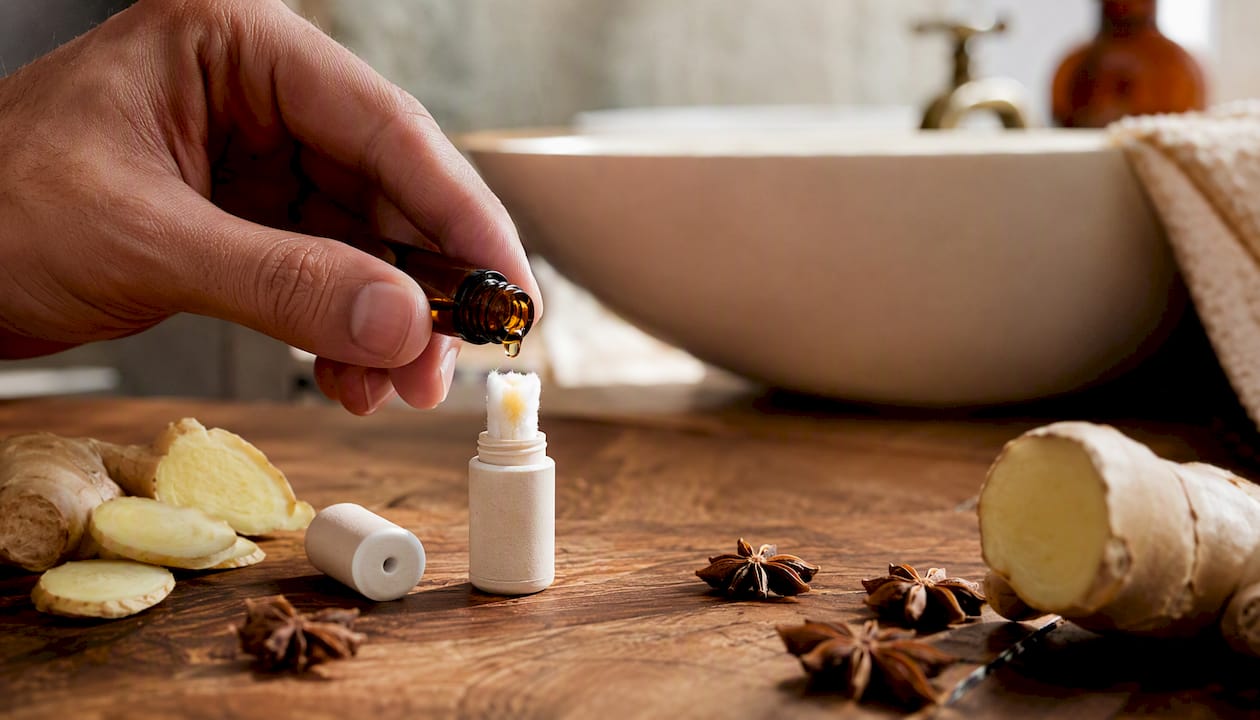
Inhalation technique: Hold the inhaler just below one nostril, close the other with a finger, and inhale slowly for 10–20 seconds. Breathe out through the mouth. Repeat on the other nostril. The slow breath is not incidental: it activates the parasympathetic nervous system and reduces acute anxiety, which compounds the oil’s effect. That pause is also a behavioral delay tactic — most cravings peak and begin to subside within 3–5 minutes, so a 20-second inhalation ritual buys meaningful time.
Timing: Use at the first sign of a craving, not after it has peaked. Pair inhalation with a brief behavioral pause: set a 5-minute timer and commit to not acting on the craving until it goes off. The inhaler fills that window.
| Parameter | Guidance |
|---|---|
| Drops per wick | 15–25 drops for initial fill |
| Uses per fill | Approximately 30–60 uses |
| Inhalation duration | 10–20 seconds per nostril |
| Daily use frequency | 3 times daily plus at craving moments |
| Wick replacement | Every 4–6 weeks or when scent fades |
Pro Tip: Replace the cotton wick every 4–6 weeks even if you still smell the oil. Oxidized oil residue on an old wick can cause irritation, and a fresh wick delivers a cleaner, more consistent scent.
Safety, side effects, and who should avoid essential-oil inhalers
Inhaler-based delivery via a cotton wick is considerably safer than combusting or vaporizing undiluted oils directly. The black pepper case report explicitly notes the risks of combusted materials and positions vaporized essential-oil alternatives as the preferable route. That said, inhalers are not risk-free.
Common side effects:
- Headache or dizziness with prolonged or frequent use
- Nasal or throat irritation, particularly with high-menthol or high-pepper concentrations
- Nausea in people sensitive to strong scents
- Bronchospasm in people with reactive airways
Who should talk to a clinician before using an essential-oil inhaler:
- People with asthma, COPD, or any chronic lung condition
- Pregnant or breastfeeding people (several oils, including peppermint and eucalyptus, carry cautions in pregnancy)
- Children under 10 (menthol-containing oils in particular can cause breathing difficulties in young children)
- People taking medications metabolized by CYP450 enzymes, as some aromatic compounds may interact
If you have a lung condition such as asthma or COPD, speak with your clinician before using any essential-oil inhaler. Inhalation of concentrated aromatic compounds can trigger bronchospasm in reactive airways, and the benefit-risk calculation is different for you than for a healthy adult. The same applies if you are pregnant or breastfeeding — not all oils are safe during those periods.
To reduce risk: Do a scent-sensitivity test first. Hold the open inhaler 6–8 inches from your nose and breathe normally for 30 seconds. If you notice tightening, stinging, or dizziness, that oil is not for you. Never apply undiluted essential oil directly to nasal membranes. Keep inhalers away from children and off shared surfaces. If cravings are linked to depression or anxiety, pairing an inhaler with professional support is worth considering — the connection between mood and addiction is well-documented and often undertreated.
What to look for when buying a craving-control inhaler
The market for aromatherapy inhalers ranges from well-formulated, clearly labeled products to unlabeled vials with no ingredient information. Here is what separates a reliable product from a gamble.
Refillable vs. disposable: Refillable inhalers with replaceable cotton wicks are better value and let you change oils as your needs shift. Disposable inhalers lock you into one blend and create more waste.
GC/MS (gas chromatography/mass spectrometry) third-party testing certificates are the gold standard for purity verification.
Label transparency: The label should list every oil by its botanical name (e.g., Piper nigrum for black pepper, Mentha piperita for peppermint), not just a marketing name. If the ingredient list says “proprietary blend” with no further detail, that is a red flag.
Aromatherapist formulation: Products formulated by a certified aromatherapist are more likely to use evidence-informed oil ratios. Ask the seller directly, or look for it stated on the product page.
Concentration guidance: A reliable product tells you how many drops are in the inhaler and what concentration that represents. Without that information, you cannot adjust use safely.
For readers ready to buy, the Breathefree inhalable nasal stick is formulated for craving support, uses clearly identified ingredients, and fits into a broader cigarette substitute toolkit rather than standing alone as a single-product solution.
Quick, safe DIY steps to fill a personal inhaler at home
Making your own inhaler takes about five minutes and costs very little once you have the materials.
Materials:
- A blank personal inhaler tube (available from aromatherapy suppliers; look for polypropylene tubes with a removable cotton wick)
- A pipette or dropper
- Your chosen 100% pure essential oil(s)
- A small label and pen
Step-by-step:
- Remove the cotton wick from the inhaler tube using tweezers or the end of the pipette.
- Place the wick on a clean, non-porous surface (a ceramic plate works well).
- Drop a moderate number of essential oil drops directly onto the wick. For a blend, apply each oil separately and let them absorb before adding the next.
- Allow the wick to sit for 60 seconds so the oil absorbs evenly rather than pooling.
- Use tweezers to place the saturated wick back into the inhaler tube. Press the cap firmly until it clicks.
- Label the inhaler with the oil(s) used and the fill date.
- Test by holding the inhaler 3–4 inches from your nose and inhaling gently. Adjust the cap position if the scent is too faint.
Safety reminders:
- Source oils from reputable suppliers with GC/MS testing available.
- Never add more than 25 drops; higher concentrations increase irritation risk without improving effect.
- Store the filled inhaler away from heat and direct sunlight, which degrade oil quality.
- Keep all DIY inhalers labeled and out of reach of children.
- Shelf life after filling is roughly 3–4 months before the oil oxidizes noticeably.
A simple, evidence-aligned 7-day plan to test aromatherapy for cravings
This is a structured experiment, not a cure. The goal is to find out whether an inhaler moves your craving numbers, so you can decide whether to keep it in your toolkit.
Daily structure:
- Morning (setup): Inhale your chosen oil for 10–20 seconds before your first typical craving window. Note your baseline urge level (1–10).
- At each craving: Use the inhaler immediately. Start a 5-minute timer. Rate your urge before and after. Record the time.
- Behavioral pairing: During the 5-minute window, use a habit-stacking technique — drink a glass of water, do 10 slow breaths, or pick up a physical substitute.
- Evening reflection: Note total cravings, how many you acted on, and your average urge rating for the day.
| Day | Focus | Tracking prompt |
|---|---|---|
| 1–2 | Baseline with inhaler | Urge rating before and after each use |
| 3–4 | Add behavioral pause (5-min timer) | Time from craving to action |
| 5–6 | Evaluate oil response; switch if no change | Which oil reduced urge most? |
| 7 | Review week data | Did average urge rating drop? Did delay to action increase? |
When to change course: If your urge ratings are not moving after day 4, try a different oil. If cravings are severe and frequent, that is a signal to add NRT or speak with a counselor. An inhaler works best for moderate, manageable urges — not for acute, high-intensity withdrawal. Understanding nicotine withdrawal symptoms helps you calibrate which cravings an inhaler can realistically address.
Why a portable inhaler belongs in your quitting toolkit
The case for a portable inhaler is not primarily chemical. It is behavioral. The hand-to-mouth motion of raising an inhaler, the slow breath, the brief pause — those actions recreate the sensorimotor ritual of smoking without any of the harm. For many people trying to quit, that ritual is as addictive as the nicotine itself. An inhaler addresses it directly.
What the research actually shows is that the oils matter less than the habit they replace. Black pepper has the strongest clinical signal, but the act of reaching for something, inhaling deliberately, and pausing is doing real work independent of the chemistry. That is why inhalers pair so well with other physical tools. The Breathefree resistance necklace handles the oral-fixation and hand-to-mouth component between inhaler uses. Together, they cover more of the behavioral surface area of smoking than either does alone. For anyone serious about replacing the smoking ritual, a two-tool approach is worth the small additional investment.
The one thing I would push back on: the idea that inhalers are too simple to matter. Simple is the point. A craving lasts minutes. You need something you will actually use in that window, not something you have to prepare or schedule. A pocket-sized inhaler clears that bar every time.
Breathefree’s inhalable nasal stick and habit-support tools
Breathefree’s inhalable nasal stick is a portable, nicotine-free craving tool built for exactly the moments this article describes: the sudden urge that hits before you have time to think. It uses aromatherapist-informed blends, clearly labeled ingredients, and a refillable format so you are not locked into one scent. Pair it with the Breathefree resistance necklace for oral-fixation support between inhaler uses, and add the Nicotine Detox eBook and Habit Tracker to run a structured version of the 7-day plan above with built-in tracking. All three tools are available directly at Breathefree’s shop, and they work as a system rather than isolated products. If you are ready to move from reading about craving control to actually doing something about it, the inhaler is the lowest-friction place to start.
Sources
- Meta-analysis on herbal preparations and smoking cessation - PMC
- Campus study on inhaled essential oils for nicotine craving (liebertpub DOI)
This article is general information, not a substitute for advice from a qualified doctor. Consult a qualified healthcare professional about your own circumstances before acting on anything here.