

Replacing a smoking ritual healthily means substituting both the chemical pull of nicotine and the learned behavioral habits that make smoking feel automatic. Smoking addiction has two layers: the physical dependence on nicotine and the deeply embedded routines tied to specific times, places, and emotions. Nicotine cravings improve after 2 to 3 weeks as the body adjusts, but the behavioral patterns can outlast the physical withdrawal by months. Addressing both layers is the only reliable path to staying smoke-free long term.
Why replacing the smoking ritual healthily requires more than willpower
Smoking is as much a learned coping behavior as it is a chemical addiction. That distinction matters because it explains why people who successfully manage nicotine withdrawal still relapse weeks later. The ritual itself, the walk outside, the lighter click, the hand-to-mouth motion, carries its own reward signal in the brain.
The behavioral components that keep you hooked
Smoking rituals are built from several interlocking habits. Each one needs a targeted replacement, not just a general plan to “stay busy.”
- Hand-to-mouth action: The physical motion of raising something to your lips is deeply conditioned. Without a substitute, the absence of that motion creates a persistent, low-level discomfort.
- Break-time cues: Morning coffee, work breaks, and post-meal moments are classic triggers. These situational cues fire the urge independently of nicotine levels in the blood.
- Stress response: Many people smoke as a default stress management tool. Removing it without a replacement leaves a coping gap that craving waves rush to fill.
- Social context: Smoking with colleagues or friends creates a social ritual. The urge to join that group can outlast the physical craving by years.
Behavioral support alongside medication is what clinical practice consistently recommends. Medication handles the chemistry. Behavioral work handles everything else.
Pro Tip: Write down your three most predictable smoking triggers and the exact time of day they hit. Naming them in advance is the first step to replacing them with intention.

How can you build healthy substitute routines for smoking?
Pre-planning specific replacements for your highest-risk moments is more effective than generic distraction. Tailored replacement activities for specific high-risk moments outperform random busyness every time. The goal is to match the full “urge package,” meaning the context, the timing, the mouth occupation, and the hand movement, with a substitute that satisfies each element.
Here is a practical framework for building those replacements:
- Map your smoking windows. Identify every time you typically smoke during the day. Morning ritual, mid-morning break, after lunch, evening wind-down. Each window needs its own plan.
- Replace the morning cigarette with a physical routine. A 20-minute walk, a short yoga sequence, or even a structured breakfast ritual occupies the same time slot and engages the body. Planning a morning routine that lasts around an hour helps fill the window that cigarettes used to own.
- Use mouth-busy alternatives. Sugar-free gum, fruits, and vegetables satisfy the oral component of the urge without nicotine. Hard candy and cut vegetables work well for people who need something to hold and chew.
- Change your physical environment. Alter the route you take to your break spot. Remove lighters and ashtrays from your car. Rearrange the space where you used to smoke. Environmental cues are powerful relapse triggers, and changing them reduces their pull.
- Pick up a hands-on hobby. Knitting, drawing, playing a musical instrument, or even squeezing a stress ball addresses the hand-movement component of the ritual. Hobbies that keep hands occupied are among the most underrated tools in cessation.
- Schedule social replacements. If you smoked with coworkers, suggest a walking break instead. Replacing the social context removes the group trigger without isolating yourself.
Pro Tip: Prepare a “quit kit” the night before your quit date. Include sugar-free gum, a water bottle, a stress ball, and a short list of three activities you can do in five minutes. Having it ready removes the decision-making burden when a craving hits.
What instant coping strategies help during craving spikes?
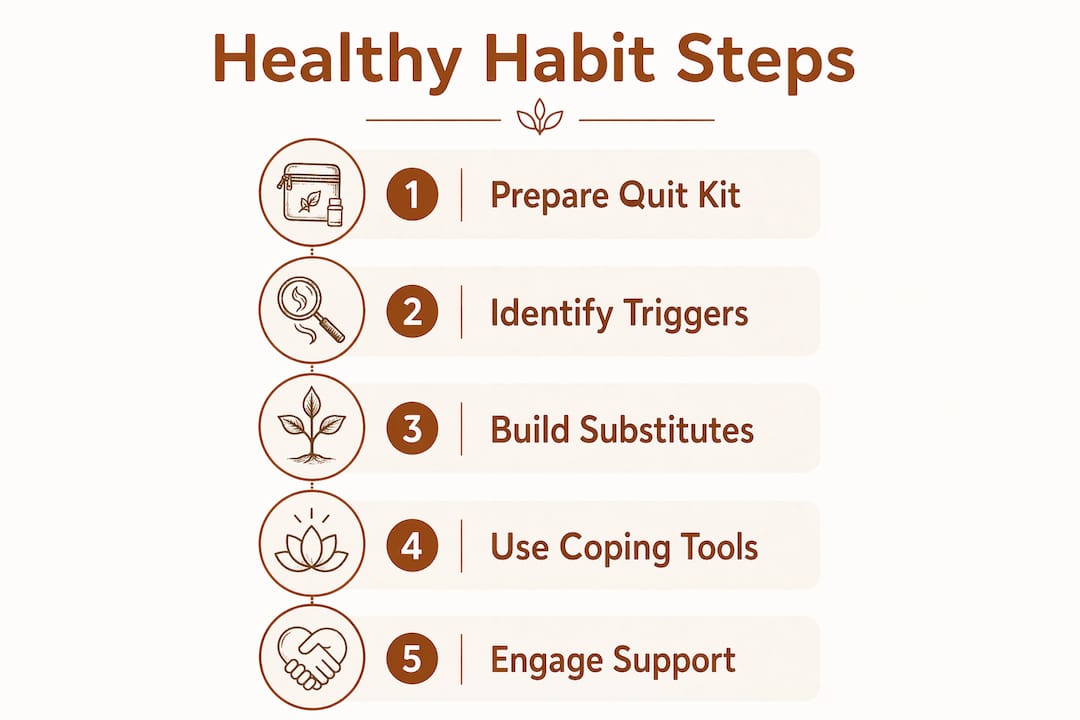
Cravings are time-limited. Withdrawal symptoms like restlessness and irritability are normal physiological responses, not signs of failure. Understanding that a craving wave will pass within minutes changes how you respond to it.
These strategies interrupt the craving cycle fast:
- Deep breathing: Inhale slowly for 5 seconds, hold briefly, exhale for 5 seconds. Repeat four times. This activates the parasympathetic nervous system and reduces the physical tension that amplifies cravings.
- Drink water or juice: The act of drinking occupies the mouth and hands simultaneously. Cold water adds a sensory interruption that breaks the craving focus.
- Move your body: A brisk two-minute walk or a set of jumping jacks shifts blood flow and releases dopamine. Physical movement is one of the fastest craving interruption tools available without any equipment.
- Call or text someone: Social connection redirects attention and shortens the craving window. Telling someone you are having a craving also creates accountability.
- Use a physical object: Holding something in your hand, whether a pen, a coin, or the Breathefree resistance necklace, addresses the tactile component of the urge without nicotine.
“Cravings are linked to withdrawal, are time-limited, and are not a willpower failure.” — NHS Inform
Relying on willpower alone is the single biggest mistake people make. Framing cravings as temporary and having a prepared response reduces the risk of relapse significantly. The craving does not mean you are failing. It means your body is adjusting.
What role does nicotine replacement play in replacing smoking rituals?
Nicotine replacement therapy (NRT) and vaping both serve a specific function: they reduce the chemical withdrawal load while you work on the behavioral side. Each option has a different relationship to the ritual itself.
| Approach | Ritual element preserved | Key consideration |
|---|---|---|
| Nicotine patch | None | Addresses chemistry only; behavioral work still required |
| Nicotine gum or lozenge | Oral occupation | Partially satisfies mouth-busy urge |
| Nicotine inhaler | Hand-to-mouth action | Closely mimics the physical ritual of smoking |
| Vaping | Full hand-to-mouth ritual | Carries health risks if used alongside cigarettes |
Vaping preserves the hand-to-mouth ritual, which is why many people find it easier to switch to than a patch. Health Canada advises stopping cigarettes completely as soon as possible and treating vaping as a transitional tool, not a permanent substitute. Dual use, meaning smoking cigarettes and vaping at the same time, maintains the health harms of both and delays the full benefits of quitting.
The risks of vaping long-term are still being studied, and the goal for anyone using it as a cessation bridge should be a clear plan to reduce and eventually stop vaping as well. NRT options like patches, gum, and lozenges are well-studied and effective when combined with behavioral support. The combination of both approaches consistently outperforms either one alone.
How does behavioral support improve long-term success?
Combining behavioral support with stop-smoking aids produces the highest quit success rates. The National Centre for Smoking Cessation and Training (NCSCT) recommends a minimum of six behavioral support sessions combined with appropriate stop-smoking aids. That number matters because it reflects how long it takes to build new habits and dismantle old ones.
Behavioral support works on several levels:
- Trigger mapping: A trained counselor helps identify the specific situations, emotions, and times of day that drive your urge to smoke.
- Relapse normalization: Psychological symptoms peak early and improve gradually. Framing a relapse as a learning event rather than a failure keeps people in the process instead of abandoning it.
- Accountability structure: Regular check-ins with a stop-smoking service create external accountability that personal motivation alone cannot replicate.
- Aid matching: A behavioral support professional helps match the right NRT or medication to your specific pattern of use and your daily routine.
Local stop-smoking services are available through most primary care providers and community health centers. Many offer free or low-cost sessions. Why behavioral support matters for long-term success is well-documented, and using it alongside personal strategies gives you the strongest possible foundation.
Pro Tip: Book your first behavioral support session before your quit date, not after. Having the appointment scheduled removes one barrier and signals commitment to yourself.
Key Takeaways
Replacing smoking rituals healthily requires targeting both the nicotine chemistry and the behavioral habits simultaneously, using pre-planned substitutes, immediate coping strategies, and structured support.
| Point | Details |
|---|---|
| Address both layers | Nicotine dependence and learned behavioral habits both need targeted replacement strategies. |
| Match the full urge package | Substitute the context, timing, mouth action, and hand movement, not just the nicotine. |
| Use instant coping tools | Deep breathing, water, movement, and physical objects interrupt cravings in under five minutes. |
| Treat NRT as a bridge | Patches, gum, and vaping reduce chemical withdrawal but require a plan to phase out completely. |
| Get structured support | At least six behavioral support sessions combined with stop-smoking aids delivers the best outcomes. |
What I have learned about replacing smoking rituals that most guides miss
The advice to “keep busy” is well-meaning but incomplete. What I have seen work, consistently, is specificity. People who succeed do not just stay busy. They have a plan for 7:15 a.m. when the coffee brews. They have a plan for the 3 p.m. break. They have something in their hand when the urge hits.
The craving wave concept changed how I think about this. Most people experience a craving and interpret it as evidence that they cannot quit. They treat it as a verdict. But a craving is just a wave. It builds, peaks, and passes, usually within five minutes. Once you know that, you stop fighting it and start riding it out.
The other thing most guides underestimate is the social ritual. Smoking with other people is a bonding behavior. Removing it without replacing the social connection leaves a real gap. Walking breaks, coffee with a colleague, or even a quick phone call can fill that space. The ritual is not just about nicotine. It is about belonging and routine.
Relapse does not mean failure. Every quit attempt adds information. You learn which triggers are stronger than you expected. You learn which substitutes actually work for you and which ones sound good in theory. That knowledge compounds. Most people who successfully quit long-term did not do it on the first try.
— Tommy
Tools to support your ritual replacement plan
Knowing what to do is one thing. Having a structured system to track it is another. Breathefree built the Nicotine Detox eBook and Habit Tracker specifically for people at this stage of the process.
The eBook walks you through identifying your personal trigger patterns and building replacement routines for each one. The habit tracker gives you a daily structure to log cravings, record what worked, and spot the patterns that lead to relapse before they become one. Over 75,000 people have used Breathefree’s approach to break free from nicotine. The tracker and eBook are designed to make the behavioral side of quitting as concrete and manageable as the physical side.
FAQ
What is the role of ritual in smoking addiction?
Smoking rituals are learned behavioral patterns tied to specific times, emotions, and environments. They operate independently of nicotine levels, which is why cravings can persist long after physical withdrawal ends.
How long do nicotine cravings last after quitting?
Cravings typically improve after 2 to 3 weeks as the body adjusts to being smoke-free. Individual craving waves usually peak and pass within five minutes.
What are the best substitutes for the hand-to-mouth smoking ritual?
Nicotine inhalers, sugar-free gum, hard candy, stress balls, and physical objects like the Breathefree resistance necklace all address the hand-to-mouth component. Choosing one that fits your daily routine increases the chance it becomes a lasting habit.
Is vaping a healthy way to replace smoking rituals?
Vaping preserves the hand-to-mouth ritual and can help people stop cigarettes, but dual use carries health risks. Health Canada recommends stopping cigarettes completely first, then planning to phase out vaping as well.
How many behavioral support sessions do I need to quit successfully?
The NCSCT recommends a minimum of six sessions combined with a stop-smoking aid. That combination consistently produces better outcomes than either behavioral support or medication alone.