

Journaling is a proven behavioral tool that helps people quit smoking by building self-awareness, regulating emotions, and tracking cravings in real time. When you use journaling to quit smoking, you give your brain a structured way to process withdrawal stress instead of reaching for a cigarette. The technique draws on expressive writing research, which shows that naming your feelings neurologically reduces the intensity of cravings by calming amygdala activation. This guide covers the formats, daily routines, and weekly review methods that make a quitting smoking diary work in practice, not just in theory.
How to use journaling to quit smoking effectively
The first decision is format. Paper, digital, and hybrid journaling each serve different people, and the right choice depends on your lifestyle, not your personality type.
Paper journaling gives you a distraction-free space. There are no notifications, no apps to update, and no battery to die. A small notebook kept on your nightstand or desk creates a physical anchor for the habit. The downside is that paper entries are harder to search when you want to spot patterns weeks later.
Digital journaling using apps like Day One or even a plain notes app on your phone makes entries searchable and portable. You can log a craving the moment it hits, wherever you are. The risk is that your phone is also where social media lives, which can derail a focused writing session.

Hybrid journaling combines both. You write daily entries on paper and use SMS reminders or simple digital tools to prompt yourself and back up key notes. Research supports hybrid systems as the most consistent approach because they balance visibility, ease, and redundancy.
| Format | Best for | Main drawback |
|---|---|---|
| Paper | Distraction-free writing | Hard to search for patterns |
| Digital | On-the-go logging | Phone distractions |
| Hybrid | Consistency and backup | Requires minor setup |
The simplest daily format is the three-line entry:
- Craving noticed: What triggered it and when
- Coping strategy used: What you did instead of smoking
- One daily win: Any positive moment from the day
This three-line daily format takes less than two minutes. That speed matters because withdrawal stress is the exact moment most people abandon new habits.
How to structure your daily journaling practice
Consistency beats length every time. A five-minute daily entry written at the same time each day builds a stronger habit than a 30-minute session done twice a week.
The recommended daily time commitment is 2–5 minutes. Morning works well for setting intentions. Evening works well for reviewing what happened. Pick one time and protect it like a medication schedule.
Your daily entry should cover four things:
- Triggers: What situations, emotions, or people made you want to smoke today?
- Cravings: How strong were they on a scale of 1–10, and how long did they last?
- Mood shifts: Did anxiety, boredom, or irritability show up? When?
- Daily win: What went right, even if it was small?
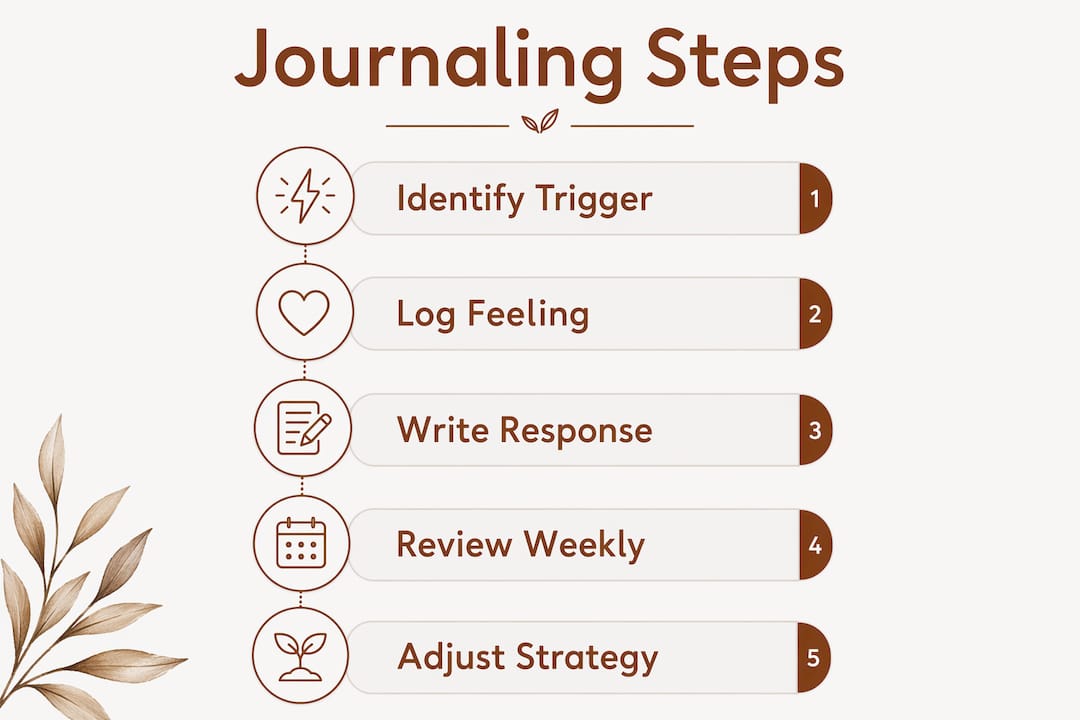
The Trigger-Feeling-Response (TFR) method adds one more layer. For each craving, you log the trigger, your emotional response, and the coping strategy you used. The TFR approach builds a personal database of your craving patterns over time. That database becomes your most useful tool during a tough week.
Expressive writing is the engine behind why this works. Writing activates the prefrontal cortex, which shifts your brain from chaotic emotional loops to linear processing. That shift is what makes a craving feel manageable instead of overwhelming. The key is honest emotional disclosure. Write what you actually feel, not what you think you should feel.
Pro Tip: On days when writing feels impossible, start with the sentence “I don’t feel like writing today because…” and keep going from there. That single line often unlocks more than you expect.
Forcing positivity in your entries actually reduces the benefit. Honest emotional disclosure activates the neurological responses that regulate your nervous system during withdrawal. Gratitude lists have their place, but they do not replace raw, truthful writing about what quitting actually feels like.
How do weekly reviews help you quit smoking faster?
A daily entry captures the moment. A weekly review reveals the pattern. These are two different and equally important functions.
Set aside 10 minutes once a week, ideally on the same day each time. Sunday evening works well because it lets you plan for the week ahead. Read through your entries from the past seven days and look for:
- Recurring triggers (the same time of day, the same person, the same emotion)
- Coping strategies that worked and ones that failed
- Mood patterns that preceded the strongest cravings
- Progress you may have dismissed in the moment
One critical rule: wait at least 24 hours before rereading any entry. Reading your own words too soon can re-trigger the emotional state you were processing. Distance gives you objectivity. You stop being the person who had the craving and start being the analyst who can learn from it.
After each weekly review, make one concrete adjustment to your quit strategy. Not five adjustments. One. You might decide to take a walk every day at 3:00 PM because that is when your cravings peak. You might text a friend instead of going to the kitchen after dinner. A weekly review cycle that produces one specific change per week compounds into a fully personalized quit plan within a month.
Pro Tip: Keep a separate “patterns” page at the back of your journal. Each week, write one sentence summarizing your biggest insight. After four weeks, that page becomes a clear map of your triggers and strengths.
Understanding what triggers smoking cravings is the foundation of any effective quit plan, and your weekly review is where that understanding becomes concrete.
Common journaling challenges and how to handle them
The most common mistake beginners make is over-tracking. Trying to log every thought and feeling creates pressure that kills the habit within a week. Starting with a simple 3-line log removes that pressure and keeps the practice sustainable during the most stressful phase of quitting.
Three other challenges come up repeatedly:
- Emotional intensity: Some entries will surface grief, anger, or shame. That is normal and actually a sign the process is working. If the intensity feels unmanageable, pause and return to the entry the next day.
- Perfectionism: Your journal does not need to be well-written. It needs to be honest. Crossed-out words and incomplete sentences are fine.
- Skipped days: Missing a day is not failure. Write a brief note about why you skipped. That note is data too.
“The hardest days to write are often the most valuable. Logging even a brief note about your resistance can provide real insights without emotional overload. You do not need a full entry to keep the habit alive.”
Journaling also works best as part of a broader support system. Journaling complements professional support and therapy but does not replace clinical treatment. If you are experiencing severe withdrawal symptoms, anxiety, or depression, clinical care comes first. Journaling works between those sessions to process what comes up.
Pairing your journal with mindfulness practices strengthens both habits. A few deep breaths before you write helps you access honest emotion rather than surface-level reporting. The combination of mindfulness and expressive writing creates a feedback loop that builds resilience over time.
For a broader look at how behavioral tools support cessation, the team at Garden State Medical Group outlines how daily routines, including journaling, create the structure that makes quitting stick.
Key Takeaways
Journaling helps you quit smoking by turning vague cravings and emotions into specific, manageable data you can act on every week.
| Point | Details |
|---|---|
| Start with three lines daily | Log the trigger, coping strategy, and one win in under two minutes to build consistency. |
| Use honest emotional disclosure | Writing what you actually feel regulates your nervous system better than forced positivity. |
| Wait 24 hours before rereading | Reviewing entries with distance gives you objectivity and prevents re-triggering emotional states. |
| Make one weekly adjustment | Each weekly review should produce one concrete change to your quit strategy. |
| Journaling complements clinical care | Use your journal between therapy or support sessions, not as a replacement for professional help. |
Why I think most people underestimate journaling as a quit tool
People tend to dismiss journaling as soft. They want a patch, a prescription, or a program with a progress bar. I get it. Writing in a notebook feels low-tech compared to everything else on the market.
But here is what I have found: the people who struggle most with quitting are not lacking willpower. They are lacking self-knowledge. They do not know which specific situations make them reach for a cigarette. They cannot name the emotion underneath the craving. Journaling fixes that. It forces you to slow down and look at your own patterns with honesty.
The TFR method changed how I think about cravings entirely. When you write “trigger: argument with my boss, feeling: helpless, response: smoked three cigarettes,” you stop seeing yourself as weak and start seeing a very logical chain of events. That shift is where real change begins.
The other thing people miss is the motivational record. After four weeks of daily entries, you have documented proof that you survived dozens of cravings. That record is more powerful than any app badge. On the hardest days, reading your own words from week one reminds you exactly how far you have come.
Pair journaling with a physical support tool, like the Breathefree resistance necklace, and you address both the mental and the oral fixation side of quitting at the same time. That combination is more complete than either approach alone.
— Tommy
A structured resource to support your journaling quit plan
Journaling works best when it sits inside a larger structure. Writing daily entries and weekly reviews is powerful, but having a dedicated framework keeps you consistent when motivation dips.

The Breathefree Nicotine Detox eBook & Habit Tracker is built to complement exactly the kind of journaling practice described in this guide. It includes structured tracking pages that align with the TFR method, daily prompts designed for withdrawal stages, and a habit tracker that makes your progress visible at a glance. Over 75,000 people have used Breathefree tools to quit smoking. Adding a structured tracker to your journaling routine removes the guesswork from what to write and when, so you can focus on the work that actually matters.
FAQ
Can journaling really help you quit smoking?
Yes. Journaling reduces craving intensity by activating the prefrontal cortex, which shifts emotional processing from reactive to analytical. Daily entries that track triggers and coping strategies build the self-awareness that makes quit attempts more successful.
How long should I journal each day when quitting smoking?
A daily entry of 2–5 minutes is enough to build the habit and capture useful data. Longer sessions are fine, but consistency matters more than length during the withdrawal period.
What should I write about in a quitting smoking diary?
Write about your triggers, craving intensity, mood shifts, and one positive moment from the day. The TFR format, logging the trigger, your emotional response, and your coping strategy, gives each entry a clear structure.
When is the best time to review my journal entries?
Wait at least 24 hours before rereading any entry. Immediate rereading can re-trigger the emotional state you were processing. A weekly review session of about 10 minutes, done on the same day each week, is the most effective schedule.
Does journaling replace other quit smoking support?
No. Journaling enhances emotional processing between therapy or support sessions but does not replace clinical treatment. If you experience severe withdrawal symptoms or mental health challenges, seek professional care first.