BreatheFree

Quitting · What The Research Says

7 reasons quitting vaping is harder than quitting smoking was, and the one thing that fixes all of them

You did the sensible thing. You got off cigarettes. So why does putting the vape down feel worse than putting the packet down ever did? The answer is not willpower, and it is not you.

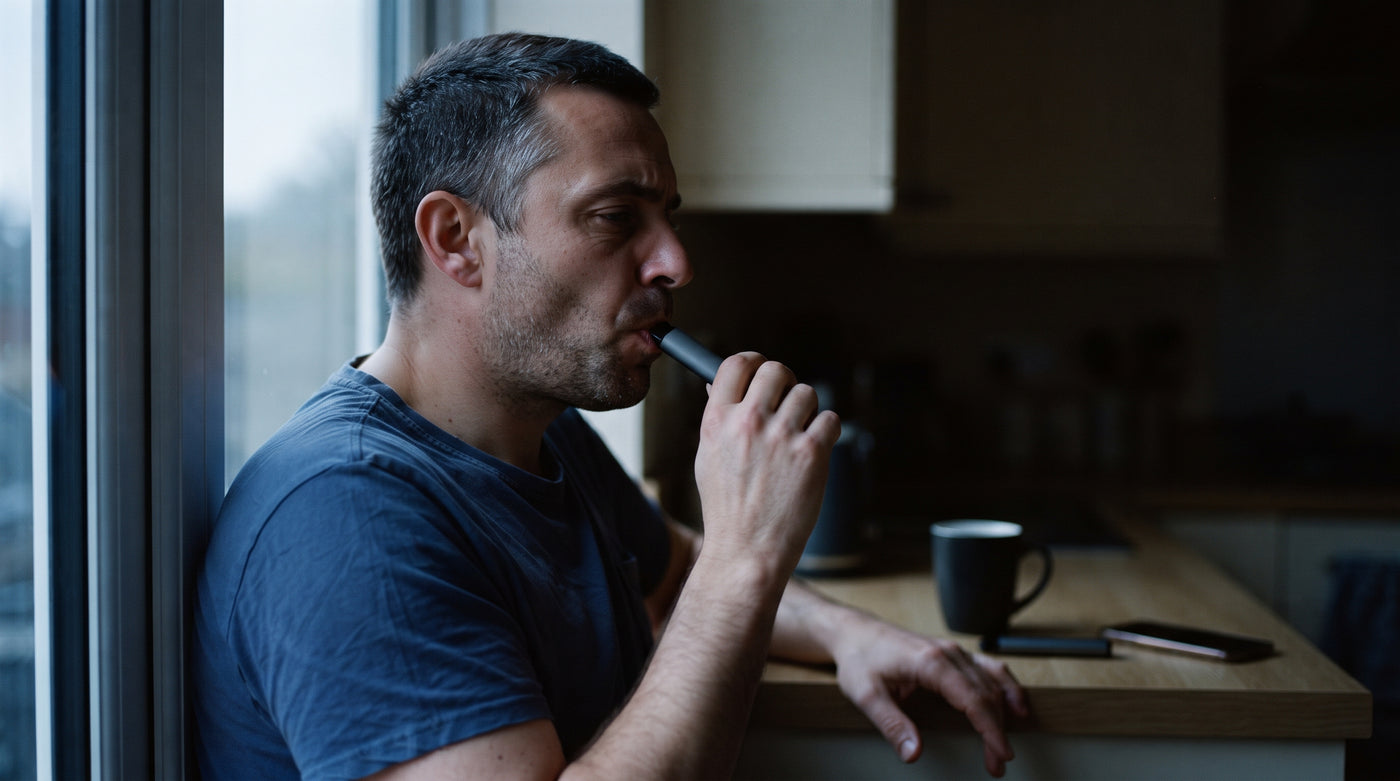
A man taking a hard draw on a disposable vape at his kitchen window before sunrise

You have probably tried to stop vaping already. Maybe more than once. You made it three days, or three weeks, and then one ordinary Tuesday you were in a petrol station at ten at night buying a device at a price you would have laughed at two years ago.

Here is the part that nobody prepares you for: for a lot of people, quitting the vape is harder than quitting the cigarettes was. Not because you have got weaker, but because a disposable is a fundamentally different object with a fundamentally different hold on you — and almost every quit method available was designed for the other thing.

Below are the seven reasons it collapses, what the evidence actually says about each, and how one approach was built specifically to close them.

Which of these sound like you?

Tap the ones that are true. It changes nothing on the page except the summary at the end — and it is worth seeing them counted.

Nothing picked yet.

Most people who have been on disposables for over a year tick at least four.

Your device never ends, so the habit never gets a full stop

A man at his desk lifting a disposable vape to his mouth on autopilot, mid-work

A cigarette is a self-limiting object. It burns down, it goes out, and the ritual has a built-in end. Twelve a day means twelve beginnings and twelve endings, and every one of those endings is a moment your brain files as "done".

A disposable ends when you decide it ends. It sits in your pocket at body temperature, ready in under two seconds, with no ash, no smell and no reason to stop. The decision that used to be made twelve times a day is now made several hundred times a day, and you have to win every single one.

What the research says

Around 43% of everyday actions are performed habitually, in the same context, on autopilot rather than by conscious decision, according to diary research in the Journal of Personality and Social Psychology.

A device that is always available and always ready hands that autopilot far more opportunities to fire than a product that has to be lit, finished and put out.

Sources: Wood, Quinn & Kashy, Journal of Personality & Social Psychology (2002) · PubMed 12500811

How BreatheFree closes it

The Resistance Necklace has a beginning and an end built into it: you lift it, you take a breath, you let it go. It is a discrete act, not a background drip. And because there is nothing addictive in it, it does not matter how many times you reach for it — there is no dose to track and nothing accumulating.

Nothing ever replaced the hand-to-mouth ritual

An empty hand raised to the lips in the shape of holding a vape — the unmet hand-to-mouth loop

By the time you have been on disposables for a couple of years, you have performed the lift-to-lips-and-draw movement hundreds of times a day, every day. That is not a preference any more. It is motor memory, welded to your coffee, your commute, your work calls and every gap in your day.

A patch on your arm does not touch it. Gum gives your jaw a job while the part of you that wants the draw sits there unanswered. When the hand goes up and finds nothing, that gap is exactly where relapse lives.

What the research says

The physical ritual is so well recognised that it has its own official remedy: the NHS nicotine inhalator exists specifically to keep your hands busy and recreate the hand-to-mouth action of smoking.

The American Cancer Society gives the same advice — if you miss having something in your hand or at your mouth, occupy both, and take slow deep breaths to ride the craving out.

Sources: NHS stop-smoking guidance on nicotine inhalators · American Cancer Society, Help for Cravings and Tough Situations · cancer.org

How BreatheFree closes it

BreatheFree describe the necklace as designed to replace the ritual rather than the addiction. It slots into the identical physical sequence — lift, to the lips, draw in — so the loop closes instead of hanging open. The company's own framing is that this helps your brain feel like nothing has suddenly been taken away.

Switching moved you up the ladder, not down it

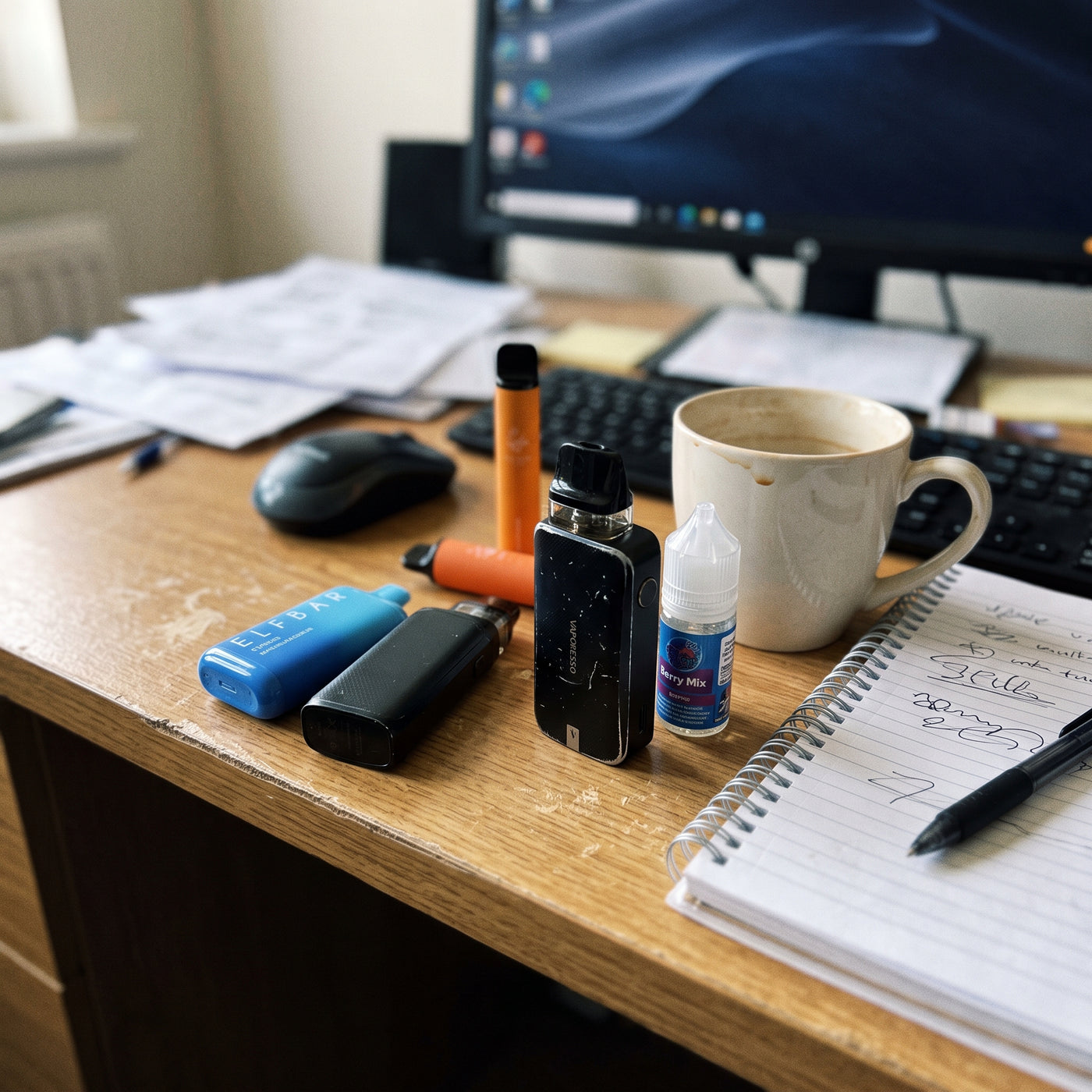
A row of nicotine devices increasing in strength — the ladder you climbed after switching

Almost nobody who moves onto disposables moves down in strength afterwards. The pattern is one direction: a low-strength refillable, then a higher one because the low one "wasn't doing anything", then salt-based disposables because they are smoother and easier to take in quantity.

The reason it feels smoother is chemistry, not restraint. Salt formulations are far less harsh on the throat at high concentrations, which removes the natural ceiling that used to stop you. The unpleasantness that limited your intake is gone. Your intake is not.

What the research says

Nicotine replacement products, taken as a category, raise the odds of quitting by roughly 1.5× versus control, and the Cochrane review notes the benefit fades once the therapy stops. Anything that keeps delivering nicotine keeps the dependency alive on a different setting.

Meanwhile only 8.8% of US adults who smoked and tried to quit in 2022 actually succeeded — and fewer than 40% used any counselling or medication at all.

Sources: Cochrane Library, Nicotine replacement therapy versus control (2018) · cochranelibrary.com · CDC MMWR, Adult Smoking Cessation, United States, 2022 · cdc.gov

How BreatheFree closes it

There is no strength here, so there is no ladder. The necklace contains no nicotine at any concentration — nothing to step down through, nothing to renegotiate with yourself at 2am, and nothing to wean off when you are finished with it. Without a refill there is literally nothing inside it but engineered airflow.

A 0mg vape removes the drug and keeps the machine

A vape device with its charging cable and spare pods — the whole apparatus a 0mg switch keeps

This is the clever-sounding fix that traps more ex-smokers-turned-vapers than any other. Drop to zero nicotine and you have solved the chemical problem on paper.

Except you are still holding a battery-powered device. Still heating a liquid. Still inhaling something that is not air. Still buying, charging, reordering and carrying the exact apparatus that had you reaching every few minutes in the first place. You have kept the entire machine and removed the only component that was doing anything.

What the research says

Smokers themselves describe their addiction as far more than chemical, citing the hand-to-mouth movement, the oral fixation and the routine — and many say removing the nicotine alone would not eliminate what keeps them hooked.

Which cuts both ways. Removing the nicotine while keeping the device leaves the behavioural half completely intact, and the behavioural half is the one that survives.

Sources: "Addicted to smoking or addicted to nicotine?", National Library of Medicine · PMC8733050

How BreatheFree closes it

The necklace is the inverse trade. No battery, no charging, no coil, no pod, no liquid, nothing heated or burned — BreatheFree are explicit that nothing is inhaled into your lungs and no batteries are involved. You keep the gesture and the draw. The machine goes in the bin.

You lost the thing you believed was calming you

A man breathing calmly through the BreatheFree necklace, held upright to his lips — the calm the vape was taking credit for

Every time you stepped outside for a vape after a difficult call, you told yourself the nicotine took the edge off. It is a very convincing story and it is mostly wrong.

A long draw in and a slow breath out is, physiologically, a paced-breathing exercise. You have been doing breathwork several hundred times a day and crediting the device. Quit, and you lose the regulator — so stress spikes with nothing to bring it down, and the "I need it to relax" story writes itself all over again.

What the research says

A landmark paper in American Psychologist found smokers have slightly higher stress than non-smokers, and that the apparent calm of a cigarette is largely just relief from the withdrawal the last one caused. The NHS puts it plainly: nicotine tricks your body into thinking it is helping with stress.

What genuinely settles you is the breathing. Long, slow exhales against light resistance activate the parasympathetic "rest and digest" response, slow the heart and reduce anxiety. In a randomised controlled trial, abstaining smokers who did a short paced-breathing exercise had significantly weaker urges than controls.

Sources: Parrott, American Psychologist (1999) · PubMed 10540594 · NHS, The truth about smoking and stress · nhs.uk · Cleveland Clinic, Pursed-Lip Breathing · Shahab et al., Psychopharmacology (2013) · PubMed 22993051

How BreatheFree closes it

The necklace keeps the exact part that was doing the calming — the slow resisted inhale and the long exhale — and drops the part that was harming you. BreatheFree market this directly as satisfying resistance for daily calm. You keep the breath. You lose the device.

The first fortnight had no safety net

A calendar with the first two weeks crossed off — the highest-risk relapse window

Most relapse happens fast, and coming off high-strength salts is not a gentle experience. If your only tool in the first two weeks is gritted teeth, you are relying on the one resource that is guaranteed to run out.

Worse, most quit aids come with a schedule — a dose, a limit, a taper — which means that in the exact window where you need something constantly, you are being told to ration it.

What the research says

A landmark study of the relapse curve in unaided quitters found most relapse happens within the first 8 days, and that only 3–5% remain quit at 6–12 months per attempt. The authors concluded that support should focus squarely on the first week.

Withdrawal follows a predictable arc: symptoms begin within a day, peak around days 2–3, then ease over 3–4 weeks. The early window is the one that decides it.

Sources: Hughes et al., "Shape of the relapse curve", Addiction (2004) · PubMed 14678060 · Cleveland Clinic, Nicotine Withdrawal · clevelandclinic.org

How BreatheFree closes it

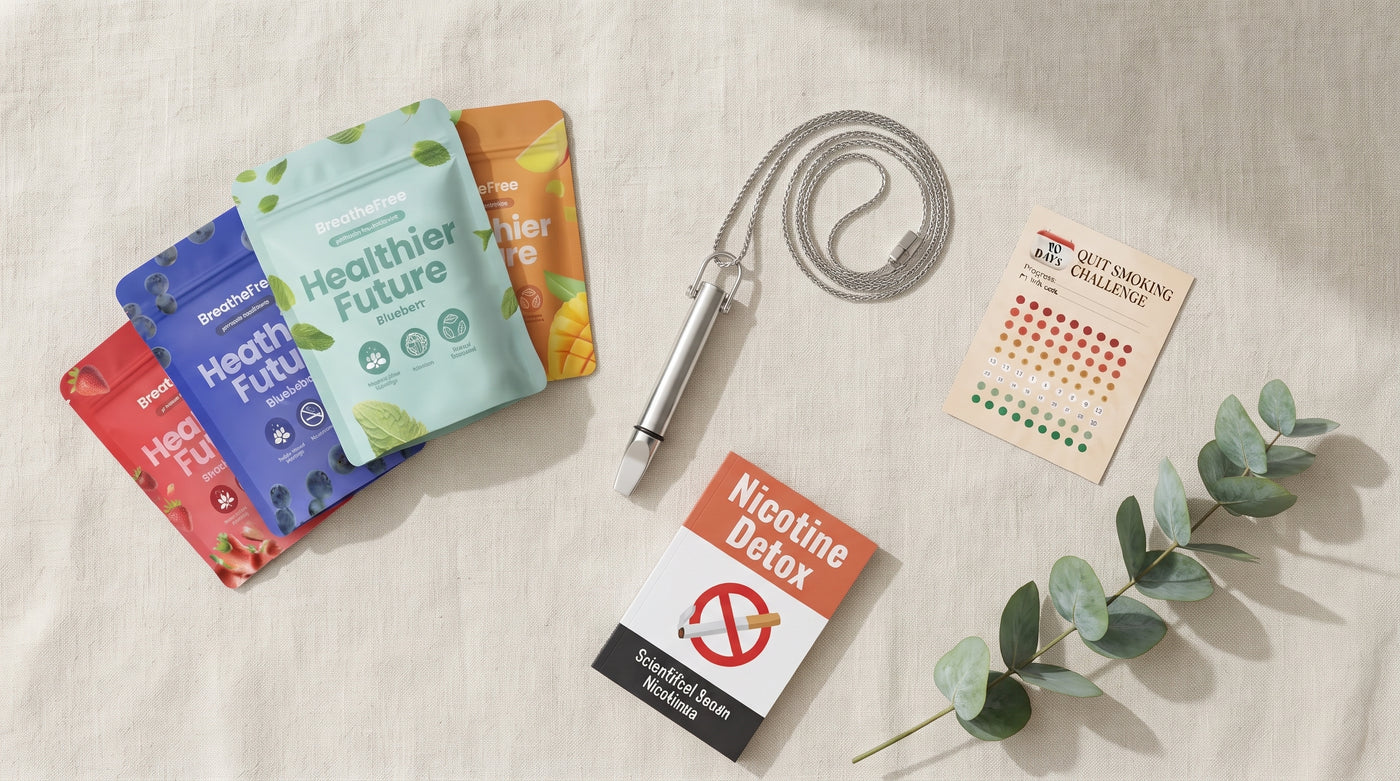
There is no usage limit and nothing addictive, so in that first fortnight you can reach for it as often as the craving arrives — fifteen, twenty, thirty times a day if that is what it takes. Every order also ships with a Nicotine Detox eBook, a Progress Habit Tracker and access to the private BreatheFree Quitters Health Group, all aimed squarely at that early window.

You tried to do it on willpower, and blamed yourself when it failed

A man gripping the kitchen counter edge, riding out a craving on willpower alone

"I'll just power through" feels like the honourable option. It is also the single most relapse-prone plan available, because it asks one finite resource to fight on two fronts — chemical and behavioural — with no tools at all.

And when it fails, you file it as a character flaw rather than a method flaw. That is what makes the next attempt harder than the last one. It is a trap dressed up as virtue.

What the research says

Unaided attempts leave roughly 3–5% of people still quit at 6–12 months — not for lack of grit, but because raw willpower addresses neither half of the dependency.

And there is a great deal of behaviour to fight: around 43% of daily actions run habitually, in context, on autopilot. That is precisely how an all-day vaping routine operates.

Sources: Hughes et al., Addiction (2004) · PubMed 14678060 · Wood, Quinn & Kashy, J. Personality & Social Psychology (2002) · PubMed 12500811

How BreatheFree closes it

Stop asking willpower to do a tool's job. Give the habit a physical substitute, keep nicotine out of the picture entirely, and spend your resolve on the decision to stop rather than on surviving every individual craving between now and Christmas.

The evidence, gathered in one place

Every fix above rests on the same idea, and it is not BreatheFree's idea. It is the consensus of the research and the major health bodies.

Dependence is two things, not one

Users themselves report the ritual, the hand-to-mouth motion and the routine as a distinct pull from the drug. Remove the chemical and the behaviour is still sitting there.

"Addicted to smoking or addicted to nicotine?", National Library of Medicine · PMC8733050

Which is why most attempts fail

Only 8.8% of US adults who smoked and tried to quit in 2022 succeeded. Nicotine replacement raises the odds roughly 1.5×, and the effect fades once you stop using it.

CDC MMWR 2022 · cdc.gov · Cochrane Review · cochranelibrary.com

The first week decides it

Most relapse in unaided quitters happens within the first 8 days. Support that window and you change the odds.

Hughes et al., Addiction (2004) · PubMed 14678060

Health bodies say: keep the hands and mouth busy

The American Cancer Society, Mayo Clinic and NHS all recommend occupying the hands and mouth and breathing through cravings. The NHS inhalator exists to recreate the hand-to-mouth action.

American Cancer Society · cancer.org · Mayo Clinic · mayoclinic.org

Slow breathing genuinely calms you

Long-exhale breathing raises parasympathetic activity and heart-rate variability and lowers cortisol — the physiology of rest and digest.

Slow-paced breathing meta-analysis, Mindfulness (2023) · springer.com

The "it relaxes me" belief is a myth

Nicotine users show slightly higher stress than non-users; the calm is mostly relief of withdrawal. What actually relaxes you is the deep paced breath — which you can keep.

Parrott, American Psychologist (1999) · PubMed 10540594 · Truth Initiative · truthinitiative.org

Read this before you take the science as a promise

The studies above are general research into nicotine dependence, relapse behaviour and the physiology of breathing. They are not trials of the BreatheFree Resistance Necklace, and none of them claims that breathing through a device cures nicotine addiction. They are included to explain why the approach is built the way it is — replacing the ritual and keeping the calming breath — not to imply any guaranteed outcome. The necklace is a wellness accessory, not a medicine or a licensed stop-smoking treatment.

The pattern

Seven problems. One missing piece.

Look back at what actually went wrong each time. Every method you were offered went after the chemical and left the other half of the habit — the lift, the draw, the breath — completely untouched. Seven different failures, one gap underneath all of them.

The one thing that closes all seven

Read back through the fixes and you will notice they are the same product answering seven different failure points. That is not a coincidence — the Resistance Necklace was built around the exact gap that patches, gum, strength-tapering, 0mg vapes and raw willpower each leave open.

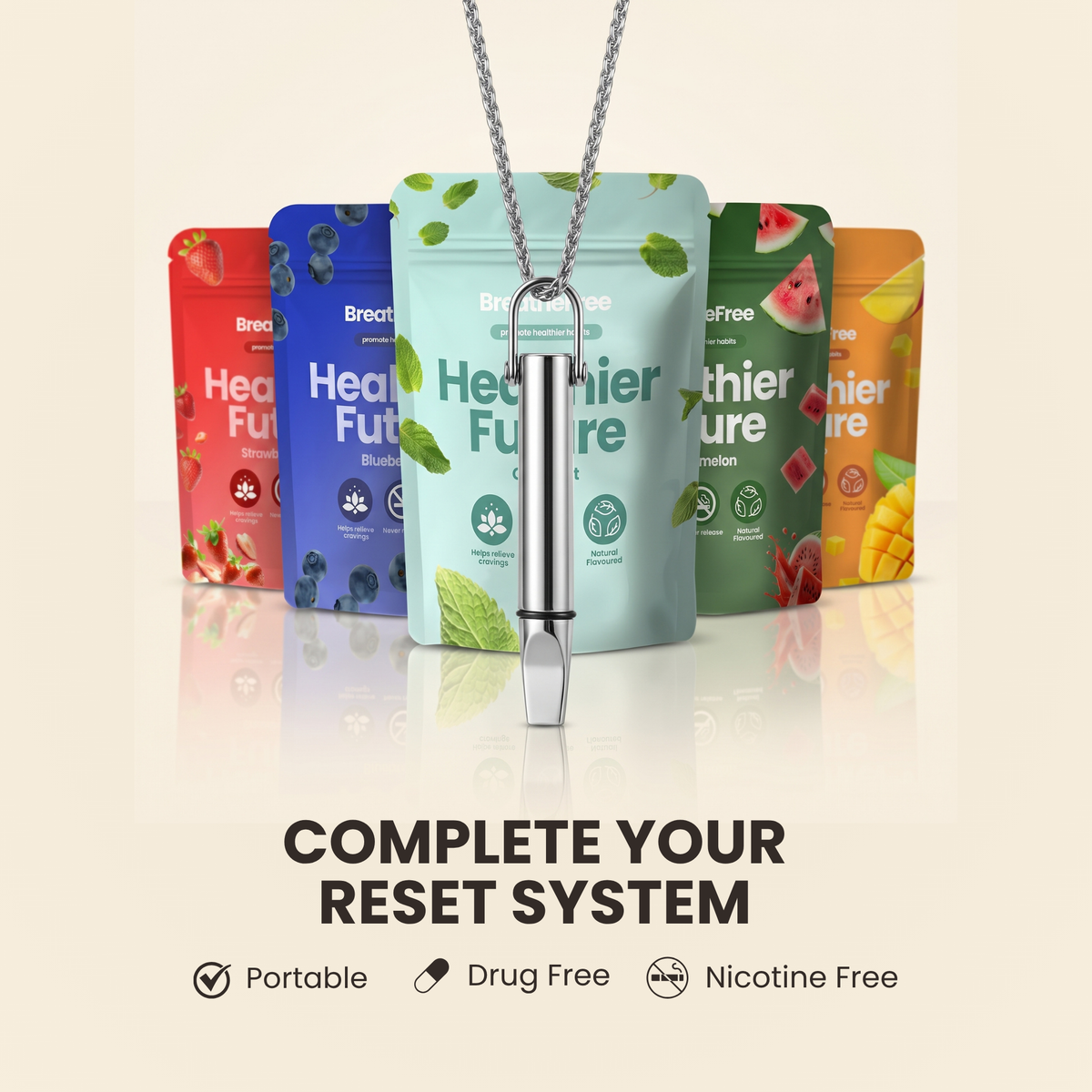
The BreatheFree Resistance Necklace, designed to replace the ritual rather than the addiction

What BreatheFree say about it

  • It replaces the ritual, not the addiction.Recreating the hand-to-mouth motion with gentle breathing resistance gives your brain the familiarity it expects, without nicotine, batteries or vapour.
  • Satisfying resistance for daily calm.A calibrated airflow channel narrows the air path to create smooth resistance on the inhale.
  • Nothing is burned, heated or vaporised.No smoke and no vapour on the exhale — it is just air. No battery and no charging.
  • Air flows around the refill, not through it.An open-air design with no seals, no cores, no wicks and no adjustable airflow parts — you sense a light aroma without inhaling any substance.
  • Clean refills.Natural flavour extracts, plant-derived essential oils and natural flavouring substances. Mint varieties contain natural menthol. Three per packet, roughly a month each.
  • Impossible to lose, and it works where vaping does not.It is around your neck, and nothing is emitted — so flights, trains and offices are all fine.
  • Rated 4.8/5 with 75,000+ customersand a 30-day money-back guarantee.
See the Resistance Necklace on BreatheFree.shop →

What BreatheFree customers report

Survey of BreatheFree customers conducted in January 2025

97%described fewer impulses to return to old habits, and felt more in control of their urges
92%reported they were breathing easier within the first two weeks
90%felt less irritable and restless than in previous quit attempts
The BreatheFree Resistance Necklace with its flavour refills and the included booklet

How it compares to everything else

Feature BreatheFree Others
Nicotine free
Replaces the hand-to-mouth ritual
No battery, no charging, no pods
Impossible to lose
Use on flights, trains and in offices
Private community group included
Free quit-nicotine eBook & habit tracker
Stylish and discreet
Weekly continuous support
30-day money-back guarantee

Comparison as published by BreatheFree on breathefree.shop.

People who were exactly where you are

Margaret · BreatheFree customer

"I couldn't leave the house without my vape."

Margaret · BreatheFree customer

Rated 5 out of 5

The necklace uses breathing resistance to mimic that familiar draw — it's actually genius. The flavours keep my mouth busy and satisfy that hand to mouth ritual I was addicted to, minus the nicotine. Within days my urges dropped massively. A few weeks in I stopped reaching for it completely. My tight chest is gone, I sleep through the night, and I'm back hitting the gym.

Tony · BreatheFree customer

"By week 2, I wasn't even thinking about going back."

Tony · BreatheFree customer

Rated 5 out of 5

Gum and cold turkey always made me relapse within weeks. This replaced the hand to mouth ritual my brain craved. Within the first week the constant mental obsession faded. Three months later I have clearer lungs, zero urges, and a thousand dollars back in my pocket.

Ella · BreatheFree customer

"Helped me avoid relapsing."

Ella · BreatheFree customer

Rated 5 out of 5

The necklace design is very unique — it's always around my neck when cravings strike, which has helped me avoid relapsing a lot. The habit tracker was a nice surprise and kept me accountable daily, and the detox eBook taught me what my body was actually going through.

Reviews taken from breathefree.shop and lightly trimmed for length. Individual experiences vary; these are not typical or guaranteed results.

4.8
792 reviews
5 ★680
4 ★109
3 ★3
2 ★0
1 ★0

Rating breakdown from 792 published reviews on breathefree.shop.

No nicotine, ever
No tobacco or vapour
Tracked worldwide shipping, 5–8 days
30-day money-back guarantee

Why people trust it

4.8/5average rating
75,000+customers
30 daysmoney-back guarantee
5–8 daystracked worldwide

Reader offer · Summer sale live now

Close all seven at once.

Nicotine-free, tobacco-free, battery-free. It closes the exact gap that made every previous attempt fail.

The BreatheFree Resistance Necklace with its flavour refills

BreatheFree Resistance Necklace

Rated 4.8/5 by 75,000+ customers

Includes 3 flavour refills · mint, coffee, blueberry, strawberry, watermelon

£31.00£65.00Save 52%
Included free — worth $55Nicotine Detox eBook · Progress Habit Tracker · access to the private BreatheFree Quitters Health Group
30-day money-back guaranteeIf the product doesn't work for you and you haven't quit within 30 days, you get a refund — no questions asked. Email support@breathefree.shop.
Get the Resistance Necklacebreathefree.shop · tracked worldwide shipping, 5–8 days
5–8 day delivery Tracked & insured worldwide
30-day refund No questions asked
Secure checkout PayPal, Apple Pay, Shop Pay, all major cards
✓ No nicotine✓ No tobacco or vapour✓ No battery or charging✓ Rated 4.8/5 by 75,000+ customers

Common questions

Is this just a 0mg vape?

No. There is no battery, no heating element, no e-liquid and no vapour. Nothing is burned, heated or turned into an aerosol — you are drawing air through a calibrated channel. If you use a flavour refill, air passes around it rather than through it, so you sense a light aroma without inhaling any substance.

Is it just another addiction?

BreatheFree's position is that it is not, because there is no nicotine or other active substance involved — it works by engaging the sensory and behavioural side of the habit rather than by delivering anything.

Does it produce smoke or vapour when I exhale?

None at all. The device works through airflow only, so what you breathe out is ordinary air. That is why it can be used on flights, trains and in offices.

How does the resistance actually work?

An open, calibrated airflow pathway gently narrows the air channel, creating smooth resistance on the inhale. There are no seals, no rotating parts and no adjustable airflow systems — it is a fixed open design.

Why not just use a straw?

A straw has no calibrated resistance — that is the engineered part. And realistically you will wear a necklace every day; you will not carry a straw around for six months.

Does it need a battery?

No battery, no charging, no cable. The only thing you replace is the flavour refill, and only if you use them — most last around a month depending on use.

What is in the refills?

Natural flavour extracts, plant-derived essential oils and natural flavouring substances. Mint varieties contain natural menthol. For aromatic use only, not intended for ingestion. Nicotine-free and tobacco-free.

How do I use it?

Unscrew the necklace, place a flavour refill inside, and take slow mindful inhales whenever a craving hits or you need the hand-to-mouth ritual. Step-by-step instructions are included in the package.

Is this a medical device?

No. It is not intended to diagnose, treat, cure or prevent any disease. BreatheFree describe it as a wellness accessory designed to encourage mindful breathing and replace habitual hand-to-mouth behaviours.

How long does delivery take?

Usually 5–8 days, though it varies by country. Shipping is tracked and insured worldwide.

What if it doesn't work for me?

There is a 30-day money-back guarantee: if it does not work for you and you have not quit within 30 days, email support@breathefree.shop for a refund, no questions asked.