

Box breathing can quickly lower the intensity of a craving by slowing your breathing and shifting your attention away from the urge; learning how to practice mindful breathing provides practical quick reset techniques to support this process. It works best as an in-the-moment tactic, not a cure on its own, so pairing it with a broader quit plan makes the biggest difference. The scripts below give you exact counts and timing to use the moment a craving hits.
TL;DR:
- For mild cravings, repeat four cycles of three seconds per phase; for moderate urges, use six to eight cycles of four seconds per phase.
- When an urge dominates, use the three minute routine: breathe with four second phases for one minute, then relax your jaw, shoulders, and hands.
- Controlled studies found short term craving relief and fewer choices to smoke, but effects were less consistent outside labs; guidance recommends broader quit support.
- Practice two or three short sessions daily to build familiarity, and contact a quitline or clinician if cravings persist or withdrawal symptoms are heavy.
- Pair breathing with water, gum, or another physical anchor to occupy your hands and mouth while the urge fades over the next few minutes.
Table of Contents
- How to do box breathing: steps, posture, and discreet options
- Why box breathing helps with cravings
- What the research says about breathing for cravings
- Scripts you can use the moment a craving hits
- Building box breathing into a full quit plan
- What I’ve learned teaching breathing to people trying to quit
- A non-nicotine tool to pair with your breathing practice
- FAQ
- Sources
How to do box breathing: steps, posture, and discreet options
Box breathing gets its name from four equal phases that form a “box” when you picture them on a square: inhale, hold, exhale, hold. The classic version uses a 4-4-4-4 count, meaning four seconds for each phase, though you can shorten this to 3-3-3-3 if four seconds feels like a stretch at first.

Breathing from your diaphragm, not your chest, makes the technique work. Place one hand on your stomach and one on your chest: if the hand on your stomach rises more than the one on your chest, you are doing it correctly. Shallow chest breathing keeps your body in a more alert state, which works against the calming effect you are after.
Here is the basic sequence:
- Inhale slowly through your nose for 4 seconds, letting your stomach expand.
- Hold your breath gently for 4 seconds without straining.
- Exhale slowly through your mouth or nose for 4 seconds, emptying your lungs.
- Hold the empty breath for 4 seconds, then repeat.
Running through this cycle several times takes about a minute or so, which is often enough to take the edge off an acute craving.
In public settings, you don’t need to make a show of it. Drop the audible exhale, count silently in your head, and keep your shoulders relaxed so the breathing looks like ordinary, calm breathing rather than an exercise. A micro-version using 2-2-2-2 counts works in a meeting or on a crowded train when four-second holds would feel too obvious.
Pro Tip: Practice the full 4-4-4-4 count when you are calm, not just when a craving hits, so the pattern feels familiar under pressure.
Why box breathing helps with cravings
Slow, regular breathing shifts the balance between your sympathetic nervous system, which drives the fight-or-flight response, and your parasympathetic system, which calms you down. Paced breathing of this kind tends to increase vagal tone and can reduce sympathetic arousal, which gives a plausible physical explanation for why a craving feels less urgent after a minute of controlled breathing.
There is also an attention component. A craving often grows because your mind keeps circling back to it, and counting breaths gives your attention something specific to hold onto instead. This is less about distraction for its own sake and more about interrupting the mental loop that makes an urge feel unbearable.
There’s a ritual angle worth naming too. Smoking involves a repeated inhale, a pause, and an exhale, so a structured breathing pattern mimics some of the physical rhythm your body associates with lighting up, minus the nicotine. That overlap may be part of why breathing feels satisfying as a substitute action rather than just a relaxation technique.
None of this makes the craving disappear permanently. What it does is buy you time: cravings typically peak and fade within a few minutes, so a short breathing routine can carry you past the worst of the urge long enough to choose not to act on it.
What the research says about breathing for cravings
The evidence for breathing as a craving tool is strongest in the short term and inside controlled settings. A randomized lab study by Shahab et al. found that simple yogic-style breathing exercises produced immediate reductions in cigarette craving compared with a control condition, though the effects were less consistent when researchers tracked smokers over 24 hours outside the lab.
A separate controlled trial on mindfulness-based yogic breathing found similar short-term results with an added behavioral detail: participants who practiced the breathing technique were less likely to choose to smoke during a laboratory choice task, and they smoked fewer cigarettes in the 24 hours that followed.
More than two-fold reduction in smoking choice: participants using mindfulness-based yogic breathing were more than twice as likely to decline smoking during a lab task compared with the control group, a meaningful signal for a technique that costs nothing and carries no side effects.
Public health guidance reflects this pattern of “helpful, but not sufficient on its own.” The CDC lists breathing techniques as one coping tool among several, and encourages people quitting to combine behavioral tactics with quitline support or medication when needed. Smokefree.gov takes a similar stance, recommending slow, deep breathing as a simple, accessible way to manage stress and cravings during a quit attempt.
A few points worth keeping in mind:
- Lab studies show consistent short-term craving relief, but adherence outside clinical settings tends to drop off.
- No major public health body frames breathing as a standalone treatment for nicotine dependence.
- Breathing costs nothing, carries essentially no risk, and can be practiced anywhere, which makes it worth using even with modest, short-term evidence.
- Pairing breathing with a physical anchor, such as a drink of water or something to hold, may strengthen the sense of coping by replacing part of the oral ritual tied to smoking.
The honest takeaway is that breathing techniques are a reliable first response to an acute urge, not a replacement for the broader structure a successful quit attempt usually needs.
Scripts you can use the moment a craving hits
Not every craving needs the same response. Matching the length of your breathing routine to how strong the urge feels keeps the tool practical instead of one more thing to manage.
- 30-second script (mild craving): Inhale for 3 seconds, hold for 3, exhale for 3, hold for 3. Repeat four times while silently counting, then check whether the urge has eased before deciding your next move.
- 60-90 second script (moderate craving): Use the full 4-4-4-4 count for six to eight cycles, saying “in, hold, out, hold” to yourself on each phase to keep your attention anchored.
- 3-minute script (intense craving): Combine box breathing with a short body scan: breathe in 4-4-4-4 cycles for the first minute, then spend the remaining two minutes slowly relaxing your jaw, shoulders, and hands between breath cycles.
Choosing the right script comes down to a quick self-check. If the urge feels like background noise, the 30-second version is usually enough. If it feels like it’s taking over your thoughts, go straight to the 3-minute routine rather than starting small and escalating.
Breathing works even better paired with a small physical action. Removing yourself from the trigger, such as stepping outside or away from a smoking area, drinking a glass of water, or chewing gum, gives your hands and mouth something to do while your breathing resets your nervous system. Some people also use a discreet, nicotine-free oral aid, such as the BreatheFree resistance necklace, alongside their breathing script, since holding and drawing on something can echo the oral habit of smoking without the chemical trigger.
Pro Tip: Set a recurring phone reminder labeled “breathe” at your usual craving times (after meals, during breaks) so the habit builds before you need it in a crisis.
For more structure around urge timing, a second breathing pattern using a 4-7-8 count offers a longer exhale that some people find more calming for stronger cravings.

Building box breathing into a full quit plan
A single breathing session helps in the moment, but the people who quit for good usually practice some form of this regularly rather than only reaching for it during emergencies. Scheduling two or three short sessions a day, even when no craving is present, builds the muscle memory that makes the technique reliable when a strong urge actually hits.
Tracking whether it’s working doesn’t need to be complicated. Simple measures work fine: how long a craving lasts before it fades, how many cigarettes you smoke per day, or a quick 1-to-10 mood or stress rating before and after a breathing session. A habit tracker can make these patterns easier to see over a week or two instead of guessing from memory.
Breathing fits alongside, not instead of, other supports. If cravings stay intense despite consistent practice, or if you’re managing heavy withdrawal symptoms, calling a quitline or talking with a doctor about medication options is a reasonable next step. The CDC’s quitline guidance specifically recommends combining behavioral tactics like breathing with counseling and, where appropriate, pharmacotherapy. For a broader rundown of what’s available, our guide to quit smoking support resources covers quitlines, counseling, and other options worth considering alongside breathing. Readers interested in combining breathing with structured thought work might also find a CBT-based urge-delay script useful for cravings that keep returning despite breathing alone.
What I’ve learned teaching breathing to people trying to quit
Working alongside the BreatheFree community, I’ve seen the same pattern over and over: people who succeed treat breathing as the first move, not the only move. A short box-breathing session interrupts the spike of a craving, and then a physical anchor, something to hold or occupy their hands, carries them through the next few minutes.
One person I corresponded with described pairing a 90-second breathing script with a resistance necklace during the first week of quitting, using the breathing to calm the initial spike and the necklace to get through the lingering urge to have something in their hands. That combination of calming the nervous system and replacing the physical habit is where a lot of our content for the BreatheFree blog has focused.
— Tommy
A non-nicotine tool to pair with your breathing practice
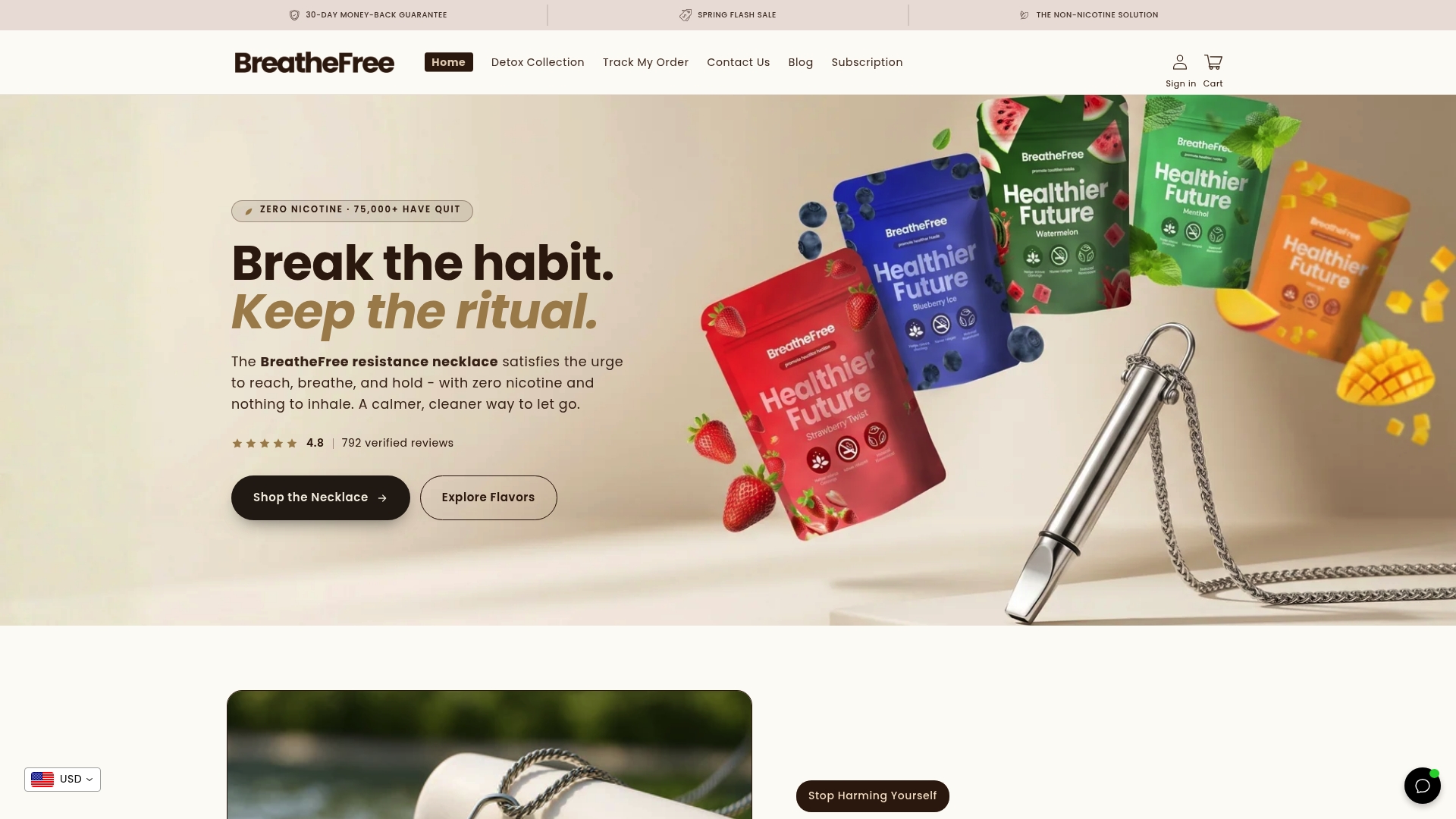
Breathing resets your nervous system, but it doesn’t replace the physical habit of holding something and bringing it to your mouth, which is part of what makes smoking hard to quit. That’s the gap the BreatheFree Resistance Necklace is built to fill: a solid, plant-fiber device with no nicotine and nothing to inhale, designed to give your hands and mouth something to do during the minutes after a breathing script when the urge hasn’t fully faded.
- Use it right after a box-breathing cycle, holding or drawing on the necklace while the calming effect from your breathing settles in.
- Flavor refills let you switch up the sensory experience instead of relying on nicotine for variety.
- It’s solid and flight-friendly, so the same routine works at your desk, in the car, or traveling.
The product comes with a money-back guarantee, so there’s little downside to adding it to a breathing-based routine. Browse the full resistance necklace and flavor refill collection to find a starting option that fits your routine.
This article is general information, not a substitute for advice from a qualified doctor. Consult a qualified healthcare professional about your own circumstances before acting on anything here.
FAQ
Do Navy SEALs really use box breathing?
Box breathing is widely associated with military and tactical training as a way to stay calm under pressure, and the same slow, equal-count pattern is taught in many stress-management programs. The technique itself isn’t exclusive to any group: the physiological principle, slowing your breathing to calm your nervous system, works the same way whether you’re facing a high-stakes situation or a nicotine craving.
How do you beat addiction cravings?
Most cravings fade within a few minutes, so the most reliable approach combines an immediate coping tool, like a short box-breathing script, with a longer-term plan that includes support such as a quitline, counseling, or medication where needed. The CDC recommends combining behavioral tactics like breathing with professional support rather than relying on one method alone.
Who should not do box breathing?
People with certain respiratory conditions, cardiovascular issues, or anxiety disorders that are worsened by breath-holding should check with a doctor before practicing extended breath holds. If a breathing exercise ever makes you feel dizzy or short of breath, stop and return to your normal breathing pattern.
How many times a day should you box breathe?
There’s no single fixed number, but practicing two to three short sessions a day, plus using it whenever a craving appears, helps the technique feel automatic when you need it most. Consistent daily practice, even without an active craving, tends to make the technique more effective in the moment it’s needed.
Sources
- The acute effects of yogic breathing exercises on craving and withdrawal symptoms in abstaining smokers (Shahab et al.)
- The Effects of Mindfulness-Based Yogic Breathing on Craving, Affect, and Smoking Behavior
- Five Reasons Why Calling a Quitline Can Be Key to Your Success | CDC
- Smokefree