

Yes, 4-7-8 breathing can take the edge off an acute smoking craving, mainly by acting as a timed pause that gives your nervous system a chance to downshift. Do one cycle right now: exhale fully, inhale through your nose for a count of 4, hold for 7, then exhale through your mouth for 8. Step away from whatever triggered the urge and delay any decision for ten minutes. It’s a supportive tool, not a medical treatment. Contact a clinician for severe withdrawal symptoms or any emergency warning signs.
TL;DR:
- Practicing 4-7-8 breathing just before a craving peaks can enhance its effectiveness by calming the nervous system early on.
- The technique reduces heart rate and physical arousal, making cravings feel less urgent and more manageable.
- Combining breathing with physical tools like a mouth or hand object effectively addresses the hand-to-mouth ritual alongside the panic response.
- Breathing works best as an adjunct within a broader quit strategy and may not be suitable for everyone, especially those with certain health conditions.
Table of Contents
- How Do You Do 4-7-8 Breathing for Smoking Cravings?
- Why Does This Breathing Method Help During Cravings?
- What Does the Research Actually Show?
- The 90-Second Craving Script You Can Use Right Now
- Who Should Be Careful With 4-7-8 Breathing?
- Why I Think Breathwork Deserves a Real Spot in Your Quit Plan
- Get the BreatheFree Resistance Necklace for Craving Support
- Sources
- FAQ
How Do You Do 4-7-8 Breathing for Smoking Cravings?
The technique comes from Dr. Andrew Weil, and it’s built on one simple idea: a longer exhale than inhale nudges your body toward calm. Here’s the exact sequence:
- Sit upright or stand still, and rest the tip of your tongue against the ridge behind your upper front teeth.
- Exhale completely through your mouth, making a soft whoosh sound.
- Close your mouth and inhale quietly through your nose for a count of 4.
- Hold that breath for a count of 7.
- Exhale fully through your mouth for a count of 8, whoosh sound included.
- That’s one cycle. Repeat three more times to finish a set of four.
The ratio matters more than the exact seconds. See Weil’s original instructions](https://nursing.rutgers.edu/wp-content/uploads/2020/07/Dr.-Weil-4-7-8-Breathing-Exercise.pdf). The mechanism stays intact even at smaller counts.
Start with four cycles, twice a day, while sitting somewhere quiet. Once that feels easy, work up to eight cycles per session. Never force a deeper inhale than feels comfortable. This isn’t a competition to hold your breath longer. It’s a nervous-system reset, and forcing it defeats the purpose.
Why Does This Breathing Method Help During Cravings?
A nicotine craving is part chemical, part habit, and part panic. The 4-7-8 pattern interrupts all three at once, which is why it shows up so often in guides on how to use 4-7-8 for smoking urges specifically.
The physiology is straightforward. A slow, extended exhale activates your vagus nerve and shifts your body from sympathetic arousal, that jittery, urgent feeling, toward parasympathetic calm. Heart rate drops. The adrenaline-driven edge of the craving softens. Medical News Today’s breakdown of the technique notes that paced, exhale-heavy breathing measurably lowers heart rate and reduces subjective anxiety, both of which are exactly what spikes during a craving.
There’s also a cognitive piece. Counting to specific numbers occupies the same mental bandwidth that would otherwise be consumed by “I need a cigarette right now.” That’s the whole point of interrupting an automatic thought loop instead of trying to argue with it.
- Extended exhale lowers heart rate and physical arousal
- Counting redirects attention away from the urge itself
- The pause creates space to choose a different action instead of reacting automatically
- Repeated practice trains your body to recognize the pattern as a signal to settle down
Pro Tip: Do your first cycle before the craving peaks, not after. If you notice the early signs, restlessness, an itch to reach for your phone or a lighter, breathe then. Waiting until the urge is at full intensity makes any technique harder to use.
What Does the Research Actually Show?
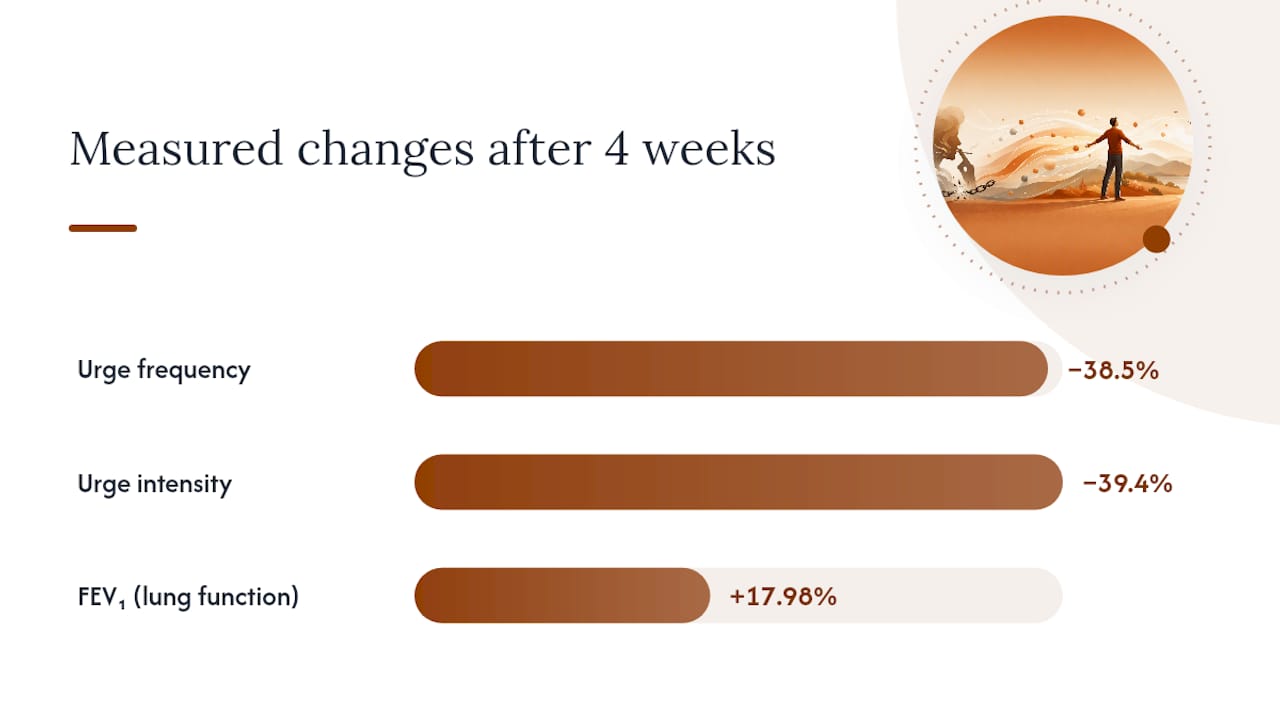
The evidence for breathwork and smoking cessation for 4-7-8 breathing anxiety relief and craving control is encouraging, but it’s not the kind of slam-dunk proof that lets anyone call it a cure.
One feasibility study on a structured volitional yoga-breathing module in smokers found real numbers worth paying attention to.
Participants saw roughly a 38.5% drop in urge frequency and a 39.4% drop in urge intensity after four weeks of practice, alongside a 17.98% increase in FEV₁, a standard measure of lung function, according to the volitional yoga breathing feasibility study.
That’s a meaningful signal. It’s also a single-arm, pre-post design, meaning there was no comparison group getting a placebo intervention, and the sample size was small. Promising, not definitive.
Separately, research on mindful, breath-based interventions found something striking in a high-risk choice procedure: participants using breathing techniques were more than twice as likely to avoid smoking compared to those who didn’t, according to an evidence summary on breathing-based interventions.
- Structured breathing reduced both how often and how strongly urges hit
- Pulmonary function improved with consistent short practice sessions
- No large randomized controlled trial yet positions breathwork alone as a standalone cessation therapy
The honest takeaway: breathwork is an evidence-backed adjunct. It works best stacked with behavioral support, a quitline, or a physical tool that satisfies the habit itself, not as a solo fix.
The 90-Second Craving Script You Can Use Right Now
When a craving hits, you don’t have time to read a manual. You need a script you’ve already memorized. Here’s one built around three moves: breathe, move, replace.
- Do one to two cycles of 4-7-8 immediately, right where you are.
- Name the urge out loud or in your head: “This is a craving. It will pass.”
- Physically move away from the trigger, whether that’s a smoking spot, a coworker’s cigarette break, or your car.
- Sip water or hold something in your hand or mouth that isn’t a cigarette.
- Set a mental timer for 10 minutes before you allow yourself to reconsider.
Two situational variations make this easier to remember. The desk break version: stand up, walk to a window, do your breathing cycle there instead of at your desk. The nighttime version, useful if cravings hit while winding down: do your cycles lying down, then reach for a glass of water on the nightstand instead of getting up.
Pro Tip: Keep something small in reach specifically for this moment, a resistance necklace, a piece of gum, anything that gives your hands and mouth something to do. The breathing handles the nervous system; the object handles the habit.
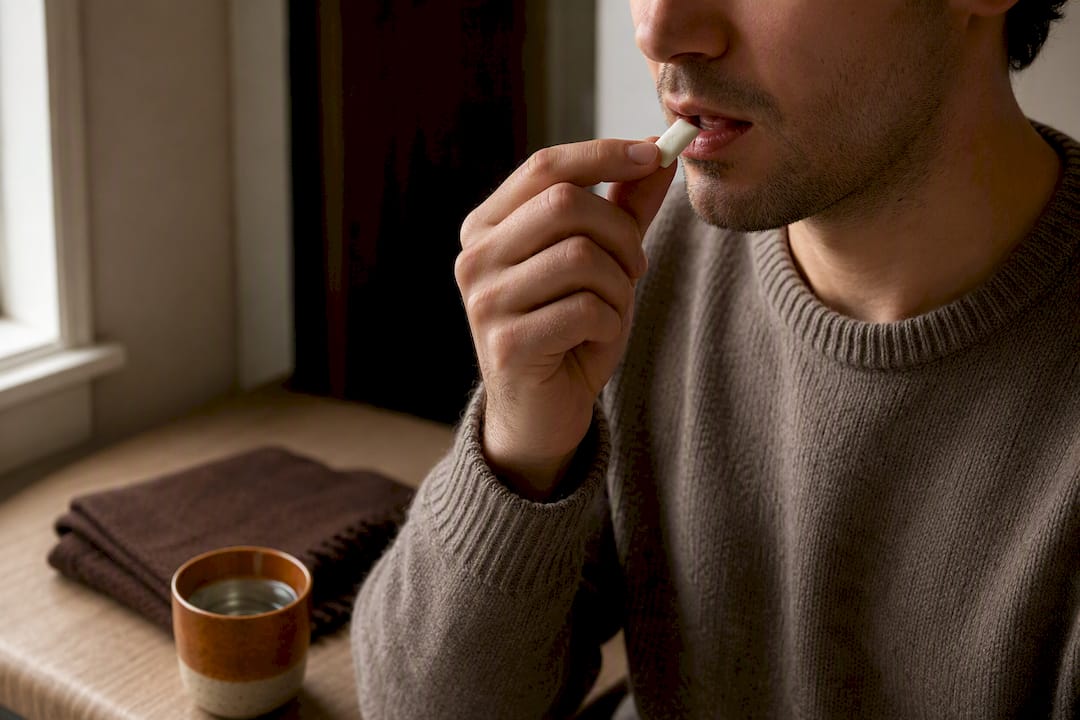
If urges keep escalating despite these steps, or you notice physical withdrawal symptoms getting worse, that’s a signal to call a quitline or talk to a clinician rather than push through alone.
Who Should Be Careful With 4-7-8 Breathing?
Most people tolerate 4-7-8 without issue, but a few things are worth knowing before you make it a daily habit.
- Lightheadedness or tingling in the fingers can happen, especially with longer holds; if that occurs, stop and switch to a gentler, shorter-count version.
- People with COPD, severe asthma, heart disease, or a history of fainting should talk to a doctor before regular practice, according to clinical safety guidance on paced breathing.
- Pregnant individuals should check with their provider first, since breath-holding patterns can affect blood pressure.
- Breathing exercises are not a substitute for emergency care. Chest pain, severe breathlessness, or thoughts of self-harm need immediate medical attention, not a breathing app.
Why I Think Breathwork Deserves a Real Spot in Your Quit Plan
The mistake a lot of people make with breathing techniques is treating them as either everything or nothing, a miracle cure or a waste of time. Neither is accurate. The research on structured breathing and craving reduction is genuinely encouraging, but it works best as one tool among several, not the whole plan.
What breathwork does well is buy you time. A craving typically peaks and fades within minutes, and 4-7-8 gives you something to do during that window besides giving in. What it doesn’t do is address the oral fixation, the hand-to-mouth ritual that makes quitting so physically frustrating for a lot of people. That’s where pairing breathing with a physical oral-fixation tool tends to close the gap that breathing alone leaves open. For more on stacking coping strategies together, our guide to ex-smoker coping mechanisms covers additional tactics worth building into your routine.
— Tommy
Get the BreatheFree Resistance Necklace for Craving Support
Breathing alone handles the panic response. It doesn’t hand your mouth and hands something to do, which is exactly the itch a lot of ex-smokers describe long after the nicotine has cleared their system. The BreatheFree Resistance Necklace is built for that gap: a nicotine-free, chemical-free tool designed around oral fixation and ritual instead of substance replacement. It’s designed to be solid and usable anywhere, including places where smoking is not allowed, such as flights and offices.
Pair it with flavor refills to keep the sensory experience varied, and note that a money-back guarantee may be offered if it’s not the right fit. Combine it with your breathing practice and support resources for a more comprehensive approach to managing cravings.
Sources
For readers who want to dig into the primary research: the volitional yoga breathing feasibility study covers urge reduction and lung function data, while the evidence summary on breathing-based interventions reviews withdrawal and risk outcomes. Dr. Weil’s original 4-7-8 handout remains the clearest technique reference. For readers managing vaping withdrawal specifically, this step-by-step quitting guide offers complementary strategies. If cravings feel unmanageable, a quitline or your doctor should be your first call.
- Volitional yoga breathing module for smokers (feasibility study)
FAQ
Is 4-7-8 Breathing Good for Your Lungs?
Yes, for most healthy adults. A feasibility study on structured yoga-based breathing found a 17.98% increase in FEV₁ after four weeks of practice, a measure of how much air you can forcefully exhale. People with severe COPD or asthma should check with a doctor before adopting it as a regular practice.
Is 4-7-8 Breathing Good for High Blood Pressure?
Paced, exhale-heavy breathing generally supports lower heart rate and reduced physical arousal, which can help with blood pressure over time. Direct large-scale trials specifically on 4-7-8 and blood pressure are limited, so treat it as a supportive habit rather than a replacement for prescribed treatment.
Which Is Better, Box Breathing or 4-7-8?
Neither is universally “better.” They work through similar principles but different rhythms. Box breathing uses equal counts for inhale, hold, exhale, and hold again, while 4-7-8 emphasizes a longer exhale relative to the inhale, which some people find more effective for winding down anxiety and cravings specifically.
Are There Any Side Effects of 4-7-8 Breathing?
Mild lightheadedness or tingling can occur, especially with longer breath holds early in practice. If that happens, shorten the counts while keeping the same ratio, and stop entirely if you feel unwell. People with heart or respiratory conditions should talk to a clinician before regular use, per clinical safety guidance.