

Yes, feeling depressed after you quit smoking is common, and for most people, it’s temporary. Mild-to-moderate low mood, irritability, and flat affect typically peak within the first few days after your last cigarette, according to the National Cancer Institute. Use active coping strategies now, and contact a healthcare provider if symptoms feel unmanageable or last beyond a couple of weeks, per CDC guidance.
TL;DR:
- Most withdrawal-related depression peaks within the first three days and generally improves within 2 to 4 weeks, though some symptoms may linger longer.
- Feelings of depression can stem from dopamine system changes, loss of habitual rituals, or unmasking of preexisting depression that was previously hidden by nicotine’s mood lift.
- Severe, unmanageable, or persistent low mood after two weeks warrants consultation with a healthcare provider, especially if symptoms worsen or include thoughts of self-harm.
- Nicotine withdrawal may cause mood dips, irritability, and sleep issues, but long-term mental health generally improves after quitting, with some studies showing decreased depression symptoms.
- Using behavioral strategies, replacement tools, and, if needed, medical support like therapy or medication can help manage depression during nicotine withdrawal.
Table of Contents
- Why Does Quitting Smoking Cause Depression?
- What Symptoms Show Up and When Do They Fade?
- Is Nicotine Withdrawal Depression Different From Clinical Depression?
- How Do You Cope With Depression After Quitting Smoking?
- When Should You Talk to a Doctor About Depression After Quitting?
- What BreatheFree Has Learned From Helping People Quit
- What the Research Actually Tells Us About Quitting and Mood
- A Nicotine-Free Tool for the Oral Fixation That Doesn’t Quit
- Sources
- FAQ
Why Does Quitting Smoking Cause Depression?
Nicotine hijacks your brain’s dopamine system. Every cigarette triggers a small flood of dopamine, the neurotransmitter tied to pleasure and motivation. Your brain adapts to that steady supply by dialing back its own natural dopamine production. Pull nicotine out of the equation and you’re left with a temporary shortfall, which is a big part of why mood crashes after you stop.
It’s not just chemistry. Smoking is also a ritual: the hand-to-mouth motion, the five-minute breather outside, the shared cigarette with coworkers. Losing that structure leaves a real gap in your day, and grief over a lost coping habit is a legitimate contributor to low mood, not a character flaw.
There’s a third factor worth naming honestly: preexisting depression. Some people who quit smoking discover depression that was already there, just masked by nicotine’s temporary mood lift. This is called “unmasking,” and it’s different from new-onset withdrawal depression that fades on its own. Key distinctions include:
- Withdrawal depression: starts within a day or two of quitting, tracks with other physical withdrawal symptoms, and improves over weeks.
- Unmasked depression: may feel deeper, doesn’t track neatly with physical withdrawal, and doesn’t lift as those symptoms fade.
- New-onset depression: can appear even without a prior history, often tied to stress of the quit attempt itself combined with neurochemical changes.
What Symptoms Show Up and When Do They Fade?
Nicotine withdrawal symptoms, including depressive ones, often begin within hours of your last cigarette and hit hardest in the first three days, according to the NCI’s withdrawal fact sheet. Most people see meaningful improvement within 2 to 4 weeks.
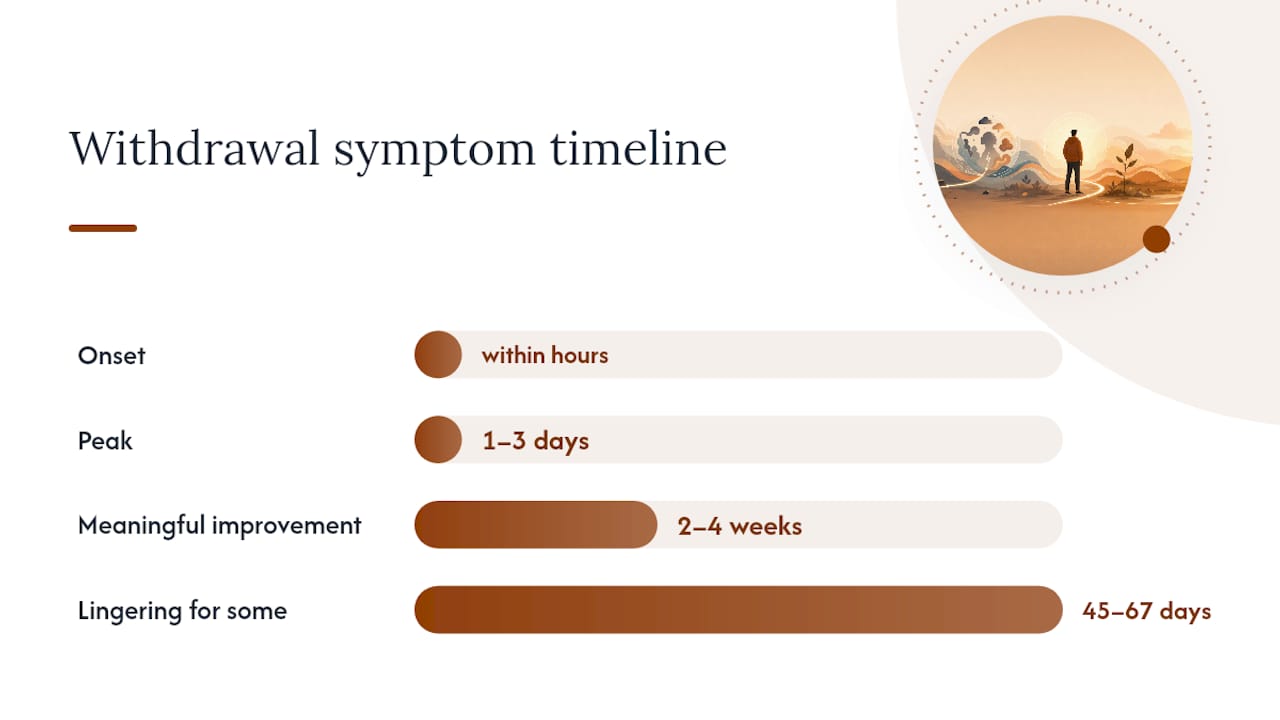
Quick reference: Symptoms peak in days 1 to 3. Most acute symptoms resolve within 2 to 4 weeks. Some affect-related symptoms, particularly in people with high dependence or a tendency toward negative emotional states, can linger closer to the 45 to 67 day mark before fully settling.
Common symptoms during this window include:
- Persistent sadness or a flat, joyless mood
- Anhedonia (losing interest in things you normally enjoy)
- Irritability and a short fuse
- Trouble falling or staying asleep
- Appetite changes, often increased hunger or sugar cravings
- Poor concentration and a foggy, unfocused feeling
How long yours lasts depends on how dependent you were, your baseline personality traits, and whether you’ve had depressive episodes before. Someone who smoked a pack a day for twenty years will likely feel this more sharply than an occasional smoker.
Is Nicotine Withdrawal Depression Different From Clinical Depression?
The short answer: usually, yes, but the line isn’t always obvious in the moment. Nicotine alters the sensitivity of dopamine receptors in your brain’s reward pathway. When you quit, those receptors need time to recalibrate to functioning without constant nicotine stimulation. That process, called neuroadaptation, is the biological engine behind withdrawal, and it is time-limited by nature rather than a permanent shift in your brain chemistry.
The long-term picture actually favors quitting. A 2014 meta-analysis published via PubMed found that people who quit smoking showed a significant decrease in depression symptoms compared with those who kept smoking (SMD −0.25). A broader systematic review confirms small-to-moderate mental health improvements after cessation, even though study quality varies across the research. The dip you’re feeling now is not a preview of your future mood. It’s usually the opposite.
How Do You Cope With Depression After Quitting Smoking?
Treat the first two weeks like a project with a plan, not something you white-knuckle through. Here’s a prioritized approach:
- Handle the acute moment. When a craving or a wave of sadness hits, try slow deep breathing for 60 seconds, then move your body for 5 to 10 minutes, a walk, stretching, even pacing. Keep a written distraction list (call a friend, do a puzzle, tidy a drawer) so you’re not deciding in the moment.
- Replace the ritual, not just the nicotine. The hand-to-mouth habit and the scheduled break are powerful behavioral drivers of smoking, and addressing that ritual directly tends to improve adherence to quitting. Non-nicotine substitutes, resistance objects, flavored oral items, or a fidget tool during stressful moments, give your hands and mouth something to do. Smokefree lists structured routines and social contact as concrete mood boosters during this stretch.
- Know the clinical options, including how mental health benefits in premium plans may support therapy or medication coverage. Nicotine replacement therapy and medications like bupropion can ease withdrawal symptoms for some people, and are worth discussing with a provider, especially if you have a prior depression history. The CDC’s guide to bupropion covers how it’s typically used alongside behavioral support. Therapy, particularly cognitive behavioral approaches, also helps some people manage the emotional side of quitting.
- Cover the basics. Protect your sleep schedule, get regular movement, cut back on alcohol (it disrupts sleep and can trigger cravings), and set goals small enough to actually hit, like getting through one stressful meeting without smoking, rather than “never smoke again.”
Pro Tip: Write your relapse-avoidance script before you need it. On a card or in your phone, list your top three triggers, your go-to distraction for each, and one person you’ll text when a craving spikes. Deciding this in advance beats trying to think clearly during an actual craving.
For more structured ideas, our survival guide to ex-smoker coping mechanisms walks through a fuller toolkit.
When Should You Talk to a Doctor About Depression After Quitting?
Most withdrawal depression fades within a few weeks. Reach out to a healthcare provider if any of the following apply:
- Your mood feels severe, unmanageable, or is getting worse rather than better
- Symptoms haven’t improved at all after two weeks, the threshold CDC guidance points to for seeking professional support
- You’re having thoughts of suicide or self-harm, which requires immediate attention, not a wait-and-see approach
- You have a history of depression or take psychiatric medication, since quitting can change how your body metabolizes certain drugs, and your prescriber may need to adjust your dose
Practical resources: call a quitline, contact SAMHSA’s National Helpline, or go to emergency services for any immediate safety concern. If you take psychiatric medication, loop in your prescriber before or shortly after quitting rather than waiting for a problem to show up.
What BreatheFree Has Learned From Helping People Quit
Quitting is genuinely hard, and most people don’t succeed on the first attempt. That’s not failure, it’s how this usually goes. Cleveland Clinic frames withdrawal as a temporary healing phase rather than a personal shortcoming, and that framing matters.
Breathefree built its educational resources around that same idea: address the ritual, not just the chemical. Our non-nicotine, oral-fixation approach is one supportive piece of a bigger plan. Pair it with real medical care when symptoms run deeper than typical withdrawal.
What the Research Actually Tells Us About Quitting and Mood
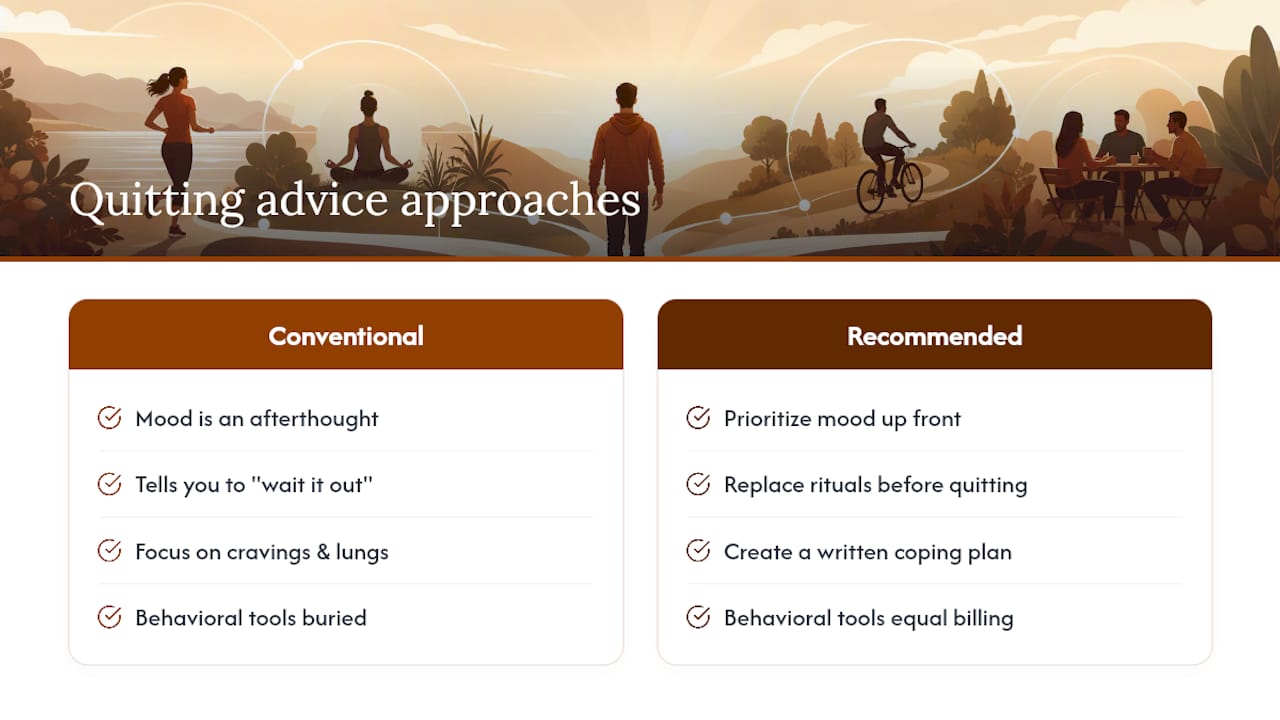
Most quitting advice treats mood as an afterthought, a footnote after cravings and lung health. That’s backward. The emotional dip is often the reason people relapse, not the physical craving alone. The data backing long-term improvement is solid, but it’s a population-level average. It says nothing about your specific week three, when you feel worse rather than better.
Here’s where I’ll push back on conventional advice: too many guides treat “just wait it out” as sufficient. Waiting works for physical symptoms that resolve on a predictable curve. Mood is messier, especially for people with any depression history, and treating it passively wastes the window where behavioral tools work best. Prioritize ritual replacement and a written coping plan before you quit, not after the first bad day hits. The behavioral piece, what you do with your hands, your breaks, your idle moments, deserves equal billing with the pharmacology. Most articles bury it. It shouldn’t be buried.
— Tommy
A Nicotine-Free Tool for the Oral Fixation That Doesn’t Quit
If the hand-to-mouth habit is what’s driving your restlessness or your worst cravings, the Breathefree resistance necklace gives your mouth and hands something to do without a single milligram of nicotine or anything to inhale.

It’s built for people who want a physical substitute for the ritual smoking used to fill, not another nicotine product to wean off later. The necklace comes with flavor refill options through the product collection, and there’s a subscription option on the flavor refill landing page if you want refills arriving automatically instead of reordering each time. Every order carries a 30-day money-back guarantee, so trying it costs you nothing but the attempt. If your mood symptoms are severe or aren’t improving, talk to a doctor first. Use this as one tool in a fuller plan, not a replacement for medical care when you need it. Ready to try it? Browse the resistance necklace collection and pick a flavor that fits your routine.
This article is general information, not a substitute for advice from a qualified doctor. Consult a qualified healthcare professional about your own circumstances before acting on anything here.
Sources
- Nicotine withdrawal fact sheet — National Cancer Institute
- Change in mental health after smoking cessation: systematic review and meta-analysis (2014) — PubMed
- Quit smoking — CDC guidance for people with mental health conditions
FAQ
Why do I feel worse three months after quitting smoking?
Most acute symptoms resolve within 2 to 4 weeks, but affect-related symptoms can linger longer in people with higher dependence or a tendency toward negative mood, sometimes extending toward the 45 to 67 day range seen in some studies. If low mood persists at three months, talk to a healthcare provider rather than assuming it’s ordinary withdrawal.
How long does depression last after quitting nicotine?
For most people, depressive symptoms peak in the first three days and substantially improve within 2 to 4 weeks. Longer-lasting cases exist, especially with high dependence or a history of depression, which is why check-ins with a provider matter if you’re not improving.
Do people actually get depressed after quitting nicotine?
Yes. Depression and low mood are recognized withdrawal symptoms tied to the drop in dopamine activity that follows nicotine cessation. For most people it’s temporary, and research shows quitting is linked to improved mental health over the long run compared with continuing to smoke.
What are the potential side effects of quitting smoking suddenly?
Common withdrawal effects include depressed mood, irritability, anxiety, insomnia, appetite changes, difficulty concentrating, and intense cravings. These typically start within hours and ease within a few weeks; non-nicotine tools like the Breathefree necklace can help with the behavioral side while your body adjusts.