

Unconscious smoking behavior is smoking driven by automatic cue-to-routine-to-reward loops and conditioned responses that fire below conscious awareness, not by an actual decision to light up. You reach for a cigarette while your mind is somewhere else entirely, and that’s the point: the habit has moved out of the “thinking” part of your brain and into the “doing” part.
Three things matter here. It feels automatic because it is automatic, wired in through repetition. It differs from conscious choice because you’re not weighing pros and cons in the moment, your body is just running a script. And it’s changeable, because scripts can be rewritten once you see them clearly.
Your first move: start a smoking log for several weeks and write down the time, place, mood, and activity every time you smoke. It’s the fastest way to make an invisible pattern visible. Breathefree’s 7-day trigger log and action plan gives you a simple format to start tonight.
Key Takeaways
Unconscious smoking behavior runs on conditioned cue-routine-reward loops that operate below awareness, and tracking those loops is what makes them changeable.
| Point | Details |
|---|---|
| Definition matters | Unconscious smoking is driven by automatic cue-routine-reward loops, not active decision-making. |
| Track before you quit | A two to three week smoking log reveals your real trigger patterns before you try to change them. |
| Triggers cluster in three types | Emotional, pattern-based, and social cues each need different replacement strategies. |
| Deprivation sharpens cravings | Automatic processing of smoking cues gets stronger, not weaker, in the early days without a cigarette. |
| Replace the ritual, not just the nicotine | Tools like Breathefree’s non-nicotine resistance necklace fill the hand-to-mouth gap during a mapped trigger. |
Table of Contents
- How Unconscious Smoking Habits Form
- What Are Common Unconscious Smoking Triggers?
- Why Do Smoking Cravings Feel Automatic?
- How Does Behavioral Withdrawal Differ From Nicotine Withdrawal?
- What’s a Simple Plan to Interrupt Unconscious Smoking?
- When Should You Get Professional Help for Smoking Urges?
- There’s No Shame in an Automatic Habit
- A Non-Nicotine Tool for the Ritual You’re Trying to Replace
- Trusted Resources for Understanding Smoking Triggers
- Frequently Asked Questions
- Sources
How Unconscious Smoking Habits Form
Habits form through a three-part loop: a cue triggers a routine, and the routine delivers a reward. Repeat that loop enough times in the same context, and the brain stops needing to think about it at all.

Nicotine accelerates this process more aggressively than almost any other reinforcing substance. It reaches the brain within seconds of a puff, which means the reward lands almost instantly after the cue, and that tight timing is exactly what strengthens the association fastest. Every context present at that moment, the coffee cup, the car seat, the phone call, gets stitched into the loop along with it.
The dopamine system in the brain’s reward circuitry, along with regions in the basal ganglia that handle habit and routine, gradually hands control over to these learned associations. You don’t decide to smoke anymore. The cue decides for you.
Common cue-routine pairings that form this way:
- Morning coffee → cigarette
- Finishing a meal → cigarette
- Getting in the car → cigarette
- Answering a stressful phone call → cigarette
- Stepping outside for a break → cigarette
What Are Common Unconscious Smoking Triggers?
Most unconscious smoking triggers fall into three buckets: emotional, pattern or routine, and social. Recognizing which bucket a craving comes from is often the first real insight a smoker has about their own habit.
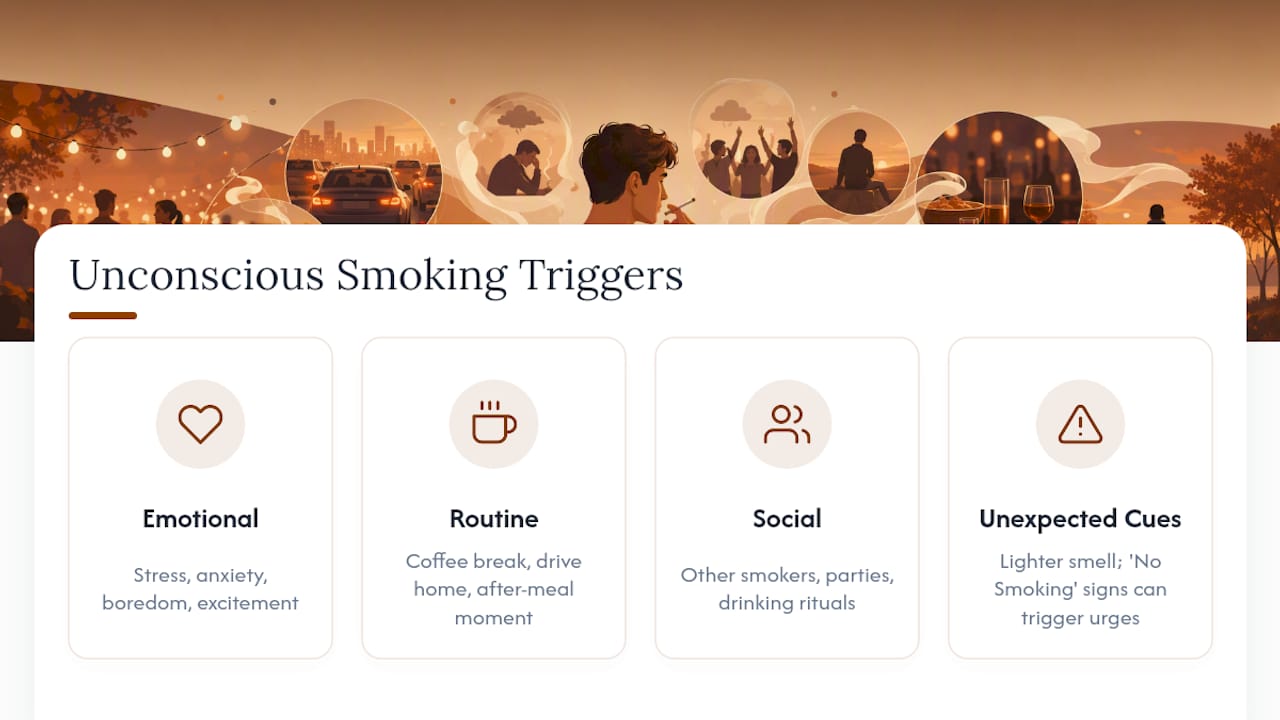
Emotional triggers include stress, anxiety, boredom, and even excitement. Pattern triggers are tied to routine and timing, like the coffee break, the drive home, or the after-meal moment. Social triggers show up around other smokers, at parties, or during specific rituals like a drink at a bar.
Pro Tip: Watch for triggers you’d never suspect, like the smell of a lighter or even a “No Smoking” sign. Research on ironic priming has found that seeing negated smoking cues can paradoxically increase the automatic urge to smoke, because your brain still processes the image of a cigarette even as it registers the word “no.”
A smoking log remains the best tool for mapping which of these three categories actually drives your own habit, since triggers are often misattributed until you track them for real.
Why Do Smoking Cravings Feel Automatic?
Cravings feel involuntary because deprived smokers show measurably stronger automatic processing of smoking-related cues than smokers who’ve recently had a cigarette. This isn’t a willpower issue. It’s a documented shift in how the brain filters incoming information.
Experimental work using subliminal priming has found that images of cigarettes flashed too quickly to consciously register still activate craving-related responses in deprived smokers, a finding that shows unconscious cue processing intensifies under deprivation. Separate EEG studies measuring visual mismatch negativity have found that smokers’ brains process smoking-related images faster and more automatically than neutral images, consistent with an incentive-sensitization account of cue-driven craving. The practical takeaway: the longer you go without a cigarette, the more your attention gets hijacked by smoking cues, not less, which is exactly why the first few days of quitting feel disproportionately hard.
Deprived smokers show a measurable subliminal processing bias toward smoking-related stimuli, meaning the brain registers and reacts to cigarette cues before conscious awareness ever catches up.
How Does Behavioral Withdrawal Differ From Nicotine Withdrawal?
Behavioral withdrawal is the loss of a ritual that used to regulate your emotions, and it’s a separate experience from the chemical symptoms of nicotine withdrawal. The hand-to-mouth motion, the pause it forced you to take, the exhale, all of that disappears at once, and your body notices.
Replacing that ritual matters as much as managing cravings. Useful substitutes include:
- Crunchy, low-calorie snacks for oral input
- Non-nicotine oral tools, like a straw or toothpick
- A fidget object or resistance necklace that occupies your hands
- Slow breathing exercises timed to match the old smoking pause
- A short walk in place of a smoke break
Keep replacements visible and pre-decide which one answers which trigger, so you’re not improvising mid-craving. Pairing a replacement with tracking and repeated practice measurably reduces relapse risk compared to going in with willpower alone.
What’s a Simple Plan to Interrupt Unconscious Smoking?
The plan comes down to four steps: track, analyze, plan, and practice, in that order and repeated as needed.
- Track. For two to three weeks, log every cigarette: time, location, mood, and what you were doing right before. Don’t try to quit yet, just observe.
- Analyze. Look for your top three to five recurring cue-routine pairs. Most smokers find that a small handful of triggers account for most of their daily cigarettes.
- Plan. Assign a specific replacement to each trigger before you need it. Coffee triggers a cigarette? Pair the coffee with a glass of water and a resistance necklace instead. After-meal urge? Chew gum or a mint.
- Practice. Run the replacement every time the trigger appears, for two to six weeks minimum.
Expect early weeks to feel harder, not easier. Awareness of your triggers spikes first, which can make cravings feel more intense before they start loosening their grip. That’s the cue and the urge beginning to uncouple, not a sign the plan isn’t working.
When Should You Get Professional Help for Smoking Urges?
Seek professional support when cravings feel unmanageable, withdrawal symptoms cause real distress, or you’ve tried to quit multiple times without success. Habit tracking handles the behavioral side, but chemical dependence sometimes needs its own treatment.
- Nicotine replacement therapy (NRT): patches, gum, or lozenges that ease physical withdrawal.
- Prescription medications: options like varenicline or bupropion that reduce craving intensity.
- CBT or behavioral counseling: addresses the thought patterns and routines behind smoking.
- Quitlines and certified cessation programs: free, structured support to combine with the above.
Start with a primary care provider or a quitline, and know that combining a medical approach with behavioral tracking tends to outperform either one alone.
There’s No Shame in an Automatic Habit
Unconscious smoking isn’t a character flaw, it’s how the brain is built to work. Repetition creates shortcuts, and shortcuts stop asking permission. That doesn’t make the habit permanent.
Progress here rarely looks like a clean break. It looks like noticing one trigger this week, swapping in one replacement, and slipping once in a while as you learn your own patterns. Track it, experiment with it, and treat a relapse as data, not failure.
A Non-Nicotine Tool for the Ritual You’re Trying to Replace
The resistance necklace from Breathefree is built for exactly the moment this article keeps circling back to: the second a trigger fires and your hands want something to do. It’s nicotine-free, worn around the neck, and designed to occupy the same hand-to-mouth motion that a cigarette used to fill.
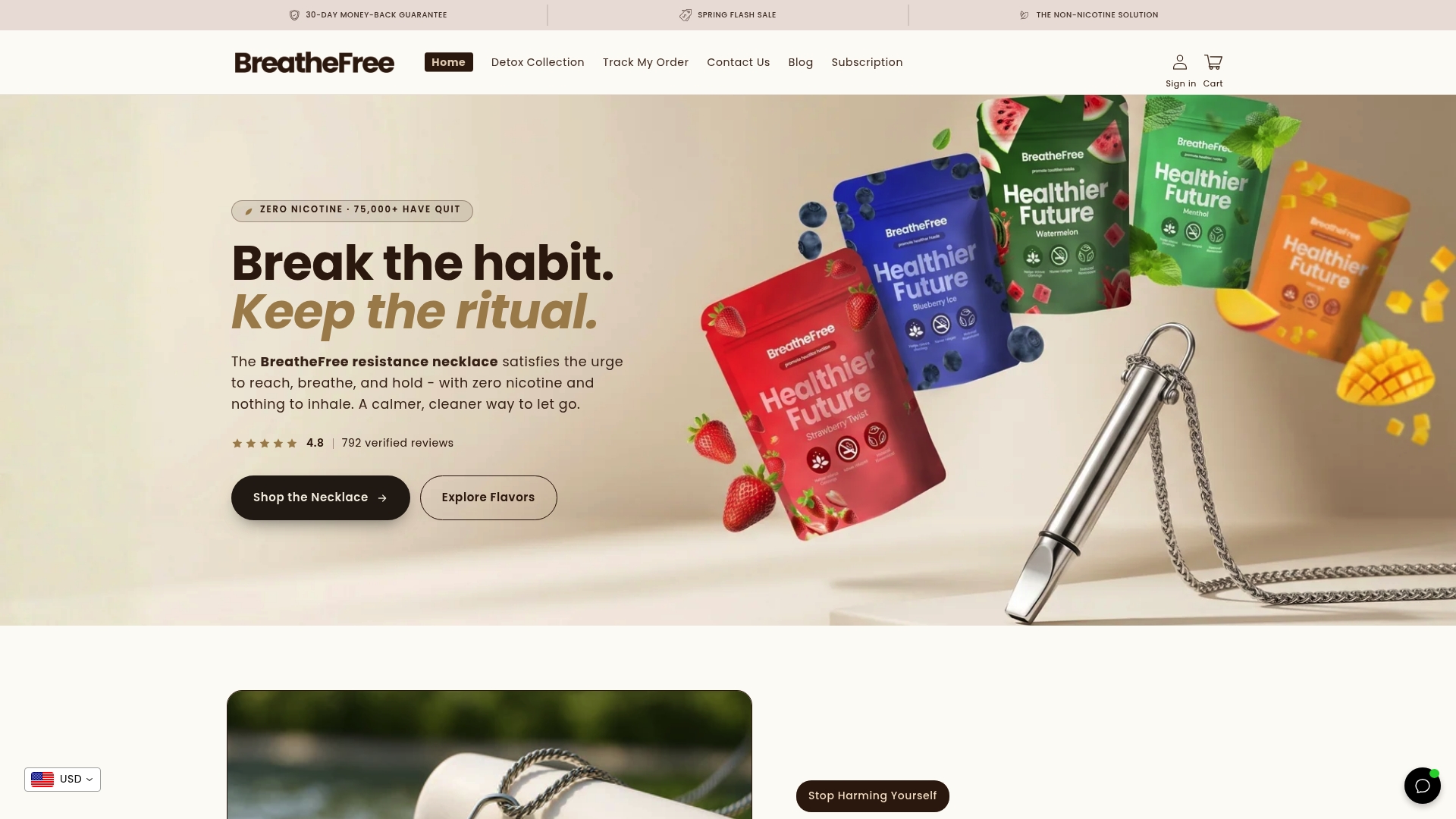
Slot it into step three of the four-step plan above. When you’ve identified a trigger, like coffee, driving, or a stressful call, keep the necklace within reach and use it as your pre-committed replacement instead of improvising. Paired with your tracking log and a few weeks of repeated practice, it gives the ritual somewhere to go that isn’t a cigarette. Breathefree also offers a Nicotine Detox eBook and Habit Tracker if you want a guided version of the tracking process instead of building your own from scratch. If nicotine dependence itself is the bigger obstacle, pair either tool with the clinical support outlined above. Ready to give your hands something else to do? Check out the resistance necklace and see which flavor refill fits your routine.
Trusted Resources for Understanding Smoking Triggers
- Smokefree
- Understand your smoking triggers and cravings — NHS
- Common smoking triggers and how to beat them — Truth Initiative
- Addiction, cigarette smoking, and voluntary control of action
- Why smokers need hand-to-mouth action, explained — Breathefree
Frequently Asked Questions
What is unconscious smoking behavior, in simple terms? It’s smoking triggered automatically by learned cues, like a certain place, mood, or activity, rather than by a conscious decision to smoke in that moment.
How is unconscious smoking different from nicotine addiction? Nicotine addiction is a chemical dependence with physical withdrawal symptoms. Unconscious smoking is the learned, ritualized behavior around it. You can have one without much of the other, which is why both behavioral and medical approaches matter.
Can you unlearn automatic smoking triggers? Yes. Tracking your triggers, assigning specific replacements, and practicing them consistently over several weeks weakens the cue-routine-reward link over time.
Why do cravings get worse right after quitting instead of better? Deprivation temporarily sharpens the brain’s automatic attention to smoking-related cues, which is why early withdrawal often feels more intense before it eases.
What’s the fastest way to start identifying my own triggers? Keep a simple log for two to three weeks: note the time, location, mood, and activity every time you smoke, then look for repeating patterns.
This article is general information, not a substitute for advice from a qualified doctor. Consult a qualified healthcare professional about your own circumstances before acting on anything here.
Sources
- Smokefree
- Subliminal processing bias in deprived smokers — research article (PMC)
- Addiction, cigarette smoking, and voluntary control of action — PMC article
- No sign of quitting — ironic priming effects on smokers (JASP DOI)
- Understand your smoking triggers and cravings — NHS