

Yes, you can break the drive-and-smoke habit, and it starts before the engine turns on. Remove cigarettes, lighters, and ashtrays from the car, pack safe oral substitutes or approved nicotine replacement therapy within reach, and map out smoke-free stops for longer trips. The habit lives in the routine, not the nicotine alone, so changing the routine is where the real work happens.
TL;DR:
- Removing cigarettes, lighters, and ashtrays from the vehicle can help break the habitual smoking routine during driving.
- Staging oral substitutes and nicotine replacement products within reach prior to starting the drive reduces the urge to fumble for smoking items while on the road.
- Smoking or vaping laws vary by state, but most issues arise from distraction, littering, or endangerment, making a car a best practice no-smoking zone.
- Cravings triggered by driving cues can be managed by pre-emptively removing triggers, staging substitutes, and using safe in-car tactics like chewing gum or sipping water.
- Heavy smokers can benefit from pairing nicotine patches with on-demand NRT products and behavioral tactics, with professional support if cravings persist despite maximum doses.
Table of Contents
- How to Practice Driving Without Smoking: A Quick Checklist
- Is Smoking or Vaping in a Car Legal?
- Preparing Your Car and Routine Before You Drive
- Safe In-Car Tactics That Won’t Take Your Hands Off the Wheel
- Managing Breakthrough Cravings With NRT and Behavioral Tricks
- Why a Smoke-Free Car Actually Matters for Your Health
- A Small Habit Change That Actually Sticks
- A Discreet Option for Drivers Who Rely on Oral Fixation
- Where to Verify This and Get Help
- Sources
- FAQ
How to Practice Driving Without Smoking: A Quick Checklist
Most people who smoke in the car aren’t chasing nicotine so much as running a script: start engine, light cigarette, drive. Break the script and the urge loses most of its power.
- Strip the car of every cue: cigarettes, lighters, matches, and the ashtray itself.
- Stock oral substitutes (sugar-free gum, sunflower seeds, a straw, a resistance necklace) and any NRT products where you can reach them, but only handle them while parked.
- Queue a playlist or podcast before you leave, set your phone to hands-free mode, and pencil in short stops every hour or two.
- Keep water and sugar-free lozenges in the cup holder, plus one small hands-busy item that doesn’t require looking away from the road.
Pro Tip: Do this staging the night before a trip, not five minutes before you leave. Rushed prep means you’ll grab the pack “just in case,” and just-in-case usually wins.
Is Smoking or Vaping in a Car Legal?
There’s no federal law banning smoking in a personal vehicle, but that doesn’t mean you’re in the clear everywhere. Several U.S. states prohibit smoking in cars when children are present, but the age cutoff for “child” varies widely among them, ranging from younger children to adolescents, according to the CDC’s state law fact sheet on vehicles. Vaping is treated the same as smoking under most of these laws.
Smoking itself rarely draws a ticket on its own. The trouble starts when it turns into something else:
- Fumbling for a lighter or dropping ash can count as distracted driving in states with broad inattentive-driving statutes.
- Flicking a cigarette butt out the window is littering in every state that enforces litter laws, and fines add up fast.
- Smoking with a minor in the car where state law forbids it can trigger a child-endangerment citation layered on top of any other charge, based on legal summaries of how these laws get enforced in smoking-while-driving cases.
The practical fix is simple: treat your car as a no-smoking zone regardless of local law, especially with kids aboard. If you do get cited, the underlying issue usually isn’t the cigarette. It’s the distraction or the littering it caused, so address that behavior directly rather than arguing the smoking itself.
Preparing Your Car and Routine Before You Drive
Cravings tied to driving are almost always cue-triggered, not random. The ignition, the seatbelt click, the first turn out of the driveway. Your brain has linked all of it to lighting up, and the fix is to physically break that chain before you start the engine.
- Clear out every trigger. Ashtray, lighter, leftover pack, even the lingering smell if you can manage it. Public-health guidance on quitting in vehicles has long recommended stripping the cabin of paraphernalia as the first practical step toward smoke-free travel.
- Stage your substitutes within arm’s reach, but not while moving. A cup holder or center console works. The goal is zero fumbling, since fumbling for anything while driving is its own hazard.
- Build a pre-trip ritual that replaces the smoking ritual. Put on your patch before you leave if you’re using one, pick your playlist, and treat that sequence as the new “start of drive” cue instead of a cigarette.
Drivers consistently underestimate how much the ignition itself functions as a trigger. Staging your setup before every trip, not just the long ones, is what actually breaks the pattern, according to public-safety guidance on smoking cues in vehicles.
Safe In-Car Tactics That Won’t Take Your Hands Off the Wheel
Some tactics work fine at 65 miles per hour. Others need a parking lot. Knowing the difference matters more than any single trick.
Safe while driving:
- Sing along to something loud. It occupies your mouth and your attention without touching your hands.
- Sip water from a bottle with a straw, already open, already within easy reach.
- Chew sugar-free gum or suck on a lozenge you unwrapped before you left.
- Talk through a podcast or audiobook out loud, like you’re reacting to a friend.
- Hold a smooth stone, a stress ball, or a fidget ring in your free hand at a stoplight or on straight, low-traffic stretches.
Never attempt while moving: unwrapping new packaging, adjusting a nicotine patch, digging through a bag for lozenges, or fiddling with any device that requires looking down. If an urge is strong enough that you need both hands or your eyes off the road, that’s the signal to pull over, not push through.
When a craving hits that hard, find a safe place to stop. Once parked, take two minutes: a few slow breaths, a short walk around the car, or the substitute you staged earlier. Cravings are time-limited. Research on urge management shows a brief burst of activity can blunt an urge for up to about 50 minutes, per Smokefree. Reframing the urge as a wave that will pass, rather than a command you have to obey, makes it easier to get back on the road without lighting up.

Pro Tip: Keep a “pull-over kit” separate from your regular glove box clutter, just your lozenge, a bottle of water, and nothing else. When you’re stopped and craving, you want zero searching.
Managing Breakthrough Cravings With NRT and Behavioral Tricks
For heavier smokers, willpower and gum aren’t always enough, and that’s exactly what nicotine replacement therapy is designed to cover. The CDC recommends pairing a steady-dose nicotine patch with a fast-acting product like gum or a lozenge for exactly this kind of situational spike, a strategy it describes in detail for combining quit-smoking medicines.
By the numbers: Nicotine lozenges can be used every 1 to 2 hours, up to 20 per day, making them well suited to on-demand relief during a long drive, according to CDC dosing guidance.
The pattern that works for a lot of travelers:
- Apply your patch before the trip starts, so baseline nicotine levels stay steady for hours.
- Keep a lozenge or gum in the console for the sharper cravings a patch alone won’t cover, but only unwrap and use it while parked or at a red light with the vehicle stationary and your full attention on the task.
- Try a short structured breathing exercise (four seconds in, four seconds hold, four seconds out) at a rest stop before reaching for anything.
- Use delay tactics: tell yourself you’ll wait 10 minutes before deciding whether to use the lozenge. Cravings often fade on their own in that window.
If cravings are constant rather than occasional, or if you’re using the maximum recommended dose and still struggling, that’s the point to call a healthcare provider or the national quitline at 1-800-QUIT-NOW. Free coaching paired with medication tends to outperform either approach alone, per the CDC’s patch usage guidance. For a deeper look at what’s actually happening when an urge spikes, this breakdown of nicotine cravings covers the mechanics in plain terms.
Why a Smoke-Free Car Actually Matters for Your Health
A car cabin is a small, sealed box, and that’s exactly why smoke concentrations inside it run so high. Studies measuring airborne nicotine in smokers’ vehicles found levels far above what’s typical in a smoke-free space, and cracking a window helps only marginally, according to a government report on smoking and vehicle air quality.
- A single cigarette can spike airborne nicotine and fine particle levels well past outdoor air quality benchmarks.
- Thirdhand smoke, the residue that settles into upholstery, carpet, and air vents, lingers for weeks and keeps releasing chemicals long after the smoke clears.
- A smoke-free cabin protects passengers, especially kids in car seats breathing concentrated air at close range, and it protects resale value, since smoke odor is one of the fastest things to tank a trade-in price.
A Small Habit Change That Actually Sticks
The drivers who succeed at cutting smoking out of their commute almost never do it through sheer willpower. They swap one specific trigger, the first turn out of the driveway, the first red light, for one specific substitute they’ve already staged. That’s it. No grand overhaul, just one predictable moment rewired.
Try this on your next short drive: before you start the engine, put your substitute of choice in the cup holder and queue up whatever you’re listening to. That’s the whole test. If the urge shows up at the usual spot and you reach for the substitute instead of the pack, you’ve just proven the habit is breakable. For a structured way to interrupt an urge in the moment, a quick CBT-based technique can help you talk yourself through it in real time. If cravings are frequent or intense, a healthcare provider or 1-800-QUIT-NOW can walk you through medication options suited to your situation.
— Tommy
A Discreet Option for Drivers Who Rely on Oral Fixation
If it’s the physical habit of holding and mouthing something, not the nicotine itself, that keeps pulling you back to the pack in traffic, that’s a problem oral substitutes solve directly. Breathefree built its resistance necklace around exactly that gap: a solid, nicotine-free tool that gives your hands and mouth something to do without introducing any chemical, smoke, or vapor into the car.
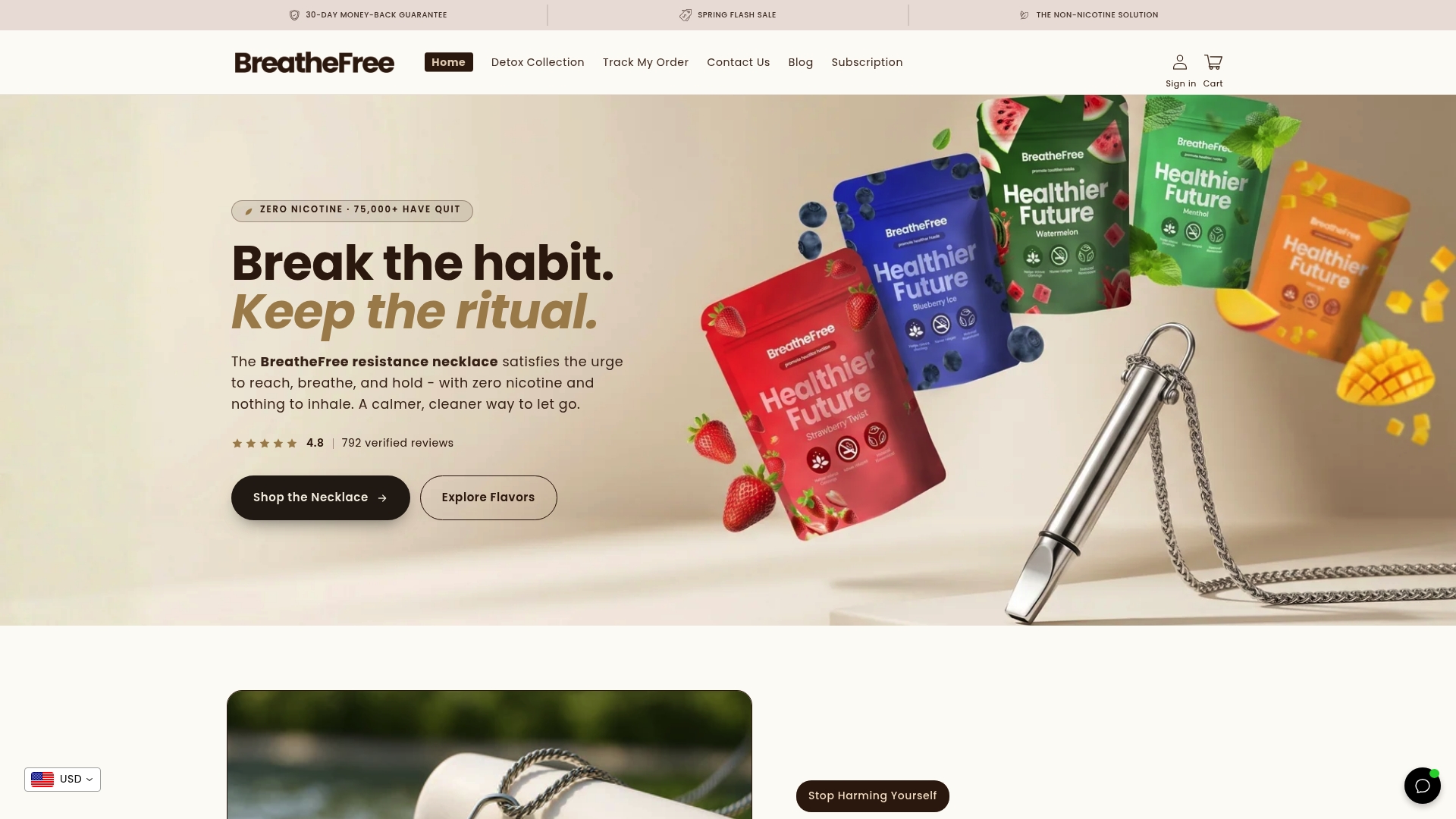
The necklace comes in a range of natural flavors through its flavor refill line, so the ritual stays satisfying trip after trip instead of going stale. It’s solid and plant-fiber based, meaning there’s nothing to light, charge, or inhale, making it usable in many situations where smoking isn’t an option. Breathefree also backs every order with a 30-day money-back guarantee, so trying it during your next few drives carries no real risk. It’s not a replacement for NRT if you’re managing heavy nicotine dependence, but as a companion tool for the habit-and-hands side of driving without smoking, it fills a real gap. Check out the resistance necklace collection and see if it fits your next commute.
Where to Verify This and Get Help
- CDC: State laws on smoking in vehicles
- CDC: How to use and combine quit-smoking medicines
- National quitline: 1-800-QUIT-NOW
Sources
- STATE System: Vehicles fact sheet (CDC)
- How to combine quit-smoking medicines (CDC)
- Driving or riding in a car … without smoking (government report / PDF)
FAQ
How Long After Smoking Can I Drive?
There’s no legal waiting period tied to smoking a cigarette before driving, since it doesn’t impair coordination or reaction time the way alcohol does. The bigger concern is secondhand smoke lingering in the cabin, so cracking a window or airing the car out for a few minutes before other passengers get in is a reasonable habit.
Will One Cigarette Make My Car Smell?
Yes, and often more than people expect. A single cigarette releases enough smoke and residue to leave a noticeable odor in the fabric, carpet, and air vents, and that thirdhand smoke residue can persist for weeks without a deep clean.
Can You Smoke in Your Car in Ohio?
Ohio has no statewide law banning smoking in a private vehicle, even with children present, which puts it outside the group of states with vehicle-specific child protections. That said, if smoking leads to distracted or reckless driving, standard traffic laws still apply regardless of the cigarette itself.
What Age Cutoffs Do States Use for Smoking-With-Kids Laws?
Age thresholds vary significantly by state, ranging from under 8 to under 18 years old in the states that regulate smoking around minors in vehicles, according to the CDC’s vehicle law summary. Check your specific state’s statute before assuming your situation is covered or exempt.
Does Breathefree Replace Nicotine Replacement Therapy?
No. Breathefree’s resistance necklace is a nicotine-free tool built for the oral and hands-busy side of the habit, not a substitute for patches, gum, or lozenges if you’re managing physical nicotine dependence. Many people use it alongside NRT or as a standalone tool once cravings are mostly habitual rather than chemical.