

Most quit aids cost somewhere between a few dollars and a few hundred dollars for a full attempt, and almost all of them cost far less than the cigarettes they replace. A nicotine-free kit such as the BreatheFree Resistance Necklace is $39.95 one-off, with Flavor Refills at $29.95 one-off. Patches, gum, lozenges, prescription medicines and structured programs each sit in a different price band. The sections below put real numbers on each one, so you can build a budget before you start.
TL;DR
- Over-the-counter nicotine replacement runs from about $8 to $26 per box at cash prices, and a full course adds up over several weeks.
- Prescription varenicline can cost up to $1,600 for 12 weeks, while insurance often reduces that sharply.
- Paid programs range from a $6.75 printed guide to a $99.95 online course.
- The BreatheFree Resistance Necklace is $39.95 and Flavor Refills are $29.95, with a 30-day money-back guarantee.
- A pack-a-day smoker spends thousands of dollars a year on cigarettes, so any of these routes can pay for itself.
Table of Contents
- What you are really budgeting for
- Nicotine patches, gum and lozenges: what they cost
- Prescription medicines: the biggest price range
- What insurance may cover
- Counseling and structured programs
- What nicotine-free tools cost
- Building a 3-month quit budget
- How to keep the cost down
- Our view on the cost of quitting
- Start with the BreatheFree Resistance Necklace
- FAQ
- Sources
What you are really budgeting for
Quitting has three kinds of cost. The first is the tool that handles cravings: a patch, gum, a pill or a physical substitute for the hand-to-mouth habit. The second is support: counseling, a program or a community. The third is the cost of a slip, meaning you buy a second round because the first one ran out before the cravings did.
Plan for the whole attempt, not for one box. Most people need weeks of cravings management, and many try more than once. Pricing a single week makes aids look cheaper than they are, and pricing only the sticker on the most expensive option makes quitting look out of reach. Neither is accurate.
There is also the other side of the ledger. A pack-a-day smoker who quits saves between $2,700 and $5,140 a year in cigarette costs depending on the state, according to a 2022 analysis by Campaign for Tobacco-Free Kids that used an average pack price of $9.16. Pack prices change with state taxes, so use your own pack price for your own number: multiply what you pay per pack by 365.
Nicotine patches, gum and lozenges: what they cost
Nicotine replacement therapy (NRT) delivers a measured dose of nicotine without smoke. Patches, gum and lozenges are sold over the counter in the US. Cash prices vary by store, brand and pack size. Drugs.com’s cash price guide lists these examples for generic products:
| Product | Example cash price |
|---|---|
| Nicotine gum, 2 mg | From $8.45 for 20 pieces |
| Nicotine lozenges, 2 mg | From $10.19 for 24; $22.08 for a 72-lozenge supply |
| Patches, 21 mg | $14.12 for 7 films |
| Patches, 14 mg | $12.61 to $26.23 for 14 films |
Those prices are for people paying cash and do not apply with insurance. They also move with the pharmacy and the date, so treat them as a snapshot rather than a quote.
The cost of a course depends on how long you use it and how much. A standard patch course steps down in strength over weeks, so you buy more than one box in more than one strength. Gum and lozenges are used as needed for cravings, and heavy use means more packs. Using a patch together with gum or lozenges costs more than either alone, though the VA/DoD guideline published in January 2026 prefers that combination over a single form of NRT. If you are weighing the two main forms, our patch vs gum comparison walks through how they differ day to day, and our 3-month quit budget adds the figures up across a full attempt.
If you are pregnant, have a heart condition, take other medicines or are under 18, talk to your doctor or pharmacist before using any nicotine product. That is a safety step, not a cost one.
Prescription medicines: the biggest price range
Varenicline (sold as Chantix) and bupropion are prescription medicines, and so are nicotine inhalers and nasal sprays. They need a prescription, so the first cost is a visit. The drug prices then vary more than anything else on this list. Guidelines from the American Thoracic Society, summarized by the American Academy of Family Physicians, note that 12 weeks of varenicline can cost up to $1,600, against less than $250 for nicotine patches. They also note that the varenicline patent expired in December 2020, so generic competition should make it more affordable.
The cash sticker is rarely what people with insurance pay. Which brings us to coverage.
What insurance may cover
This is where the biggest cost differences come from, because the same medicine can be free on one plan and several hundred dollars on none.
According to the American Lung Association’s coverage chart (last updated September 10, 2024), federal guidance requires Medicaid expansion plans, Marketplace plans and employer-sponsored plans to cover cessation as a preventive service. That means 90 days of FDA-approved cessation medications and at least four counseling sessions, with two quit attempts per year, and no cost-sharing or prior authorization. Your own plan’s paperwork decides what actually applies to you, since plans differ in how they handle over-the-counter products and which prescriptions they need.
Medicare is narrower. The UW-Madison Center for Tobacco Research and Intervention explains that Medicare Part D covers nicotine nasal spray, the nicotine inhaler, bupropion and varenicline, plus four individual counseling sessions per quit attempt, up to two attempts a year, with no cost-sharing for the counseling.
Medicaid varies by state. The National Cancer Institute’s progress report found that in 2024, 26 states provided comprehensive Medicaid coverage of all seven FDA-approved medications plus individual and group counseling for standard enrollees. If you are on Medicaid, check your state’s rules.
The practical takeaway: coverage tends to focus on medicines and counseling, and it does not usually extend to physical, nicotine-free habit tools. We explain how insurers treat quit aids in our guide on insurance coverage for quit tools, so you know what to budget for out of pocket.

Counseling and structured programs
Support costs less than most people expect, and it comes in several price points. The American Lung Association’s pricing page lists its Freedom From Smoking Plus online program at $99.95, covering a 6-week program with 9 sessions and a 1-year membership, and a printed self-help guide at $6.75 in English and Spanish. Group programs run 7 weeks over 8 sessions, with pricing set by the provider’s location and funding.
Telephone quitlines are a public service. The CDC reports that quitlines exist in every state, the District of Columbia, Puerto Rico and Guam, and that their services are free and confidential, with 1-800-QUIT-NOW (1-800-784-8669) as the national number. Some state quitlines also offer free cessation medications or discounts on them. Calling is a sensible first step to learn what your state offers before you spend anything, and it works alongside any tool you choose.
Community support is the other part of the picture. Many quitters find that talking to people who are going through the same cravings keeps them going. Our guide to peer support for quitting smoking explains how it works, and a BreatheFree purchase comes with our community for support.
What nicotine-free tools cost
Nicotine replacement works by supplying nicotine. A different group of aids goes after the habit side of smoking: the hand-to-mouth motion, the breathing pattern and the pause in the day. That is the group BreatheFree sits in.
Our prices are published and one-off:
| Item | Price |
|---|---|
| BreatheFree Resistance Necklace | $39.95 one-off |
| Flavor Refills | $29.95 one-off |
A necklace plus one refill pack comes to $69.90. We also offer a subscription; no price is published for it, so check the subscription page for the current terms.
What the price includes matters as much as the number. The necklace is solid and plant-fiber based, 100% nicotine- and chemical-free, and needs no inhalation. It is made to satisfy the need for something in your mouth, and it can go anywhere, including flights and offices. There are natural flavors to choose from, and every order is covered by a 30-day money-back guarantee. More than 75,000 people have used this method to quit, by our own count.
Because it is nicotine-free, there is no dose to step down, no second box in a different strength and no prescription visit. You can pair it with whatever support you already have, such as a quitline or a counselor. For the full range of what we offer beyond the necklace, see our guide to smoke-free tools for beginners and our comparison of smoke-free alternatives.
Building a 3-month quit budget
Here is how the pieces fit together for someone paying out of pocket. The numbers use the prices above and should be adjusted for your own pharmacy and insurance.
Scenario 1: nicotine-free tools plus support. Necklace ($39.95) plus one refill pack ($29.95) is $69.90. Add a free quitline call, or the $6.75 printed guide, and the total stays under $80.
Scenario 2: over-the-counter NRT. Take two boxes of 14 mg patches at the higher end of the Drugs.com range ($26.23 each, $52.46) plus a few packs of gum or lozenges at $8.45 to $22.08. A 12-week course with a step-down in patch strength and extra packs for cravings will need more boxes than that, which is why the total tends to climb into the low hundreds. Add the $99.95 online program and you pass $200 quickly.
Scenario 3: prescription medicine. Without coverage, up to $1,600 for varenicline over 12 weeks, plus the visit. With a plan that follows the federal preventive-care guidance, the drug may cost you nothing.

Compare any of these with your own yearly cigarette spend. If you buy a pack a day at $9.16, that is roughly $3,343 a year at the 2022 average pack price from the Tobacco-Free Kids analysis, and about $279 a month. Every scenario above costs less than three months of cigarettes at that price.
How to keep the cost down
- Price the whole attempt. Add up weeks of use, not a single box.
- Check your plan first. If you have employer, Marketplace, Medicaid or Medicare coverage, read what it says about cessation medications and counseling before you pay cash.
- Call your state quitline. It is free, and in some states it comes with free medication or discounts.
- Choose tools that handle the habit, not only the chemistry. The urge to put something in your mouth does not go away because a patch is delivering a steady dose, so a nicotine-free habit tool fills a gap that a nicotine dose does not.
- Keep your records. If you use a health savings or flexible spending account, our guide on HSA and FSA records for quitting lists what to keep.
Our view on the cost of quitting
Most people ask us what quitting costs before they ask whether it will work. That is a fair order. Money is tight, and a plan that looks expensive on paper often never gets started.
What we have found is that the sticker price is the wrong number to look at. The right one is the cost of the whole attempt compared with what a smoker spends in a month. When you do that, a $39.95 necklace and a $29.95 refill pack are small next to a carton budget.
We built BreatheFree around the part of smoking that nobody bills for: the hands and mouth wanting something to do. Our necklace is solid, plant-fiber based, free of nicotine and chemicals, and needs no inhalation, so you can use it at your desk, on a flight or in the car. We pair it with a community because quitting is easier with people who know what a 3 p.m. craving feels like.
If you have a plan that covers medicines or counseling, use it. Our tools sit beside that support, and the 30-day money-back guarantee means you can start without carrying much risk.
Tommy
Start with the BreatheFree Resistance Necklace
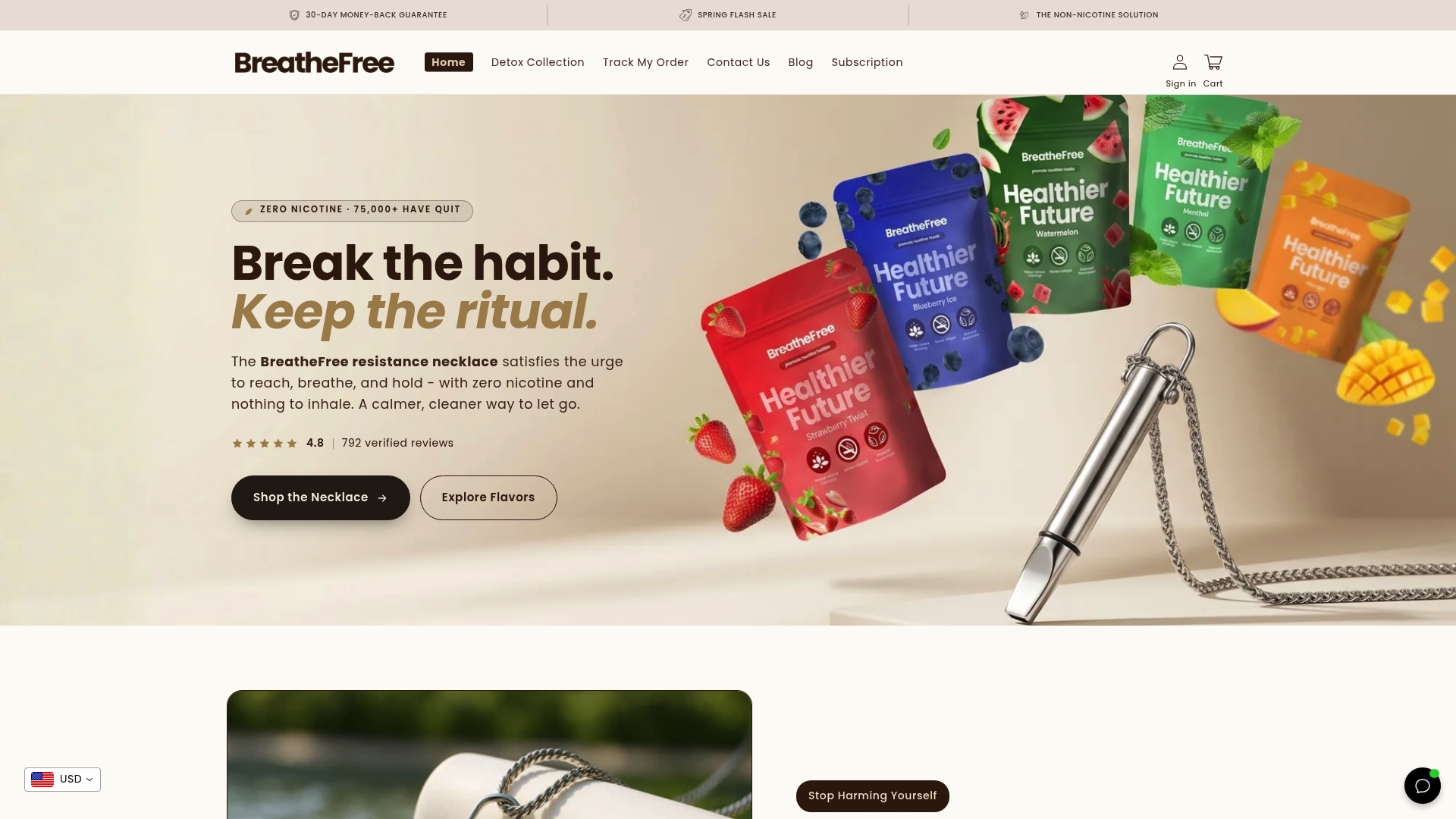
If you want a nicotine-free way to handle cravings that costs less than a single month of cigarettes, start with the BreatheFree Resistance Necklace at $39.95, and add Flavor Refills at $29.95 when you want to change or restock flavors. Both are one-off prices. You can see the full range on the BreatheFree product collection, and every order comes with our 30-day money-back guarantee.
If you prefer to compare options first, our guide to quit smoking support resources shows how the pieces fit together.
FAQ
How much do quit smoking aids cost?
It depends on the type. Over-the-counter nicotine gum, lozenges and patches run from about $8 to $26 per box at cash prices, prescription varenicline can reach $1,600 for 12 weeks without coverage, and paid programs start at $6.75. The BreatheFree Resistance Necklace is $39.95 one-off.
Does insurance pay for quit smoking aids?
Often for medicines and counseling. Federal guidance requires many plans to cover cessation as a preventive service, including 90 days of FDA-approved medications and at least four counseling sessions, and Medicare and Medicaid have their own rules. Check your plan’s documents, because coverage for over-the-counter products and non-medical tools differs.
Are there free ways to get help?
State quitlines are free and confidential in every state, and some also provide free or discounted medication. The national number is 1-800-QUIT-NOW (1-800-784-8669). You can use a quitline alongside any tool you buy.
What is the cheapest quit smoking aid?
Per box, gum and lozenges are the cheapest nicotine products at cash prices, but a course needs several boxes. A nicotine-free necklace at $39.95 with a $29.95 refill pack totals $69.90 and has no step-down schedule to buy for.
Can I save money by quitting?
Yes. A pack-a-day smoker who quits saves between $2,700 and $5,140 a year on cigarettes depending on the state, per the 2022 Tobacco-Free Kids analysis. Use your own pack price for a personal figure.
Sources
- Nicotine prices, Drugs.com
- Medications for Smoking Cessation: Guidelines from the ATS, AFP
- Freedom From Smoking programs and pricing, American Lung Association
- Tobacco Cessation Treatment: What Is Covered?, American Lung Association
- Medicare and Quitting Tobacco Use, UW-CTRI
- Medicaid Insurance Coverage of Tobacco Cessation Treatments, National Cancer Institute
- Quitlines and Other Cessation Support Resources, CDC
- Immediate Smoker Savings from Quitting in Each State, Campaign for Tobacco-Free Kids
- VA/DoD Clinical Practice Guideline for Tobacco Use Treatment, 2026