

The most common remote work smoking triggers are routine cues like morning coffee and finishing a task, boredom, digital notifications, visible tobacco within reach, and isolation. The single most effective approach is to remove those cues from sight, build short replacement rituals into your day, and keep a craving tool on hand for the moments when the urge still hits. The steps below walk through exactly how to do that.
TL;DR:
- Removing tobacco from sight and easy reach significantly reduces automatic smoking cues and makes quitting more manageable.
- Replacing routine triggers like coffee or breaks with non-smoking rituals and grounding techniques helps manage cravings effectively.
- Structuring the workday with start and end rituals, dedicated breaks, and clear workspace boundaries decreases unstructured time that fosters smoking.
- Building accountability through check-ins and support lines boosts motivation and offers personalized guidance during the quitting process.
- Using nicotine-free oral fixation tools, such as the resistance necklace, helps satisfy the habitual hand-to-mouth action without nicotine or inhalation.
Table of Contents
- Specific remote work smoking triggers you might not notice
- Why remote work makes these triggers stronger
- Practical strategies to manage cravings and avoid triggers
- Rebuilding routines and boundaries that reduce triggers
- Resources and support you can use right now
- A note from Tommy on what remote workers actually struggle with
- What the research actually supports, and what gets overstated
- How a nicotine-free resistance tool fits into a remote work quit plan
- FAQ
- Sources
Specific remote work smoking triggers you might not notice
Working from home changes the shape of your day, and that shape is full of small cues that used to be broken up by a commute, a coffee shop, or a coworker walking by. Now they repeat in the same room, often within arm’s reach of each other.
Pattern triggers show up around transitions: the first cup of coffee, the end of a task, a scheduled break, a phone call, even watching a video that used to pair with a cigarette. Environmental cues matter just as much. The chair you always smoke in, an ashtray left on the porch, a pack sitting on the kitchen counter, or a particular room you associate with smoking all act like silent reminders your brain doesn’t need words to recognize.

Emotional triggers run underneath the physical ones. Boredom between meetings, loneliness from skipping office chatter, and anxiety from a workday that never really ends all push toward a cigarette as a quick reset.
The trigger types to watch for:
- Pattern cues: coffee, task completion, scheduled breaks, phone calls, video watching
- Environmental cues: a specific chair, an ashtray, tobacco left in view, certain rooms
- Emotional cues: boredom, loneliness, anxiety from blurred work and home boundaries
- Access effect: easy reach to tobacco at home tends to produce more frequent, smaller smoking episodes throughout the day rather than a few planned ones
That last point matters more than people expect. At an office, smoking required a trip outside. At home, it might just mean standing up. That shorter distance between impulse and action is often what turns a two-a-day habit into something closer to eight or ten.
Why remote work makes these triggers stronger
Working from an office imposes structure you don’t choose: no smoking indoors, limited breaks, coworkers nearby. Remove that structure and the opportunities to smoke multiply. Pandemic-era research on remote work and smoking behavior found that increased time at home, disrupted routines, and loss of workplace restrictions were linked to changes in smoking, with many people reporting more smoking tied to boredom and blurred boundaries between work and personal time.
The commute used to do real work for your habit, whether you smoked during it or not. It marked a clear start and stop to the workday, and that boundary limited how often smoking fit into your schedule. Without it, the day bleeds together, and so does the smoking.
Loneliness compounds this. Isolation and stress are well-documented drivers of smoking as an emotion-regulation tool, and remote work strips out the casual social contact that used to buffer both. None of this means remote work causes smoking on its own, but the mechanisms line up: fewer rules, fewer transitions, more unstructured time alone.
Practical strategies to manage cravings and avoid triggers
The fastest wins come from making smoking slightly harder to do and slightly easier to skip.
- Create a friction gap. Move tobacco out of your workspace and out of arm’s reach, ideally into another room. Smokefree that even small physical and contextual changes, like a covered desk or a different workspace setup, can reduce automatic smoking cues.
- Break the coffee-cigarette pairing. Swap gum, a flavored oral substitute, or a short five-minute ritual, like stepping outside without a cigarette, into the slot that coffee used to share with smoking.
- Use craving first-aid in the moment. Take 10 slow, deep breaths, inhaling through the nose and exhaling through the mouth. Smokefree this alongside a 5 to 10 minute physical interruption like a walk or stair climb, drinking water, or chewing gum.
- Build non-smoking breaks into your calendar. Set alarms for scheduled breaks and consider a visible no-smoking sign near your desk as a reminder of the rule you’ve set for yourself.
- Add accountability. A quick check-in with a friend, partner, or a shared Slack channel for smoke-free breaks replaces some of the social structure an office used to provide.
Our practical swaps for replacing smoke breaks go deeper on specific substitutes that work well for a home office setup.
Pro Tip: Keep a glass of water and a chewable object at your desk before the craving hits, not after, so you’re not hunting for a substitute while already fighting the urge.

Grounding techniques borrowed from other fields work here too. Self-soothing exercises built around breathing and physical grounding can slot directly into the same moment a craving hits.
Rebuilding routines and boundaries that reduce triggers
Recreating the structure an office used to provide is less about willpower and more about ritual design.
- Start-of-day ritual: a short walk, making coffee away from your desk, or two minutes of focused breathing before opening your laptop
- End-of-day ritual: a power-down checklist, a short walk outside, or changing clothes to signal the workday is over
- Workspace rules: keep a separate device or browser for leisure versus work, keep your desk surface clear, and store tobacco somewhere that takes real effort to reach
- Daily checklist: copy a simple version of these rituals into your calendar or habit tracker so they become automatic rather than optional
Our guide to building a quitting action plan walks through how to turn this into a full calendar-based plan, and our piece on replacing a smoking ritual covers ritual substitution in more depth.
Resources and support you can use right now
You don’t have to do this without backup. The CDC’s quitline program offers free, confidential coaching at 1-800-QUIT-NOW, available 24/7, with counseling and a personalized quit plan built around your situation.
- Call 1-800-QUIT-NOW for free coaching and a tailored quit plan
- Text to join NCI’s SmokefreeTXT through the National Texting Portal, a structured 6 to 8 week program with 24/7 support
- Ask a clinician about medication if cravings remain intense after a few weeks; quitlines can also refer you
- Add a non-nicotine oral-fixation tool, like our resistance necklace and flavor refills, as a hands-on adjunct alongside these supports
Our roundup of U.S. cessation supports lists these programs together in one place.
A note from Tommy on what remote workers actually struggle with
The remote workers I hear from most often aren’t fighting willpower, they’re fighting proximity. The pack is always visible, and visibility is the trigger. Many people have used our resistance necklace as part of quitting, and the pattern I see repeated is simple: when the hands have something else to do, the cigarette loses its automatic pull.
— Tommy
What the research actually supports, and what gets overstated
Most advice on quitting while remote focuses on motivation: want it more, try harder. That misses the real lever, which is proximity and structure, not willpower. The research on remote work and smoking points to something more mechanical: fewer rules, shorter distances to tobacco, and no commute to mark the day’s edges. Fix those three things before worrying about mindset.
The overrated piece of advice is “just power through cravings.” Cravings are short and physical, and a craving ignored without a plan tends to come back stronger within the hour. What’s underrated is friction: the simple act of putting tobacco in another room does more real work than most people expect, because it turns an automatic habit into a conscious decision every single time.
If you only do one thing from this article, make it the friction gap. Everything else, from breathing techniques to calendar alarms, works better once that gap exists.
How a nicotine-free resistance tool fits into a remote work quit plan
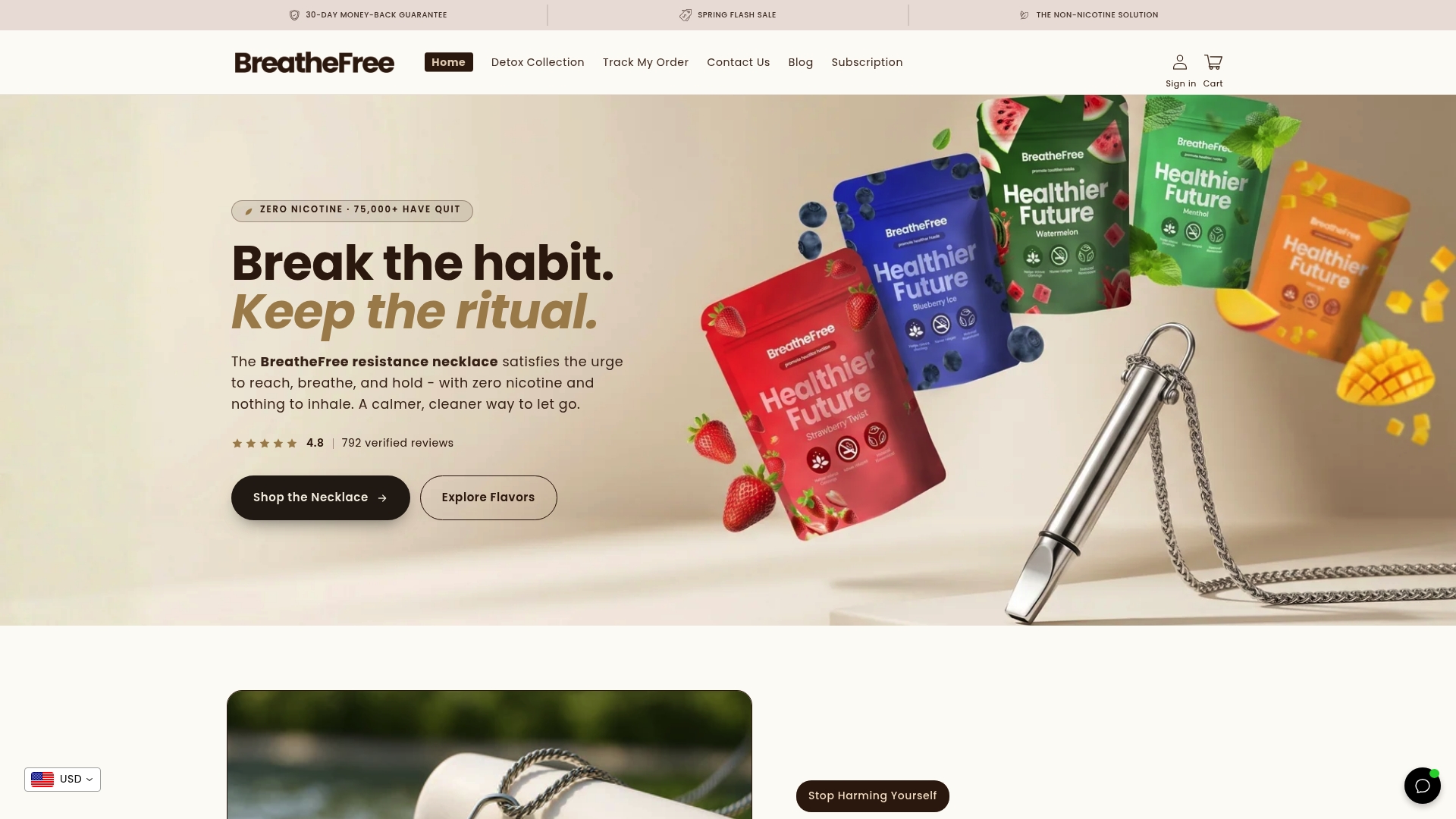
A quiet workday full of pattern cues is exactly the situation where oral fixation tools earn their place. Our BreatheFree Resistance Necklace gives your hands and mouth something to do in the same slot a cigarette used to fill, without nicotine or inhalation, and it works at your desk, on a walk, or on a flight.
- Use it during the coffee-cigarette window or any scheduled break as a ritual replacement
- Pair it with flavor refills to keep the sensory habit interesting over weeks, not just days
- Comes with a satisfaction guarantee if it isn’t the right fit
Check availability and current options on our product collection page.
This article is general information, not a substitute for advice from a qualified doctor. Consult a qualified healthcare professional about your own circumstances before acting on anything here.
FAQ
What are some free online smoking cessation programs available?
The CDC’s quitline offers free coaching at 1-800-QUIT-NOW, and the National Texting Portal connects you to NCI’s SmokefreeTXT, a free 6 to 8 week text program. Both are available at no cost to U.S. residents.
What are the long-term effects of nicotine on the brain?
Nicotine dependence creates a repeating cycle of withdrawal symptoms, including cravings and anxiety, that drive repeated use throughout the day. This cycle is part of why quitting support often combines behavioral tools with counseling or medication rather than willpower alone.
What are some effective coping skills for nicotine cravings?
Smokefree pattern disruption: chew gum, drink water, or do a short burst of physical activity like a walk. Ten slow, deep breaths, in through the nose and out through the mouth, can also reduce craving intensity in the moment.
Is there a free vape kit available to help people stop smoking?
We don’t have information on free vape kits as a cessation tool, and vaping itself still delivers nicotine. For a nicotine-free alternative aimed at the oral fixation part of the habit, our resistance necklace is designed for that purpose.
How does remote work affect the risk of relapse after quitting?
Isolation, blurred work hours, and easy access to tobacco at home can raise relapse risk by removing the social accountability and structure an office provided. Building deliberate breaks, start and end-of-day rituals, and accountability check-ins helps replace that lost structure.
Sources
- Five Reasons Why Calling a Quitline Can Be Key to Your Success | Quit Smoking | Tips From Former Smokers | CDC
- Smokefree
- Pandemic-era studies on smoking behavior and remote work (systematic/qualitative evidence)