

If you want to get through a day without smoking, a research study can give you a structured program, a schedule and sometimes a payment. Between visits and surveys, though, the cravings are still yours to handle. This guide shows you where U.S. quit-smoking studies are listed, what they ask of you, and how to keep your hands and mouth busy in the moments between sessions. For those moments we make the BreatheFree resistance necklace, a nicotine-free oral fixation tool.
TL;DR
- Smokefree.gov points readers to clinicaltrials.gov to find smoking studies that are recruiting, and many U.S. studies are NIH-funded and run by universities or medical schools.
- Eligibility differs by study: most want adults 18 or older who smoke daily, and some exclude people who already use cessation medication.
- Compensation, visits and side effects are spelled out in the consent form, so read it before you agree.
- Any study leaves long stretches between sessions. A nicotine-free ritual tool, such as our resistance necklace, helps you fill them.
- Free quitline coaching is available at 1-800-QUIT-NOW.
Table of Contents
- What a quit-smoking study actually is
- Where to find a study in the United States
- Who qualifies and what you will be asked to do
- What studies pay, and what to check first
- Between sessions: what to do when a craving hits
- A nicotine-free tool for the gaps
- Where else to get free support
- FAQ
- Sources
What a quit-smoking study actually is
A research study tests or evaluates treatments: new or existing medications, behavioral programs, medical equipment or other approaches, to learn whether they are safe and effective. Smokefree.gov explains that participants may receive new treatments before they are widely available, and that their involvement can help other smokers in the future.
The same page says Smokefree.gov does not review or endorse study protocols, so the researchers are responsible for what each listing says. That is one reason to read the details of any study yourself, which the sections below walk you through.
Studies come in a few common forms:
- Medication and counseling trials. You receive a study medication or placebo plus counseling sessions.
- Digital studies. You use a text-message program or app, and everything happens on your phone.
- Incentive studies. You are paid for completing assessments, or for verified quitting.
- Substitution studies. You try a different product in place of cigarettes while researchers observe.
Where to find a study in the United States
Start with clinicaltrials.gov, the federal registry of studies, and search for smoking cessation along with your state. Smokefree.gov’s research page also lists studies recruiting right now, including some that run fully online.
Other places to look:
- University and medical school pages. Examples from the research include UPenn’s CIRNA program, KU Medical Center’s KICK IT program and Yale’s Fucito Lab.
- Cancer centers. Memorial Sloan Kettering lists tobacco-treatment trials for its patients, such as one on an indoor air quality monitor for a smoke-free home.
- Remote studies. UAB’s ADAPT study runs entirely online, with an initial screening, eight contacts over six months and the chance to try varenicline or nicotine patches and lozenges.
Listings change, so use the recruiting status on each page and contact the study team for current openings.
Who qualifies and what you will be asked to do
Eligibility is the first filter. A University of California trial that started in September 2025 is a typical example. It asks for:
- age 18 or older
- at least one cigarette a day for the past seven days, and at least 100 in your lifetime
- a digital device and moderate English proficiency
- the ability to take part for six months
It excludes people who are currently in a cessation program or using nicotine replacement or cessation medication, and people with cognitive impairment that would prevent informed consent.
That last point matters if you are planning ahead. Some studies want you to be starting from scratch, with no other quit aid already in use. Others are built around a specific group, such as daily smokers living with HIV at UPenn or African American smokers in the Kansas City area at KU.
What the commitment looks like
The time demands vary a lot:
| Study type | What you do | Example |
|---|---|---|
| Phone app | Use an app for 4 weeks, answer surveys at 2 and 4 weeks | quitSTART study, University of Virginia |
| Text-message program | Everything on your phone, adults 18+ nationwide | Yale study listed on Smokefree.gov |
| Counseling plus assessments | Four weekly therapist sessions, eight online assessments over about eight months | RUSH ON-DEQ study, listed on Smokefree.gov |
| Clinic-based trial | Weekly visits, breath samples and daily phone questionnaires for 5 weeks | University of Oklahoma consent form |
What studies pay, and what to check first
Payment is typically for your time, not for results. Rose Research Center’s FAQ says compensation is based on time and discomfort and prorated if you withdraw early. Side effects, extra visits and any costs are documented in the consent form.
Published examples show the range:
- Yale’s digital study pays up to $100 for completing all activities, and RUSH’s study pays up to $250, according to Smokefree.gov’s listings.
- A young-adult remote trial paid between $30 and $170 depending on the group.
- The Oklahoma study offered up to $150 in gift cards for assessments, plus escalating gift cards for verified quitting.
- Yale’s Fucito Lab lists studies paying up to $330, $492 and $500 for Connecticut participants.
Before you enroll, run through this list:
- Read the consent form in full. Informed consent is an ongoing process, not a contract, and you can withdraw at any time without penalty, as Rose Research Center explains.
- Ask what the study provides. Medication, counseling, patches or lozenges, and for how many weeks.
- Count the visits and surveys. Add up travel and time against the payment.
- Ask about privacy. The Oklahoma consent form notes that a federal Certificate of Confidentiality protects identifying information from compelled disclosure.
- Check the sponsor. University, medical school and NIH-backed studies are listed on clinicaltrials.gov with a registration number.
If you are pregnant, talk to your doctor before joining any study that involves medication. The CDC notes there is insufficient evidence on the effectiveness of the seven FDA-approved cessation medications in pregnancy, and that they can be considered case by case, weighing medication risks against the risks of continued smoking.
Between sessions: what to do when a craving hits
Even the most structured study leaves you alone for most of the week. The cravings arrive at the usual times: after coffee, in the car, on a break. Smokefree.gov’s craving guide recommends:
- keeping your mouth busy with gum, hard candy or water
- switching to a different activity right away
- short bursts of movement, like walking or climbing stairs
- ten slow, deep breaths
- going to a smoke-free public place
- reviewing your reasons for quitting and calculating your savings
It also says to keep at it until you find what works, and to avoid even one puff.
The common thread is that cravings are as much about hands and mouth as about nicotine. That is the reason we built our products around the ritual. If you want a fuller routine, our guides on replacing your smoking ritual and CBT for smoking cravings go step by step.
A nicotine-free tool for the gaps
The BreatheFree resistance necklace gives you something to hold and draw on in place of a cigarette. It is 100% nicotine- and chemical-free, needs no inhalation, and is fully solid and plant-fiber based, so you can use it on flights and in offices. It comes in natural flavors, and refills keep the routine going.
The necklace is $39.95 one-off and flavor refills are $29.95 one-off, with a 30-day money-back guarantee. Because the tool contains no nicotine and no medication, it is simple to use alongside the counseling and assessments of a program.
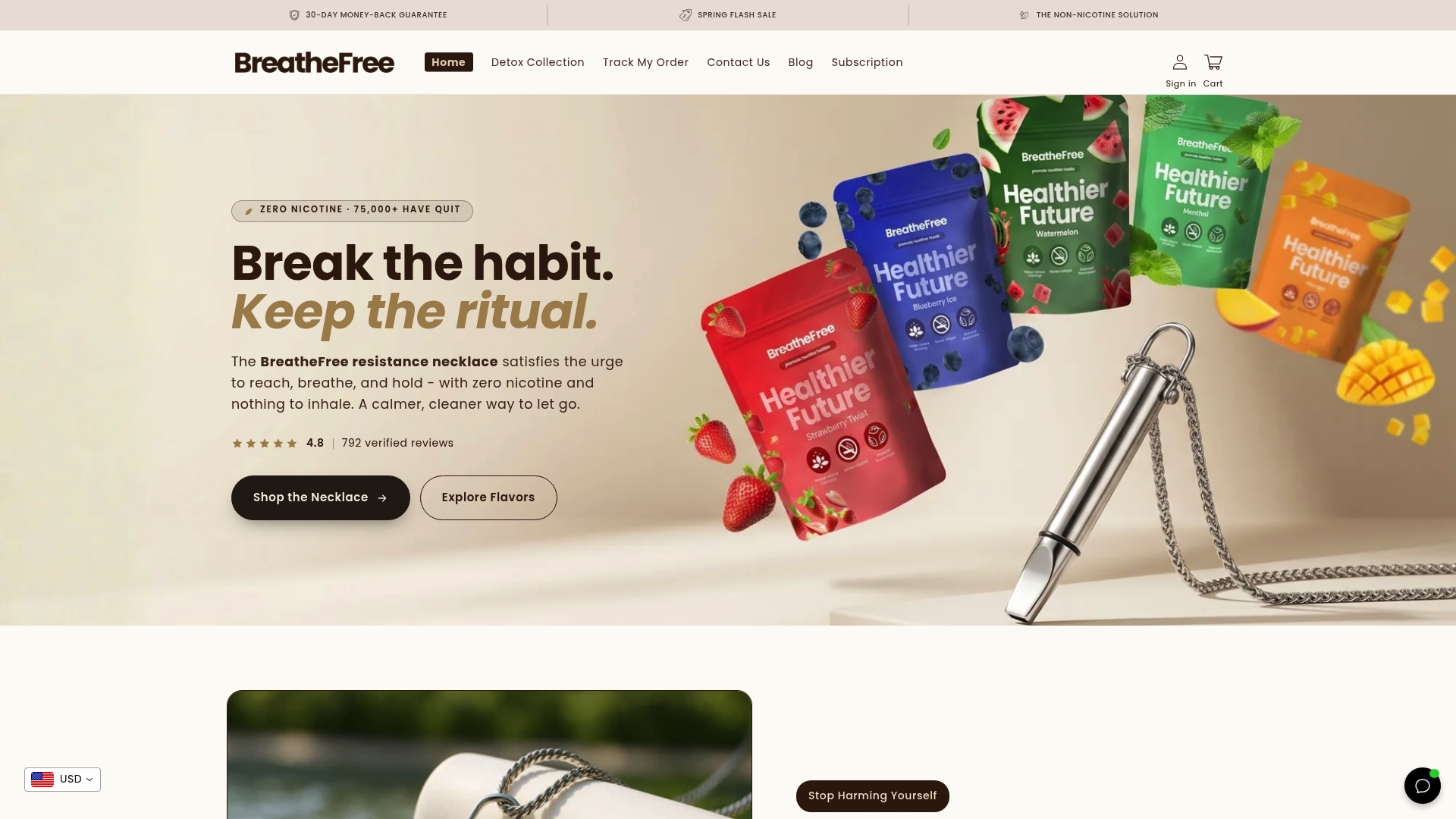
You can see both on our necklace and refills page. If you prefer a recurring option, there is also a subscription. For a wider look at tools, our quit-smoking support resources guide covers what is available.
Where else to get free support

You do not have to wait for a study to open. The CDC lists telephone quitlines (1-800-QUIT-NOW, or 1-800-784-8669), text messaging such as SmokefreeTXT and web-based programs as cessation resources. The CDC also says counseling and medication together can more than double your chances of quitting, and that seven medications are FDA-approved: five forms of nicotine replacement (patch, gum, lozenge, inhaler, nasal spray), varenicline and bupropion. Talk to a doctor or pharmacist about which fits you.
If you are looking at studies on vaping, the same logic applies. Remote and digital studies suit many people, and for teens, parents can read about vaping health risks and warning signs before deciding on next steps.
Our view
We hear one thing again and again from people who quit: the hard part is not the appointment, it is the Tuesday afternoon with nothing in your hands. Studies, quitlines and counseling build the plan. A ritual tool covers the moments the plan cannot.
That is why we built the resistance necklace around oral fixation and ritual instead of substance replacement. It is nicotine-free, it works anywhere, and it gives you a physical routine to lean on while you build new habits. Our community has more than 75,000 members who say they quit with this method, and you can join them.
Pair it with a plan, a coach and a tracker, and each craving becomes a few minutes you know how to get through.
Tommy
FAQ
Can I get paid to join a quit-smoking study?
Often, yes. Published studies pay for your time and effort, and amounts range from about $30 to $500 depending on length and demands. Payment details are in each study’s consent form.
Do I need to be ready to quit right now?
It depends on the study. Some recruit smokers interested in quitting within months, while others test substitution or reduction. The eligibility section of each listing says which one it is.
Can I use other quit aids during a study?
Check first. Some trials exclude people currently using nicotine replacement or cessation medication, while others provide those products themselves. Ask the study team what is allowed before you enroll.
What if I change my mind after enrolling?
You can withdraw at any time without penalty. Compensation is usually prorated, so ask how it works before you start.
Sources
- Join a Research Study, Smokefree.gov
- How to Manage Cravings, Smokefree.gov
- How to Join a Study, ClinicalTrials.gov
- Clinical Interventions to Treat Tobacco Use and Dependence, CDC
- Tobacco Treatment Clinical Trials, Memorial Sloan Kettering
- University of California Health Smoking Cessation Trial
- Participate in Research, UPenn CIRNA
- KICK IT at Swope Quit 2 Live, KU Medical Center
- ADAPT study, UAB
- Fucito Lab, Yale
- quitSTART app study, NCT04623736
- Young-adult cessation trial, NCT04379388
- Oklahoma consent form, NCT02737566
- Rose Research Center FAQ