

A cigarette substitute is any product or method that replaces traditional cigarette smoking by addressing nicotine addiction, the hand-to-mouth ritual, or both. The most recognized industry term for this category is “smoking cessation aid,” though cigarette substitutes span a much wider range than FDA-approved therapies alone. Nicotine replacement therapy (NRT) products like patches, gum, and lozenges sit at one end. Nicotine e-cigarettes, very-low-nicotine cigarettes (VLNCs), herbal cigarette alternatives, and behavioral tools like the Breathefree resistance necklace sit at the other. Effective substitutes address two problems: nicotine dependence and the behavioral ritual of smoking. Replacing both gives you a far better shot at quitting for good.
What is a cigarette substitute and what types exist?
A cigarette substitute falls into one of two broad categories: nicotine-delivering products and non-nicotine behavioral replacements. Understanding the difference matters because your level of nicotine dependence determines which category you need most.
Nicotine-delivering substitutes work by giving your body controlled doses of nicotine without the toxic smoke from burning tobacco. FDA-approved NRT forms include the patch, gum, lozenges, and nicotine nasal spray. The patch delivers a slow, steady dose throughout the day. The gum and lozenges act faster, making them useful for sudden cravings. The nasal spray peaks the quickest of all NRT forms, which makes it effective for acute withdrawal moments.

Nicotine e-cigarettes occupy a separate category. A Cochrane review found high-certainty evidence that nicotine e-cigarettes increase quit rates compared to both NRT and non-nicotine e-cigarettes. That finding matters because it confirms nicotine content in your substitute is not optional if you are a dependent smoker.
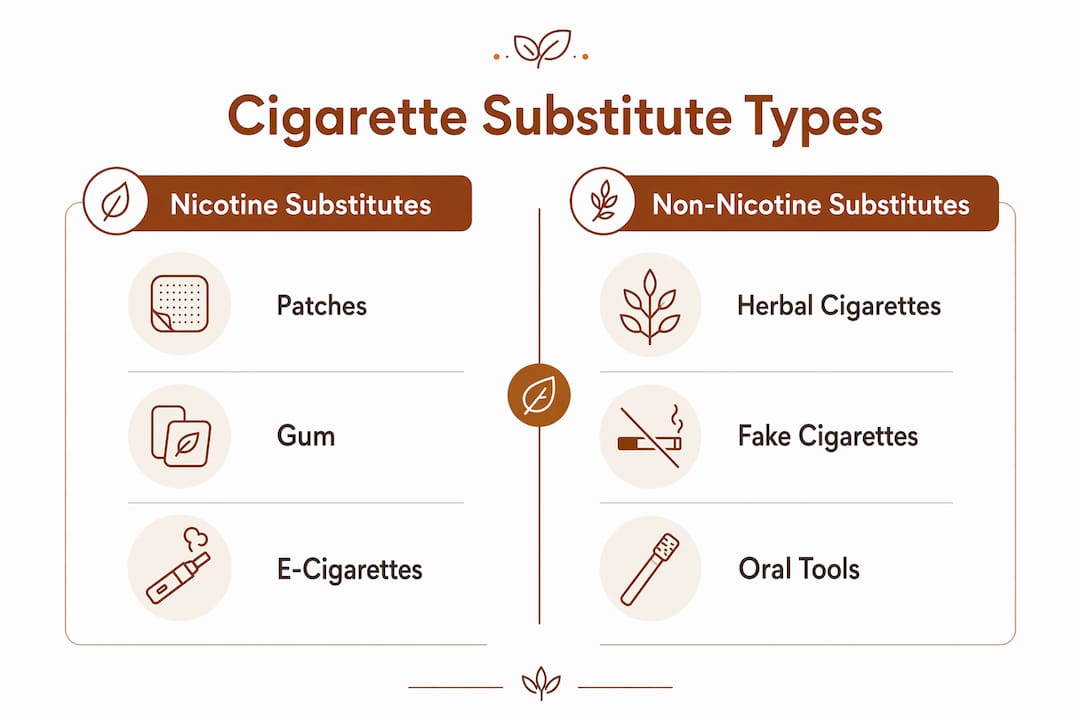
Non-nicotine substitutes target the behavioral side of smoking. These include herbal cigarette alternatives, fake cigarettes, oral fidget tools, and products like the Breathefree resistance necklace, which satisfies the oral fixation and hand-to-mouth habit without delivering any nicotine or requiring inhalation.
| Substitute type | Nicotine? | Addresses ritual? | Best use case |
|---|---|---|---|
| NRT patch | Yes | No | Steady background craving control |
| NRT gum or lozenge | Yes | Partially | Acute craving relief |
| Nicotine e-cigarette | Yes | Yes | High-dependence smokers switching fully |
| Very-low-nicotine cigarette | Trace only | Yes | Sensory substitution during transition |
| Herbal cigarette alternative | No | Yes | Ritual replacement without nicotine |
| Breathefree resistance necklace | No | Yes | Oral fixation and habit replacement |
Pro Tip: Clinicians often recommend combining a long-acting NRT form like the patch with a fast-acting form like the gum. This covers both background cravings and sudden urges at the same time.
How does exclusive switching improve your chances of quitting?
Exclusive switching means stopping all cigarette use and relying entirely on a substitute. Dual use, meaning smoking cigarettes while also using a substitute, keeps your health risks high and makes quitting harder. Health Canada’s guidance is direct: if you choose vaping as a substitute, stop all cigarettes as soon as possible. Continuing to smoke even one or two cigarettes a day while vaping maintains smoking-related harm and often leads to relapse.
The FDA reinforces this position. E-cigarettes still deliver addictive nicotine plus other harmful chemicals, so they are not risk-free. The goal is to move completely off cigarettes, then eventually off the substitute as well.
Practical steps that support exclusive switching:
- Set a firm quit date and treat it as the last day you smoke a cigarette, not the first day you try a substitute.
- Remove all cigarettes, lighters, and ashtrays from your home and car on quit day.
- Identify your highest-risk moments, such as morning coffee, driving, or stress, and have your substitute ready before those moments arrive.
- Tell people close to you about your switch so they can hold you accountable.
- If you slip and smoke a cigarette, do not abandon the substitute. Treat it as a data point, not a failure.
Pro Tip: If you find yourself reaching for a cigarette “just once,” check whether your substitute is delivering enough nicotine. Underdosing NRT is one of the most common reasons people relapse in the first two weeks.
What role do behavioral and sensory experiences play in substitution?
Nicotine is only part of what makes cigarettes hard to quit. The physical act of smoking, the hand-to-mouth motion, the inhale and exhale, and the social rituals around it, creates a deeply wired behavioral habit. Substitutes that only address nicotine often fail because they leave this behavioral loop intact.
A UW-Madison study published by the University of Wisconsin Center for Tobacco Research and Intervention found that VLNCs increased cigarette avoidance by 35.9 percentage points compared to a no-product group. That result came not from nicotine content, since VLNCs contain almost none, but from the sensory and behavioral experience of smoking something. The ritual itself was doing the work.
This finding has direct implications for choosing a substitute. Four behavioral factors drive early quitting success:
- Hand-to-mouth motion. Reaching for something and bringing it to your mouth is a conditioned reflex. Substitutes that replicate this motion reduce the urge to reach for a cigarette.
- Oral fixation. The mouth-centered habit of smoking is distinct from nicotine craving. Products like fake cigarettes, herbal alternatives, or the Breathefree resistance necklace address this directly.
- Sensory feedback. The sensation of inhaling and exhaling, or simply holding something, provides a calming signal the brain associates with relief. Substitutes that mimic this signal reduce anxiety during early withdrawal.
- Routine disruption. Replacing the cigarette break with a different ritual, such as a short walk, a piece of gum, or a breathing exercise, rewires the habit loop over time.
Sensory and behavioral substitution is often as important as nicotine dosing in the first weeks of quitting. Ignoring it is one of the main reasons people who use NRT patches alone still struggle. The patch handles the chemistry but leaves the habit untouched.
How to choose the best cigarette substitute for you
The right cigarette replacement option depends on three factors: your nicotine dependence level, your health profile, and how strongly the behavioral ritual drives your smoking.
Assess your nicotine dependence first. If you smoke within 30 minutes of waking up or smoke more than 10 cigarettes a day, you have moderate to high dependence. You need a nicotine-delivering substitute. The Cochrane review confirms that nicotine e-cigarettes outperform non-nicotine options for dependent smokers. NRT patches, gum, and lozenges are also proven options with strong safety records.
Check FDA approval status. NRT products approved by the FDA have been tested for safety and efficacy. Products without that approval carry unknown risks. Australian health guidance explicitly discourages switching to low-tar or low-nicotine cigarettes and using cigarette filters as quitting methods. These approaches maintain harm without improving your odds of quitting.
Add behavioral counseling. The FDA notes that counseling combined with NRT doubles quitting success compared to NRT alone. Relapse within six months is common without structured support. A counselor, a quit-smoking app, or a community program all count as behavioral support.
Consider your ritual needs. If the hand-to-mouth habit is a strong driver for you, add a behavioral substitute alongside any nicotine product. The Breathefree resistance necklace, for example, is designed specifically for people who need something to hold and engage with during cravings. It is nicotine-free and works well as a complement to NRT or as a standalone tool for people with lower dependence.
What to avoid when choosing a substitute:
- Low-tar or light cigarettes. These are not substitutes. They maintain all the risks of regular cigarettes.
- Cigarette filters marketed as harm reducers. The evidence does not support them.
- Non-nicotine e-cigarettes if you are a dependent smoker. The Cochrane data shows they underperform compared to nicotine versions.
- Any product that encourages continued dual use with regular cigarettes.
You may need to try multiple substitute types before finding the right fit. That is normal. The research supports offering quitters a choice among products, because individual responses to substitutes vary significantly.
Key Takeaways
The most effective cigarette substitute combines nicotine replacement for dependent smokers with a behavioral tool that addresses the hand-to-mouth ritual, supported by counseling.
| Point | Details |
|---|---|
| Define your dependence level | Smokers with high dependence need a nicotine-delivering substitute like NRT or a nicotine e-cigarette. |
| Prioritize exclusive switching | Dual use with cigarettes keeps health risks high and increases the chance of relapse. |
| Address the behavioral habit | Sensory and ritual substitutes like VLNCs or the Breathefree necklace improve early quitting success. |
| Add counseling to your plan | Combining behavioral support with a substitute doubles your odds compared to a substitute alone. |
| Avoid discouraged methods | Low-tar cigarettes and cigarette filters are not evidence-based substitutes and maintain harm. |
What I’ve learned about substitutes that most guides won’t tell you
Most quitting guides treat cigarette substitutes as a delivery problem. Get the nicotine in, reduce the craving, done. That framing misses about half of what actually drives people back to cigarettes.
The smokers I have seen struggle most are not the ones who ran out of patches. They are the ones who had nothing to do with their hands at 9 p.m. on a Tuesday. The ritual of smoking is a stress management system, a social signal, and a sensory anchor all at once. A patch addresses none of that.
What actually works is pairing a nicotine substitute with something that fills the behavioral gap. That might be an e-cigarette, a VLNC, a piece of gum you chew slowly, or a physical object you hold. The Breathefree resistance necklace is one of the more interesting non-nicotine options I have come across because it targets oral fixation directly without adding any new chemical dependency. Over 75,000 people have reportedly used it to quit, which is a meaningful signal even if it is not a clinical trial.
The other thing most guides understate is patience. The first two weeks are the hardest, and most people who relapse do so because they expected the substitute to eliminate cravings entirely. It will not. It will reduce them enough to get through. That distinction matters. If you know the substitute is a management tool rather than a cure, you stop being surprised when a craving hits and start being prepared for it instead.
Quitting is not a single decision. It is a series of small decisions made under pressure. The right substitute gives you a better tool for each of those moments.
— Tommy
Breathefree tools to support your quit plan
Choosing a substitute is only the first step. Tracking your habits, understanding your triggers, and having a structured plan are what turn a good start into a lasting quit.
Breathefree offers a Nicotine Detox eBook and Habit Tracker designed to work alongside whatever substitute you choose. The eBook walks you through the science of nicotine withdrawal and gives you a framework for the first 30 days. The Habit Tracker helps you spot patterns in your cravings so you can adjust your substitute strategy in real time. For people who need a physical tool to address oral fixation, the Breathefree resistance necklace is a nicotine-free option built around the calming ritual of breathing and holding. Together, these tools cover both the chemical and behavioral sides of quitting.
FAQ
What is the most effective cigarette substitute?
Nicotine e-cigarettes show the highest quit rates based on a Cochrane review with high-certainty evidence, outperforming both NRT and non-nicotine e-cigarettes. Combining any substitute with behavioral counseling doubles success rates compared to using a substitute alone.
Are non-nicotine cigarette substitutes worth using?
Non-nicotine substitutes like herbal cigarettes, fake cigarettes, and oral tools address the behavioral and sensory habit of smoking, which is a major driver of relapse. They work best as a complement to nicotine-delivering products for dependent smokers, or as a standalone option for people with low nicotine dependence.
Is vaping a safe cigarette substitute?
Vaping is generally lower risk than smoking cigarettes, but the FDA confirms it still delivers addictive nicotine and other harmful chemicals. It is not risk-free, and the goal should be exclusive switching off cigarettes followed by eventually stopping vaping as well.
What cigarette substitutes should I avoid?
Low-tar cigarettes, light cigarettes, and cigarette filters are not effective substitutes. Australian health authorities explicitly discourage these methods because they maintain smoking-related harm without improving quit outcomes.
Can I use more than one cigarette substitute at a time?
Yes. Clinicians often recommend combining a long-acting NRT form like the patch with a fast-acting form like the gum to cover both steady cravings and sudden urges. Adding a behavioral tool alongside a nicotine substitute addresses both the chemical and ritual sides of the habit.