

A sustainable quitting method is a long-term behavior change strategy that combines trigger mapping, behavioral substitution, and habit restructuring to quit smoking without relying solely on willpower or nicotine. The industry standard term for this approach is “multi-modal cessation,” and it consistently outperforms single-method strategies. Willpower alone succeeds just 3–5% of the time. That number tells you everything about why most quit attempts fail. Breathefree, which reports over 75,000 people successfully quitting through its method, is built on this exact principle: sustainable quitting requires structure, not just motivation.
What is the sustainable quitting method and its core components?
Sustainable quitting is not a single action. It is a system built from several interlocking principles that address both the physical habit and the psychological pull of smoking.
The foundation is trigger mapping. Identifying 10–15 high-risk situations and pre-loading a substitute for each one dramatically reduces relapse. Think of trigger mapping as writing a script for your future self. When the craving hits, you already know your next move.

The second principle is behavioral substitution. You replace the act of smoking with a physical alternative that satisfies the same need. This matters because smoking is not just a nicotine delivery system. It is a ritual: the reach, the hold, the breath. Replacing that ritual with something concrete, like a physical object for cravings, keeps your hands and mouth occupied without introducing more nicotine.
The third principle is habit restructuring. Sustainable behavior change requires building new routines around the times and places you used to smoke. That means changing your morning coffee spot, taking a different route after lunch, or replacing the after-dinner cigarette with a short walk.
Key components of a sustainable quitting strategy include:
- Trigger mapping: List every situation, emotion, or location that prompts a craving
- Pre-loaded substitutes: Assign a specific alternative to each trigger before you quit
- Environmental redesign: Remove smoking cues from your home, car, and workspace
- Slip planning: Decide in advance how you will respond to a momentary lapse
- Support structure: Build in daily check-ins with a friend, group, or app
Pro Tip: Write your trigger list the week before your quit date. For each trigger, write one substitute action next to it. Keep the list on your phone so you can access it in real time.
How effective is the sustainable quitting method compared to other techniques?
The data on quitting success rates is stark. Single methods rarely work. Integrated methods consistently do.
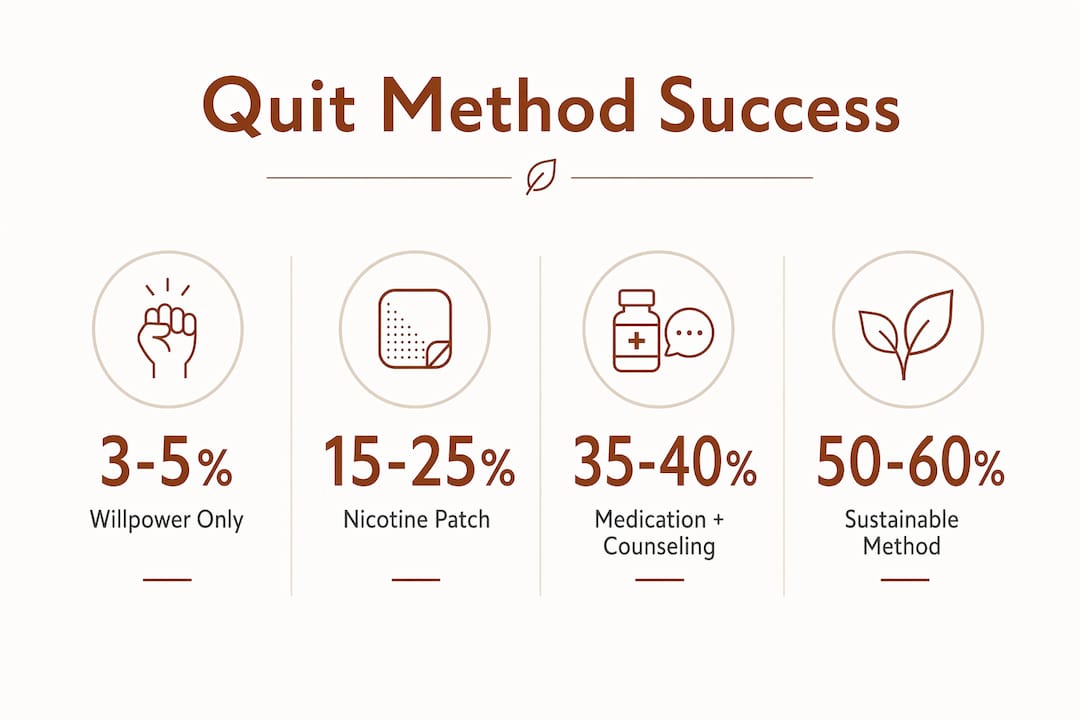
Combining medication with behavioral counseling triples quit rates compared to willpower alone. That is not a marginal improvement. It is the difference between a 5% chance and a 30–40% chance of staying smoke-free at one year.
| Method | Approximate success rate at 12 months |
|---|---|
| Willpower only | 3–5% |
| Single nicotine replacement therapy (NRT) | 15–20% |
| Combination NRT or varenicline | 25–30% |
| Pharmacotherapy plus behavioral support | 30–40% |
| Gradual nicotine tapering (for vapers) | Up to 2.4x higher vs. abrupt cessation |
Tapering nicotine concentration by 20–50% every 1–2 weeks produces 2.4 times higher success at six months compared to quitting abruptly. Gradual reduction gives your brain time to recalibrate its dopamine response, which makes the final quit far less physically brutal.
One overlooked failure point is NRT dosing. Under-dosing NRT is a leading cause of failure. A 7 mg patch, for example, is insufficient for someone smoking a pack a day. Matching the dose to actual intake is non-negotiable for pharmacological support to work.
The takeaway from this data is clear. No single method is sufficient on its own. The sustainable approach layers behavioral strategies on top of whatever pharmacological support fits your situation, including the option of no pharmacological support at all when physical and psychological tools are strong enough.
What practical steps can you take to implement a sustainable quitting strategy?
Implementation is where most plans fall apart. The steps below are sequenced deliberately, because order matters.
-
Choose your quit date with intention. Schedule your quit day so that Day 3, which is typically the peak of withdrawal, falls on a low-stress day. Avoid quit dates that land during work deadlines, travel, or family events.
-
Build your quit plan in writing. A written plan outperforms a mental one every time. Your plan should include your trigger list, your substitutes for each trigger, your support contacts, and your response to a slip. Use a resource like a quitting action plan to structure this.
-
Start medication one week before your quit date. If you are using varenicline or NRT, medication should begin seven days before you stop smoking. Nausea is a common early side effect and typically resolves within days.
-
Redesign your environment. Remove cigarettes, lighters, and ashtrays from every space you occupy. Change the physical layout of your smoking spots. Rearrange furniture if needed. Your environment shapes your behavior more than your intentions do.
-
Stock your substitutes. Keep physical alternatives within reach at all times. Options include chewing gum, toothpicks, a resistance necklace, or a small fidget tool. The Breathefree resistance necklace is designed specifically for this purpose, addressing oral fixation without any nicotine.
-
Use exercise as a craving interrupt. A 10-minute moderate exercise bout reduces craving intensity by approximately 50% during and immediately after activity. A brisk walk, ten push-ups, or a short bike ride all qualify.
-
Track your progress daily. Note which triggers you handled well and which ones caught you off guard. Use that data to refine your plan each week.
Pro Tip: If you slip, do not restart your quit clock. Instead, write down exactly what triggered the lapse and add a new substitute to your plan. One cigarette is data, not defeat.
How do psychological and physical strategies complement each other in sustainable quitting?
The most durable quit attempts treat the mind and body as one system. Psychological strategies reduce the emotional pull of smoking. Physical strategies replace the sensory ritual. Together, they cover the full picture of addiction.
Cognitive behavioral therapy (CBT) is the most studied psychological tool for smoking cessation. CBT teaches you to identify the thought patterns that precede a craving and interrupt them before they escalate. Behavioral counseling combined with medication produces the highest quit rates of any approach.
Mindfulness works differently. Rather than interrupting cravings, mindfulness trains you to observe them without reacting. Mindfulness practice reduces the urgency of cravings by teaching you that the urge will pass on its own, usually within 3–5 minutes.
Physical strategies that complement psychological work include:
- Oral fixation management: Use a necklace, toothpick, or straw to replace the hand-to-mouth motion
- Breathing exercises: Slow, controlled breathing mimics the deep inhale of a cigarette and activates the parasympathetic nervous system
- Sensory substitutes: The black pepper essential oil technique, where you inhale from a tissue with a few drops, has randomized trial support for calming cigarette cravings
- Exercise: Regular physical activity raises baseline dopamine, reducing the neurological gap left by nicotine
- Routine replacement: Build new rituals around the times you used to smoke, such as a short meditation after meals
The combination of CBT, mindfulness, and physical substitutes addresses what happens to your brain during withdrawal at every level: thought, emotion, and sensation.
What challenges arise during sustainable quitting and how do you overcome them?
Every quit attempt hits predictable obstacles. Knowing them in advance is the best defense.
- Peak withdrawal timing: The first 72 hours are the hardest. Days 2 and 3 carry the highest relapse risk. Plan your schedule around this window.
- Decision fatigue: When cravings hit, your ability to make good decisions drops sharply. Pre-planned substitutes remove the need to decide in the moment.
- Stress spikes: Unexpected stress is the most common relapse trigger after the first week. Build a crisis response into your plan: a specific person to call, a specific place to go, a specific action to take.
- Social pressure: Situations involving alcohol or other smokers are high-risk. Rehearse your response before you encounter them.
- Complacency: Many people relapse at 3–6 weeks, when they feel confident enough to “test” themselves. Confidence is not the same as safety.
“A slip is not a relapse. One cigarette after quitting identifies a missed trigger and gives you the information you need to strengthen your plan. The quit timeline does not reset. The learning does.”
Reframing a slip as feedback rather than failure is one of the most evidence-backed mindset shifts in cessation research. People who treat a lapse as a learning opportunity are far more likely to reach long-term abstinence than those who treat it as proof they cannot quit.
Key Takeaways
The most effective long-term quitting method combines trigger mapping, behavioral substitution, and structured support, because no single technique addresses all dimensions of nicotine addiction.
| Point | Details |
|---|---|
| Willpower alone rarely works | Solo willpower succeeds just 3–5% of the time; layered strategies are required. |
| Trigger mapping prevents relapse | Identifying 10–15 high-risk situations and pre-loading substitutes cuts decision fatigue. |
| Medication timing matters | Starting pharmacological support one week before quit day improves effectiveness. |
| Exercise interrupts cravings | A 10-minute moderate workout reduces craving intensity by approximately 50%. |
| Slips are data, not failure | One cigarette should refine your plan, not restart your quit timeline. |
What I’ve learned after watching thousands of quit attempts
The most common mistake I see is treating quitting as a single event rather than a process. People pick a quit date, white-knuckle through a few days, and then hit one bad afternoon and conclude they are not the type of person who can quit. That framing is the problem, not the person.
Trigger mapping changed how I think about this entirely. When you sit down and actually list the 12 or 15 specific moments in your day when you reach for a cigarette, something shifts. You stop seeing smoking as a constant craving and start seeing it as a predictable set of situations. That is a solvable problem.
The other thing most articles get wrong is the role of physical ritual. Nicotine is part of the addiction, but the hand-to-mouth motion, the pause, the breath, those are equally powerful. People who address only the chemical side of the habit often find themselves reaching for something, anything, weeks after quitting. Giving that reflex a healthy outlet is not a workaround. It is the strategy.
My honest advice: expect the first three months to require active management. After that, the new habits start to feel normal. The goal is not to white-knuckle forever. The goal is to build a life where the old habit simply does not fit anymore.
— Tommy
A practical resource to support your quit plan
Knowing the method is one thing. Having the right tools to execute it daily is another. Breathefree’s Nicotine Detox eBook and Habit Tracker is built specifically for people who want a structured, day-by-day system for quitting without nicotine.
The eBook walks you through trigger identification, substitute planning, and withdrawal management in plain language. The habit tracker gives you a daily log to record cravings, substitutes used, and patterns over time. That data becomes your personal quit map. Over 75,000 people have used Breathefree’s approach to break free from nicotine. The tracker is where that process starts.
FAQ
What is the most effective sustainable quitting method?
The most effective approach combines behavioral support with pharmacological treatment when appropriate, producing quit rates of 30–40% at 12 months. Trigger mapping and pre-loaded substitutes are the behavioral foundation of any durable quit plan.
How long does it take to quit smoking sustainably?
Most relapse risk occurs in the first three months. After that window, the risk drops significantly, though ongoing habit management supports long-term success.
Can you quit smoking without nicotine replacement?
Yes. Physical substitutes, behavioral counseling, mindfulness, and exercise can support a nicotine-free quit. Tools like the Breathefree resistance necklace address oral fixation without introducing any nicotine.
What should I do if I slip during a quit attempt?
Treat the slip as information, not failure. Identify the trigger that caused it, add a new substitute to your plan, and continue your quit without resetting your timeline.
How does trigger mapping reduce relapse?
Trigger mapping identifies the specific situations that prompt cravings and pairs each one with a pre-planned substitute. This removes the need to make decisions under craving pressure, which is when willpower is weakest.