7 reasons your last quit attempt failed, and the one thing that fixes all of them
If patches, gum and willpower keep letting you down, the problem was never your willpower. It's that almost every quit method solves half the addiction and ignores the other half. Here's the half they miss.
By Jane Smith · BreatheFree
Published 21 July 2026 · 8 min read
You've quit before. Maybe more than once. You made it three days, or three weeks, and then one ordinary afternoon you were standing outside with a cigarette in your hand wondering how you got there.
Here's the part almost nobody tells you: the relapse wasn't a moral failure. The research on why people go back is remarkably consistent, and it has very little to do with wanting it badly enough. It has to do with what the methods you were given actually address, and what they leave completely untouched.
Below are the seven reasons quit attempts collapse, each with what the evidence says. The same gap runs through all of them, and there's one approach built specifically to close it.
1
Your method treated a habit like a drug
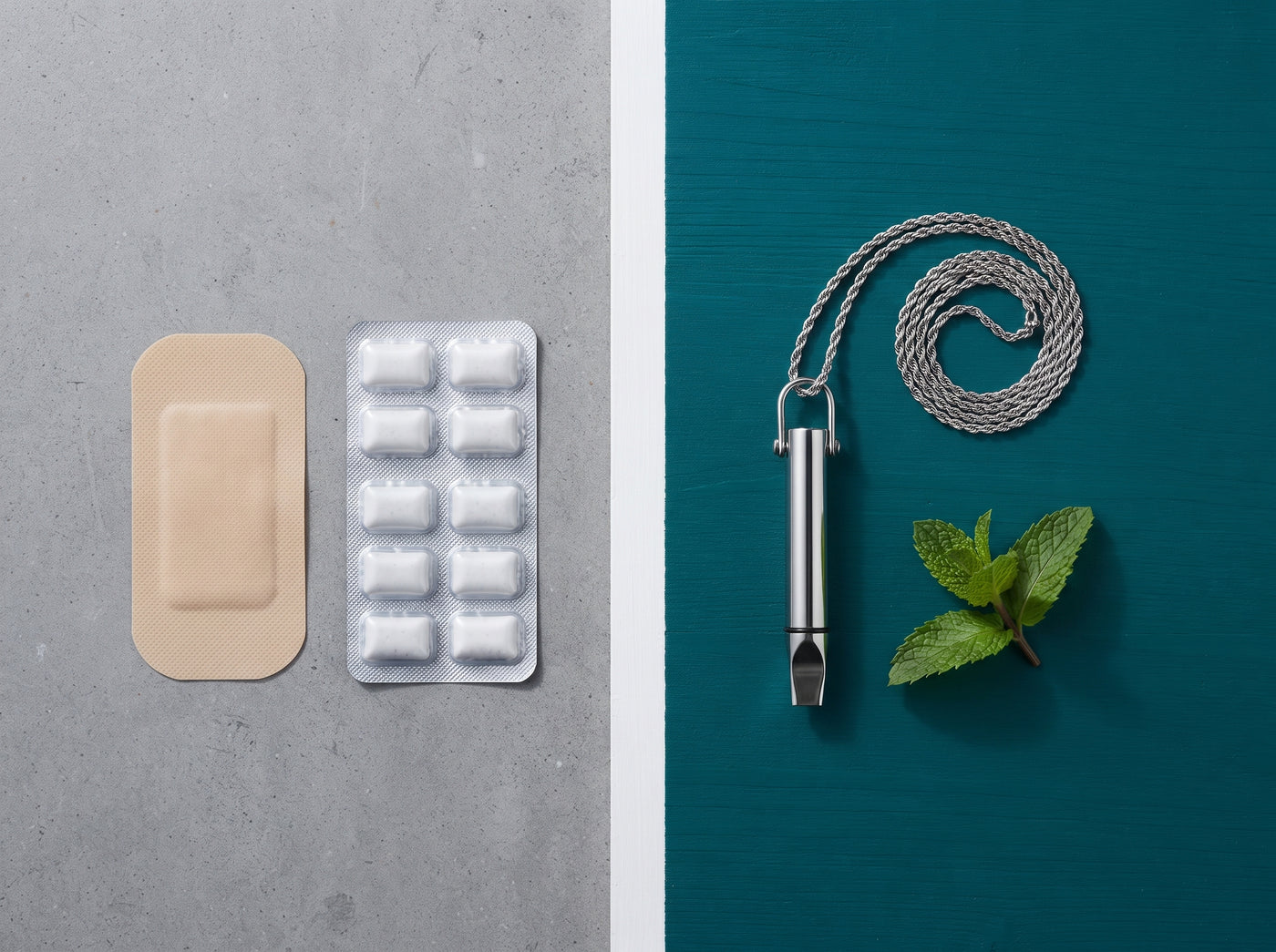
Patches and gum are built on a single premise: that smoking is a nicotine problem. So they deliver nicotine without the smoke and call the job done. But smoking is two addictions wearing one coat, a chemical dependency and a deeply worn behavioural ritual. Solve only the chemical, and the behaviour is still sitting there at 3pm, fully intact, waiting.
What the research says
In a US focus-group study, experienced smokers described their addiction as far more than chemical, citing the hand-to-mouth movement, the oral fixation and the smoking routine itself, and many said that removing the nicotine entirely wouldn't eliminate what kept them hooked.
It shows up in the outcomes. According to the CDC, of the US adults who smoked and tried to quit in 2022, only 8.8% succeeded, and fewer than 40% used any counselling or medication.
Sources: "Addicted to smoking or addicted to nicotine?", PMC / National Library of Medicine PMC8733050 · CDC MMWR, Adult Smoking Cessation, United States, 2022 cdc.gov
The fix
Address both halves at once. The BreatheFree Resistance Necklace targets the behavioural half directly, the part patches leave alone, without adding any nicotine to the chemical half you're trying to escape.
2
Nothing replaced the hand-to-mouth ritual
For years you lifted something to your lips dozens of times a day. That movement is muscle memory now, automatic, comforting, tied to every coffee, every break, every stressful phone call. A patch on your arm doesn't touch it. When the hand reaches up and finds nothing there, the gap is exactly where relapse lives.
What the research says
This is so well recognised that the physical ritual has its own official remedy. The NHS nicotine inhalator exists specifically to "keep your hands busy and recreate the hand-to-mouth action" of smoking, an acknowledgement that replicating the gesture is a legitimate part of quitting.
The American Cancer Society gives the same advice: if you miss having a cigarette in your hand or something at your mouth, occupy both, and take slow, deep breaths to ride out the craving.
Sources: NHS stop-smoking guidance on nicotine inhalators · American Cancer Society, Help for Cravings and Tough Situations cancer.org
The fix
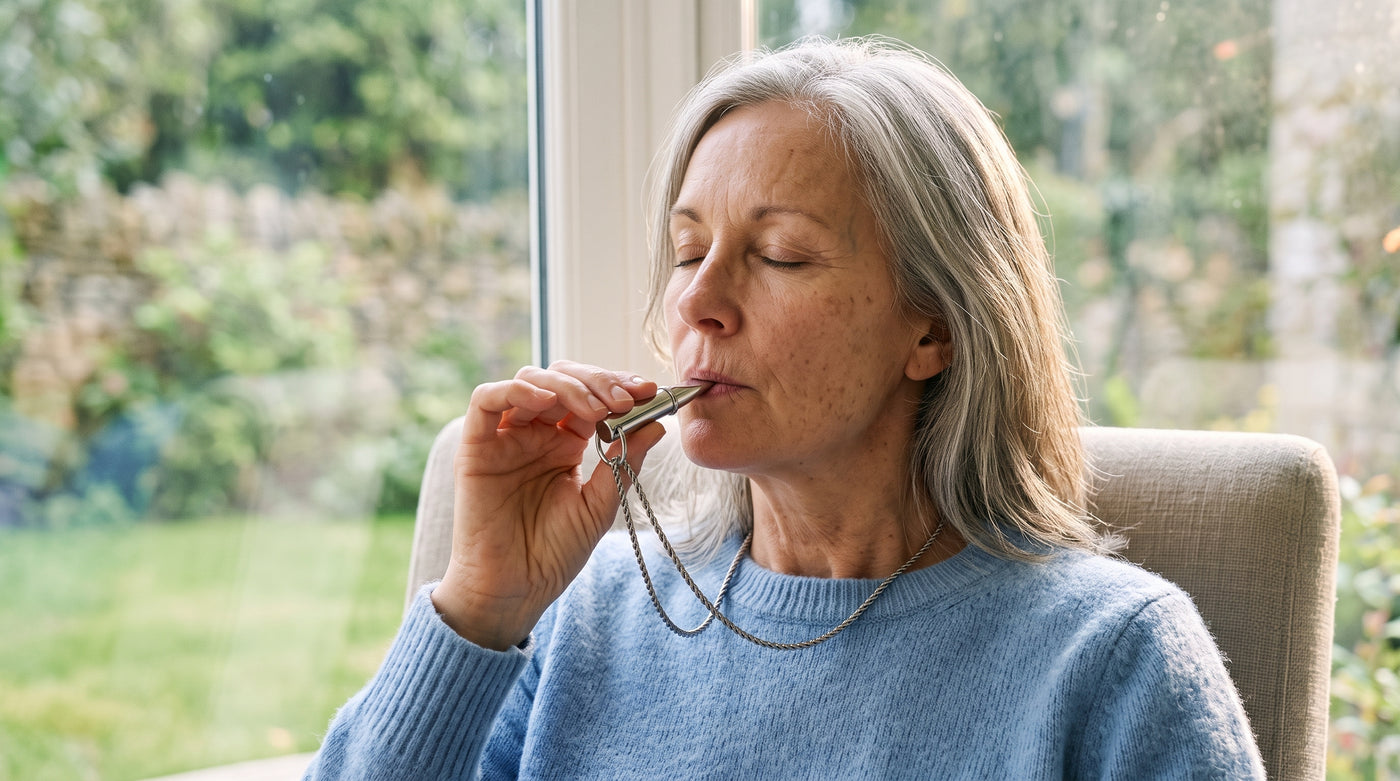
The Resistance Necklace slots into the identical physical sequence, lift, to the lips, draw in. The loop completes instead of hanging open, so the hand has somewhere to go the moment the urge hits.
3
You were still putting nicotine in your body
There's a quiet irony in most quit aids: the tool meant to free you from nicotine keeps feeding you nicotine. Patches, gum, lozenges, vapes, all of them keep the dependency alive on a lower setting. You're not escaping the drug; you're renegotiating your relationship with it, and the drug always has the better lawyer.
1.55×Nicotine replacement raises quit odds only about 1.5-fold versus placebo, it helps, but the majority still relapse (Cochrane review).
What the research says
The Cochrane review of nicotine replacement, the gold standard of evidence synthesis, puts its effect at a relative risk of just 1.55 versus control, and notes the benefit fades once you stop the therapy. The US Surgeon General's report finds unaided "cold turkey" attempts succeed only about 7–8% of the time, with relapse above 50% even among those using treatment.
Keeping nicotine in the picture, on a lower setting, keeps the dependency alive.
Sources: Cochrane Library, Nicotine replacement therapy versus control (2018) cochranelibrary.com · Smoking Cessation: A Report of the Surgeon General, NCBI Bookshelf ncbi.nlm.nih.gov
The fix
The Resistance Necklace contains no nicotine at any strength. There's no dose to taper, no lower setting to renegotiate, and nothing to wean off at the end. You breathe air through a calibrated channel, that's the whole mechanism.
4
The first two weeks had no safety net
Most relapse happens fast. The single hardest stretch is the first fortnight, and a single lapse in that window is the strongest predictor of a full return to smoking. If your only tool in those two weeks is gritted teeth, the odds are stacked against you before you start.
What the research says
A landmark study of the relapse curve in unaided quitters found that most relapse happens within the first 8 days, and that only 3–5% stay quit at 6–12 months per attempt, leading the authors to conclude that cessation support should focus squarely on the first week.
Withdrawal follows a predictable arc: symptoms begin within a day, peak around days 2–3, then ease over 3–4 weeks (Cleveland Clinic). The early window is the one that decides it.
Sources: Hughes et al., "Shape of the relapse curve," Addiction (2004), PubMed 14678060 · Cleveland Clinic, Nicotine Withdrawal clevelandclinic.org
The fix
There's no usage limit and nothing addictive, so in that first fortnight you can reach for it as often as the craving comes, fifteen, twenty times a day if you need to. Every order also includes a Nicotine Detox eBook and a private Quitters group precisely to cover that early window.
5
You lost the thing that calmed you down
You always believed the cigarette relaxed you. Here's the twist: a good part of that calm was never the nicotine, it was the breath. A slow draw in and a long breath out is, physiologically, a paced-breathing exercise. Quit, and you lose that regulator, so stress spikes with nothing to bring it down. Then the "I need a cigarette to relax" story writes itself.
What the research says
The "cigarettes relax me" belief is largely an illusion. A landmark paper in American Psychologist found smokers have slightly higher stress than non-smokers, and that the apparent calm of a cigarette is mostly just the relief of the withdrawal the last one caused. The NHS puts it plainly: nicotine tricks your body into thinking it's helping with stress.
What genuinely calms you is the breathing. Long, slow exhales against light resistance, pursed-lip breathing, activate the parasympathetic "rest-and-digest" system, slow the heart and reduce anxiety (Cleveland Clinic).
Sources: Parrott, "Does cigarette smoking cause stress?", American Psychologist (1999), PubMed 10540594 · NHS, The truth about smoking and stress nhs.uk · Cleveland Clinic, Pursed-Lip Breathing clevelandclinic.org
The fix
The Resistance Necklace keeps the exact part that was actually calming you, the slow, resisted inhale and long exhale, and drops the part that was harming you. You keep the breath. You lose the smoke.
6
The craving had nowhere to go
A craving is a wave. It builds, peaks, and passes in a couple of minutes, if you can ride it out. But willpower alone gives the wave nothing to break against. You just stand there white-knuckling it, and every time you have to do that, the reservoir of resolve drains a little lower until one afternoon it's empty.
What the research says
A craving really is a wave. Public health services put its length at just 3 to 5 minutes, and recommend the "4 Ds", delay, distract, deep breathing, drink water, to ride it out until it passes.
And breathing isn't just a distraction. In a randomised controlled trial, abstaining smokers who did a short paced-breathing exercise had significantly weaker urges to smoke than a control group, the breath itself took the edge off the craving.
Instead of resisting the wave, you redirect it. When the urge hits you lift the pendant and take the breath, same gesture, same relief, no cigarette. The craving gets an outlet rather than a fight, and your willpower isn't spent down to nothing by lunchtime.
97%of surveyed BreatheFree customers said they felt more in control of their urges, with fewer impulses to return to old habits.
Survey of BreatheFree customers, January 2025.
7
You tried to do it on willpower alone
"I'll just power through" feels noble. It's also the single most relapse-prone plan there is, because it asks one finite resource to fight a battle on two fronts, chemical and behavioural, with no tools. When it fails, you blame yourself, which makes the next attempt even harder. It's a trap dressed as virtue.
What the research says
Willpower alone is among the least effective plans there is: unaided attempts leave roughly only 3–5% of people smoke-free at 6–12 months, not for lack of grit, but because raw willpower addresses neither the chemical nor the behavioural side of the addiction.
And there's a lot of behaviour to fight. Diary research in the Journal of Personality and Social Psychology found that around 43% of daily actions are performed habitually, in the same context, on autopilot, which is exactly how a smoking ritual runs.
Sources: Hughes et al., Addiction (2004), PubMed 14678060 · Wood, Quinn & Kashy, J. Personality & Social Psychology (2002), PubMed 12500811
The fix
Stop relying on willpower to do a tool's job. Give the habit a physical substitute, keep nicotine out of the picture, and let your resolve go toward the decision to quit rather than toward surviving every single craving.
The science, in one place
Every fix above rests on the same idea, and it isn't BreatheFree's idea, it's the consensus of the research and the major health bodies. Here's the evidence, gathered.
Smoking is two addictions, not one
Smokers themselves report the ritual, the hand-to-mouth motion, the oral fixation, the routine, as a distinct pull from the nicotine. Remove the drug and the habit is still there.
"Addicted to smoking or addicted to nicotine?", National Library of Medicine · PMC8733050
Which is why most quit attempts fail
Only 8.8% of US smokers who tried to quit in 2022 succeeded. Nicotine replacement raises the odds just ~1.5× and the effect fades once you stop it.
The American Cancer Society, Mayo Clinic and NHS all recommend occupying the hands and mouth and breathing through cravings. The NHS inhalator exists to recreate the hand-to-mouth action.
Slow, long-exhale breathing raises vagal/parasympathetic activity and heart-rate variability and lowers cortisol, the physiology of "rest and digest." A meta-analysis of 31 studies confirms the cardiovascular and emotional effects.
Smokers have slightly higher stress than non-smokers; the "calm" is mostly relief of withdrawal. What actually relaxes you is the deep, paced breath, which you can keep without the smoke.
Read this before you take the science as a promise
The studies above are general research into smoking behaviour and the physiology of breathing. They are not trials of the BreatheFree Resistance Necklace, and none of them claims that breathing through a device cures nicotine addiction. They explain why the approach is built the way it is, replacing the ritual and keeping the calming breath, not that any specific outcome is guaranteed. The necklace is a wellness accessory, not a medicine or a licensed stop-smoking treatment.
The one thing that fixes all seven
Read back through the fixes and you'll notice they're the same product answering seven different failure points. That isn't a coincidence, the Resistance Necklace was built around the exact gap that patches, gum, vapes and willpower each leave open.
What makes it different
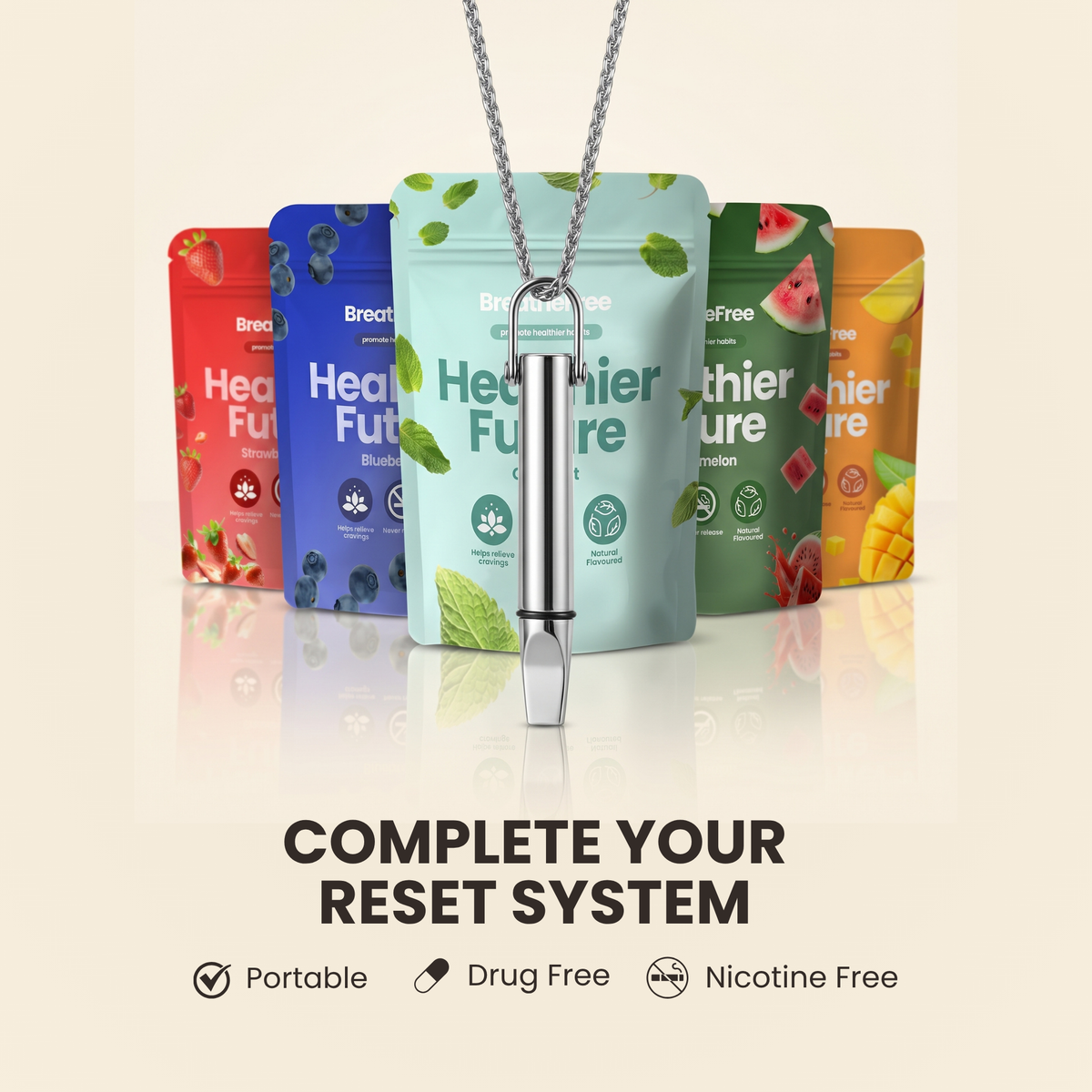
Replaces the ritual, not the drug.It's the only common approach that targets the hand-to-mouth habit without adding nicotine.
Nicotine-free and tobacco-free.No vapour, no combustion, nothing heated or burned, nothing to taper off.
Keeps the calming breath.A calibrated airflow channel gives you the resisted inhale and long exhale that were doing the real relaxing.
No battery, no charging, no limit.Reach for it as often as you need, especially in that critical first fortnight.
Works where smoking and vaping can't.Flights, trains, offices, nothing is emitted.
Rated 4.8/5 by 75,000+ customers, with a 30-day money-back guarantee.
Not a single review below three stars, out of 792. Rating data from breathefree.shop.
★★★★★
Rated 5 out of 5
I smoked for over 40 years & was able to quit with this device. My doctor had begged me to quit for years, but I was consumed with worry about failing due to the hand to mouth habit. Now, I can go for days without needing the device.
JuneBreatheFree customer
★★★★★
Rated 5 out of 5
Been smoking for 30 years... I was at 2.5 packs a day... since receiving mine I have been between 6 to 8 cigs a day... day number 3 so far. Very hopeful this will help me quit for good.
PaulaBreatheFree customer
★★★★★
Rated 5 out of 5
My tight chest is gone, I sleep through the night, and I'm back hitting the gym. The necklace uses breathing resistance to mimic that familiar draw, it's actually genius.
MargaretBreatheFree customer
★★★★★
Rated 5 out of 5
Okay, I'll admit, I was skeptical. But this actually helps curb urges. The flavors feel so refreshing.
Jake H.Verified buyer
Reviews taken from breathefree.shop and lightly trimmed for length.
Why people trust it
4.8/5average rating
75,000+customers
30 daysmoney-back guarantee
5–8 daystracked worldwide
Common questions
Is this just a vape without the nicotine?
No. There's no battery, no heating element, no e-liquid and no vapour. Nothing is heated or turned into an aerosol, you're drawing air through a calibrated channel. If you use a flavour refill, air passes around it so you catch a light aroma without inhaling any substance.
Does it actually contain nicotine?
None. No nicotine at any strength, no tobacco. It isn't a nicotine replacement therapy, so there's nothing to taper and nothing to wean off at the end.
Is BreatheFree claiming this is a medical treatment?
No. BreatheFree describe it as a wellness accessory for mindful breathing and habit replacement. It's not a medical device or a licensed stop-smoking medicine, and the studies cited on this page are general research into smoking behaviour and breathing, not trials of this specific product.
Will it work for vaping, not just cigarettes?
The mechanism is the same. Disposables hook you on the hand-to-mouth draw as much as the nicotine, and that draw is exactly what the necklace substitutes.
What if it doesn't work for me?
There's a 30-day money-back guarantee. If it doesn't work for you and you haven't quit within 30 days, email support@breathefree.shop for a refund, no questions asked.
Reader offer · Summer sale live now
Fix all seven at once.
The BreatheFree Resistance Necklace: nicotine-free, tobacco-free, battery-free. It closes the exact gap that made every other attempt fail.
£31.00£65.00Save 52%
Included free, worth £44
Nicotine Detox eBook · Progress Habit Tracker · access to the private BreatheFree Quitters Health Group
30-day money-back guarantee
If it doesn't work for you and you haven't quit within 30 days, you get a refund, no questions asked. Email support@breathefree.shop.