

Quitting cold turkey is defined as stopping nicotine use completely and immediately, with no tapering period. A 2016 randomized trial showed 49% abstinence at four weeks for abrupt cessation versus 39% for gradual reduction. That gap matters. It means the benefits of quitting cold turkey are not just psychological. They are measurable, clinical, and immediate. The challenge is that unaided cold turkey has a low success rate of 3–7% at 12 months without support. The good news: combining abrupt cessation with behavioral coaching and pharmacotherapy triples that rate to 30–35%.
1. Faster elimination of nicotine from your body
Abrupt cessation clears nicotine from your bloodstream faster than gradual reduction. When you keep smoking at a reduced rate, your body continues to process nicotine daily. That prolongs the chemical dependency cycle. Stopping completely lets your body begin detoxing from day one, and most nicotine metabolites clear within 48–72 hours.

2. Higher abstinence rates than gradual methods
Clinical evidence favors cold turkey for short and long-term quit rates. The 2016 randomized trial found a 10-percentage-point advantage for abrupt cessation at four weeks. That advantage reflects a cleaner psychological break. When you set a firm quit date and stop entirely, you remove the ambiguity of “how much is too much today.”
3. No prolonged nicotine dependence
Gradual reduction keeps you chemically dependent on nicotine for weeks or months. Cold turkey cuts that dependency immediately. This matters because every day you consume nicotine, your brain reinforces the reward pathway. Stopping abruptly forces your brain to start rebuilding its natural dopamine regulation faster.
Pro Tip: Write your quit date on paper and place it somewhere visible. A physical commitment cue reinforces your decision before withdrawal symptoms even begin.
4. Immediate cardiovascular and respiratory benefits
Within 20 minutes of your last cigarette, blood pressure and heart rate begin to drop. Within 12 hours, carbon monoxide levels in your blood normalize. These immediate health improvements are not available to gradual quitters at the same pace. Stopping completely gives your lungs and circulatory system the fastest possible recovery window.
5. A clear psychological break from your smoking identity
Smoking is not just a chemical habit. It is a behavioral identity. Cold turkey forces a sharp line between who you were as a smoker and who you are now. That psychological break is harder to achieve when you are still lighting up occasionally. Behavioral support helps you reinforce that new identity through habit substitution and trigger management.
6. Immediate cost savings
The financial benefit of stopping abruptly is straightforward. You stop spending money on cigarettes from day one. There is no “I’ll cut back to half a pack” budget math. That clarity makes it easier to track progress and redirect spending toward something meaningful, whether that is a gym membership, a vacation fund, or a quit-support tool.
7. Empowerment from a definitive decision
Making a bold, all-or-nothing choice activates a different kind of motivation than gradual reduction. People who quit cold turkey often report a stronger sense of personal agency. That sense of control is not just emotional. Research shows that willingness to attempt quitting is one of the strongest predictors of long-term success, sometimes more than the method itself.
Common challenges when quitting cold turkey
Stopping abruptly is effective, but it is not easy. Knowing what to expect reduces the shock and keeps you from interpreting normal withdrawal as failure.
The most intense phase hits between days 2 and 3. Symptoms during this window include irritability, difficulty concentrating, intense cravings, disrupted sleep, and increased appetite. These are signs your brain is recalibrating, not signs that something is wrong.
The first 14 days carry the highest relapse risk. After day 30, cravings shift from chemical to behavioral. That means the urge to smoke becomes tied to specific triggers, such as morning coffee, stress at work, or social situations, rather than physical withdrawal. This is the phase most people underestimate.
Key challenges to prepare for:
- Days 2–3: Peak physical withdrawal, including irritability, headaches, and strong cravings
- Days 4–14: Highest relapse window; emotional volatility and sleep disruption are common
- Weeks 2–4: Behavioral triggers emerge as the dominant challenge
- Month 2 onward: Identity-level habit breaking requires active substitution strategies
Pro Tip: Map your top three smoking triggers before your quit date. Write down a specific substitute behavior for each one. Having a plan for your 8:00 AM coffee craving is more useful than willpower alone.
Psychological cravings outlast physical withdrawal by weeks. Behavioral coaching addresses the trigger loops and identity shifts that medication cannot touch. Addressing both layers is what separates a 30-day quit from a permanent one.
How to increase your success rate when stopping abruptly
Unaided cold turkey has a 3–7% success rate at 12 months. Adding structured support changes that outcome significantly.
1. Add nicotine replacement therapy or medication
Combination NRT approximately doubles your success rate compared to going it alone. Using a patch for baseline coverage alongside a short-acting form like a lozenge for acute cravings outperforms single-product approaches. Prescription medications like varenicline have shown even stronger results in clinical settings.
2. Build a behavioral support system
Tell the people around you that you have quit. Recruit at least one accountability partner. Peer support reduces relapse rates by giving you someone to contact during a craving instead of reaching for a cigarette.
3. Create a quit action plan
A structured quit plan maps your triggers, identifies substitute behaviors, and sets milestones. Without a plan, you are relying on willpower at the exact moments it is most depleted.
4. Use physical activity to manage cravings
Brisk walking reduces cravings by about 50% during and after exercise. Exercise increases dopamine and endorphin release, which directly counteracts withdrawal. A 10-minute walk during a craving is not a distraction. It is a physiological intervention.
5. Replace the ritual, not just the substance
Smoking is a ritual as much as a chemical habit. Replacing your smoking ritual with a physical substitute, such as a breathing exercise, a resistance necklace, or a specific drink, addresses the behavioral layer that NRT alone cannot reach. Breathefree’s resistance necklace is designed specifically for this purpose, satisfying the oral fixation and calming ritual that many quitters miss most.
6. Practice breathing improvement techniques
Controlled breathing exercises reduce acute anxiety during cravings and help you stay grounded during the peak withdrawal window. Diaphragmatic breathing in particular activates the parasympathetic nervous system, which counteracts the stress response that drives relapse.
Is quitting cold turkey right for you?
No quit method is universally superior. The best approach aligns with your personality, smoking history, and support environment.
Cold turkey works best for people who prefer a clean break over a drawn-out process. Unaided cold turkey suits social smokers, people with strong self-regulation, and those experiencing a major life event that creates natural motivation. If you have smoked fewer than 10 cigarettes a day for less than five years, abrupt cessation is a realistic starting point.
Heavy or long-term smokers face a harder path without pharmacological support. If you smoke more than a pack a day or have tried and relapsed multiple times, adding NRT or medication is not a concession. It is evidence-based strategy.
| Profile | Best approach |
|---|---|
| Social or light smoker | Cold turkey, unaided or with minimal support |
| Heavy smoker, first quit attempt | Cold turkey plus combination NRT |
| Multiple prior relapses | Prescription medication plus behavioral coaching |
| Prefers gradual change | Structured reduction with a firm quit date endpoint |
| Major life event motivating quit | Cold turkey with peer accountability |
Psychological readiness matters as much as smoking history. If the idea of stopping today feels paralyzing, a brief reduction phase may increase your willingness to attempt a full quit. Gradual reduction increases willingness to attempt quitting among some people, even if the eventual quit is still abrupt. The goal is a permanent quit, not a perfect method.
Key Takeaways
Quitting cold turkey produces higher short-term abstinence rates than gradual reduction, but combining abrupt cessation with behavioral support and NRT is what drives long-term success.
| Point | Details |
|---|---|
| Cold turkey outperforms gradual reduction | A 2016 trial showed 49% vs. 39% abstinence at four weeks for abrupt vs. gradual cessation. |
| First 14 days are highest risk | Relapse is most likely in the first two weeks; plan support structures before your quit date. |
| Support triples success rates | Combining cold turkey with NRT and behavioral coaching raises 12-month success to 30–35%. |
| Behavioral triggers outlast withdrawal | After day 30, cravings are habit-driven, not chemical. Substitute behaviors are non-negotiable. |
| Method fit matters | Cold turkey suits light smokers and high self-regulators; heavy smokers benefit from added pharmacological support. |
What I’ve learned from watching people quit cold turkey
I have seen cold turkey work brilliantly and fail spectacularly, often for the same reason: preparation. The people who succeed are not necessarily the most motivated. They are the most prepared. They know their triggers before day one. They have a substitute behavior ready for each one. They have told someone they trust.
The biggest mistake I see is treating cold turkey as a willpower contest. It is not. Nicotine rewires your brain’s reward system over years of use. Stopping abruptly is the right call for many people, but it does not mean going it alone. The combination of medication, behavioral coaching, and a physical ritual substitute consistently outperforms any single approach.
What I find underappreciated is the identity shift required after the physical withdrawal passes. Most people expect the hard part to end at day 14. It does not. The behavioral layer, the morning coffee craving, the post-meal urge, the stress response, persists for months. Planning for that phase is what separates a 30-day quit from a permanent one. If you are serious about stopping, build your quit plan around behavior change, not just chemical withdrawal.
— Tommy
Breathefree’s tools for your cold turkey quit
Stopping abruptly is a decision. Staying stopped is a system.
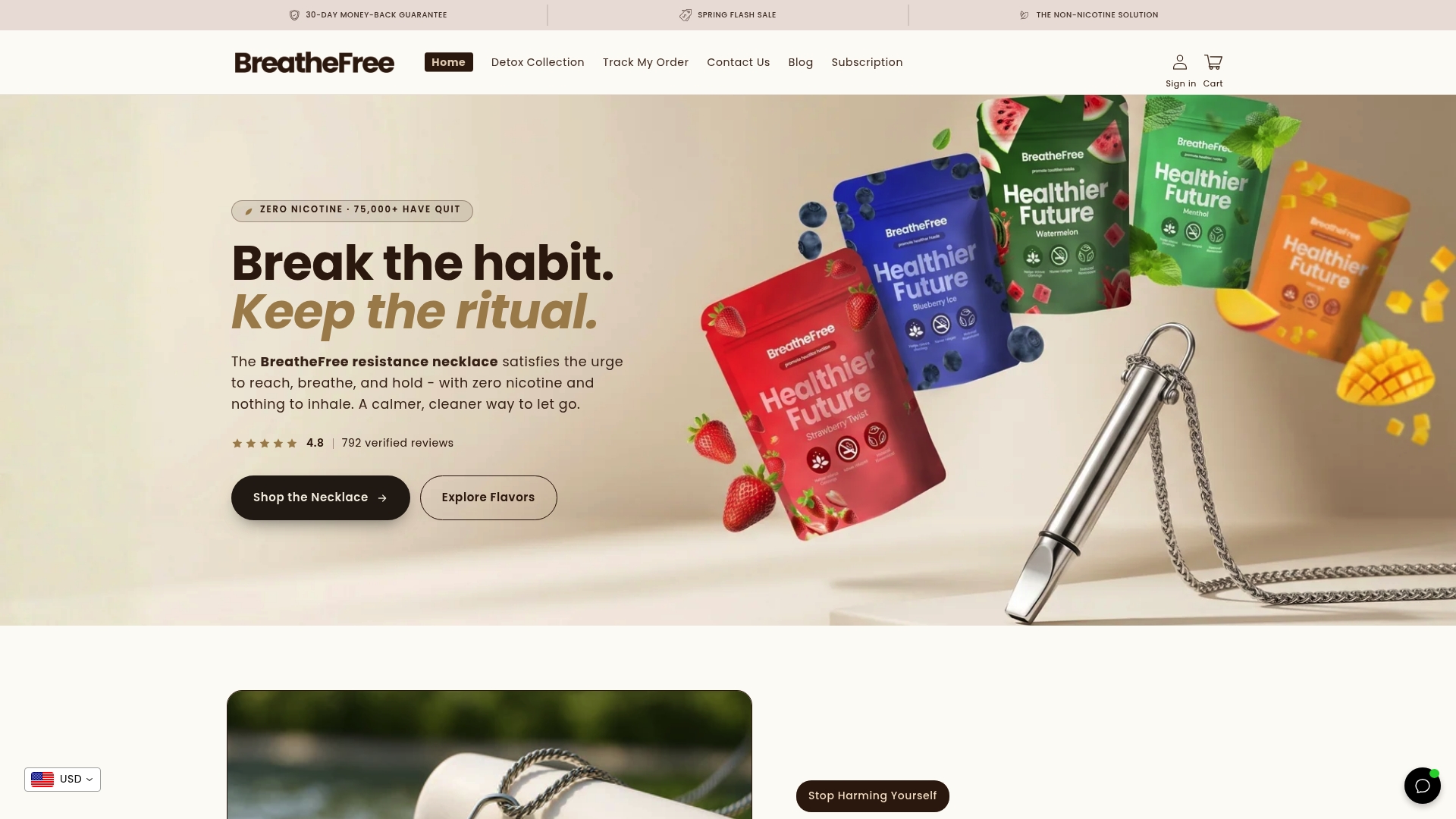
Breathefree’s Nicotine Detox eBook & Habit Tracker gives you a structured framework for the weeks that matter most. It covers withdrawal timelines, trigger mapping, and daily habit tracking so you can see your progress in real time. Over 75,000 people have used Breathefree’s approach to quit nicotine without replacement substances. The Breathefree resistance necklace addresses the oral fixation and calming ritual that most quitters miss, filling the behavioral gap that no patch or medication can cover. If you are ready to quit, these tools give your decision the structure it needs to last.
FAQ
What are the main benefits of quitting cold turkey?
The main benefits include faster nicotine clearance, higher short-term abstinence rates than gradual reduction, immediate cardiovascular improvements, and a cleaner psychological break from the smoking identity.
Is quitting cold turkey more effective than gradual reduction?
A 2016 randomized trial showed 49% abstinence at four weeks for cold turkey versus 39% for gradual reduction, making abrupt cessation the clinically stronger method for most people.
What are the worst withdrawal symptoms when quitting cold turkey?
Peak symptoms occur on days 2 and 3 and include irritability, intense cravings, difficulty concentrating, disrupted sleep, and headaches. Most physical symptoms ease significantly by day 10.
How can I improve my chances of success with cold turkey?
Adding combination NRT approximately doubles your success rate. Pairing that with behavioral coaching and a structured quit plan raises 12-month success rates to 30–35%, compared to 3–7% for unaided attempts.
Who is cold turkey quitting best suited for?
Cold turkey works best for social or light smokers, people with strong self-regulation, and those motivated by a major life event. Heavy or long-term smokers typically benefit from adding pharmacological support.