

The best structured quitting support systems in 2026 combine FDA-approved pharmacotherapy, intensive behavioral counseling (usually four or more sessions), proactive scheduled follow-up, and accessible digital or text-based supports. Most clinical guidelines specify at least four counseling sessions, though numbers can vary by program type (see typical session counts below). That combination is what separates programs with real quit rates from single-tool approaches that rarely hold up past the first month.
The elements that make a system genuinely effective:
- Combination pharmacotherapy (nicotine patch plus short-acting NRT, or varenicline) to address biochemical dependence
- Intensive behavioral counseling with at least four sessions led by trained counselors
- Proactive follow-up built into the schedule, not left to the quitter to initiate
- Digital or text adjuncts for between-session support and coping prompts
- Personalization based on tobacco type, comorbidities, and individual quit history
If you want a fast way to evaluate any program you’re considering, the checklist in the “How to choose” section below gives you the exact questions to ask.
Key Takeaways
The strongest evidence in 2026 points to one conclusion: combination pharmacotherapy plus intensive behavioral counseling, supported by proactive follow-up and digital adjuncts, produces the best quit rates of any approach tested.
| Point | Details |
|---|---|
| Combine meds and counseling | Programs pairing FDA-approved pharmacotherapy with 4+ counseling sessions outperform single-method approaches. |
| Proactive follow-up matters | Programs that contact you between sessions, rather than waiting for you to call, produce better engagement and lower dropout. |
| Digital tools amplify results | Personalized SMS interventions showed a relative risk of 1.63 for quitting versus standard care in a major network meta-analysis. |
| Free national resources exist | 1-800-QUIT-NOW, Smokefree.gov, and state quitlines provide free, evidence-aligned support with no enrollment barriers. |
| Breathefree as a behavioral adjunct | The Breathefree resistance necklace and habit tracker address oral fixation and structured planning alongside pharmacotherapy and counseling. |
Table of Contents
- What does a structured quitting support system actually mean?
- What do clinical guidelines say every top program must include?
- Where can you find structured quitting programs in the U.S.?
- How do you choose the right structured quitting program for you?
- What should you expect week by week during a structured quit plan?
- What does the evidence actually say about structured programs?
- How Breathefree’s approach fits into an evidence-aligned quit plan
- Why structured programs work, and what most people get wrong about them
- Breathefree fits naturally into your structured quit plan
- Trusted national resources for quitting support
- Sources
What does a structured quitting support system actually mean?
A structured quitting support system is a multi-component program that combines at least two evidence-based interventions, typically medication and counseling, into a coordinated plan with measurable milestones and scheduled touchpoints. It is not a single gadget, a one-time class, or a willpower strategy.
Common delivery formats include:
- Clinic-based programs run through health systems or hospital outpatient departments
- Phone-based quitlines offering immediate coaching and medication referrals
- Digital and app-based programs with tailored messaging, tracking, and optional human coaching
- Workplace or insurer-sponsored programs that integrate cessation into employee health benefits
Personalization matters more than most people expect. A program designed for a 45-year-old daily cigarette smoker with anxiety looks different from one built for a 22-year-old vaper. The best programs adapt to the type of tobacco product used, the quitter’s mental health history, pregnancy status, and prior quit attempts. That adaptability is what the clinical evidence consistently rewards.
What do clinical guidelines say every top program must include?
The strongest evidence points to four non-negotiable components. According to the VA/DOD 2026 Clinical Practice Guideline, FDA-approved pharmacotherapies are recommended for all adults using combustible tobacco (strong recommendation), varenicline is preferred over other medications for abstinence (strong), combination patch plus short-acting NRT outperforms single NRT (strong), and intensive behavioral counseling independently increases abstinence rates (strong). That is four strong-for recommendations in one guideline, which is rare.
Pharmacotherapy options at a glance:
- Nicotine patch + short-acting NRT (gum or lozenge): Combination is more effective than the patch alone; typical duration is 8–12 weeks
- Varenicline (Chantix/generic): Strongest single-agent evidence; requires a prescription and titration over the first week
- Bupropion SR: Useful when varenicline is contraindicated; also addresses mood symptoms common during withdrawal
NIDA’s research on nicotine’s addictive properties explains why medication is not optional for most people: nicotine rewires dopamine pathways in ways that behavioral strategies alone rarely overcome. Addressing that biochemical dependence is what gives counseling room to work.
Behavioral counseling is the second pillar. MedlinePlus notes that programs offering at least four sessions of 15–30 minutes, led by trained counselors, consistently outperform shorter or single-session approaches. The mechanism is straightforward: repeated sessions build coping skills, identify triggers, and create accountability across the highest-risk withdrawal window.
Text and digital supports are now mainstream adjuncts, not experimental add-ons. A large network meta-analysis published in Nature Human Behaviour found that personalized digital interventions showed a relative risk of 1.86 for quitting versus standard care, and SMS interventions showed a relative risk of 1.63. Both outperformed generic digital tools. The catch: digital programs work best when paired with pharmacotherapy or human coaching, not used alone.
Proactive outreach rounds out the picture. Programs that reach out to participants between sessions, rather than waiting for them to call back, produce better engagement and lower dropout. Motivational interviewing, used to connect people to existing evidence-based treatments, also increases treatment entry per the VA/DOD guideline.
Where can you find structured quitting programs in the U.S.?
In 2026, structured support is available through five main channels, and most are free or covered by insurance.
- State quitlines via 1-800-QUIT-NOW: Every state offers a free phone-based coaching service. Callers get immediate counseling, a quit plan, and in most states a free NRT starter kit mailed to their home. CDC’s quit-smoking resources list these services and explain how to access them.
- Smokefree: The federal government’s central hub for digital quitting supports. It runs text programs (SmokefreeTXT), apps, and tailored web tools for adults, teens, pregnant women, veterans, and Spanish speakers. Free, evidence-aligned, and available 24/7.
- American Lung Association’s Freedom From Smoking®: One of the longest-running structured programs in the country. The ALA reports it has helped over one million people quit and offers it in clinic, online, and group formats with evidence-based techniques built in.
- VA/DoD programs for veterans and military: SmokefreeVET, YouCanQuit2, and the 1-855-QUIT-VET quitline provide system-level, proactive cessation support with pharmacotherapy access and counseling built into the care pathway. The DoD’s clinical guide for providers outlines how these programs integrate medication and behavioral support at scale.
- Workplace and insurer-sponsored programs: Many large employers and health plans now cover intensive cessation programs under the ACA’s preventive services mandate. These vary widely in quality; the checklist below helps you evaluate them.
On the technology side, AI-driven personalization is now embedded in several national programs. Smokefree.gov’s text tools adapt message timing and content based on quit date, cravings reported, and prior slips. That kind of real-time tailoring is what the Nature Human Behaviour meta-analysis identified as the strongest digital signal.
Peer support amplifies every other component. Programs that build in group sessions, accountability partners, or community forums consistently show better engagement than solo digital tools. If your program doesn’t include a social layer, adding one, even informally through a peer support framework, meaningfully improves your odds.
How do you choose the right structured quitting program for you?
Choose programs that offer both medication and multiple counseling sessions (most evidence-based models include at least four), proactive follow-up, and some form of personalization. Everything else is secondary. Check the session count for your program: state quitlines typically offer 3–5, clinic-based programs may offer more, and four is the minimum threshold highlighted in most guideline recommendations.
Questions to ask any program before you enroll:
- Does the program offer FDA-approved pharmacotherapy, and will a provider help me choose the right medication?
- How many counseling sessions are included, and are they at least 15–30 minutes each?
- Is follow-up proactive (they contact me) or reactive (I have to call back)?
- What is the program’s reported quit rate, and over what time period?
- Is the cost covered by my insurance or Medicaid, and is there a free option?
- Does the program accommodate comorbidities like depression, anxiety, or COPD?
- Are there specific accommodations for pregnant women or adolescents?
- What happens if I slip? Is there a re-engagement protocol?
- Are counselors certified in tobacco treatment (CTS credential or equivalent)?
- Does the program use motivational interviewing or another validated counseling method?
Typical cost and timeline by program type:
| Program type | Typical cost to participant | Counseling sessions | Duration |
|---|---|---|---|
| State quitline (1-800-QUIT-NOW) | Free | 3–5 phone sessions | 4–8 weeks |
| Most clinical guidelines recommend at least four counseling sessions for optimal outcomes. | |||
| Check that your program meets or exceeds this threshold. | |||
| Clinic-based 12-week program | — | 6–12 sessions | 12 weeks |
| Digital program with optional coaching | Free–$30/month | Varies (several human sessions) | Flexible |
| VA/DoD program (eligible beneficiaries) | Free | Multiple sessions | Ongoing |
Pro Tip: Ask specifically whether the program follows the VA/DOD or USPSTF clinical guidelines and whether counselors hold a Certified Tobacco Treatment Specialist (CTTS) credential. Programs that can answer both questions confidently are the ones worth your time.
For a deeper look at how nicotine alternatives fit alongside these programs, the 2026 guide to quit smoking with nicotine pouches covers the options clearly.
What should you expect week by week during a structured quit plan?
The first 72 hours are the hardest, full stop. Nicotine clears the bloodstream within one to three days, and withdrawal peaks in that window: irritability, difficulty concentrating, strong cravings, and disrupted sleep are all normal. Medication started on or before quit day blunts this peak significantly.

Week 1–2: Cravings are frequent but short, typically lasting 3–5 minutes each. Counseling sessions during this phase focus on identifying triggers and building immediate coping responses. Text programs send the highest message frequency here, timed to common craving windows like morning coffee or after meals.
Weeks 3–12: Physical withdrawal fades, but psychological habit loops remain strong. This is when behavioral counseling earns its keep, helping you replace smoking rituals with alternative behaviors. Medication continues through this window; stopping early is one of the most common reasons for relapse. A structured 12-week quit plan maps this phase in detail.

Months 3–6: Most people who reach the three-month mark without smoking have a strong chance of long-term abstinence, but this phase still carries relapse risk, especially around stress events. Scheduled follow-up calls or check-ins during this window are what separate programs with good long-term outcomes from those with good short-term numbers.
On relapse: Clinical guidance is clear: a slip is not a failure, and immediate re-engagement with treatment is the recommended response. Programs that plan for relapse, rather than treating it as a program exit, produce better eventual quit rates. If you slip, contact your program the same day.
Digital supports fit across every phase. Reminders before high-risk times, coping prompts during cravings, and milestone messages at one week, one month, and three months all reinforce the behavioral work happening in sessions.
What does the evidence actually say about structured programs?
The core signal is consistent: combination pharmacotherapy plus intensive behavioral counseling produces the highest quit rates of any approach tested. A 2024 PMC review confirms that medications are most effective when complemented by counseling or support groups, and that multi-component programs outperform single-method approaches across populations.
Key findings from clinical guidance and major research:
- The VA/DOD 2026 guideline gives strong-for recommendations to FDA-approved pharmacotherapy, combination NRT, varenicline, and intensive behavioral counseling. These are the highest-confidence recommendations in the guideline.
- Personalized digital interventions showed a relative risk of 1.86 for quitting versus standard care; SMS interventions showed 1.63, per the Nature Human Behaviour network meta-analysis. Both figures come with the caveat that long-term follow-up data are limited.
- Programs with multiple counseling sessions consistently outperform shorter programs, per MedlinePlus’s summary of the evidence base.
- Device- and app-based tools increase engagement but are most effective when embedded in a clinical workflow alongside medication and counseling, not used as standalone solutions.
A note on complementary therapies: Acupuncture, hypnotherapy, and mindfulness-only programs lack sufficient evidence to be recommended as primary quitting strategies. They may support overall wellbeing during a quit attempt, but the evidence does not support using them in place of guideline-recommended pharmacotherapy and counseling. Coordinated, multi-component care consistently outperforms any single complementary approach.
How Breathefree’s approach fits into an evidence-aligned quit plan
Breathefree offers non-nicotine adjunct tools designed to address two of the most persistent barriers to quitting: oral fixation and the behavioral habit loop. These are real clinical challenges. Many people who successfully manage withdrawal medication still relapse because the hand-to-mouth ritual remains, and no pill addresses that.
The Breathefree product line maps to specific clinical needs:
- Breathing resistance necklace: Provides a physical, nicotine-free substitute for the oral fixation component of smoking. Over 75,000 users have used it as part of their quit attempt, per Breathefree’s own reported figures.
- Nicotine Detox eBook and Habit Tracker: Supports the structured planning component of a quit attempt, covering daily tracking, trigger identification, and milestone logging, the same functions a counselor reinforces in sessions.
- Essential oil nasal sticks and fidget spinner rings: Address sensory cravings and irritability during the acute withdrawal window, two symptoms that medication manages partially but not completely.
Breathefree tools work best as adjuncts, not replacements. Pair the resistance necklace and habit tracker with a provider-recommended pharmacotherapy plan and at least four counseling sessions. The necklace handles the ritual; the medication handles the biochemistry; the counseling handles the triggers. That three-part structure is what the evidence supports.
Who benefits most: adults who want a non-nicotine behavioral tool alongside NRT or varenicline, people who have tried medication alone and found the oral habit persisted, and anyone pairing a digital program with physical coping tools for a more complete system. For a broader overview of where these tools fit, the smoke-free tools guide for beginners is a practical starting point.
Why structured programs work, and what most people get wrong about them
Quitting smoking is not primarily a motivation problem. Most people who smoke want to quit. The gap between wanting to quit and actually quitting is almost always a systems problem: no medication to address the biochemical pull, no scheduled support to get through the first two weeks, no plan for what to do when a craving hits at 10 PM.
Structured programs solve that systems problem. They do not rely on the quitter to figure out the right medication dose, call a counselor at the right moment, or know instinctively how to handle a slip. The program does the scaffolding. That is why the evidence so consistently favors them over willpower-based approaches.
What most people underestimate is the role of proactive follow-up. The difference between a program that calls you and one that waits for you to call back is enormous in practice. Motivation fluctuates. Cravings don’t announce themselves at convenient times. A program that reaches out on day three, day seven, and week four catches people at exactly the moments they are most likely to slip without support.
The other thing worth saying plainly: relapse is not a sign that quitting is impossible for you. It is a sign that the program needs adjustment, usually a medication change or more frequent counseling. The clinical guidance is explicit on this. Re-engage immediately, not after a week of feeling like you failed.
Breathefree fits naturally into your structured quit plan
Quitting with medication and counseling is the evidence-backed foundation. Breathefree’s non-nicotine tools are built to fill the gaps those approaches leave open, specifically the oral habit and the between-session cravings that no pill fully covers.
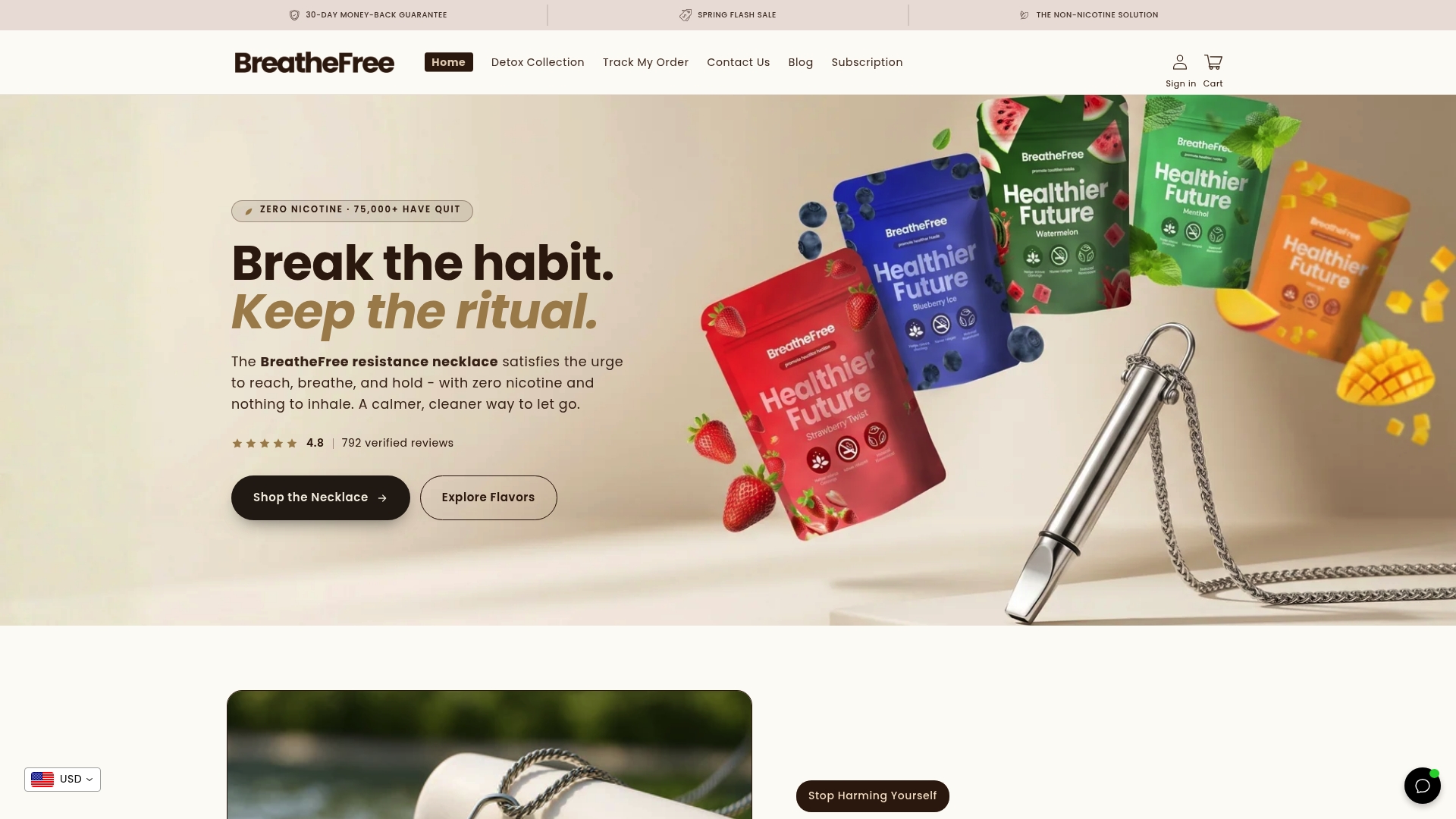
The Breathefree resistance necklace gives you something to reach for instead of a cigarette, nicotine-free, with flavor refill options to keep the ritual satisfying. Pair it with the Nicotine Detox eBook and Habit Tracker to build the daily structure your counselor reinforces in sessions. Together, they cover the behavioral side of quitting while your pharmacotherapy handles the biochemical side. Start with the habit tracker today and use it alongside whatever program you choose.
Trusted national resources for quitting support
Start with free, government-backed resources. They are the fastest path to evidence-aligned support without cost barriers.
- Smokefree: The federal hub for digital quitting tools, including SmokefreeTXT, apps, and tailored programs for specific populations. Free and available immediately.
- 1-800-QUIT-NOW: Connects you to your state quitline for free phone coaching and, in most states, a free NRT starter kit. Available in English and Spanish.
- CDC quit-smoking resources: Lists state quitlines, evidence-based tips, and links to national programs. A reliable starting point for anyone mapping their options.
- American Lung Association Freedom From Smoking®: Clinic, online, and group formats with evidence-based techniques; has helped over one million people quit.
- SmokefreeVET / 1-855-QUIT-VET / YouCanQuit2: VA and DoD programs for veterans and military personnel, with pharmacotherapy access, counseling, and proactive outreach built in.
- Breathefree quit support resources guide: A practical directory of national resources alongside Breathefree’s own tools for readers who want both clinical and behavioral support in one place.
Before enrolling in any program, confirm it offers pharmacotherapy access and at least four counseling sessions. Those two features are the clearest markers of a program built on evidence rather than good intentions.
This article is general information, not a substitute for advice from a qualified doctor. Consult a qualified healthcare professional about your own circumstances before acting on anything here.
Sources
- VA/DOD CLINICAL PRACTICE GUIDELINE FOR TOBACCO USE TREATMENT
- Efficacy of digital interventions for smoking cessation by type and method: a systematic review and network meta-analysis | Nature Human Behaviour
- A Review of Smoking Cessation Interventions: Efficacy, Strategies for Implementation, and Future Directions - PMC
- CDC — Quit smoking resources
- Smokefree
- Join Freedom From Smoking | American Lung Association
- MedlinePlus — Stop-smoking programs
- NIDA — Nicotine is addictive