

A tobacco cessation action plan is the single most effective tool you have for quitting smoking for good. People who quit smoking can gain up to 10 years of life expectancy compared to those who continue. That number alone makes a structured plan worth every minute you put into it. The standard clinical term for this process is a “smoking cessation plan,” and it combines behavioral strategies, pharmacological support, and personal trigger management into one clear roadmap. When you create a quitting smoking action plan tailored to your life, you stop relying on willpower alone and start building a system that actually works.
How to create a quitting smoking action plan that sticks
The first step in any quit smoking roadmap is picking a quit date. Choose a day when your stress level is naturally lower, such as the start of a vacation week or a quiet weekend. Avoid high-pressure periods like deadlines, family events, or holidays. A date two to four weeks out gives you enough time to prepare without losing momentum.
Once you have a date, make it real. Write it on your calendar, set a phone reminder, and tell at least two people close to you. Accountability is not a soft concept. When others know your quit date, you are far less likely to quietly push it back.
Preparing mentally is just as critical as preparing your environment. Write down your top three reasons to quit and read them every morning. Visualize yourself as a non-smoker: what you smell like, how you breathe, how you feel after a meal without reaching for a cigarette. This mental rehearsal builds a new identity before your quit date even arrives.

Environmental prep matters more than most people expect. Removing smoking paraphernalia and cues from your home, car, and workspace before quit day directly reduces urges. Throw out lighters, ashtrays, and any remaining cigarettes. Wash clothes and fabrics that carry smoke smell. Change the physical spaces where you smoked most often.
Key mental preparation steps:
- Write down your personal reasons to quit and keep them visible
- Identify your strongest emotional motivators, such as children, health, or finances
- Set a specific quit date and mark it publicly
- Visualize a smoke-free version of your daily routine
- Remove all smoking-related objects from your environment before quit day
Pro Tip: Tell a friend or family member your quit date and ask them to check in with you on that morning. That one text message can be the difference between following through and delaying.
How do you identify and manage your personal smoking triggers?
Identifying triggers is as critical as managing physical withdrawal for long-term success. A trigger is any situation, emotion, or environment that creates an urge to smoke. Common triggers include morning coffee, driving, stress at work, alcohol, and social settings where others smoke.
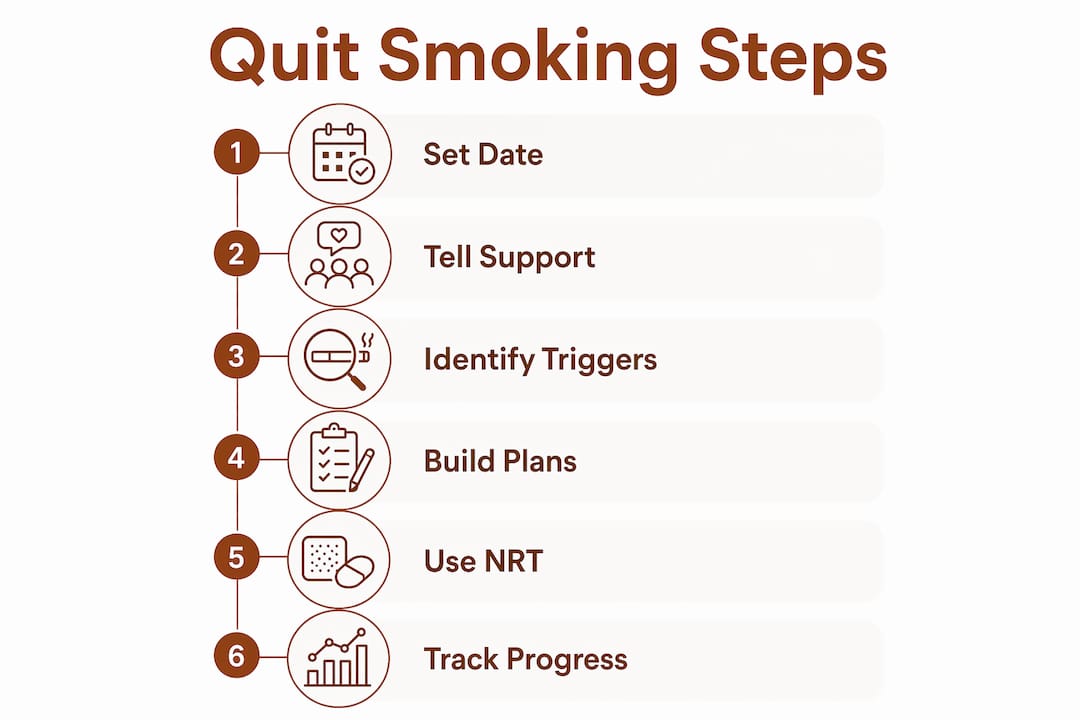
The most reliable way to map your triggers is to keep a smoking diary for one week before your quit date. Every time you light up, note the time, your location, your mood, and what you were doing. After a few days, patterns emerge. You might discover that 60% of your cigarettes happen in just two or three specific situations.
Once you know your triggers, you can build a response plan for each one. The goal is not to avoid life. The goal is to replace the automatic smoking response with a different behavior.
| Trigger | Replacement strategy |
|---|---|
| Morning coffee | Switch to tea or take a short walk instead |
| Driving | Keep gum or a Breathefree resistance necklace in the car |
| Stress at work | Use a 2-minute breathing exercise or step outside |
| Social situations | Hold a drink, use a physical object, or step away briefly |
| After meals | Brush your teeth immediately or chew sugar-free gum |
Rearranging daily routines also helps. If you always smoked on the back porch after dinner, change that routine entirely. Eat in a different room, go for a short walk, or call a friend. Breaking the physical habit loop weakens the trigger over time.
Pro Tip: Use the quit smoking using physical objects approach to replace the hand-to-mouth ritual. Many people underestimate how much of their craving is behavioral rather than purely chemical.
What support systems actually help you quit smoking?
Healthcare providers are essential partners in building a personalized cessation plan. Your doctor or pharmacist can review your health history, recommend the right pharmacological support, and provide non-judgmental guidance throughout the process. A single conversation with your doctor before your quit date can significantly change your approach.
Combining behavioral counseling with pharmacotherapy consistently produces higher quit rates than either method alone. Behavioral counseling, including cognitive-behavioral therapy and mindfulness-based techniques, teaches you to recognize thought patterns that lead to smoking and replace them with healthier responses. These are skills you build over time, not a one-time fix.
Behavioral support options worth considering:
- Quitlines: Free telephone counseling services staffed by trained cessation specialists
- Cognitive-behavioral therapy (CBT): Structured sessions that address the thought patterns behind cravings
- Mindfulness practice: Teaches you to observe cravings without acting on them
- Support groups: In-person or online communities of people at the same stage of quitting
- Quit apps and journals: Digital tools that track smoke-free days, money saved, and health milestones
Family and friends play a real role too. Ask specific people for specific support. “Please don’t offer me a cigarette, even as a joke” is a clearer request than a general “please support me.” The more concrete your ask, the more useful the support you receive.
Exploring behavioral health strategies that address the psychological side of addiction gives you tools that outlast any medication. The mental work is where most quit attempts succeed or fail.
What does quitting smoking involve with nicotine replacement therapy?
Nicotine has a biological half-life of roughly 2 hours. Withdrawal symptoms peak within 2–4 days after your last cigarette. Knowing this timeline removes a lot of fear. The worst of it passes quickly, even though it does not feel that way in the moment.
FDA-approved nicotine replacement therapies (NRT) reduce withdrawal intensity by delivering controlled, lower doses of nicotine without the toxic chemicals in cigarette smoke. The three most accessible forms are:
| NRT type | How it works | Best for |
|---|---|---|
| Nicotine patch | Delivers steady nicotine through the skin over 16–24 hours | Heavy smokers needing consistent baseline relief |
| Nicotine gum | Provides on-demand relief when cravings spike | Managing situational or sudden urges |
| Nicotine lozenge | Dissolves in the mouth for fast absorption | People who prefer a discreet, portable option |
Combining a long-acting NRT like a patch with a short-acting form like gum or lozenges produces better results than using one method alone. The patch handles background cravings while the gum or lozenge addresses sudden spikes.
Withdrawal symptoms like sleep disruption, anxiety, and irritability are temporary. They typically resolve within a few weeks. Understanding that these symptoms are a sign your body is healing, not failing, changes how you experience them.
Pro Tip: Learn what happens to your brain without nicotine before your quit date. Understanding the neuroscience of withdrawal makes the experience feel less random and more manageable.
How do you track progress and stay smoke-free long term?
Keeping a quit diary is the most underused tool in long-term cessation. Record your smoke-free days, the money you have saved, and physical changes you notice, such as improved breathing, better sleep, or food tasting different. Seeing concrete progress on paper reinforces your motivation during hard stretches.
- Set weekly milestones. Celebrate one week, two weeks, and one month smoke-free with a specific reward you plan in advance.
- Track your savings. Calculate what you spent on cigarettes monthly and redirect that money toward something visible and meaningful.
- Log craving episodes. Note the time, trigger, and how you responded. This data helps you refine your coping strategies.
- Schedule follow-up check-ins. Book a call or appointment with your doctor or counselor at the two-week and one-month marks.
- Build a contingency plan. Identify two or three high-risk situations coming up and decide in advance exactly how you will handle them.
Cravings last only 3–5 minutes. The skill is outlasting them, not eliminating them. When a craving hits, use a timer. Drink water, take five deep breaths, or walk to a different room. By the time the timer goes off, the craving has almost always passed.
If you slip and smoke a cigarette, do not treat it as total failure. Each quit attempt gives you diagnostic information about which triggers and coping strategies need more work. Treat a slip as data, adjust your plan, and continue. Most people who quit successfully made multiple attempts before it stuck.
Key takeaways
A structured tobacco cessation action plan that combines a set quit date, trigger management, behavioral support, and NRT gives you the strongest foundation for lasting success.
| Point | Details |
|---|---|
| Set a strategic quit date | Choose a low-stress period and tell people close to you to build real accountability. |
| Map your personal triggers | Keep a smoking diary for one week to identify the situations that drive most of your cravings. |
| Combine support methods | Pairing behavioral counseling with pharmacotherapy produces better results than either alone. |
| Use NRT correctly | Combine a long-acting patch with short-acting gum or lozenges for full-day craving coverage. |
| Treat slips as data | Each relapse reveals a gap in your plan. Adjust your strategy and keep going. |
What I’ve learned from watching people quit the hard way
Most people who fail at quitting do not fail because they lack willpower. They fail because they treated quitting as a single event instead of a process. They picked a quit date, white-knuckled through a few days, hit one bad trigger, and concluded they were not the type of person who could quit. That story is wrong, and it costs people years of their lives.
The plans that actually work share one trait: they are specific. Not “I will avoid stress” but “when my boss calls on a Friday afternoon, I will take three deep breaths and chew a piece of nicotine gum before I respond.” That level of detail feels excessive until you are in the moment and your brain is screaming for a cigarette.
The other thing I have seen consistently is that people underestimate the oral fixation component. Nicotine patches handle the chemical side. They do nothing for the hand-to-mouth habit, the ritual of stepping outside, or the feeling of holding something. That gap is where a lot of quit attempts fall apart, and it is worth addressing directly in your plan.
Professional support also matters more than most people admit. There is a real reluctance to ask a doctor for help quitting, as if it signals weakness. Doctors who specialize in cessation are not there to judge you. They are there to give you better tools. Use them.
Finally, give your plan permission to evolve. The version you write today will not be the version that gets you to one year smoke-free. That is fine. Refine it as you learn more about yourself.
— Tommy
Breathefree tools to support your quit plan
Building a quit plan is one thing. Having the right materials to execute it daily is another.

Breathefree’s Nicotine Detox eBook & Habit Tracker gives you a structured system for tracking cravings, logging milestones, and staying accountable through the hardest weeks. The habit tracker is built specifically for the behavioral side of quitting, the part most people leave to chance. Over 75,000 people have used Breathefree’s approach to break free from nicotine. The eBook and tracker give you the same framework in a format you can use every single day, starting right now.
FAQ
What is a tobacco cessation action plan?
A tobacco cessation action plan is a personalized written strategy that outlines your quit date, trigger management tactics, support resources, and pharmacological options. It replaces willpower-only attempts with a structured, repeatable system.
How long does nicotine withdrawal last?
Withdrawal symptoms typically peak within 2–4 days after your last cigarette and resolve within a few weeks. Symptoms like irritability, anxiety, and sleep disruption are temporary signs that your body is adjusting.
Should I use nicotine replacement therapy to quit?
FDA-approved NRT options like patches, gum, and lozenges reduce withdrawal intensity and improve quit rates. Combining a long-acting patch with a short-acting form like gum produces the best results for most people.
What if I relapse during my quit attempt?
A relapse is not a failure. Each slip provides information about which triggers and coping strategies need strengthening. Adjust your plan based on what you learned and continue from where you are.
How do I identify my smoking triggers?
Keep a smoking diary for one week before your quit date. Log the time, location, mood, and activity for every cigarette. Patterns will emerge within a few days and show you exactly where to focus your coping strategies.