

Yes, you can quit vaping without nicotine, but it takes a deliberate plan, not willpower alone. You need something for your hands and mouth, a way to break the trigger-response loop, and a realistic expectation that withdrawal will hit for a week or two. Start today: pick a quit date, remove every device from reach, and choose one or two nicotine-free substitutes to carry with you. If mood swings or withdrawal symptoms feel severe, talk to a clinician or call a quitline rather than pushing through alone.
TL;DR:
- Using two different physical substitutes, such as a resistance necklace and chewing gum, can help prevent dependency on any one object during withdrawal.
- Tracking triggers and applying a four-minute distraction technique reduces the intensity and duration of cravings in the initial quitting phase.
- Nicotine-free vaping products often contain hidden nicotine or chemicals, making non-inhaled alternatives the safer choice for behavioral habit replacement.
- Setting a firm quit date and relying on structured support programs like text-message interventions significantly improve long-term quitting success rates.
- Building a personalized routine that includes removing devices, rotating substitutes, and environment changes helps break the vaping ritual effectively.
Table of Contents
- Nicotine-Free Alternatives You Can Use Today
- How Do You Break the Vaping Ritual Itself?
- Building a Nicotine-Free Quit Plan Week by Week
- Are Nicotine-Free Vapes and Zero-Nic Aerosols Safe?
- What Evidence Actually Supports This Approach?
- What I Learned Quitting Without Nicotine in Week One
- How Breathefree Supports a Nicotine-Free Quit
- Where to Get Help and Keep Learning
- Sources
Nicotine-Free Alternatives You Can Use Today
Vaping satisfies two separate urges at once: the physical habit of hand-to-mouth movement and the ritual of a break, a pause, a reward. Nicotine-free substitutes work best when they address both without reintroducing an inhaled aerosol.
Chewing-based options give your jaw something to do during the exact moments cravings spike. Sugar-free gum, mints, and crunchy snacks like carrots or roasted chickpeas mimic the repetitive motion of a vape hit, and the sensory feedback (crunch, cooling flavor) can interrupt a craving in under a minute.

Hand-to-mouth tools replace the physical gesture itself, which matters more than most quitters expect. Flavored toothpicks, drinking straws, and a resistance necklace give your hand something familiar to hold and bring to your mouth, while fidget rings address the restlessness that shows up separately from oral cravings.
Sensory swaps target the ritual without touching your lungs at all. Essential-oil nasal sticks deliver a sharp, satisfying sensation through the nose, sipping cold water resets your mouth and hands simultaneously, and non-thermal aroma inhalers give you a “hit” of scent without any combustion or vapor.
- Chewing: sugar-free gum, mints, crunchy vegetables
- Hand tools: resistance necklace, toothpicks, fidget rings
- Sensory: essential-oil nasal sticks, cold water, aroma inhalers
Pro Tip: Rotate between two substitutes instead of relying on one. If you only ever reach for gum, your brain can start treating gum as “the new vape,” recreating the same dependency loop with a different object.
Pick your top two now, keep them within arm’s reach at your usual trigger points (car, desk, couch), and see how physical objects can replace the ritual for a longer breakdown of what to carry where.
How Do You Break the Vaping Ritual Itself?
Vaping runs on a loop: a cue triggers an urge, you vape (the routine), and you get relief (the reward). Breaking that loop nicotine-free means keeping the cue, swapping the routine, and finding a different reward.
- Track your pattern for three days. Log the time, place, and mood every time you reach for your device. Most people find their vaping clusters around four or five specific triggers, not random moments throughout the day.
- Match a swap to each trigger. After meals, brush your teeth immediately. During stress, do 10 slow breaths. On your commute, chew gum. In social settings, hold a drink in your dominant hand.
- Use the four-minute rule. Most cravings peak and fade within about four minutes. Set a timer, distract yourself with a short walk or a phone game, and let the urge pass instead of negotiating with it.
- Change your environment, not just your mindset. Remove devices from your car and bag, take a different route past your usual vape spot, and build a new break routine at work that doesn’t involve stepping outside alone.
Avoid the trap of “just one vape without nicotine” as a bridge. Oral habits persist long after the chemical dependency fades, so keeping the inhaling motion alive, even nicotine-free, tends to slow down the habit’s actual extinction rather than speed it up.
Building a Nicotine-Free Quit Plan Week by Week
A quit date works better than “cutting back gradually” for most people, because it gives your brain a clear line instead of an endless negotiation. Health organizations consistently recommend setting that date, naming your triggers in advance, and tracking slips as data rather than failure.
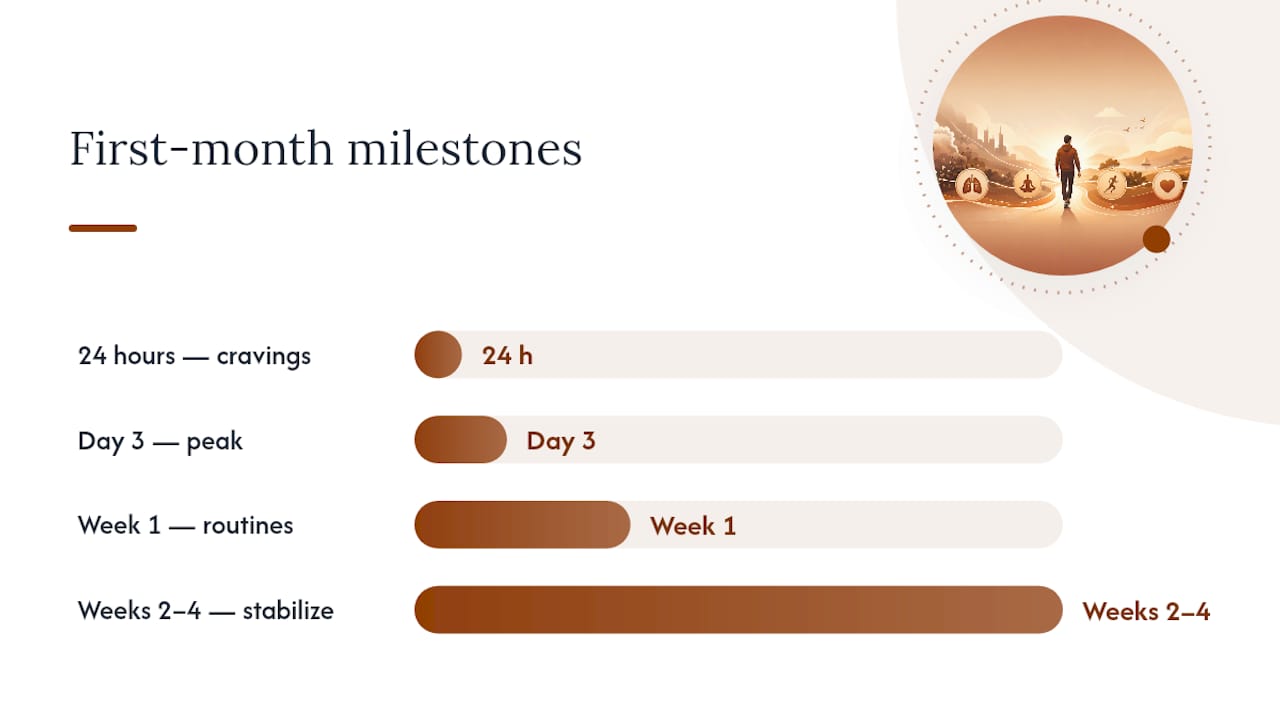
Here’s a rough shape for the first month:
- 24 hours in: Expect irritability and strong cravings. Keep your craving kit (gum, necklace, nasal stick) on you at all times.
- Day 3: Physical withdrawal often peaks around now. Prioritize sleep and water over anything else.
- Week 1: Cravings shorten but hit at predictable times. Build a morning routine and an evening wind-down that don’t involve your hands being free and bored.
- Week 2 to 4: Mood stabilizes for most people. Watch for high-risk windows like parties, deadlines, or breakups, and have a craving script ready (“this will pass in four minutes, I’ve done this before”).
Write a one-line script for your three worst triggers before you need it, not during the moment. If withdrawal includes chest pain, severe depression, or thoughts of self-harm, that’s a signal to escalate to a clinician immediately rather than continue solo.
Are Nicotine-Free Vapes and Zero-Nic Aerosols Safe?
Not entirely, and the label deserves more skepticism than most quitters give it. Independent testing has repeatedly found “nicotine-free” vape products that actually contain trace nicotine or unlisted chemicals, which undercuts the entire point of using one to quit.
Beyond mislabeling, inhaling any aerosol, nicotine-free or not, still exposes your lungs to volatile organic compounds and heated flavoring chemicals whose long-term effects remain poorly understood. Public health guidance treats “nicotine-free vaping” as a harm-reduction step at best, not a clean exit.
- Zero-nic vapes may ease the transition off nicotine dependence for some people
- They do nothing to address chemical dependence itself, since there’s no nicotine to wean off
- Inhalation risk stays present regardless of nicotine content
- Some products marketed as nicotine-free have tested positive for nicotine
A systematic review of vaping cessation methods found low-certainty evidence that nicotine-free vapes alone help people quit, while other research suggests nicotine-containing e-cigarettes outperform nicotine-free versions for cessation, though nicotine-free versions can still help with the behavioral side. If your goal is avoiding inhalation entirely, a non-inhaled substitute is the more consistent choice.
What Evidence Actually Supports This Approach?
Text-based support programs are one of the few interventions with solid trial data behind them. A randomized trial found text-message programs can raise quit odds by up to 40 percent among young adults, likely because they deliver encouragement and coping tips at the exact moments cravings hit hardest.
The appetite to quit is already there. About 67 percent of nicotine users aged 18 to 24 plan to quit within the year, which suggests the gap isn’t motivation, it’s having a structured plan and the right tools on hand.
- Sign up for a free text program (EX Program or This Is Quitting) the same day you set your quit date
- Pair text support with a physical substitute like a resistance necklace for the oral-fixation piece
- Track your progress daily instead of relying on memory to spot patterns
Combining behavioral support with a physical cessation tool can more than triple your odds of quitting compared to trying alone, according to Truth Initiative’s own quit-support research.
What I Learned Quitting Without Nicotine in Week One
Day one, I pulled every device out of my car, desk drawer, and jacket pocket before I could talk myself out of it. Day two, I signed up for a text-support program and clipped a resistance necklace to my keys so it was always in reach. By day four, cravings still hit hard around 3 p.m., but four minutes of walking outside made them pass faster than I expected. I had one slip on day six, at a friend’s barbecue, and instead of treating it as a reset, I logged it as data: stress plus alcohol plus no substitute in hand. That pattern became the thing I fixed in week two.
— Tommy
How Breathefree Supports a Nicotine-Free Quit
Breathefree is built specifically for the moment described above: the hand that wants something to hold, the mouth that wants something to do, and the four minutes when a craving feels unbeatable. The resistance necklace gives you a discreet, reusable tool for that exact gesture, with flavor refills so the sensory ritual doesn’t go stale after week two.

Pair it with the Nicotine Detox eBook and habit tracker, which turns the trigger log described earlier into a structured, day-by-day record instead of scattered notes on your phone. Use the necklace during high-risk windows, log the craving in the tracker right after, and rotate flavors every couple of weeks so the tool keeps feeling new rather than automatic. Some users have reported using this method to work toward quitting, without adding another inhaled product to the mix. If you’re ready to build your kit, start with the necklace and tracker bundle and set your quit date this week.
Where to Get Help and Keep Learning
For real-time support, Smokefree’s withdrawal guidance walks through what to expect day by day, and Mass General Brigham’s quit-vaping overview covers when to loop in a doctor. For anxiety management during cravings, this behavioral toolkit offers practical techniques worth trying alongside your physical substitutes. For a deeper look at swapping the ritual itself, see how to replace your smoking ritual healthily.
This article is general information, not a substitute for advice from a qualified doctor. Consult a qualified healthcare professional about your own circumstances before acting on anything here.
Sources
- Truth Initiative press release: New Truth Initiative survey indicates most young people who use nicotine say
- Randomized trial of text messaging for smoking cessation (PubMed entry)
- Smokefree: Nicotine withdrawal and vaping
- Systematic review on vaping cessation interventions (PMC)