

Nicotine replacement therapy (NRT) fails primarily because it addresses physical dependence while leaving brain receptor adaptation, behavioral triggers, and dosing errors completely unresolved. If you have tried patches, gum, or lozenges and relapsed anyway, you are not alone and you did not fail because of weak willpower. Clinical research as of 2026 confirms that why nicotine replacement fails comes down to predictable biology and correctable mistakes. Understanding those mechanisms is the first step toward a quit attempt that actually holds.
Why nicotine replacement fails at the biological level
The most critical window in any quit attempt is the first 72 hours. Most quit attempts collapse at the 48–72 hour mark because of what researchers call the “Day 3 wall.” This is not a metaphor. It is a measurable physiological event driven by peak stress hormones and a process called dopamine receptor recalibration.
When you smoke regularly, your brain builds extra nicotine receptors to handle the constant stimulation. Remove nicotine suddenly, and those receptors flood your system with craving signals while stress hormones spike simultaneously. NRT slows the drop in nicotine levels, but it does not stop receptor recalibration from happening. The brain still goes through withdrawal. It just does so more gradually.
The Day 3 withdrawal wall is a receptor adaptation phenomenon where brain nicotine receptors undergo downregulation, triggering continuous cravings and stress hormone spikes. This fundamentally limits unaided quit attempts and reduces the effectiveness of standard-dose NRT during the most vulnerable hours.
This explains why so many people wearing a patch still feel desperate cravings on day two or three. The patch is delivering nicotine, but not at the speed or intensity the brain expects. That mismatch between what NRT delivers and what the brain demands is one of the core reasons nicotine addiction relapse happens even when people follow instructions.
How improper dosing and stopping too early cause NRT to fail

Under-dosing is one of the most common and most correctable reasons for NRT failure. Heavy smokers need 21 mg patches and 4 mg gum or lozenges to start, yet many people choose lower doses out of caution or reduce their dose too quickly. The result is a nicotine gap that makes cravings unmanageable.
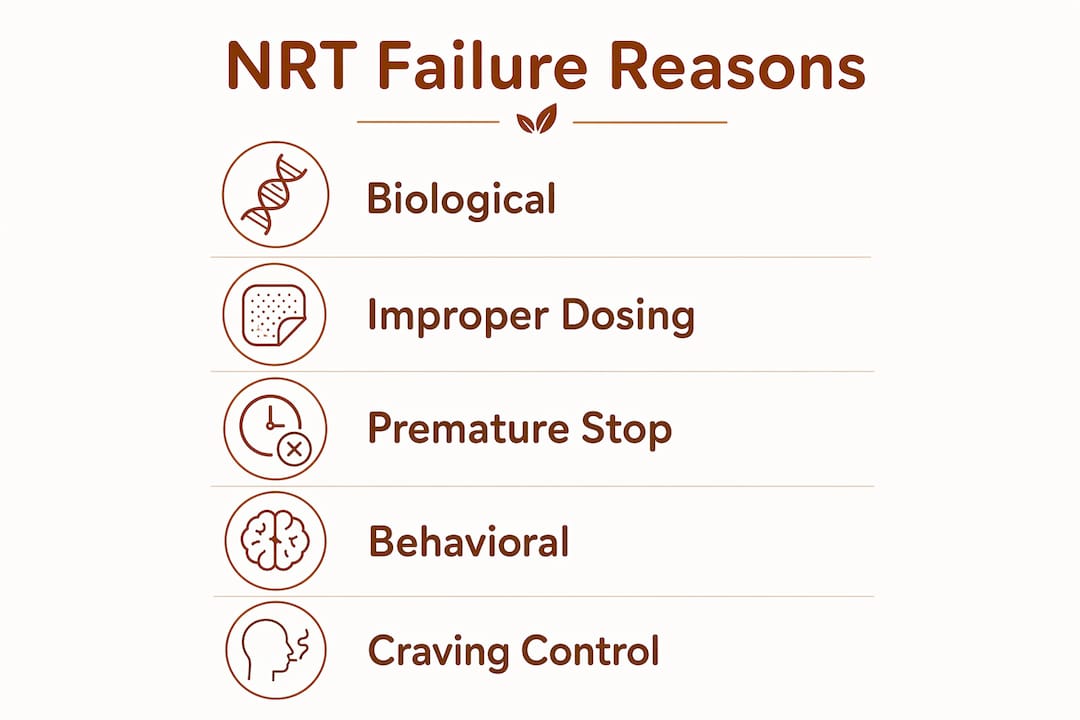
Stopping treatment early compounds the problem. Most people quit NRT at the 4–6 week mark, often because they feel better or assume the hard part is over. Clinical guidelines recommend 8–12 weeks of consistent use. Extended NRT use at optimal doses significantly improves abstinence rates without clinical harm compared to continuing to smoke.
Side effects also drive people off their regimen prematurely. Mild skin irritation from patches and hiccups from gum are common reactions. Many people confuse these normal effects with signs that the treatment is not working or is harming them. That misreading leads to inconsistent use, which is nearly as ineffective as no treatment at all.
- Start at the dose matched to your smoking level, not the lowest available option.
- Do not taper before week 8 unless a clinician advises it.
- Treat mild skin irritation by rotating patch sites daily.
- Treat gum-related hiccups by slowing your chewing pace and parking the gum between cheek and gum.
- Track your cravings daily so you can see progress even when it does not feel obvious.
Pro Tip: Keep a craving log for the first two weeks. Seeing craving frequency drop from 20 times a day to 8 is concrete proof the NRT is working, even when you still feel the urge.
Why do nicotine patches fail to control breakthrough cravings?
Patches are the most widely used NRT product, but their delivery mechanism creates a structural problem. Patches deliver nicotine slowly and at much lower peak concentrations than a cigarette. A cigarette delivers a sharp nicotine spike to the brain within seconds. A patch provides a slow, steady baseline. That baseline prevents severe withdrawal but does nothing for the sudden, intense cravings triggered by stress, boredom, or habit cues.
A June 2026 study from the University of Wisconsin Center for Tobacco Research and Intervention found that adding patches to varenicline and counseling did not significantly reduce cravings or withdrawal symptoms in early quit attempts. This result points to a clear conclusion: patches alone cannot carry the full weight of cessation, especially in the first critical weeks.
Combination therapy closes this gap. Using a long-acting patch alongside a fast-acting product like gum or a lozenge gives you the steady baseline plus an on-demand tool for breakthrough cravings. The patch handles the background level. The gum handles the spike. Together, they better replicate the nicotine delivery pattern the brain has adapted to expect.
| Delivery method | Speed of nicotine delivery | Best use case |
|---|---|---|
| Nicotine patch | Slow, steady over 16–24 hours | Preventing baseline withdrawal |
| Nicotine gum or lozenge | Fast, within 20–30 minutes | Managing breakthrough cravings |
| Combination therapy | Both slow and fast | Comprehensive craving control |
Pro Tip: Use your fast-acting NRT product proactively before high-risk situations like meals, commutes, or social events. Waiting until a craving peaks makes it much harder to manage.
What psychological and behavioral factors cause NRT failure?
NRT only addresses the physical side of nicotine dependence. Behavioral cues tied to smoking rituals require dedicated, multi-faceted behavioral interventions to overcome. This is the gap that catches most people off guard.
Smoking is woven into daily routines. The morning coffee, the post-meal cigarette, the smoke break with coworkers. These are not just habits. They are conditioned responses where the brain has linked a specific context to the act of smoking. NRT removes the chemical need but leaves the conditioned response fully intact. When the trigger appears, the urge fires regardless of how much nicotine is in your bloodstream.
- Map your triggers. Write down every situation where you typically smoke. Time of day, emotional state, location, and social context all count.
- Replace the ritual, not just the substance. Replacing your smoking ritual with a physical substitute, such as a breathing exercise or a textured object to hold, addresses the behavioral loop directly.
- Prepare a response for each trigger. Decide in advance what you will do when the urge hits in each high-risk context.
- Recognize the relapse-shame loop. Relapse is often misread as willpower failure, which triggers shame, which reduces motivation to try again. Framing relapse as a predictable receptor event, not a character flaw, improves clinical outcomes.
- Add structured behavioral support. Behavioral support alongside NRT consistently outperforms NRT used in isolation.
Physical withdrawal peaks and then subsides within the first week. The behavioral habits, however, persist for months and require structured intervention to rewire. This is why people who complete NRT successfully still relapse weeks later when a powerful trigger appears without a prepared response.
How can you optimize NRT to improve your chances of quitting?
Getting NRT right requires treating it like a medical protocol, not a consumer product you adjust based on how you feel day to day. Under-dosing often stems from fear of side effects and a misunderstanding of how dosing works. Education and clinical support reduce both problems significantly.
- Match your starting dose to your smoking level. If you smoke more than 10 cigarettes a day, start with the highest available patch strength.
- Use combination therapy from day one. Pair a long-acting patch with fast-acting gum or lozenges for breakthrough cravings.
- Plan specifically for the Day 3 wall. Know it is coming, schedule low-stress activities, and have your behavioral substitutes ready.
- Do not stop NRT because you feel better at week 4. Stay on the full 8–12 week course.
- Consult a clinician if cravings remain severe after two weeks at full dose. Prescription options exist that work through different mechanisms and can be combined with NRT.
Building a structured quit plan before your quit date dramatically improves follow-through. People who quit without a plan are far more likely to make dosing errors and abandon treatment during the hardest days.
Key Takeaways
NRT fails most often because of brain receptor adaptation, under-dosing, premature discontinuation, and unaddressed behavioral triggers, not because quitting is impossible.
| Point | Details |
|---|---|
| The Day 3 wall is biological | Peak stress hormones and dopamine recalibration cause the hardest cravings, regardless of NRT use. |
| Dose and duration matter | Heavy smokers need 21 mg patches and 4 mg gum, used consistently for 8–12 weeks. |
| Patches alone are not enough | Combination therapy with fast-acting NRT controls breakthrough cravings that patches cannot reach. |
| Behavioral triggers outlast withdrawal | Conditioned smoking rituals persist for months and require structured habit replacement strategies. |
| Relapse is chemistry, not character | Framing relapse as a receptor event, not a moral failure, improves persistence and outcomes. |
What I have learned from watching people quit and relapse
The most damaging myth in smoking cessation is that relapse means you are not trying hard enough. I have seen people go through four or five serious quit attempts, each time walking away more convinced they simply lack the discipline to succeed. That belief is wrong, and it is also dangerous because it stops people from trying again with a better approach.
What actually happens is predictable. The brain is not being stubborn. It is running a chemical process that NRT partially manages but does not fully override. The people who succeed are not tougher. They are better prepared. They know the Day 3 wall is coming. They have a fast-acting product ready for breakthrough cravings. They have mapped their triggers and built a substitute response for each one.
Treating NRT like a medical prescription rather than a consumer product changes everything. You would not stop antibiotics because you felt better on day five. The same logic applies here. Persistence through the discomfort, combined with the right dose and behavioral support, is what separates a successful quit from another relapse.
— Tommy
Tools from Breathefree to support your quit attempt
Quitting is easier when you understand exactly what your brain and body are doing at each stage. Breathefree built the Nicotine Detox eBook and Habit Tracker specifically for people who want that clarity. The eBook walks you through the biology of addiction, the Day 3 wall, and the behavioral triggers that outlast physical withdrawal.

The Habit Tracker gives you a daily structure to log cravings, identify patterns, and measure real progress. Over 75,000 people have used Breathefree’s approach to quit without relying on nicotine-based products alone. If you want a plan that accounts for both the physical and behavioral sides of quitting, these tools give you a concrete starting point.
FAQ
Why do nicotine patches fail even when used correctly?
Patches deliver nicotine slowly and at lower peak levels than cigarettes, which means they prevent baseline withdrawal but cannot stop breakthrough cravings triggered by stress or habit cues. Combining a patch with a fast-acting product like gum or a lozenge addresses this gap.
What is the most common dosing mistake with NRT?
The most common mistake is starting at too low a dose or stopping treatment at 4–6 weeks instead of completing the recommended 8–12 week course. Heavy smokers should begin with 21 mg patches and 4 mg gum or lozenges.
Does relapsing mean NRT is not working?
Relapse during NRT most often reflects receptor adaptation and unaddressed behavioral triggers, not treatment failure. Adjusting the dose, adding behavioral support, and restarting the quit attempt improves outcomes significantly.
Why do cravings persist even while using NRT?
Cravings persist because physical withdrawal and behavioral conditioning are two separate problems. NRT manages the physical side, but conditioned responses tied to daily rituals require dedicated habit replacement strategies to overcome.
How long does it take for NRT to work effectively?
NRT reduces withdrawal severity within the first few days, but full benefit requires consistent use for 8–12 weeks. The first 72 hours remain the hardest regardless of NRT use due to the Day 3 wall of dopamine receptor recalibration.