

Short answer: non‑nicotine oral‑fixation products are generally low risk when they’re used the way they’re labeled, kept out of the mouth’s airway path, and free of undisclosed nicotine. The exceptions are direct inhalation of concentrated essential oils and anything shaped like candy that contains nicotine. The American Lung Association warns that inhaling concentrated oils can irritate the respiratory tract, and a Cochrane review found only limited, low-certainty evidence for oral nicotine pouches.
Pro Tip: If a product needs to touch your lungs or your bloodstream to work, it needs a much higher evidence bar than one you just hold in your hand.
Breathefree tracks its own resistance necklace users, reporting more than 75,000 people who have used the non‑inhaled, nicotine‑free method. That’s brand-reported outcome data, not a clinical trial, but it points in the same direction as the safety research: keep the product out of your airway and out of your bloodstream, and the risk profile drops sharply.
Key Takeaways
Non-inhaled, fully labeled, nicotine-free products carry the lowest documented risk among smoking-cessation aids, while inhaled essential-oil devices and nicotine gummies carry the clearest evidence of harm.
| Point | Details |
|---|---|
| Route of use matters most | Inhaled and ingested products carry more documented risk than handled, non-inhaled tools. |
| Inhalation has real evidence of harm | The American Lung Association and lab studies link concentrated oil inhalation to airway irritation and inflammation. |
| Oral pouch evidence is thin | Cochrane found only small, low-certainty trials with no clear long-term safety or efficacy answer. |
| Nicotine gummies pose child-poisoning risk | As little as 1 to 14 mg of nicotine can seriously harm a child under five. |
| Breathefree offers a non-inhaled alternative | The resistance necklace and flavor refills avoid inhalation and nicotine, tracked across 75,000-plus reported users. |
Table of Contents
- Main Health Risks By How You Use The Product
- How Do You Check A Label Before You Buy?
- What Does The Research Actually Show?
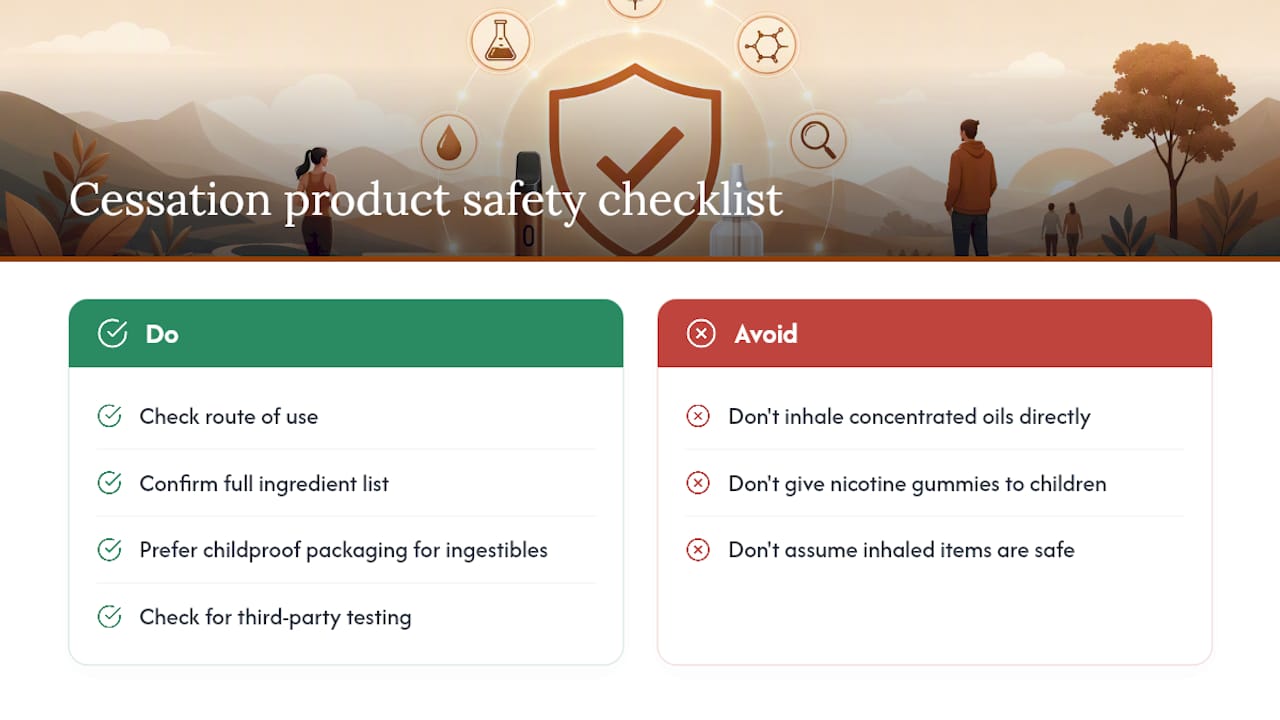
- Quick Pre-Purchase Safety Checklist
- What To Do If Something Goes Wrong
- A Safer, Non-Inhaled Way To Handle Cravings
- Frequently Asked Questions
- Sources
Main Health Risks By How You Use The Product
Route of exposure changes everything about a quit-smoking product’s risk. A resistance necklace you hold in your hand carries a different hazard profile than a stick you inhale through your nose, and lumping them together is where a lot of safety confusion starts.

Inhaled products (essential-oil nasal sticks, aroma inhalators) put concentrated compounds directly into your airway. The American Lung Association distinguishes ambient aromatherapy from direct inhalation, warning that concentrated oils can trigger coughing, throat irritation, and inflammation when inhaled directly rather than diffused into a room. A review of inhalable flavored devices found that flavoring compounds like black pepper, cinnamon, and mint have been linked in lab studies to airway toxicity and impaired immune cell function. Separate lab analyses of nicotine‑free inhalators detected VOCs including menthol and (+)-isomenthone, some at concentrations that exceeded sensory irritation thresholds in sampled devices.
Buccal and placed-in-mouth products (oral pouches, some gummies) sit against mucous membranes that absorb compounds quickly. If nicotine is present, even at low declared doses, absorption is fast and dosing is hard for a consumer to verify at home.
Ingestible products (nicotine gummies) pose the sharpest risk to small children. As little as 1 to 14 milligrams of nicotine can cause serious toxicity in a child under five, and the FDA has issued warning letters to manufacturers marketing nicotine gummies as unapproved cessation products.
Handled products (fidget rings, necklaces) carry the lowest systemic risk. The main concern is contact dermatitis from metal alloys or coatings, which shows up as localized skin irritation rather than a systemic health event.
If you have asthma or COPD, skip inhaled cessation aids entirely. Respiratory tissue that’s already inflamed has far less tolerance for VOCs or flavoring compounds, even at concentrations most healthy adults handle without issue.
How Do You Check A Label Before You Buy?
A five-minute label check catches most of the products worth avoiding.
Look for a complete ingredient list, not a marketing summary. The label should state the route of use plainly, whether that’s “for external use only,” “not for inhalation,” or “keep out of reach of children.” Concentration or dose information should appear in actual units, not vague terms like “potent blend.”
Red flags worth walking away from:
- No ingredient list at all, or one that lists a proprietary “blend” with no breakdown
- Marketing language like “natural” or “organic” with zero supporting detail
- Cooling agents or flavor chemicals (menthol, methyl salicylate) listed with no explanation of concentration or purpose
- No manufacturer contact information anywhere on the packaging or product page
- Packaging that isn’t childproof despite containing an ingestible product
Before buying, search for third-party lab testing or a certificate of analysis (COA). A legitimate manufacturer will publish or provide one on request. The AHA has called for exactly this kind of ingredient transparency from companies selling smokeless oral nicotine products, and the same standard applies to non-nicotine alternatives.
Pro Tip: Email the manufacturer and ask two specific questions: “Has this product been tested for VOC emissions?” and “Is there inhalation toxicology data available?” A company with nothing to hide answers quickly. A company that goes quiet is telling you something too.
What Does The Research Actually Show?
The evidence base for smoking-cessation aids is uneven, and knowing where the gaps are matters as much as knowing what’s proven.
Oral nicotine pouches sit in a strange spot: popular, heavily marketed, and thinly studied. The Cochrane review covering them found only three small trials, reporting no serious short-term harms but offering no clear answer on long-term safety or whether pouches actually help people quit compared to no support at all. One small study even suggested slightly lower quit rates for pouches than e-cigarettes. That’s not a condemnation. It’s a research gap, and it means anyone claiming pouches are “proven safe” is overstating what the science currently supports.
Essential-oil inhalation research tells a more consistent story. The American Lung Association’s position doesn’t leave much wiggle room: concentrated oils are not the same as ambient aromatherapy, and treating them interchangeably is a mistake plenty of product marketing encourages. Toxicology work on inhalable flavored devices backs this up, finding that some flavoring compounds cause measurable epithelial inflammation in lab conditions.
Smaller pilot studies on aromatherapy for craving reduction exist too, and they’re worth mentioning honestly: a handful of participants reported reduced withdrawal symptoms, while others reported sinus irritation or simple intolerance. These trials are small, inconsistent in design, and nowhere near large enough to settle the question either way.
The honest summary of the evidence: inhaled devices have real, documented airway risks even without nicotine, oral pouches have thin data in either direction, and handled, non-inhaled tools have the cleanest safety profile of the group, mostly because there’s nothing to inhale, swallow, or absorb.
The common thread across every gap is short follow-up periods, small sample sizes, and product formulations that vary so much between brands that findings on one device rarely transfer cleanly to another.
Quick Pre-Purchase Safety Checklist
Run through this before you add anything to your cart.
- Route of use is inhaled? Yellow light. Confirm VOC testing exists before buying, and skip it entirely if you have asthma or COPD.
- Route of use is handled or oral substitute (non-ingested)? Green light. Lowest systemic risk category.
- Ingredient list is complete and specific? Green light. Vague or absent listings are a red light, full stop.
- Product contains nicotine but isn’t labeled as an FDA-approved cessation aid? Red light. Walk away.
- Third-party testing or a COA is available on request? Green light if yes, yellow if the company won’t say.
- Packaging is childproof and clearly marked? Non-negotiable green light requirement if the product is ingestible or candy-shaped.
- Company lists contraindications (asthma, pregnancy, existing respiratory conditions)? Green light for transparency.
On cost and timing: non-inhaled tools like necklaces or fidget items typically run a modest one-time purchase with no recurring exposure risk. Adverse reactions to inhaled or ingested products, when they happen, usually show up within minutes to a few days of first use, not weeks later.
What To Do If Something Goes Wrong
If you or someone nearby reacts badly to a product, act on the route of exposure first.
- Stop using the product immediately.
- For inhalation symptoms (coughing, throat irritation), move to fresh air right away.
- For oral exposure, rinse the mouth thoroughly with water.
- For skin contact, remove any contaminated clothing and wash the area.
Call Poison Control at 1-800-222-1222 for suspected nicotine ingestion, especially in a child, or dial 911 for severe respiratory distress, seizures, loss of consciousness, or rapid heartbeat.
- Save the packaging and note the time and amount used.
- Photograph the ingredient label before disposing of anything.
- Report the incident to the manufacturer and to the FDA.
Doctors evaluating tobacco or nicotine exposure sometimes use blood markers like COHb or NNAL in research settings, but you don’t need to know those terms to respond to an emergency. Just call for help and bring the packaging.
A safer path to managing oral fixation
Breathefree leans toward non-inhaled tools for a specific reason: nothing goes into your lungs, and nothing looks like candy a child could mistake for a treat. That’s not a marketing preference, it’s a direct response to where the evidence points on inhalation risk and accidental ingestion. Our internal tracking shows more than 75,000 people have used the resistance necklace method, though that’s brand-reported usage data, not a controlled trial, and we say so plainly.
Pro Tip: Pair a physical substitute with a behavioral plan. Products handle the oral fixation piece; a structured quit plan handles the habit-and-trigger piece. Most people need both.
A Safer, Non-Inhaled Way To Handle Cravings
There are inhaled options and pouch-style options on the market, and this article has laid out honestly where the evidence on each one stands. If you’d rather sidestep the open questions around inhalation and buccal absorption altogether, the Breathefree resistance necklace gives your hands and mouth something to do without putting anything into your airway or bloodstream.
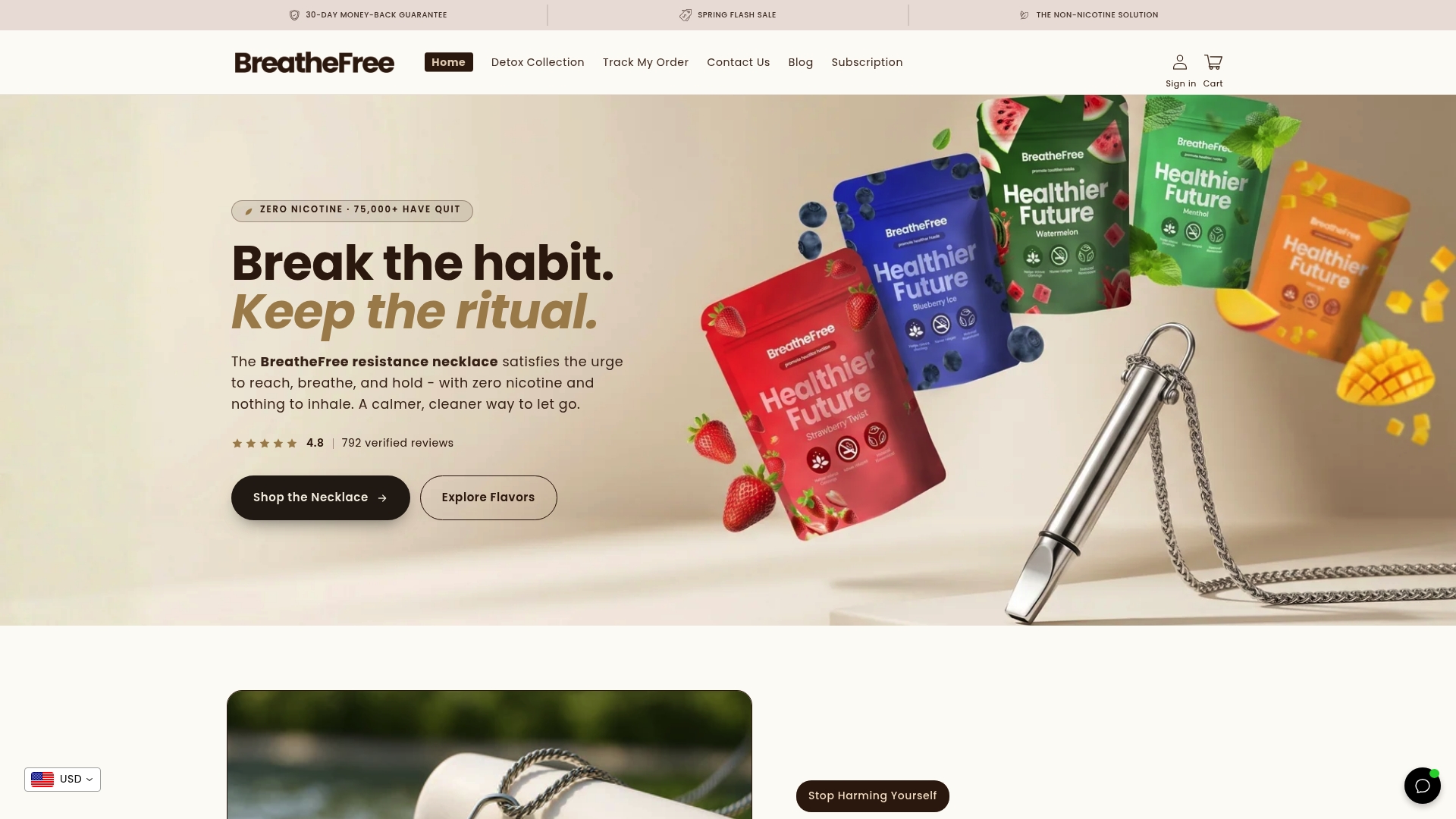
The necklace and its flavor refills are built around the same checklist covered above: full ingredient transparency, a clearly non-inhaled route of use, and no nicotine content to worry about around kids. It’s designed to satisfy the same hand-to-mouth ritual smoking provides, minus the parts of that ritual that carry actual toxicological risk. If portability matters to you, there’s also a travel-friendly version sized for flights and daily carry.
If you’re ready to try a tool that skips the inhalation question entirely, visit the resistance necklace collection and pick the option that fits how you plan to use it.
Frequently Asked Questions
How do I evaluate smoking cessation product safety before buying? Check the route of use first, then confirm a full ingredient list, childproof packaging if it’s ingestible, and whether third-party testing is available. Products you hold or handle carry lower risk than anything inhaled or swallowed.
Are non-nicotine oral fixation products actually safe? Most are, provided they’re non-inhaled and fully labeled. Handled items like resistance necklaces or fidget rings have the cleanest safety profile because nothing enters your lungs or bloodstream.
Is it safe to inhale essential oil nasal sticks for cravings? Use caution. The American Lung Association distinguishes ambient aromatherapy from direct inhalation and warns that concentrated oils can irritate the respiratory tract when inhaled directly.
Can nicotine gummies poison a child? Yes. As little as 1 to 14 milligrams of nicotine can cause serious toxicity in a child under five, which is why the FDA has warned manufacturers marketing these as candy-like products.
What should I do if I have a bad reaction to a cessation product? Stop using it immediately, address the exposure route (fresh air, rinse mouth, or wash skin), and call Poison Control at 1-800-222-1222 or 911 for severe symptoms.
This article is general information, not a substitute for advice from a qualified doctor. Consult a qualified healthcare professional about your own circumstances before acting on anything here.
Sources
These sources shaped the safety verdict in this guide and are worth reading directly if you want the full context behind any single claim.
- Essential Oils: More Harmful Than Helpful? | American Lung Association
- What are the benefits and risks of oral nicotine pouches when used to help people stop smoking or vaping nicotine? | Cochrane
- AHA review on smokeless oral nicotine products and public policy
- Alternative flavored inhalable products—A new respiratory hazard? (PMC)
- Vapor compounds released from nicotine-free inhalators as a smoking-cessation aid (Applied Sciences / MDPI)
Any specific product you’re considering deserves its own label check and, where available, its own certificate of analysis before it earns a place in your routine.