

Start a 7-day smoking log today. That single step is the most reliable way to identify personal smoking triggers and turn a vague quit attempt into something you can actually manage. Here is what to do in the next 10 minutes:
- Open a notes app or grab a small notebook.
- Write today’s date and commit to logging every craving for 7 days, including at least one weekend day.
- Pick one substitution to try right now when an urge hits: chew a piece of gum, take five slow breaths, or hold something in your hand.
The one-line verdict: knowing your specific, repeat triggers makes quitting measurable. You won’t have to fight every urge at once. You’ll fight the two or three that actually run your habit.
Table of Contents
- What are smoking triggers and why do they matter?
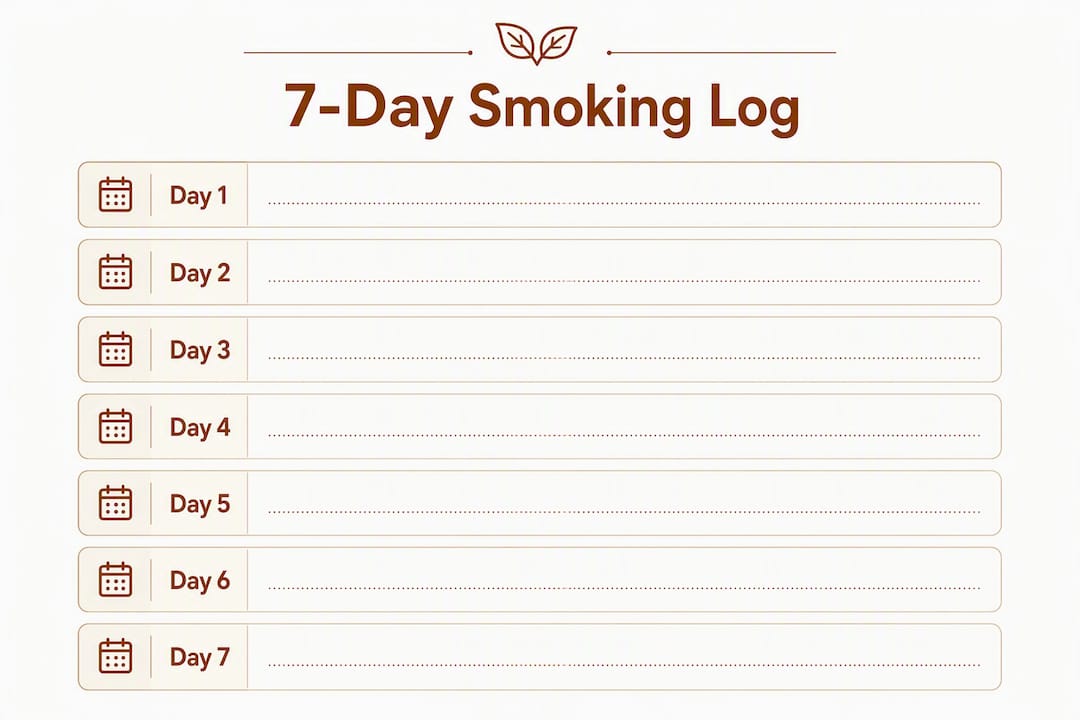
- How to track your triggers with a 7-day smoking log
- Real-life trigger scenarios and what to do in the moment
- How to build a plan that actually manages your triggers
- What happens to cravings after you stop smoking?
- Do non-nicotine oral tools actually help?
- Where can you get reliable help to quit smoking?
- Key Takeaways
- Why trigger tracking changed how I think about quitting
- Breathefree’s nicotine-free tools for pattern and oral triggers
What are smoking triggers and why do they matter?
A smoking trigger is any person, place, emotion, or daily routine that reliably produces a craving to smoke. The craving itself is not random. It is a conditioned response, the brain linking a situation to the reward of nicotine until the association becomes almost automatic.
Smokefree.gov classifies triggers into four standard categories. Knowing which category a trigger falls into tells you a lot about which strategy will actually work against it.
| Category | What it looks like | Best first response |
|---|---|---|
| Emotional | Stress, boredom, anxiety, loneliness, happiness | Breathing exercise, journaling, call a friend |
| Pattern/routine | Morning coffee, after meals, driving, work breaks | Change the routine, add a substitution at the cue |
| Social/situational | Bars, parties, friends who smoke, celebrations | Plan ahead, bring a substitute, rehearse a script |
| Withdrawal/physical | Smelling smoke, handling a lighter, hand-to-mouth urge | NRT, oral fixation tool, grounding technique |
One category most people overlook: positive emotional triggers. Celebrations, good news, a drink with friends after a win — practitioners report that many relapses happen in exactly these moments, when people are caught off guard by an urge they never planned for. A solid quit plan covers the happy occasions just as carefully as the stressful ones.
The practical reason to categorize triggers is prioritization. A pattern trigger (morning coffee) responds well to a simple routine swap. A withdrawal-driven trigger (the smell of smoke, the feel of a lighter) often needs a physical substitute or clinical support. Treating them the same way wastes effort.
How to track your triggers with a 7-day smoking log
Experts recommend logging for at least 7 days, including at least one weekend day, and rating craving intensity on a 1–5 scale. Weekday and weekend patterns often look completely different. A person who smokes heavily during work-break stress may barely think about cigarettes on a relaxed Saturday morning — or the reverse. You need both to see the full picture.

Setting up your log
Use whatever you will actually keep with you: a phone notes app, a small pocket notebook, or a printed sheet. The format matters less than consistency.
Record these fields for every craving, whether you smoke or resist:
- Time — exact time the craving started.
- Activity — what you were doing (driving, eating, working, watching TV).
- Location — home, office, car, outside a bar.
- People present — alone, with a smoker, with family, with coworkers.
- Mood — one word: stressed, bored, happy, anxious, relaxed.
- Craving intensity — rate 1 (mild, easy to ignore) to 5 (overwhelming, hard to resist).
- What preceded it — the specific cue: finished a meal, got a stressful email, smelled smoke.
- Outcome — smoked or resisted.
Example log row:
| Time | Activity | Location | People | Mood | Intensity | Preceded by | Outcome |
|---|---|---|---|---|---|---|---|
| 8 AM | Morning coffee | Kitchen | Alone | Tired | 4 | First sip of coffee | Smoked |
How to review your log after 7 days
After a week, count how many times each trigger appeared and calculate its average intensity. Then multiply frequency by average intensity to get a priority score. A trigger that shows up 12 times at an average intensity of 2 scores 24. One that appears 5 times at an average intensity of 4.5 scores 22.5. They are roughly equal priority, even though the first one happens more often. That math keeps you from chasing frequency alone and ignoring the triggers that actually break your resolve.
Pick the top 1–3 triggers by score. Those are the ones you address first.
Pro Tip: Don’t try to fix everything on day one of reviewing. Circle your top trigger in red, write one substitution next to it, and start there. The log is a tool for focus, not a to-do list of everything wrong.
Real-life trigger scenarios and what to do in the moment
Recognizing a trigger in the abstract is one thing. Catching it in real time, when the craving is already building, is harder. These short scenarios show the cue, the thought loop, and a ready response.

Morning coffee. You pour your first cup and your hand reaches for a cigarette before you have even thought about it. The cue is the coffee itself, not the nicotine. Changing the place or time of a routine can break the association: drink coffee in a different room, switch to tea for the first week, or step outside without a cigarette and hold something else in your hand.
After a meal. The meal ends and the urge arrives like clockwork. Chew a piece of gum immediately after the last bite, before the craving has a chance to build. A 5-minute walk around the block works just as well and adds a physical reset.
Driving. Singing along to a song, keeping both hands on the wheel, or keeping a Breathefree resistance necklace in the cupholder gives your hands and mouth something to do. The hand-to-mouth motion is a major driver of driving-related urges — address the motion, not just the nicotine.
Work break. The break itself is the cue. Change where you take it: walk to a different floor, sit in a non-smoking area, or call a quit buddy for 5 minutes instead of stepping outside.
A party or celebration. This is the scenario most quit plans miss entirely.
Test any substitution for three consecutive trigger instances and note the craving intensity and outcome in your log. Three data points tell you whether it is working.
How to build a plan that actually manages your triggers
Successful quitters typically pick 1–3 top triggers and replace them sequentially rather than trying to avoid everything at once. That is not a shortcut — it is the strategy that holds up over months, not just days.
Here is how to build your trigger-focused action plan:
- Pull your top 1–3 triggers from the log review (highest frequency × intensity score).
- Assign one substitution to each. Make it specific: not “do something else” but “chew a mint and take three slow breaths.”
- Plan for unavoidable triggers. Some triggers you cannot remove from your life. For those, write a coping response in advance: what you will do in the first 3 minutes when the urge hits.
- Add a distraction layer. Short mindfulness exercises, a 5-minute walk, or a structured coping strategy give you something to do while the craving peaks and fades.
- Review the log weekly. As you knock out the top triggers, the next tier becomes visible.
For acute cravings that hit hard and fast, use the 3-3-3 grounding method: name 3 things you can see, identify 3 sounds you can hear, and move 3 parts of your body. It takes under 90 seconds and redirects attention away from the automatic craving pathway toward conscious awareness.
Clinical options matter for high-intensity triggers. If your log shows multiple triggers scoring 4–5 consistently, especially withdrawal-driven ones like smelling smoke or handling a lighter, that pattern suggests behavioral strategies alone may not be enough. FDA-approved options include nicotine replacement therapy (NRT) in patch, gum, or lozenge form; varenicline (Chantix); and bupropion. Talk to a clinician before starting any medication, and bring your 7-day log. It gives them real data to work with.
Pro Tip: Use your log to decide whether to call a doctor. If you have five or more triggers rated 4–5 and resisting them feels physically painful, that is a signal for clinical support, not just willpower.
- Oral substitutes: sugar-free gum, mints, toothpicks, flavored straws, or a resistance necklace.
- Physical distractions: squeezing a stress ball, a fidget ring, brief stretching.
- Behavioral swaps: a 5-minute walk, texting a friend, drinking a glass of water slowly.
- Mindfulness: box breathing (4 counts in, hold 4, out 4, hold 4) or a 2-minute body scan.
Building a structured quit plan around your logged triggers converts raw data into a daily routine you can actually follow.
What happens to cravings after you stop smoking?
Cravings do not stay at peak intensity. That is the most important thing to understand about the withdrawal timeline, because the first week is the hardest and also the most misleading about what the rest of quitting will feel like.
In the first hours after your last cigarette, nicotine levels drop and physical withdrawal begins. Cravings peak in intensity during the first 3–7 days. By weeks 2–4, the physical withdrawal symptoms ease for most people, though psychological cues — the smell of smoke, a stressful meeting, a cup of coffee — can still trigger urges because the conditioned associations take longer to fade than the nicotine does.
Withdrawal-driven triggers (the physical craving for nicotine itself) tend to resolve faster, usually within a few weeks with or without NRT. Habit-driven triggers (the morning coffee, the post-meal ritual) can persist for months because they are behavioral, not chemical. That distinction matters for your plan: NRT addresses the chemical side; substitution and tracking address the behavioral side. Most people need both working together.
The reassurance worth holding onto: each time you resist a trigger and use a substitution instead, the craving response to that trigger weakens. It does not disappear overnight, but it does get quieter. Understanding nicotine cravings and their timeline helps you stay in the plan when the first week feels impossible.
Do non-nicotine oral tools actually help?
The hand-to-mouth motion is a conditioned behavior, separate from the chemical dependence on nicotine. For many people, the physical ritual of holding something, raising it to their mouth, and exhaling is as much a part of the habit as the nicotine itself. Non-nicotine tools target that behavioral layer directly.
Here is when they work best and how to use them:
- Pattern and routine triggers (morning coffee, driving, after meals) respond well to oral fixation tools because the trigger is behavioral, not withdrawal-driven.
- As an adjunct to NRT, a physical substitute handles the hand-to-mouth urge while the patch or gum handles the chemical withdrawal — two different problems, two different tools.
- In social situations, having something in your hand removes the awkwardness of not knowing what to do with your hands at a party.
Breathefree’s resistance necklace is designed specifically for this: it gives your hands and mouth a familiar motion without nicotine or inhalation. The brand also offers flavor refills, essential oil nasal sticks for withdrawal support, and fidget spinner rings for irritability — each targeting a specific trigger type rather than one-size-fits-all cessation. Breathefree reports that many users have used this method as part of their quit strategy.
These tools do not replace clinical treatment for heavy nicotine dependence. They work best when paired with a trigger log, a substitution plan, and clinical support where needed. Using physical objects as part of quitting is an evidence-informed approach to the behavioral side of the habit.
What these tools do not claim to do: they are not a cure, they do not eliminate withdrawal, and they are not a substitute for medical advice. They address the oral fixation and hand-to-mouth habit component, which is real and worth addressing.
Where can you get reliable help to quit smoking?
You do not have to do this alone, and the best resources are free.
Smokefree.gov is the most comprehensive U.S. government resource for quitting. It includes trigger guides, quit plans, text programs (SmokefreeTXT), and apps.
1-800-QUIT-NOW connects you to your state’s free quitline, where trained coaches help you build a personalized plan. Bring your 7-day log to the first call. Coaches can help you interpret the data and suggest targeted strategies.
Apps: Smokefree’s apps (quitSTART, Smoke Free) track your progress and send craving-management prompts in real time.
When to see a clinician: if you smoke more than a pack a day, have a mental health condition that smoking helps you manage, are pregnant, or find that cravings are physically unmanageable, schedule an appointment with your doctor before your quit date. Medication works significantly better when it is started with professional guidance.
If you are concerned about relapse warning signs or feel that your smoking is tied to deeper patterns of addiction, a structured recovery program may offer the level of support that a quit app alone cannot.
Bring your trigger log to every appointment. A week of real data is more useful to a clinician than a general description of “I smoke when I’m stressed.”
Key Takeaways
Identifying your top 2–3 personal smoking triggers through a 7-day log, then replacing them one at a time with specific substitutions, is the most reliable path to a quit attempt that actually holds.
| Point | Details |
|---|---|
| Start the log today | Record time, place, mood, company, and craving intensity (1–5) for 7 days including a weekend. |
| Prioritize by score | Multiply each trigger’s frequency by its average intensity to find the 1–3 to tackle first. |
| Replace, don’t just avoid | Assign one specific substitution to each top trigger and test it for three consecutive instances. |
| Use clinical support for high-intensity triggers | Triggers consistently rated 4–5 may need FDA-approved NRT or medication alongside behavioral strategies. |
| Breathefree tools for oral fixation | The Breathefree resistance necklace and supporting products address the hand-to-mouth habit component for pattern and routine triggers. |
Why trigger tracking changed how I think about quitting
Most quit advice treats smoking like a single problem with a single solution. Patch, gum, willpower, done. What the research and the real stories actually show is that smoking is a bundle of separate habits, each with its own cue, its own emotional weight, and its own best fix. The morning coffee trigger is almost nothing like the stress-at-work trigger, and treating them identically is why so many quit attempts stall in week two.
What I find genuinely underestimated is the positive trigger problem. Nobody plans for the birthday party. Nobody rehearses what to say when a friend lights up at a celebration and offers one over. That gap in planning is where a lot of otherwise solid quit attempts fall apart, not during the hard days, but during the good ones.
The 7-day log is not glamorous. It is a notebook and a number from 1 to 5. But it is the only tool that shows you your habit, not a statistical average of everyone else’s. And once you can see the pattern, the substitution work stops feeling like white-knuckling and starts feeling like problem-solving. That shift matters more than any single product or technique.
For readers who want behavioral support alongside their tracking work, the evidence consistently points in the same direction: combine the log with a physical substitute, a support system, and clinical help where the intensity demands it.
Breathefree’s nicotine-free tools for pattern and oral triggers
Quitting the behavioral side of smoking — the hand-to-mouth ritual, the something-to-hold feeling, the post-meal reach — is a separate challenge from managing nicotine withdrawal. Breathefree was built specifically for that gap.
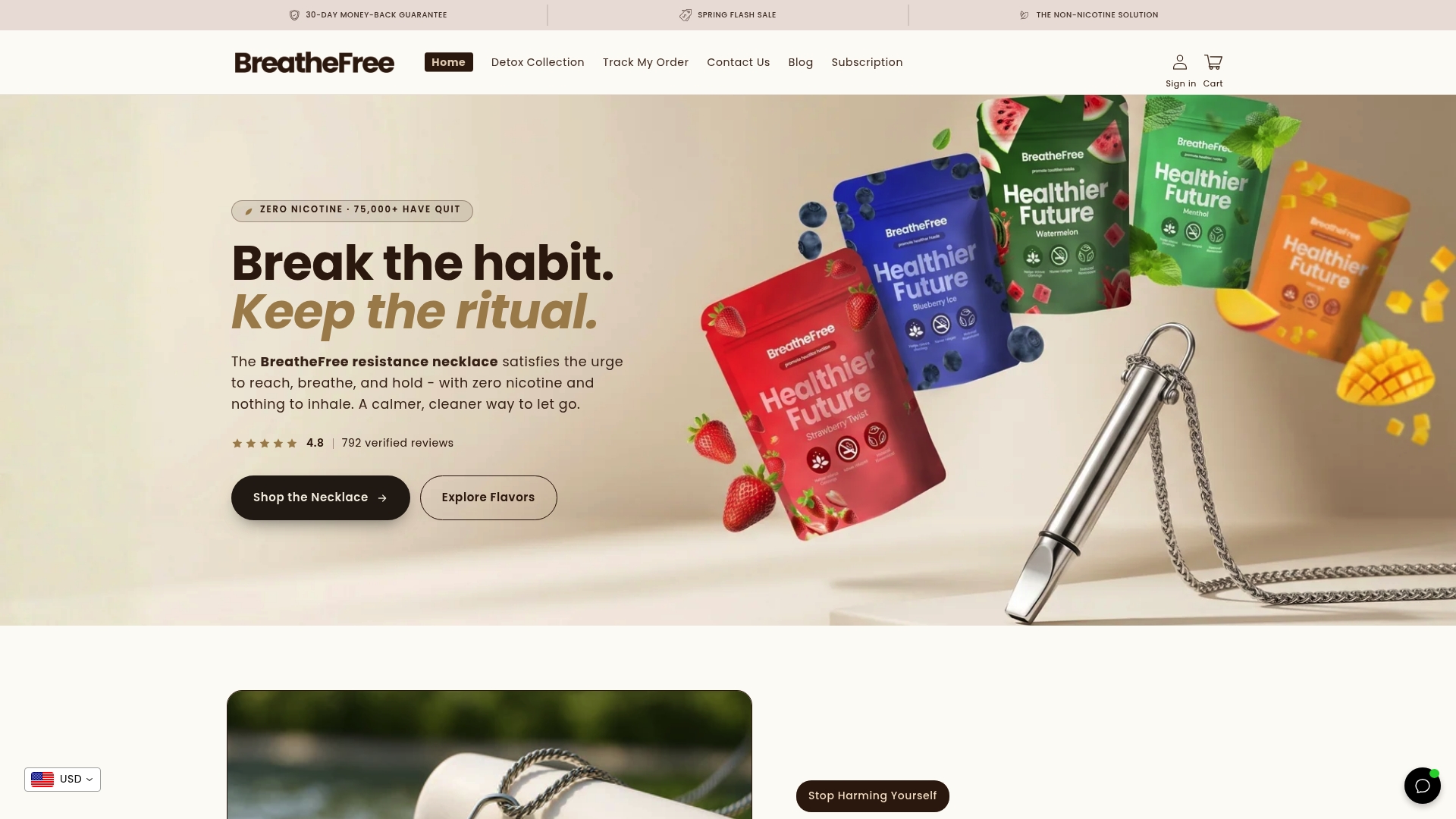
The Breathefree resistance necklace gives your hands and mouth a familiar motion without nicotine or inhalation. Pair it with flavor refills to satisfy oral cravings, essential oil nasal sticks for withdrawal moments, and a fidget spinner ring when irritability spikes. For readers who want a structured way to apply everything in this article, the Nicotine Detox eBook and Habit Tracker walks you through the log, the trigger prioritization, and the substitution plan in one place. These tools work best as adjuncts to your tracking and substitution work, not as replacements for clinical care when that is what the situation calls for. Start with the habit tracker eBook and the resistance necklace if pattern and oral fixation triggers top your log.
Useful sources
These are the primary resources referenced in this article. Use them for deeper reading, clinical questions, and quitline coaching.
- Know Your Smoking Triggers | Smokefree.gov — the U.S. government’s trigger guide with substitution tips and quit tools.
- Find and Beat Your Smoking Triggers | WebMD — practical log guidance, the 1–5 intensity scale, and the 3-3-3 grounding method.
- Common Smoking Triggers and How to Beat Them | Truth Initiative — evidence-informed substitution strategies and trigger categorization.
- 1-800-QUIT-NOW — free U.S. state quitline; trained coaches available at no cost.
- Breathefree — non-nicotine oral fixation tools, habit tracker eBook, and product support for pattern and behavioral triggers.
This article is general information, not medical advice. For questions about withdrawal management, medication, or your specific health situation, consult a qualified clinician or contact your state quitline.