

Behavioral support is the structured use of psychological techniques, coaching, and accountability tools to help people change deeply ingrained habits. It is the single most underused resource among people who have recently quit smoking. Willpower alone yields only a 3–5% quit success rate. Adding behavioral support alongside medication pushes that number to 30–40%. Tools like the 1-800-QUIT-NOW helpline, the My QuitBuddy app, and cognitive behavioral therapy (CBT) exist precisely because quitting is not just a physical challenge. The psychological and habitual layers of smoking require their own targeted approach.
Why ex-smokers need behavioral support beyond willpower
Smoking is not only a nicotine addiction. It is a deeply embedded coping mechanism tied to stress, boredom, social rituals, and daily routines. Smoking is woven into coping patterns for stress relief and social breaks in ways that medication simply cannot address. A nicotine patch removes the chemical craving. It does nothing for the habit of stepping outside after lunch or reaching for something when anxiety spikes.
Behavioral support, often called behavioral therapy or behavioral counseling in clinical settings, targets these triggers directly. CBT, for example, changes beliefs like “I can’t handle stress without smoking” into healthier, more accurate thoughts. That shift in thinking is what makes the difference between a temporary quit and a permanent one. Without it, the same emotional situations that drove smoking before will drive relapse after.

The oral fixation piece is also real and often overlooked. Behavioral therapy targets habitual oral and ritual behaviors, not just the chemical dependency. When you remove nicotine but leave the ritual vacuum unfilled, the pull back to smoking stays strong. Replacing those rituals with new ones is a core behavioral skill, and it requires practice and support to stick.
What triggers behavioral relapse
The most common relapse triggers fall into three categories: emotional, environmental, and social.
- Emotional triggers: stress, anxiety, anger, boredom, or sadness that previously cued a cigarette
- Environmental triggers: specific locations, smells, or times of day associated with smoking
- Social triggers: being around other smokers, drinking alcohol, or attending events where smoking was routine
Recognizing your personal trigger pattern is the first step. Behavioral support gives you a framework to map those patterns and build specific responses to each one.
Pro Tip: Write down the three situations where you most wanted to smoke in the past week. Bring that list to your next counseling session or share it with a quit coach. Named triggers are manageable triggers.
What types of behavioral support are actually available?
The range of behavioral support options is wider than most people realize, and several are free.
1-800-QUIT-NOW is a free, federally funded helpline that connects callers with trained quit coaches. It offers multilingual support and can coordinate with local state programs. My QuitBuddy is a free app that tracks quit progress, sends motivational prompts, and provides distraction tools during cravings. SmokefreeTXT delivers daily text messages with tips and encouragement, which research shows improves accountability between counseling sessions.
Free behavioral support services like these remove the cost barrier that stops many people from seeking help. Cost is one of the most cited reasons people skip professional support. When the tools are free and available on your phone, that excuse disappears.
CBT with a licensed clinician goes deeper. It involves structured sessions focused on thought restructuring, trigger identification, and building new coping responses. Group support programs add a social accountability layer. Knowing that others are watching your progress changes behavior in ways that solo efforts rarely achieve.
| Support type | Format | Cost | Best for |
|---|---|---|---|
| 1-800-QUIT-NOW | Phone coaching | Free | Immediate, personalized guidance |
| My QuitBuddy app | Mobile app | Free | Daily tracking and craving management |
| SmokefreeTXT | Text messages | Free | Ongoing motivation between sessions |
| CBT with clinician | In-person or telehealth | Varies | Deep trigger and thought pattern work |
| Group support programs | In-person or online | Free to low-cost | Social accountability and shared experience |
The right combination depends on your schedule, budget, and how deeply smoking was tied to your emotional life. Most people benefit from at least two types running simultaneously.
Behavioral support vs. medication alone: what the numbers say
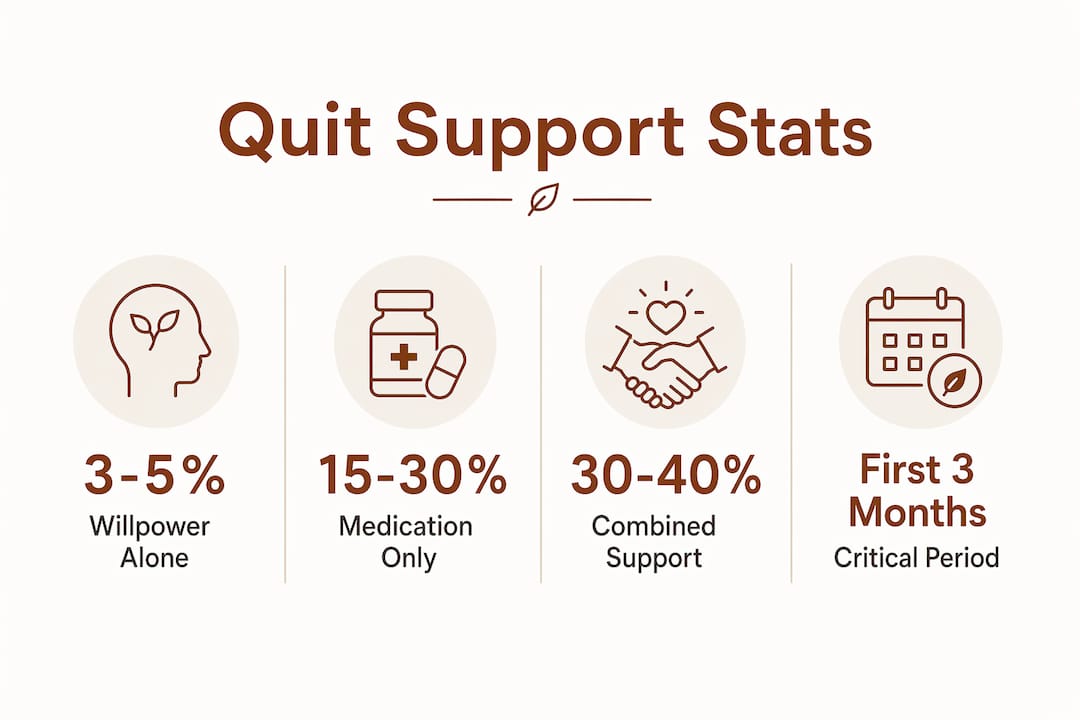
The data on this comparison is clear. Willpower alone produces a 3–5% success rate. Nicotine replacement therapy (NRT) alone reaches 15–30%. Combining pharmacotherapy with behavioral support reaches 30–40%. That gap between medication alone and the combined approach represents tens of thousands of people who stay quit versus those who relapse.
Medication handles the physical withdrawal. Behavioral support handles everything else. Behavioral counseling combined with pharmacotherapy yields better quit rates than either approach alone, despite cost barriers that prevent some people from accessing both. The implication is direct: if you are using NRT or varenicline without any behavioral support, you are leaving the most powerful part of the quit equation unused.
| Approach | Approximate success rate |
|---|---|
| Willpower alone | 3–5% |
| NRT or medication alone | 15–30% |
| Medication + behavioral support | 30–40% |
Relapse risk peaks in the first 3 months after quitting. This is the window where behavioral support is most critical. Physical withdrawal symptoms ease within weeks, but the psychological pull of old habits persists much longer. Staying engaged with a counselor, app, or support group during this window dramatically reduces the chance of a full relapse.
Pro Tip: Do not stop behavioral support when you stop feeling cravings. Cravings quiet down before the habit patterns do. Keep your support system active for the full first three months, even when things feel easy.
Practical strategies to stay quit using behavioral support
Behavioral strategies are not abstract concepts. They are specific techniques you can use today.
-
Use the 5-minute delay rule. When a craving hits, commit to waiting 5 minutes before acting on it. Most cravings peak and fade within that window. This single tactic interrupts the automatic response cycle.
-
Replace the ritual, not just the substance. If you smoked after meals, replace that slot with a 5-minute walk, a glass of water, or a breathing exercise. The ritual slot needs to be filled with something, or the vacancy pulls you back.
-
Plan your quit around calm periods. Quit attempts during high-stress life events carry a higher relapse risk. If a major life disruption is happening, this is not the moment to go it alone. Increase your support contact during those periods.
-
Treat a slip as data, not failure. A single cigarette slip is an opportunity to identify what triggered it and adjust your strategy. One cigarette does not erase your progress. Abandoning your quit plan does.
-
Engage support resources consistently. Sporadic use of apps or helplines produces sporadic results. Schedule your check-ins the same way you would schedule a medication dose.
Behavioral support builds long-term coping skills that extend well beyond the quit itself. People who complete structured behavioral programs report better stress management and emotional regulation in other areas of life. Quitting smoking, done with proper support, becomes a foundation for broader resilience.
Pro Tip: Pair your quit support resources with a simple daily habit tracker. Seeing your streak grow is a behavioral reinforcement tool in itself.
Key takeaways
Behavioral support combined with medication is the most effective quit strategy available, reaching 30–40% success compared to 3–5% for willpower alone.
| Point | Details |
|---|---|
| Willpower is not enough | Quitting without support succeeds only 3–5% of the time. Add behavioral tools to change those odds. |
| First 3 months are critical | Relapse risk peaks early. Stay actively engaged with support during this window. |
| Multiple support types work best | Combine a helpline, app, or CBT with your medication plan for the strongest outcome. |
| Slips are not failures | Treat a slip as trigger data and adjust your strategy rather than abandoning the quit. |
| Behavioral skills last | Support builds coping capacity that reduces relapse risk long after cravings fade. |
What I’ve learned about why support makes or breaks a quit
The most common mistake I see people make is treating quitting as a single event rather than a process. They set a quit date, white-knuckle through the first week, and then assume the hard part is over. It is not. The hard part is the Tuesday afternoon three weeks in when stress hits and the old habit pattern fires automatically.
Medication is genuinely useful. But I have watched people under-dose their NRT, stop it too early, and then blame themselves when they relapse. The medication was not the problem. The missing behavioral layer was. Avoiding under-dosing NRT and stopping medication too early is one of the most practical pieces of advice in cessation medicine, and almost no one talks about it.
The other thing worth saying directly: do not try to quit during a crisis. A job loss, a breakup, a family emergency. These are the moments when the urge to smoke feels most justified. They are also the moments when your behavioral support system matters most. Call the helpline. Open the app. Reach out to your group. The support is there specifically for those moments, not just the easy days.
Behavioral support does not create dependency. It builds the skills to manage triggers independently over time. That is the goal: not needing the support forever, but using it long enough to build genuine resilience. Give yourself the full three months. The version of you on the other side is worth it.
— Tommy
Tools from Breathefree to support your quit
Quitting smoking is a process that rewards preparation. Breathefree’s Nicotine Detox eBook & Habit Tracker gives you a structured guide through the behavioral side of quitting, covering trigger identification, craving management, and daily habit tracking in one place. It is designed to complement whatever other support you are using, whether that is a helpline, CBT, or NRT.
Over 75,000 people have used Breathefree tools as part of their quit plan. The Habit Tracker keeps your behavioral strategies visible and consistent, which is exactly what the first three months require. If you want a practical, nicotine-free resource to anchor your behavioral support plan, this is where to start.
FAQ
What is behavioral support for quitting smoking?
Behavioral support is structured coaching, therapy, or accountability tools that help people change the habits and thought patterns tied to smoking. It includes CBT, helplines like 1-800-QUIT-NOW, apps like My QuitBuddy, and group programs.
How much does behavioral support improve quit rates?
Adding behavioral support to medication increases quit success from 15–30% with medication alone to 30–40% with the combined approach. Willpower alone succeeds only 3–5% of the time.
When is behavioral support most needed after quitting?
The first three months after quitting carry the highest relapse risk. Behavioral support is most critical during this window, when psychological habit patterns are still active even after physical withdrawal fades.
Can behavioral support replace medication?
Behavioral support and medication address different parts of the addiction. Medication handles physical withdrawal. Behavioral support handles habits, triggers, and thought patterns. The combination produces the best outcomes.
What should I do if I slip and smoke a cigarette?
Treat the slip as information, not failure. Identify what triggered it, adjust your coping strategy, and continue your quit plan. One cigarette does not undo your progress. Abandoning the plan does.