

The best clean living addiction support products are evidence-informed, low-risk tools that work alongside clinical care and peer support, not instead of it. That distinction matters more than any ingredient list or product claim. Before anything else, two categories deserve your immediate attention:
- National helplines and treatment locators: The SAMHSA National Helpline (1-800-662-HELP) and findtreatment.gov are free, federally backed, and available right now. They are the foundation that everything else builds on.
- Nicotine-free oral-fixation tools and basic sleep/nutrition supports: For people quitting smoking or vaping, non-nicotine habit-replacement tools like the Breathefree resistance necklace address the physical ritual of smoking without adding new substances. Sleep aids, hydration, and whole-food nutrition round out the daily toolkit.
Crisis support is available 24/7. Call or text 988 (Suicide and Crisis Lifeline) for immediate mental health or substance-use crisis support. Call 1-800-662-HELP (4357) for SAMHSA’s National Helpline, available 24/7 in English and Spanish, free and confidential.
Table of Contents
- What free U.S. resources can you access right now?
- What evidence-based approaches actually support long-term recovery?
- Which product categories actually help, and which are unproven?
- How do you choose safe, evidence-informed addiction support products?
- How do you build a recovery routine around these products?
- How does Breathefree fit into a clean-living toolkit?
- Key Takeaways
- The gap between “clean living” products and actual recovery
- Breathefree: a nicotine-free option worth adding to your toolkit
- Useful sources and where to find more
What free U.S. resources can you access right now?
The table below covers the highest-trust national services. Bookmark what applies to you before reading further.
| Service | What it does | How to access |
|---|---|---|
| 988 Crisis Lifeline | Immediate crisis support for mental health and substance use | Call or text 988 |
| SAMHSA National Helpline | 24/7 free, confidential treatment referral and information in English and Spanish | Call 1-800-662-4357 |
| findtreatment.gov | Federal locator for local substance-use treatment facilities nationwide | findtreatment.gov |
| HRSA Health Center Finder | Locates federally funded community health centers offering behavioral health services | findahealthcenter.hrsa.gov |
| VA Substance Use Resources | Targeted behavioral health and substance-use services for veterans | va.gov |
| Medicaid | Coverage pathway for addiction treatment and related health services for eligible individuals | usa.gov/medicaid |
| SAMHSA Store | Free and low-cost brochures, toolkits, and recovery planning materials | store.samhsa.gov |
Getting the most from findtreatment.gov: Enter your ZIP code, filter by substance type and payment option (including sliding-scale and Medicaid-accepted), and call at least two facilities. Availability changes fast, and a second call often turns up an opening the first one missed.
Free printable resources from the SAMHSA Store include recovery support guides, relapse-prevention worksheets, and family education materials. Most are available as instant PDF downloads, no account required.
If you or someone you know is in crisis right now, call or text 988. For treatment referrals, call SAMHSA at 1-800-662-4357, available every hour of every day, at no cost.
What evidence-based approaches actually support long-term recovery?
Products work best when they slot into a treatment framework that already has clinical backing. The core approaches with the strongest evidence are:
- Cognitive-behavioral therapy (CBT): Teaches people to identify triggers, reframe automatic thoughts, and build coping skills. The NCBI counseling chapter on sustaining recovery summarizes CBT as one of the most consistently supported approaches across substance types.
- Contingency management: — Uses structured positive reinforcement to reward abstinence. Evidence is particularly strong for stimulant and opioid use disorders.
- Individual and group counseling: Motivational interviewing and structured counseling sessions address the psychological and social drivers of use. Pairing these with behavioral support strategies significantly improves quit rates.
- SMART Recovery and peer support: SMART Recovery uses a science-based, self-empowerment model with free online and in-person meetings. Peer support adds accountability and lived-experience perspective that clinical settings often cannot replicate.
Pro Tip: Use a habit tracker during counseling sessions. Logging craving times, triggers, and product use gives your clinician concrete data to work with, and it gives you a visible record of progress that is genuinely motivating.
Which product categories actually help, and which are unproven?
The table below maps product types to their evidence level, typical use case, and key safety notes. Use it as a filter, not a shopping list.
| Product type | Evidence level | Typical use case | Safety notes |
|---|---|---|---|
| Non-nicotine oral-fixation tools | Moderate (habit-replacement mechanism supported by behavioral science) | Replacing the physical ritual of smoking/vaping | No known drug interactions; safe alongside MAT |
| Wearable behavioral tools (fidget rings, stress tools) | Low-to-moderate (anecdotal + behavioral theory) | Managing irritability and restless hands | Generally safe; no clinical contraindications |
| Sleep environment improvements | Strong (sleep hygiene evidence is robust) | Reducing insomnia common in early recovery | Low risk; consult clinician if using sleep medications |
| Foam rollers and resistance bands | Strong evidence-for-value per Axis Therapy’s home recovery review | Physical recovery, stress reduction, mood support | Safe for most; check with clinician post-detox |
| Mindfulness and breathing apps | Moderate | Craving interruption, anxiety management | Free options (Insight Timer, UCLA Mindful) carry no risk |
| OTC supplements (magnesium, B vitamins, NAC) | Mixed; limited FDA evaluation for recovery-specific claims | Nutritional repletion during early recovery | Check interactions with prescribed medications before starting any supplement |
| “Detox” supplements marketed for addiction | Low to none; most lack clinical evidence | Often marketed for cravings or cleansing | Many are unregulated; avoid without clinician sign-off |
| Nutrition supports (whole foods, SNAP-eligible items) | Strong for overall recovery outcomes | Stabilizing blood sugar, reducing mood swings | No risk; USDA SNAP benefits can help cover costs |

A few categories stand out as genuinely worth your money. Sleep improvements, physical activity tools, and non-nicotine oral-fixation products have reasonable evidence and low risk. Expensive “detox” supplements and devices marketed specifically for addiction recovery are where the evidence thins out fast. The holistic add-ons guide from Spine offers a useful framework for thinking about where complementary supports fit alongside conventional treatment.
Before starting any supplement, tell your prescribing clinician. Some OTC products interact with buprenorphine, naltrexone, and antidepressants commonly used in recovery. That conversation takes five minutes and can prevent a serious problem.
How do you choose safe, evidence-informed addiction support products?
Most people searching for clean living wellness items and natural recovery tools run into the same problem: the market is full of products making claims that outrun their evidence. Here is a practical checklist.
What to verify before you buy:
- Mechanism or ingredient transparency: Can the company explain why the product works, citing a plausible behavioral or physiological mechanism? Vague “supports wellness” language is a red flag.
- Third-party testing: Look for GMP (Good Manufacturing Practice) certification or NSF International testing for any supplement. These are not guarantees of efficacy, but they confirm the product contains what the label says.
- Clear contraindications and labeling: Reputable products list what they are not appropriate for. If a product claims to be safe for everyone with no caveats, that is a warning sign.
- Refund policy: A 30-day return window is standard for legitimate vendors. No-return policies on health products are a red flag.
- Vendor transparency: Real company address, customer service contact, and no pressure tactics.
Questions to ask before purchasing:
- Does this product have any peer-reviewed research behind it, or only testimonials?
- Is it compatible with the medications I am currently taking?
- What does it cost per month, and is that sustainable on my budget?
- Has it been tested by a third party for purity and potency?
- What happens if it does not work for me?
Trust signals to look for:
- Links to government resources (SAMHSA, NIDA, FDA) on the vendor’s site
- Clinical citations in product descriptions, not just celebrity endorsements
- GMP, NSF, or USP certification marks on supplements
- Transparent ingredient lists with dosages
For smoke-free tools aimed at beginners, the bar is simpler: does the product replace a harmful behavior with a harmless one, and does the company stand behind it? That covers most of what you need to know.
How do you build a recovery routine around these products?
Start with clinical care and peer support as the foundation. Products fill specific gaps in that structure, not the other way around.
Weeks 0–7 (early recovery): The first week is when cravings and withdrawal symptoms peak for most substances. This is the time to lean hardest on your clinician and support network. If you are quitting smoking or vaping, a non-nicotine oral-fixation tool addresses the physical ritual immediately. A habit tracker helps you log craving times and identify patterns. Sleep hygiene changes (consistent bedtime, dark room, no screens 30 minutes before sleep) cost nothing and pay off fast. If you are managing opioid or alcohol withdrawal, do not attempt this period without medical supervision.

Weeks 2–8: Cravings become more manageable but triggers multiply as you return to normal routines. This is when CBT skills and peer support become most valuable. Physical activity tools (resistance bands, foam rollers) support mood and reduce anxiety. Mindfulness apps can interrupt craving cycles in real time. Nutrition stabilization matters here too: regular meals with adequate protein and complex carbohydrates reduce mood swings that drive relapse. If you have not already, check Medicaid eligibility and use findahealthcenter.hrsa.gov to locate low-cost behavioral health services near you.
Months 2–6: The acute phase is behind you, but this window carries real relapse risk as the novelty of early recovery fades. Sustainable habits matter more than any single product. Review your habit tracker data with your clinician every few weeks. Adjust your toolkit as your needs shift. Replacing your smoking ritual healthily becomes the focus: what do you do with your hands, your stress, your social time?
When to escalate: If cravings intensify after week four, if mood symptoms worsen, or if you relapse, contact your clinician or call SAMHSA at 1-800-662-4357. Products are not a substitute for a higher level of care when you need it.
Pro Tip: Pair your habit tracker with a brief weekly check-in note to your counselor. Even a two-sentence text message creates accountability and gives your clinician early warning if something is slipping.
Financial assistance is available. Medicaid covers addiction treatment for eligible individuals, and many HRSA-funded health centers use sliding-scale fees. The SAMHSA Store offers free recovery planning materials you can use alongside any paid product.
How does Breathefree fit into a clean-living toolkit?
Breathefree’s nicotine-free oral-fixation approach is a safe, non-pharmacologic option for people who need to address the physical habit of smoking or vaping. It does not treat addiction in a clinical sense. What it does is give your hands and mouth something to do that is not a cigarette, without introducing nicotine, chemicals, or inhalation risk.
The product line covers several specific needs:
- Resistance necklace: The flagship product. Worn around the neck, it provides a physical object to hold and use during craving moments. Flavor refills extend the sensory experience without nicotine. Breathefree reports that many users have quit using this approach.
- Nicotine Detox eBook and Habit Tracker: A structured resource for tracking cravings, identifying triggers, and planning quit milestones. Pairs well with CBT-based counseling.
Suggested use: Start the resistance necklace on your quit day as a direct replacement for the smoking ritual. Use the habit tracker from day one to log cravings and note what triggered them. Introduce the nasal stick during high-stress moments when the urge to inhale something is strongest. Quitting smoking using physical objects works best when the replacement is immediate, accessible, and consistent.
Safety note: Breathefree products are supportive tools. They are not a substitute for clinical care, medication-assisted treatment, or counseling. If you are managing withdrawal symptoms or have co-occurring health conditions, consult your clinician before relying on any product as your primary support.
Key Takeaways
The most effective approach to clean living addiction support combines federally backed treatment resources, evidence-based clinical care, and low-risk habit-replacement tools used together, not separately.
| Point | Details |
|---|---|
| Crisis resources come first | Call 988 or SAMHSA (1-800-662-4357) before purchasing any product if you are in crisis or withdrawal. |
| Use findtreatment.gov to locate care | The federal locator connects you to local, Medicaid-accepted treatment facilities at no cost. |
| Prioritize low-risk product categories | Sleep improvements, physical activity tools, and non-nicotine oral-fixation products have the strongest evidence-to-risk ratio. |
| Verify before you buy | Check for GMP/NSF certification, clear ingredient labeling, and a real refund policy on any supplement or wellness product. |
| Breathefree as a habit-replacement tool | The Breathefree resistance necklace and habit tracker are nicotine-free options to address oral fixation and track progress alongside counseling. |
The gap between “clean living” products and actual recovery
The phrase “clean living addiction support” gets used to sell a lot of things that have nothing to do with recovery. Herbal detox teas, crystal-infused water bottles, and expensive biohacking devices show up in the same search results as SAMHSA and NIDA. That gap is worth naming directly.
The products that actually help in recovery are almost always boring. Foam rollers. A consistent sleep schedule. A physical object to hold when a craving hits. A habit tracker you actually fill out. The evidence for these is not glamorous, but it is real. The expensive, aesthetically pleasing “wellness” products that dominate social media tend to have the weakest clinical backing and the highest price tags.
What I find genuinely useful about Breathefree’s approach is that it does not pretend to be medicine. It addresses one specific, real problem: the physical ritual of smoking is hard to break even after the nicotine dependence fades. Giving that ritual a harmless substitute is not a cure, but it is a practical, low-risk tool that fits cleanly into a broader recovery plan. Over 75,000 people have used it to quit, which is a meaningful signal even without a randomized controlled trial behind it.
The bigger mistake I see people make is treating product selection as the primary task of recovery. It is not. The primary task is connecting with clinical care, peer support, and a treatment plan that fits your situation. Products are the supporting cast. Get the foundation right first, and the toolkit almost selects itself.
Breathefree: a nicotine-free option worth adding to your toolkit
Quitting smoking is hard enough without adding nicotine patches, gum, or inhalers that keep the dependency alive. Breathefree takes a different route: a physical, nicotine-free resistance necklace that satisfies the oral and tactile habit without any substance at all.
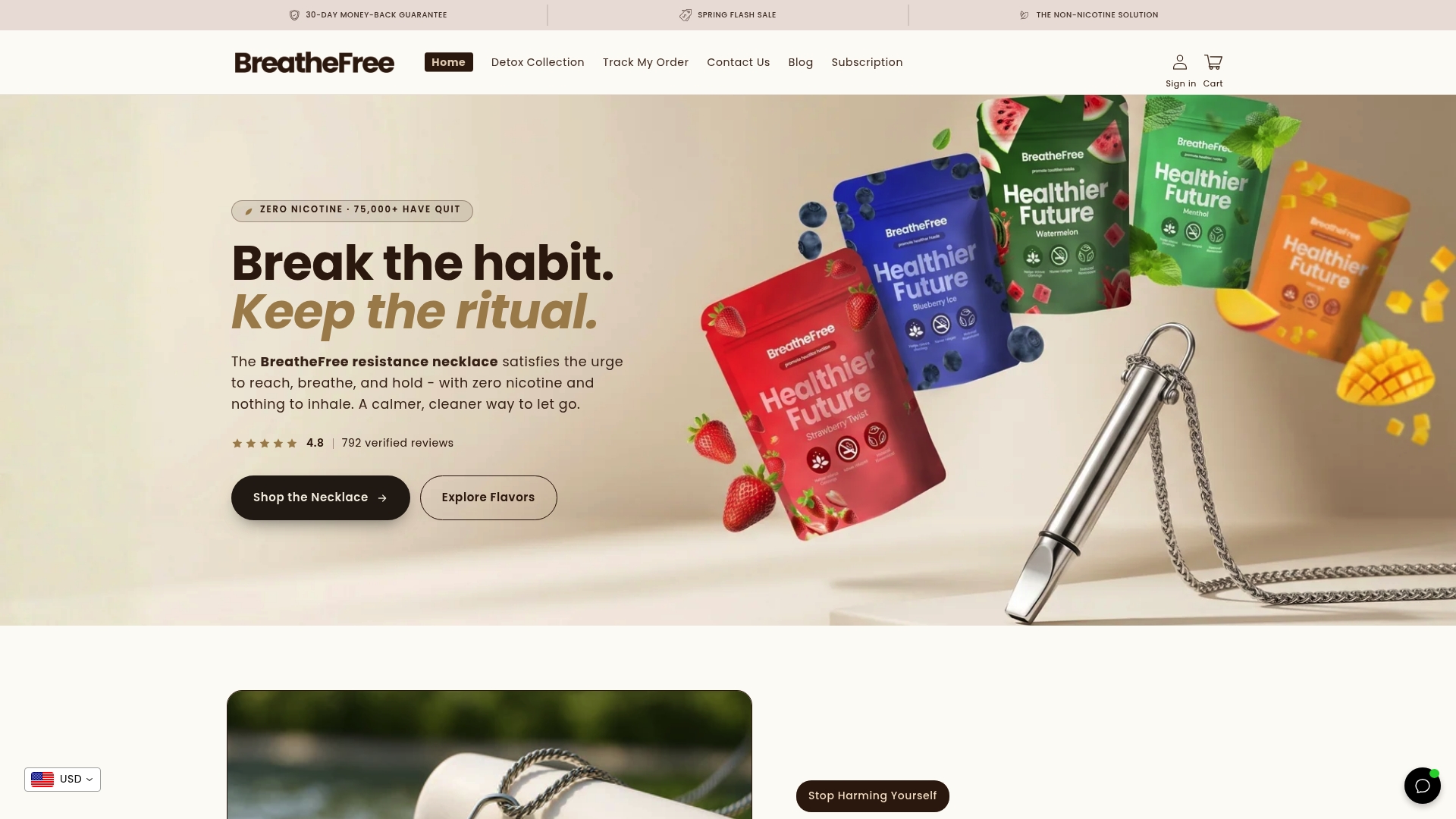
The Breathefree resistance necklace is designed for the moment a craving hits and you need something in your hands right now. Pair it with the Nicotine Detox eBook and Habit Tracker to log your progress and identify the triggers that keep pulling you back. Both ship directly to your door and work alongside whatever clinical program you are already in.
Disclaimer: Breathefree products are supportive wellness tools, not medical treatments. They are not a substitute for clinical care, medication-assisted treatment, or professional counseling. If you are managing withdrawal symptoms or taking prescribed medications, consult your clinician before adding any new product to your routine.
Browse the full range and find what fits your quit plan at breathefree.shop.
Useful sources and where to find more
- National Helpline for Mental Health, Drug, Alcohol Issues
- Chapter 4—Counseling Approaches for Sustaining Recovery …
- findtreatment.gov
- store.samhsa.gov
- findahealthcenter.hrsa.gov
- Recovery tools & gadgets for home — Axis Therapy
- usa.gov
- va.gov
This article provides general information about addiction support resources and products. It is not a substitute for professional medical or clinical advice. Confirm current treatment options and medication interactions with a qualified clinician or contact SAMHSA at 1-800-662-4357.