

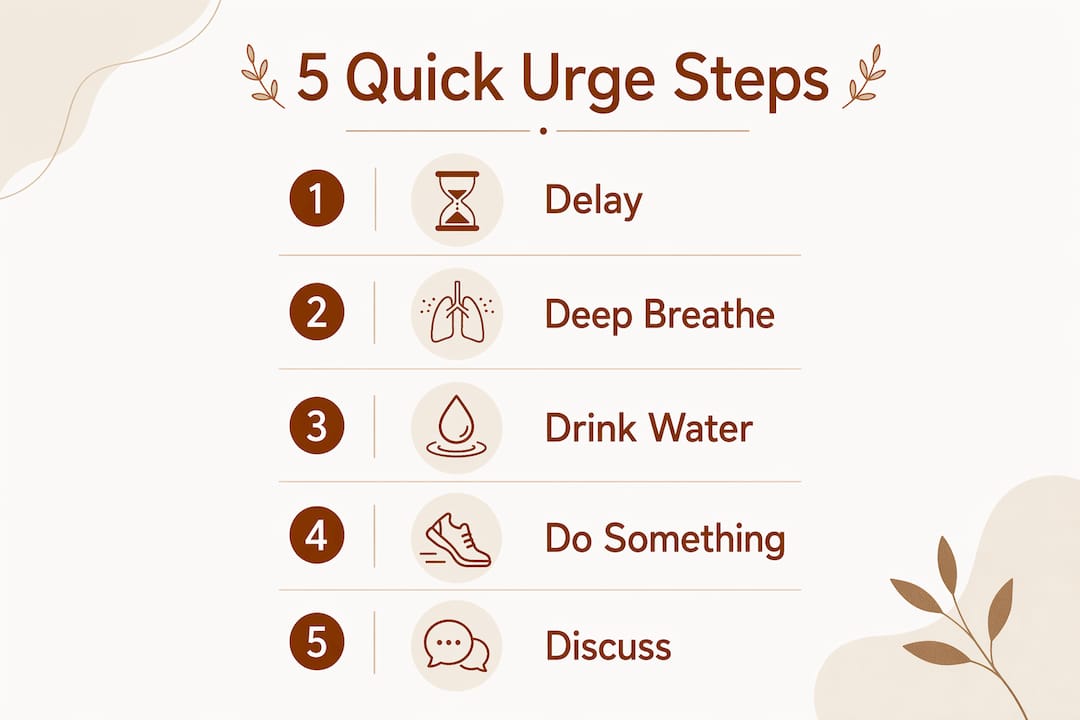
When a craving hits mid-meeting or right before a deadline, you need a response that takes seconds, not willpower. The fastest way to handle a sudden smoking urge at work is to run the 5 D’s: Delay, Deep breathe, Drink water, Do something else, Discuss.
Your one-minute craving checklist:
- Delay: Set a 10-minute timer on your phone. Don’t negotiate — just wait.
- Deep breathe: Four counts in, hold seven, out for eight. Do it twice.
- Drink water: A full glass, slowly. Cold works best.
- Do something else: Switch tasks, reply to an email, or stand up.
- Discuss: Text your quit buddy or call 1-800-QUIT-NOW.
Cravings are temporary brain states, not permanent needs. Clinical guidance confirms they peak in the first 72 hours after quitting and grow shorter and weaker over the following weeks. You are not fighting the urge forever — just the next ten minutes.
The FDA-approved nicotine replacement options (gum, lozenge) and nicotine-free tools like the Breathefree resistance necklace give you something to reach for the moment that timer starts. More on both below.
Table of Contents
- How to handle a sudden smoking urge at work in under 60 seconds
- Desk-friendly swaps that actually satisfy the urge
- Discreet cessation aids that fit a workday
- How to spot your work triggers and build a two-minute plan
- Two-minute breathing exercises you can do at your desk
- When urges keep coming back: support options and realistic timelines
- Why oral-fixation tools work and how to use the Breathefree necklace at work
- Key Takeaways
- The part most quit guides skip
- A nicotine-free option built for the workday
- Trusted U.S. sources and contacts for immediate help
How to handle a sudden smoking urge at work in under 60 seconds
Each of the 5 D’s fits inside a meeting break or a bathroom trip. Here is how to execute each one in a workplace setting, without drawing attention.
- Delay: Lock in the 10-minute rule. Most cravings dissolve on their own if you refuse to act for that window. Set a silent phone timer and keep working.
- Deep breathe (4-7-8): Inhale through your nose for four counts, hold for seven, exhale through your mouth for eight. One full cycle takes about 19 seconds. Two cycles and you are done.
- Drink water: Keep a full water bottle at your desk. Drinking a full glass occupies your hands, your mouth, and your attention simultaneously.
- Do something else: Pick a two-minute desk task you have been avoiding — sort a folder, reply to a message, reorganize your desktop. The cognitive switch interrupts the craving loop.
-
Discuss: Three scripted texts you can send right now:
- “Craving hitting hard — can you check in with me in 10?”
- “Need a distraction. What are you working on?”
- “Remind me why I’m doing this.”
Pro Tip: Use a short-acting NRT lozenge or the Breathefree resistance necklace before your known trigger times, not after the craving peaks. Anticipatory use — reaching for your tool before the 10 AM coffee break, not during it — keeps the craving curve from climbing in the first place.
Desk-friendly swaps that actually satisfy the urge
Overcoming smoking cravings at work is partly about your mouth and hands, not just your mind. The smoking ritual involves oral stimulation, hand movement, and a brief sensory experience. Replacing all three is what makes a substitute actually work.
Oral substitutes that help:
- Sugar-free gum: Chewing activates the jaw and keeps your mouth busy. Cinnamon or mint flavors add a sensory punch that plain gum misses.
- Cinnamon toothpicks: Discreet, zero-calorie, and the spice provides real sensory feedback. A favorite among people who miss the hand-to-mouth motion.
- Mints: Dissolve slowly, occupy the mouth, and are socially invisible at a desk or in a meeting.
- Carrot sticks or celery: Mayo Clinic lists crunchy snacks as a proven craving disruptor — the texture and chewing effort redirect attention.
Tactile and movement options:
- A stress ball or fidget ring keeps your hands occupied without anyone noticing.
- Seated stretches (shoulder rolls, neck tilts) lower physiological arousal within 60 seconds.
- A short walk to a different floor or a stairwell run resets your nervous system fast.
What commonly fails: Sugary snacks spike blood sugar and often worsen cravings within 20 minutes. Scrolling your phone is passive and does not interrupt the craving loop the way an active physical task does. Changing your physical environment — moving to a different chair, adjusting the room temperature — can also break the conditioned cue that triggers the urge in the first place.
The American Cancer Society notes that nicotine actually raises heart rate and blood pressure, so the “calm” smokers feel is relief from withdrawal, not real relaxation. Movement and breathwork deliver genuine physiological calm without the rebound.

Discreet cessation aids that fit a workday
NRT options you can use at your desk
Short-acting nicotine replacement therapy — gum and lozenges — are FDA-approved and designed for exactly this situation: a sudden, intense craving that needs fast relief. Both are silent, portable, and require no explanation to coworkers. A lozenge dissolves in 20–30 minutes; gum works in about the same window. Neither produces smoke, vapor, or smell.
The USPSTF recommends combining a slow-acting form (patch) with a fast-acting form (gum or lozenge) for adults who smoke, based on evidence that combined NRT outperforms a single type. If you are already wearing a patch, adding a lozenge during a high-stress meeting is a clinically supported move, not doubling up irresponsibly.
Nicotine-free options for professional settings
Some people prefer to avoid nicotine entirely, especially later in a quit attempt when the goal is breaking the habit loop, not managing withdrawal chemistry. Options in this category include:
- Nicotine-free herbal lozenges
- Oral-fixation objects (chewable jewelry, resistance necklaces)
- Essential oil nasal sticks for sensory redirection
The Breathefree resistance necklace fits squarely here. It is a nicotine-free, wearable oral-fixation tool you can hold or use discreetly during a meeting without anyone noticing. It satisfies the hand-to-mouth ritual that makes quitting hard, without delivering nicotine or any substance. Breathefree also offers flavor refills to keep the sensory experience fresh.
Pro Tip: Wear the Breathefree necklace under your collar during meetings. When a craving starts, reach for it under the table rather than excusing yourself. No one sees it, and you stay in the room.
Over 75,000 people have used the Breathefree method, pairing the physical necklace with community support and habit-tracking resources to replace the smoking ritual without nicotine.
How to spot your work triggers and build a two-minute plan
Dealing with cravings at work gets easier when you stop reacting and start anticipating. Most workplace cravings are not random — they attach to specific cues. Understanding what triggers smoking cravings at work lets you pre-load a response before the urge climbs.
Common workplace triggers:
- Morning coffee or the first break of the day
- High-stress calls or difficult conversations
- Post-lunch slump (blood sugar dip + habit association)
- Seeing a coworker head to the smoking area
- Deadline pressure or a frustrating email
Your two-minute plan template:
For each trigger, fill in: When does it happen? What is the cue? What is my replacement action? Who is my support person?

| Trigger | Replacement action | Support move |
|---|---|---|
| Morning coffee break | Breathe 4-7-8, sip water, use resistance necklace | Text quit buddy |
| Post-lunch slump | Walk one flight of stairs, chew sugar-free gum | Check in with a friend |
| Stressful call ends | Step away from desk, do shoulder rolls for 60 seconds | Call 1-800-QUIT-NOW if urge persists |
MedlinePlus guidance recommends making lists and practicing brief waits with substitutes — exactly this kind of pre-loaded plan. Changing your route to avoid the smoking area outside your building is another small adjustment that removes the visual cue entirely, which can help reduce office air pollutants and keeps you away from secondhand smoke triggers.
Two-minute breathing exercises you can do at your desk
Breathing techniques work because they directly counter the physiological stress response. A craving spikes cortisol and tightens the chest; controlled breathing reverses both within about 90 seconds.
1. 4-7-8 breathing (60 seconds)
- Sit upright, feet flat on the floor.
- Inhale through your nose for 4 counts.
- Hold your breath for 7 counts.
- Exhale slowly through your mouth for 8 counts.
- Repeat twice. Total time: under 40 seconds.
2. Box breathing (90 seconds)
- Inhale for 4 counts.
- Hold for 4 counts.
- Exhale for 4 counts.
- Hold for 4 counts.
- Repeat three full cycles. Used by Navy SEALs for acute stress — it works.
3. Paced diaphragmatic breathing (2 minutes)
- Place one hand on your belly, one on your chest.
- Breathe in slowly so only the belly hand rises.
- Exhale for twice as long as you inhale (e.g., 4 counts in, 8 counts out).
- Continue for 8–10 breath cycles.
Pro Tip: If you are in an open office and a craving is building, choose movement over breathing. A two-minute stairwell walk resets your nervous system faster when you cannot close your eyes or focus inward. Save the 4-7-8 for private moments or your car.
When urges keep coming back: support options and realistic timelines
If you are running the 5 D’s and still struggling, that is not a personal failure — it is a signal to add more support, not more willpower.
Escalation steps:
- Combine a nicotine patch with a fast-acting lozenge or gum for stronger withdrawal coverage.
- Talk to your primary care provider about prescription options (varenicline, bupropion) — both are evidence-based and covered by many U.S. insurance plans.
- Join a behavioral support program. USPSTF guidelines recommend at least four in-person counseling sessions for best results, and telephone counseling with at least three calls is also effective.
- Consider peer support. Peer support for quitting has measurable impact on quit rates and is available through quitlines and online communities.
U.S. resources:
- 1-800-QUIT-NOW: Free, confidential coaching. Coaches help you build a quit plan and can connect you with free NRT in many states.
- Smokefree.gov: Text “QUIT” to 47848 for SmokefreeTXT, or use the online chat. Also offers a free app (quitSTART) with craving tracking.
- American Cancer Society: Online support groups and a 24/7 helpline at 1-800-227-2345.
Timeline reality check: Clinical evidence shows cravings typically peak within the first 72 hours after quitting and become shorter and less intense over the following weeks. Each craving you ride out without smoking makes the next one slightly easier to handle.
Why oral-fixation tools work and how to use the Breathefree necklace at work
The behavioral case for oral-fixation objects
Smoking is not just a nicotine habit — it is a physical ritual. The hand-to-mouth motion, the sensory feedback, the brief pause from work: all of these are conditioned behaviors that persist even after nicotine dependence fades. An oral-fixation object interrupts that ritual by giving your hands and mouth something to do that is not a cigarette. It does not replace nicotine chemistry; it replaces the behavioral loop. That distinction matters for people who are past the acute withdrawal phase but still reaching for a cigarette out of habit. You can read more about replacing the smoking ritual in a way that sticks.
How to use the Breathefree resistance necklace at work
- Put it on before your first trigger window — not after a craving starts. Wear it under your shirt or visible, whichever feels natural.
- When a craving hits, hold the necklace pendant and breathe through it slowly. The resistance in the airflow mimics the draw of a cigarette without any substance.
- Add a flavor refill if plain breathing feels unsatisfying. Breathefree offers flavor options that provide sensory variety and keep the experience fresh.
- In meetings, hold the pendant under the table or rest it in your palm. The motion is small enough to go unnoticed.
- Clean it weekly with a damp cloth. Replace flavor refills as directed on the packaging.
75,000+ users have used Breathefree’s method, combining the necklace with community support and habit-tracking tools. The product contains no nicotine and no inhaled substances — it is a behavioral tool, not a pharmacological one. If you have a respiratory condition, check with your doctor before using any breathing-resistance device.
Using physical objects to quit smoking is a well-documented behavioral approach, and the necklace format makes it one of the most discreet options available in a professional setting.
Key Takeaways
The fastest way to handle a sudden smoking urge at work is to run the 5 D’s immediately, pair them with a discreet oral-fixation tool or short-acting NRT, and pre-load a two-minute plan for your most predictable triggers.
| Point | Details |
|---|---|
| Use the 5 D’s immediately | Delay, Deep breathe, Drink water, Do something else, Discuss — in that order, starting with a 10-minute timer. |
| Pre-load before triggers | Use your tool (NRT lozenge or Breathefree necklace) before the craving peaks, not after — anticipatory use is more effective. |
| Cravings peak in 72 hours | Clinical guidance confirms the first three days are hardest; urges shorten and weaken over the following weeks. |
| Escalate when needed | Call 1-800-QUIT-NOW or talk to a clinician if urges keep returning — combined NRT and counseling outperform willpower alone. |
| Breathefree necklace | A nicotine-free, discreet oral-fixation tool used by 75,000+ people to replace the smoking ritual without nicotine. |
The part most quit guides skip
Most smoking cessation strategies treat workplace cravings as a willpower problem. They are not. They are a ritual problem.
The smokers I see struggle most are not the ones with the strongest nicotine dependence — they are the ones who used cigarettes as their only legitimate reason to step away from their desk, take a breath, and reset. When you take the cigarette away without replacing that function, the craving is not just chemical. It is the only break you had.
That is why the most durable workplace tactics are the ones that preserve the break but swap the cigarette. Walk to the stairwell. Breathe through a resistance necklace. Sip water slowly at a window. The ritual matters. The nicotine does not.
Cravings are also genuinely temporary — not just as reassurance, but as a neurological fact. Each one you ride out without smoking weakens the neural pathway that fired it. The first week is the hardest because those pathways are still strong. By week three, most people are surprised by how infrequently the urge appears. That is not willpower. That is biology working in your favor, if you give it the time.
Small experiments beat grand commitments. Try one desk swap this week. Use the 4-7-8 once tomorrow. See what the Breathefree necklace feels like during a meeting. You do not need a perfect plan — you need a first move.
A nicotine-free option built for the workday
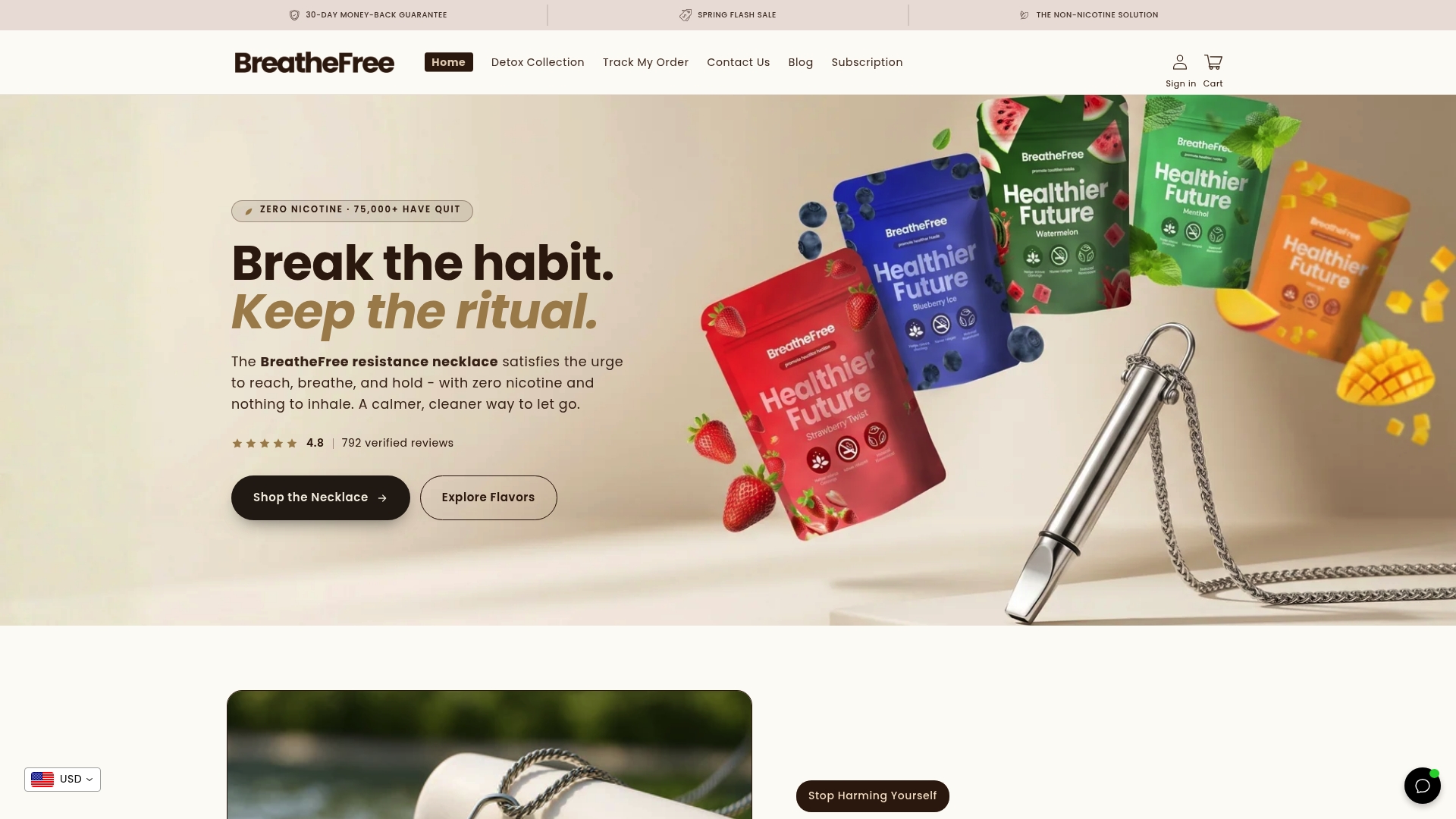
If you have tried gum, mints, and deep breathing and still find yourself reaching for a cigarette the moment stress spikes, the missing piece might be the ritual itself — not the nicotine. The Breathefree resistance necklace is a nicotine-free, wearable oral-fixation tool designed to replace the hand-to-mouth habit that makes quitting hard at work.
You wear it, hold it during a craving, and breathe through it. No smoke, no vapor, no substances. It is quiet enough for a conference room and discreet enough that no one asks questions. Breathefree also offers flavor refills, lung detox gummies, and a habit tracker to support the full quit process.
Full disclosure: Breathefree publishes this article and sells the products described. Over 75,000 people have used the Breathefree method. If you are ready to try a behavioral approach that fits your workday, explore the resistance necklace and see which option fits your situation.
Trusted U.S. sources and contacts for immediate help
- Smokefree.gov: Free quit plans, craving management guides, the quitSTART app, and SmokefreeTXT (text “QUIT” to 47848). The 5 D’s framework lives here.
- 1-800-QUIT-NOW (1-800-784-8669): The national quitline. Free coaching, personalized quit plans, and NRT access in many states. Available in English and Spanish.
- Mayo Clinic — Tobacco Cravings: Ten evidence-based strategies for resisting urges, including distraction, replacement snacks, and trigger planning.
- American Cancer Society (1-800-227-2345): 24/7 helpline, online support groups, and detailed guides on managing tough craving moments.
- MedlinePlus — Dealing with Cravings: Plain-language guidance on planning, practicing brief waits, and using substitutes — backed by the National Library of Medicine.
This article is general information, not medical advice. For guidance specific to your health situation, consult a qualified healthcare provider or contact one of the resources above.