

A 12-week structured quit plan that combines at least four behavioral contacts with daily use of a nicotine-free oral fixation aid is the most practical non-medical route for heavy smokers. CDC guidance confirms that counseling paired with support tools gives people the best chance of quitting, and NCBI Bookshelf evidence shows that four or more sessions produce meaningfully better sustained abstinence than minimal contact. The 2026 VA Tobacco Cessation Guideline normalizes relapse and recommends immediate re-engagement in treatment after a slip.
Your TL;DR checklist:
- Pick a quit date 2–3 weeks out and commit to it in writing
- Schedule at least four behavioral or support sessions before and during your quit window
- Choose a nicotine-free oral aid (Breathefree Resistance Necklace, Silicone Mouthpiece, or sugar-free gum) and map it to your top three triggers
- Set weekly reduction milestones and log them in a habit tracker
- Write a one-page relapse recovery step before your quit date
Table of Contents
- Why oral fixation drives relapse for heavy smokers
- What every structured quit plan for heavy smokers must include
- How to follow a 12-week step-by-step quit plan
- Which nicotine-free oral aids actually fit a structured plan?
- How do you choose and use an oral fixation aid safely?
- What to do after a slip so it does not become a full relapse
- Where to get behavioral support and what it costs
- Key Takeaways
- The part most quit plans get wrong
- Breathefree tools that fit directly into this plan
- Useful sources and further reading
Why oral fixation drives relapse for heavy smokers
Smoking is both a chemical and a behavioral addiction. The CDC and Mayo Clinic both point out that the hand-to-mouth ritual, the sensory cues, and the structured break around a cigarette persist long after nicotine withdrawal fades. That physical act of bringing something to your mouth is often what triggers a relapse weeks into an otherwise successful quit attempt.
Heavy smokers typically smoke in tight clusters around predictable cues: morning coffee, the first ten minutes of a commute, a stressful call, a post-meal break. Each of those moments carries a conditioned oral ritual, not just a nicotine craving. Replacing the chemical without replacing the ritual leaves a gap that willpower alone rarely fills.
The dose-response is real. NCBI Bookshelf research identifies a direct link between treatment intensity and sustained abstinence — four or more sessions outperform one or two every time.
Common triggers where oral fixation is strongest:
- Morning coffee or tea
- Driving or commuting
- Work stress or deadline pressure
- After meals
- Social settings where others smoke
What every structured quit plan for heavy smokers must include
A smoking cessation plan without these components is more wish than plan. Each element addresses a specific failure point.
- Fixed quit date or phased reduction window (4–6 weeks maximum). Smokefree.gov recommends picking a quit date within two weeks and building preparatory tasks around it. A reduction phase longer than six weeks risks losing momentum.
- At least four behavioral contacts. Schedule one session before quit day, two in the first week after, and at least one more within the first month.
- Trigger mapping. List your top five smoking cues and assign a specific replacement behavior to each.
- Oral-fixation replacement plan. Decide which nicotine-free aid you will use at each trigger before quit day arrives.
- Daily habit tracker. Journaling and habit tracking improve self-monitoring and adherence throughout a quit attempt.
- Relapse recovery plan. Write it before you need it: trigger identification, 10-minute delay, oral aid, contact a support person.
- Social support. Tell at least one person your quit date and ask them to check in weekly.
How to follow a 12-week step-by-step quit plan
Start here: weeks 1–4 are a phased reduction into a firm quit day at week 5, with intensive behavioral contact through week 6 and maintenance tracking through week 12.
Weeks 1–2: Prepare
- Choose your quit date (target: end of week 2 or start of week 3).
- Remove cigarettes, lighters, and ashtrays from your home and car.
- Map your triggers and write a replacement behavior for each.
- Buy or set up your nicotine-free oral aid before quit day.
- Schedule your first behavioral or counseling session this week.
Weeks 3–4: Reduce
- Cut daily cigarette count progressively each week using firm reduction targets to preserve momentum.
- Begin using your oral aid at the two strongest trigger moments each day.
- Complete your second behavioral contact session.
- Log daily counts and cravings in your habit tracker.
Week 5: Quit day
- Smoke your last cigarette the night before and discard everything.
- Use the oral aid at every former smoking trigger from day one.
- Apply the 4 D’s at every craving: Delay 10 minutes, Deep breath, Drink water, Do something else.
- Complete your third behavioral contact session within the first three days.
Weeks 6–8: Consolidate
- Complete your fourth behavioral contact session by end of week 6.
- Review trigger map weekly and adjust replacement behaviors that are not holding.
- Keep the oral aid accessible at all former smoking locations.
Weeks 9–12: Maintain
- Taper oral aid use gradually — use it at your two hardest triggers only, then one, then as needed.
- Continue weekly habit tracker entries.
- Schedule a check-in session if cravings spike.
Pro Tip: Reduce by 20–30% every seven days during the reduction phase. NCSCT guidance supports firm weekly milestones to preserve momentum — keep the reduction phase to four to six weeks maximum, or commitment tends to drift.
Which nicotine-free oral aids actually fit a structured plan?
Nicotine-free oral aids reduce cue-triggered relapse by replacing the hand-to-mouth ritual without adding any nicotine. The American Cancer Society lists preparing oral substitutes as a standard preparatory step before quit day.

Breathefree reports a large user base across its nicotine-free product line. The three tools that map most directly to a structured plan are the Breathefree Resistance Necklace (tactile, wearable, discreet), the Breathefree Silicone Mouthpiece (direct oral contact, portable), and the Breathefree Nicotine Detox eBook & Habit Tracker (daily structure and reflection).
| Option | Oral/tactile | Nicotine-free | Safety notes | Discretion | Cost/reuse | Plan fit | US availability |
|---|---|---|---|---|---|---|---|
| Breathefree Resistance Necklace | Tactile (hand/mouth) | Yes | No known cautions | High — worn as jewelry | Reusable | Trigger moments, driving, stress | Yes |
| Breathefree Silicone Mouthpiece | Oral contact | Yes | Clean regularly; not for those with jaw issues | Moderate | Reusable | Post-meal, coffee, desk work | Yes |
| Sugar-free gum/mints | Oral contact | Yes | Limit with dental work; xylitol caution for pets | High | Low cost, disposable | Any trigger, on the go | Yes |
| Flavored toothpicks/cinnamon sticks | Oral contact | Yes | Avoid if prone to splinters; not for young children | High | Very low cost | Short cravings, after meals | Yes |
| Breathefree Nicotine Detox eBook & Habit Tracker | Behavioral/written | Yes | None | N/A | One-time purchase | Daily tracking, weekly reflection | Yes |
Pros and cons by category:
- Tactile wearable (necklace): Discreet enough for meetings and public spaces; no hygiene maintenance beyond wiping; suits people who fidget or need something in their hands. Less effective for those who need direct oral contact.
- Silicone mouthpiece: Directly mimics the oral sensation of smoking; easy to carry. Requires regular cleaning and is less suitable for people with jaw or dental sensitivities.
- Sugar-free gum/mints: Widely available, zero setup, familiar. Can become a new compulsive habit if used constantly rather than at specific triggers.
- Toothpicks/cinnamon sticks: Cheap and effective for short cravings. Not ideal in formal settings.
How do you choose and use an oral fixation aid safely?
Choose based on how you prefer oral contact (mouth vs. hand), any medical cautions, and how discreet you need to be at work or in social settings.
Selection checklist:
- Do you have dental work, jaw pain, or a swallowing disorder? Stick to tactile options like the necklace rather than mouthpieces.
- Will you use it in meetings or public spaces? A wearable necklace or discreet gum beats a visible mouthpiece.
- Do you want reusable or disposable? Reusable tools cost more upfront but less over 12 weeks.
- How many triggers do you have per day? High-frequency users benefit from a reusable, always-on option.
Usage rules:
- Clean silicone mouthpieces daily with warm water and mild soap.
- Use the aid at specific trigger moments, not continuously. Constant use risks replacing one compulsive habit with another.
- Begin tapering aid use during weeks 9–12 as triggers weaken.
Pro Tip: Rotate two complementary aids, such as the Breathefree Resistance Necklace for driving and stress moments, and sugar-free gum for post-meal cravings. Varied sensory input prevents boredom and keeps the replacement ritual feeling fresh.
What to do after a slip so it does not become a full relapse
A slip is common. The 2026 VA Tobacco Cessation Guideline recommends immediate re-engagement in treatment rather than treating a slip as failure. One cigarette does not erase your progress. What you do in the next 30 minutes does.
Immediate recovery script:
- Stop. Note the exact trigger that caused the slip (time, place, emotion).
- Apply the 10-minute delay: deep breath, drink water, hold your oral aid.
- Contact your support person or coach within the hour.
- Schedule an extra counseling or peer session that week.
- Re-read your relapse recovery plan and recommit to your quit date.
Prevention steps to build in before you need them:
- Pre-plan a specific response for your top three triggers.
- Carry a “slip kit”: your oral aid plus a printed one-page checklist.
- Set a daily phone reminder to log in your habit tracker. Consistent logging surfaces warning patterns before a slip happens.
For a deeper look at common relapse triggers and recovery steps, Breathefree’s blog covers the most frequent failure points and how to address each one.
Where to get behavioral support and what it costs
The most effective smoking cessation plans combine counseling with tools. Free options cover most of what heavy smokers need.
Free support channels:
- 1-800-QUIT-NOW: The national quitline connects you to a trained counselor at no cost. Available in every U.S. state.
- Smokefree.gov: Free digital tools including the quitSTART app, a build-a-plan tool, and text support programs.
- Community health clinics: Many offer free or sliding-scale cessation counseling.
- Telehealth counseling: Low-cost video sessions available through several platforms; check your insurance, as many plans cover cessation counseling.
- Peer support groups: In-person and online; pairs well with the 12-week plan for accountability between formal sessions.
Cost range: Free (quitlines, Smokefree.gov) to low cost (apps, eBooks, habit trackers) to moderate (private one-on-one counseling). Insurance often covers clinical treatment — check with your provider. Breathefree’s quit support resources guide lists additional free and paid options.
Key Takeaways
A 12-week structured quit plan combining at least four behavioral contacts with a nicotine-free oral fixation aid gives heavy smokers the strongest non-medical foundation for lasting cessation.
| Point | Details |
|---|---|
| Set a quit date now | Pick a date 2–3 weeks out and build all preparatory steps around it. |
| Schedule ≥4 behavioral sessions | Four or more contacts produce better sustained abstinence than minimal contact. |
| Map triggers to oral aids | Assign a specific nicotine-free aid to each of your top three smoking cues before quit day. |
| Treat slips as data, not failure | Identify the trigger, use the 10-minute delay, and re-engage treatment immediately. |
| Breathefree tools fit the plan | The Resistance Necklace, Silicone Mouthpiece, and Habit Tracker each address a distinct phase of the 12-week program. |
The part most quit plans get wrong
Most smoking cessation plans focus almost entirely on the chemical side of addiction and treat the behavioral side as a footnote. That is backwards for heavy smokers. By the time someone has smoked a pack a day for years, the ritual is as deeply wired as the nicotine dependence. The morning coffee, the post-lunch walk, the stress break — these are not just cravings. They are structured routines that happen to involve a cigarette.
What actually works is treating the oral ritual as a first-class problem, not an afterthought. That means choosing an oral aid before quit day, not scrambling for one after the first bad craving. It means mapping exactly which moments of the day are highest-risk and having a physical object in your hand or mouth at those moments. The Breathefree Resistance Necklace, for instance, works precisely because it gives you something to do with your hands and mouth simultaneously, without any nicotine and without looking conspicuous in a meeting.
The other thing most plans underestimate: the reduction phase. Four to six weeks of gradual cuts with firm weekly targets is enough. Longer than that and the quit date starts to feel theoretical. The milestone discipline matters more than the method.
Breathefree tools that fit directly into this plan
Breathefree builds nicotine-free oral fixation tools specifically for the kind of structured plan outlined here. The Breathefree Resistance Necklace handles the tactile and hand-to-mouth ritual discreetly, whether you are at your desk, in traffic, or in a meeting. The Silicone Mouthpiece delivers direct oral contact for moments when the craving is strongest. Both are reusable, nicotine-free, and available in the U.S.
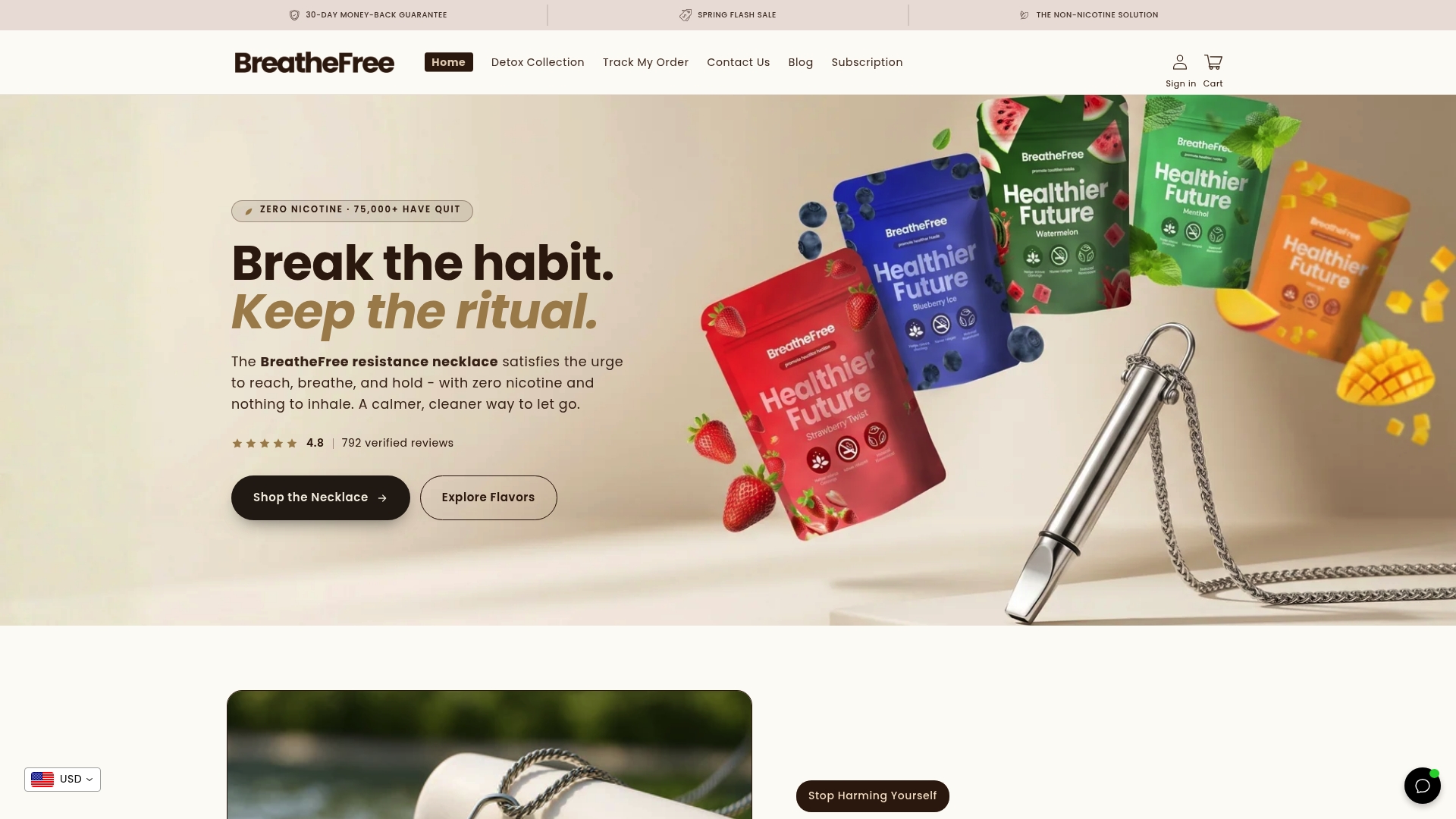
The Nicotine Detox eBook & Habit Tracker ties the whole 12-week plan together: daily tracking pages, weekly reflection prompts, and structured guidance that mirrors the plan above. Over 75,000 people have used Breathefree’s approach to quit without nicotine replacement. If you are ready to start, the habit tracker is the clearest first step.
Useful sources and further reading
- CDC: How to Quit Smoking — counseling and support tool overview
- Smokefree.gov: Build My Quit Plan — free personalized quit plan builder
- NCBI Bookshelf: Tobacco Cessation Evidence Summary — behavioral intensity and abstinence outcomes
- Mayo Clinic: 10 Ways to Resist Tobacco Cravings — practical craving management techniques
- VA Tobacco Cessation Clinical Practice Guideline 2026 — relapse normalization and repeat treatment recommendations
- American Cancer Society: Deciding to Quit and Making a Plan — preparatory steps and oral substitutes
- NCSCT: Treatment Programme Guidance — phased reduction milestones
- CDC Tips From Former Smokers: Quit Resources — free quitlines and digital tools
This article is general information, not medical advice. For personalized guidance on quitting smoking, consult a qualified healthcare provider or call 1-800-QUIT-NOW to speak with a free counselor.