

Yes. Drinking alcohol is one of the most consistent triggers for smoking lapses, and alcohol and smoking relapse feed each other in both directions. If you’re newly quit, the safest move is to skip alcohol entirely for at least the first week and build a concrete coping plan before you walk into any situation where drinking and smoking have historically gone together.
TL;DR:
- Drinking alcohol increases the risk of smoking relapse, especially within the first two weeks after quitting, due to boosted urges and lowered resistance.
- Alcohol cues alone can trigger smoking urges, and heavy drinking or drinking in social contexts significantly raise relapse chances regardless of quit duration.
- Nicotine withdrawal peaks around days two and three, making this the worst time to consume alcohol or engage in risky drinking behaviors.
- Behavioral plans, such as delaying alcohol, avoiding trigger locations, and using fast-acting NRT, can reduce the likelihood of relapse when drinking socially.
- Combining medical treatment with behavioral tools and specific trigger scripts yields the best chance to maintain smoking abstinence during periods of alcohol consumption.
Table of Contents
- The Research on Alcohol and Smoking Relapse
- Why Drinking Makes Smoking Relapse More Likely
- Who Faces the Highest Relapse Risk
- Timing Matters: The Withdrawal Window You Need to Plan Around
- How to Avoid Smoking When Drinking
- What Clinicians Recommend for Dual Recovery
- Why I Recommend Pairing Behavioral Tools With Real Treatment
- What the Evidence Actually Tells You to Do
- Try a Nicotine-Free Tool Alongside Your Quit Plan
- Sources
The Research on Alcohol and Smoking Relapse
The evidence here isn’t a single study you can wave away. It’s cohort data, systematic reviews, and real-time diary studies that all point the same direction, with one interesting wrinkle about timing.
Start with the NESARC cohort study, which followed more than 9,000 adults in remission from alcohol use disorder across two waves, roughly three years apart. People who smoked at the first check-in were significantly more likely to have relapsed into alcohol abuse or dependence by the second one, even after researchers adjusted for other risk factors. Smoking wasn’t just a bystander habit sitting next to drinking. It predicted whether alcohol recovery held.
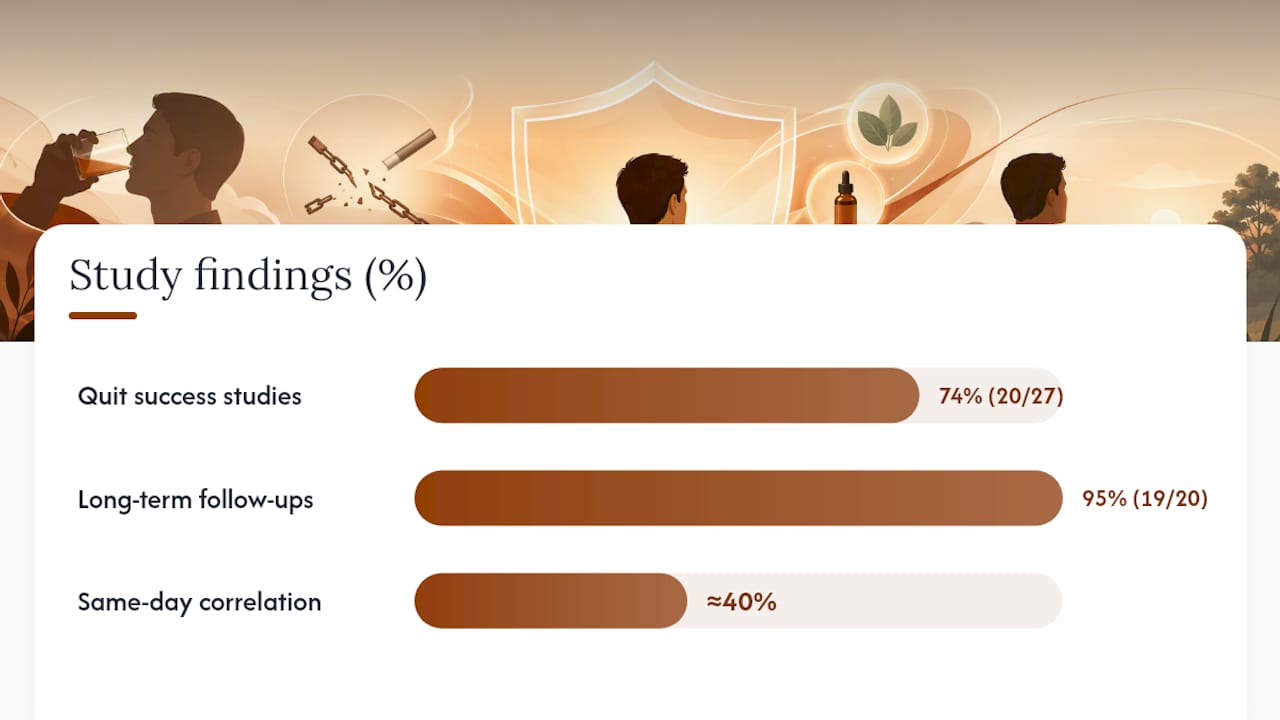
The direction runs the other way too. A systematic review covering 60 studies on alcohol and smoking cessation found that drinking was linked to lower quit success in 20 of 27 studies that measured it, and to shorter smoking-abstinence duration in 19 of 20 long-term follow-ups. When researchers ran controlled experiments exposing people to alcohol cues, 12 of 13 studies found it provoked smoking urges. That’s a strikingly consistent signal for a behavioral science question.
By the numbers: In the alcohol-and-cessation systematic review, alcohol use undermined smoking quit attempts in roughly 74% of the studies that tracked quit success (20 of 27), and shortened abstinence in 95% of long-term follow-ups (19 of 20).
Real-time data backs this up with texture the bigger studies can’t offer. Electronic diary research on alcohol-dependent smokers tracked people for two weeks after treatment and found a genuinely bidirectional pattern: alcohol urges climbed after smoking episodes, and smoking urges climbed after drinking. Drinking relapses were best predicted by a combination of low self-efficacy and high urge to smoke. Smoking relapses were best predicted by high smoking urge paired with high negative, high-arousal mood, meaning anxious or agitated states, not just sadness. Separate time-series work found that around 40% of people who relapsed showed same-day positive correlations between drinking and smoking, with the strongest link occurring on the same day or the day after a drink.
Here’s the nuance that surprises most people: a stratified analysis of ex-smokers found that moderate drinking was associated with a lower smoking-relapse risk within the first year of quitting, but a higher relapse risk after that first year passed. The researchers themselves flagged this as a finding that needs replication, and it shouldn’t be read as permission to drink freely early on. But it does suggest that risk isn’t static. It shifts as your quit matures, which is exactly why a one-size-fits-all rule about alcohol falls short.
A few takeaways worth sitting with:
- Smoking predicts later alcohol relapse just as strongly as drinking predicts smoking relapse. This is a two-way street.
- Alcohol cues alone, without any actual drinking, were enough to spike smoking urges in most experimental studies.
- Same-day drinking and smoking cluster together for roughly four in ten people who relapse.
- Risk isn’t fixed. It changes with how long you’ve been quit, which the next sections unpack.
Why Drinking Makes Smoking Relapse More Likely
The link between alcohol and smoking relapse isn’t just bad luck or weak willpower. It runs through specific, identifiable pathways, and once you know them, you can actually interrupt them.
Pharmacologic synergy. Alcohol amplifies how rewarding nicotine feels while simultaneously lowering the inhibition that normally helps you say no to a cigarette. That’s a rough combination: the thing you’re trying to resist becomes more appealing right when your resistance is weakest.
Cue reactivity. If you spent years smoking with a drink in hand, your brain built a strong association between the two. Alcohol becomes what researchers call a conditioned cue. Just picking up a glass can trigger a smoking urge even before any alcohol hits your bloodstream, which is part of why experimental studies found alcohol cues alone provoked urges in most participants.
Mood and self-control effects. Drinking chips away at self-efficacy, your belief that you can handle a craving without giving in, while also stirring up the negative, agitated mood states that the diary research linked to smoking relapse. You end up with less confidence and more emotional noise at the same time, which is a bad combination for holding a quit.
Combined health harm. There’s a biological angle too. Research on plasma reactive carbonyl species found meaningfully higher levels of these damaging compounds in people who both drank and smoked, compared with people who did only one or neither. The habits don’t just reinforce each other behaviorally. They compound each other’s physical toll.
What this means practically:
- Alcohol lowers the barrier to smoking chemically and psychologically at the same moment.
- Old drinking rituals act as smoking triggers even without conscious awareness.
- Negative, high-energy moods (irritation, anxiety) are a bigger relapse risk factor than sadness alone.
- Quitting both habits together reduces combined physical damage, not just the risk of relapse.
Who Faces the Highest Relapse Risk
Not everyone who drinks faces the same odds of slipping back into smoking. Your risk depends heavily on how long you’ve been quit, how you drink, and who you’re drinking with.
The quit-duration finding deserves top billing here. That stratified study found moderate drinking linked to lower relapse risk in the first year of smoking abstinence but higher relapse risk afterward. One plausible read: early on, people are hyper-vigilant and treat any drinking occasion as a controlled test. After a year, vigilance relaxes, old habits creep back in, and alcohol starts doing what it always did, cueing a cigarette.
Certain drinking patterns carry more danger than others regardless of quit duration:
- Heavy or binge drinking episodes, where inhibition drops sharply and cue reactivity spikes.
- Drinking in the presence of other smokers, especially in social settings where “just one” is normalized.
- Drinking alongside a diagnosed alcohol use disorder, where the alcohol relapse trigger and the smoking relapse trigger are essentially the same event.
- Drinking during high-stress life periods, when negative mood already primes both cravings.
Personal factors matter too. Higher nicotine dependence (measured by things like how soon after waking you used to smoke) predicts stronger cravings under any trigger, alcohol included. Co-occurring anxiety or depression raises the odds that a drink turns into a cigarette, since both conditions feed the negative-mood pathway the diary studies flagged. And social networks matter more than most people admit. If your closest friends still smoke and drink together, your environment is doing a lot of the relapse work for you, independent of your own willpower.
Timing Matters: The Withdrawal Window You Need to Plan Around
Nicotine withdrawal follows a fairly predictable script, and knowing it lets you time your guard rails instead of guessing.
According to Cleveland Clinic, withdrawal symptoms typically begin 4 to 24 hours after your last nicotine dose, peak around day 2 or 3, and generally fade over a period ranging from several days to 3 or 4 weeks. That peak window, days two and three, is when irritability, restlessness, and craving intensity are at their worst, which is precisely the wrong moment to add alcohol’s disinhibiting effects on top.
Key figure: Nicotine withdrawal peaks on day 2 or 3 after quitting and can persist for up to 3 to 4 weeks, according to Cleveland Clinic.
Here’s how the first month tends to break down, and what it means for your drinking decisions:
- Days 1 to 3: Withdrawal is climbing toward its peak. Skip alcohol entirely. Your self-control reserves are already stretched thin, and this is the worst possible time to add a disinhibiting substance.
- Days 4 to 7: Symptoms are still intense for most people. Continue avoiding alcohol if you can. If you must attend a drinking event, treat it as a controlled exposure with an exit plan, not a night out.
- Days 8 to 14: Physical withdrawal starts easing for many, though cravings tied to specific situations (stress, social events) can persist. This is a reasonable point to consider low-risk, short, supervised drinking occasions if you feel stable, but stay alert to any alcohol relapse triggers tied to your old routines.
- Days 15 to 30: Withdrawal has usually faded to occasional urges rather than constant discomfort. You can begin cautiously reintroducing social drinking, but keep the coping tools from the first two weeks close by, since research shows this is also when vigilance naturally starts to drop.
Understanding the general craving timeline helps you separate “this is just withdrawal peaking” from “this is a real relapse risk building,” which matters when you’re deciding whether tonight’s plans are worth the exposure.
How to Avoid Smoking When Drinking
This is the part that actually changes outcomes. Knowing the research is one thing; having a plan for Friday night is another.
Behavioral planning comes first. The single highest-leverage move is delaying alcohol until your quit has some stability, ideally past that first high-risk week. When you do drink, write an actual if-then script before you go out: “If someone offers me a cigarette, then I say I’m taking a break and step outside alone.” Vague intentions collapse under social pressure. Specific scripts survive it. Bringing a sober friend who knows your quit status, or simply giving yourself permission to leave early, removes the moment of negotiation entirely.
Environmental control matters more than people expect. Choose smoke-free venues when you have a choice. Avoid the specific bar, patio, or friend’s porch where you used to smoke and drink simultaneously, since that location is now a conditioned cue whether you think about it or not. If you’re hosting, keep the space free of ashtrays, lighters, or anything that visually cues the old ritual.

Fast-acting NRT deserves a place in your bag, literally. Research on real-time relapse patterns points to fast-acting nicotine replacement, gum or nasal spray, as particularly useful in live drinking situations because you can deploy it the moment an urge spikes, rather than waiting it out. Smokefree echoes this and adds a concrete moderation benchmark if you do choose to drink: no more than one drink a day for women and two for men, framed as a ceiling, not a target. Talk to your clinician before combining any medication with alcohol.
Psychological skills close the gap that products can’t. Urge surfing, the practice of observing a craving without acting on it, works because cravings are time-limited even when they feel unbearable. Delay tactics help here too: telling yourself to wait just 3 to 5 minutes before deciding gives the urge time to crest and fall, since most cravings peak and fade within that window. Pair delay with something physical, slow breathing, a short walk, or chewing something with texture, to occupy the oral and behavioral loop that a cigarette used to fill. Understanding what actually drives a nicotine craving makes these tools easier to trust in the moment, because you’re not fighting a mystery urge, you’re recognizing a known pattern.
Quick reference for your toolkit:
- Delay alcohol until past the acute withdrawal window when possible.
- Write specific if-then scripts for predictable trigger situations, not general intentions.
- Avoid the exact locations tied to old drinking-smoking rituals.
- Carry fast-acting NRT to specific high-risk events.
- Use the 3 to 5 minute delay rule paired with a physical distraction.
- Know your moderation ceiling if you choose to drink at all.
Pro Tip: Keep a short list of two or three “exit lines” saved in your phone, actual sentences you can say out loud when someone hands you a cigarette at a party. Rehearsed language beats improvised language every time your guard is down.
If you find yourself relying on these tactics constantly and still slipping, or if your drinking itself feels outside your control, that’s the signal to move from self-directed strategies to integrated treatment that addresses both alcohol and tobacco use as one connected problem rather than two separate fights.
What Clinicians Recommend for Dual Recovery
Treating alcohol use and smoking cessation at the same time is generally considered safe and can improve outcomes for both, despite an older assumption that quitting two habits at once was too much at once. The pathways described earlier, shared cues, shared mood triggers, mean addressing one in isolation often leaves the other’s triggers untouched.
A typical clinical approach looks like this: intensify pharmacotherapy during known high-risk windows rather than using a flat dose throughout, and build in monitoring for urge spikes rather than waiting for a full lapse to react. This tracks with the diary research showing that self-efficacy and urge levels predict relapse before it happens. If you can measure those signals, you can intervene earlier.
For acute situations, fast-acting nicotine options (gum, lozenge, nasal spray) give you something to deploy in real time when a drinking-related urge hits. For longer-term support, prescription medications like bupropion or varenicline are worth discussing with a clinician, particularly if nicotine dependence is high or previous quit attempts failed around drinking-related lapses. These require a prescriber’s judgment about interactions and your specific health history, so this isn’t a self-directed choice the way carrying gum is.
Walking into an appointment ready with specifics gets you better guidance. Bring:
- A rough history of your drinking and smoking patterns, including which came first developmentally.
- The specific contexts where you’ve relapsed before (parties, stress, certain people).
- What’s worked and failed in previous quit attempts, including any medications tried.
- Whether alcohol use itself feels manageable or has ever felt out of control.
If your drinking sits closer to a use disorder than casual social drinking, a formal alcohol screening can clarify whether integrated treatment, rather than smoking-focused support alone, is the better starting point.
Why I Recommend Pairing Behavioral Tools With Real Treatment
Nicotine-free habit-replacement tools, things like a resistance necklace or a structured tracker, exist to solve a narrow but real problem: the physical, ritualistic side of smoking that pharmacotherapy doesn’t touch. Holding something, fidgeting with it, having an oral substitute during that first brutal week of withdrawal, addresses the behavioral loop the research keeps flagging as a relapse driver. A resistance necklace was built around exactly that gap, alongside habit-tracking resources that help people see their own patterns, including the drinking-smoking clustering described in the electronic diary studies above.
These tools are adjuncts, not substitutes. They don’t treat alcohol use disorder, and they don’t replace bupropion, varenicline, or counseling when someone needs them. What they do is fill the hours between triggers, the fidgeting, the hand-to-mouth ritual, the need for something to do with restless energy, which is precisely where a lot of people report losing their quit.
Producing structured quit guides has made one thing obvious: the plans that hold up under real drinking situations are the ones that name the exact trigger moment in advance, not the ones that rely on general willpower. Specificity beats motivation almost every time.
If you’re building a longer-term coping strategy that has to survive actual social drinking, not just the easy weeks, treat behavioral tools as one layer among several, sitting alongside medical treatment where it’s needed and honest tracking of your own patterns.
What the Evidence Actually Tells You to Do
Most quit advice treats alcohol as a single, flat risk: avoid it, full stop. The research doesn’t support that flat a rule, and I think pretending it does actually undermines credibility with people who are going to drink anyway. The quit-duration finding matters more than it gets credit for: risk isn’t static, and a plan built for week one shouldn’t be the same plan you’re running at month eight.
What conventional advice underrates is the after-the-first-year window. Everyone braces for the early days and then relaxes exactly when a different, quieter risk period opens up. What it overrates is willpower as the fix. The diary data is clear that mood and self-efficacy predict lapses before the drinking even starts, which means the intervention point is earlier than most people think, at the mood dip, not the glass in hand.
Prioritize this in order: protect the first week hard, build specific scripts for predictable triggers, and stay honest with yourself about month nine, not just day nine.
— Tommy
Try a Nicotine-Free Tool Alongside Your Quit Plan
If you’re navigating alcohol and smoking relapse risk and want something concrete for the physical side of quitting, the Breathefree resistance necklace gives you an oral substitute you can reach for the moment a craving hits at a bar or a barbecue, no lighting up, no nicotine, just something to hold and use in your hand and mouth during the exact moments this article describes as highest risk.
It’s built for people who need something physical to interrupt the ritual, not replace medical treatment. If you’re also using NRT or working with a counselor, the necklace and the accompanying nicotine detox eBook and habit tracker slot in alongside those, giving you a way to log drinking-related triggers and see your own patterns over time. Check with your clinician before combining any medication with alcohol, but the behavioral side, the fidgeting, the hand-to-mouth habit, the boredom between cravings, is exactly what these tools are designed for. Visit the Breathefree resistance necklace collection to see the current options and pick a starting point for your own quit plan.
Sources
- Cigarette smoking and risk of alcohol use relapse among adults in recovery from alcohol use disorders
- The effect of alcohol use on smoking cessation: A systematic review
- Alcohol and tobacco cessation in alcohol dependent smokers: analysis of real-time reports
- Nicotine withdrawal (Cleveland Clinic)
This article is general information, not a substitute for advice from a qualified doctor. Consult a qualified healthcare professional about your own circumstances before acting on anything here.