

Urge surfing lets you notice a smoking craving, watch it build and fade in your body, and let it pass without lighting up. It’s a mindfulness skill, not a magic switch: research shows it weakens the link between craving and cigarette use more reliably than it kills the craving outright. Use it the moment an urge hits, and practice it daily so it’s ready when withdrawal spikes.
TL;DR:
- Urge surfing weakens the connection between cravings and smoking by reinforcing mindful observation rather than suppressing the urge itself.
- Practice urge surfing at least once daily to build resilience and respond faster during intense withdrawal periods; multiple short sessions are more effective than one long one.
- Research shows mindfulness reduces the link between craving and actual cigarette use more reliably than it lowers craving intensity, especially when practiced consistently.
- Pair urge surfing with oral substitutes, behavioral distractions, or nicotine replacement therapy for comprehensive support during withdrawal.
- The technique is most effective when combined with a broader quit plan, including coaching, triggers management, and preparedness for heavy withdrawal moments.
Table of Contents
- What Is Urge Surfing, and Why Does the Wave Metaphor Work?
- How Do You Actually Practice Urge Surfing When a Craving Hits?
- Does Urge Surfing Actually Work? What the Research Shows
- What Else Should You Pair With Urge Surfing?
- Riding Out a 3 A.M. Craving: What Actually Happened
- A Nicotine-Free Way to Keep Your Hands and Mouth Busy While You Ride It Out
- Where to Go for More Help
- Sources
What Is Urge Surfing, and Why Does the Wave Metaphor Work?
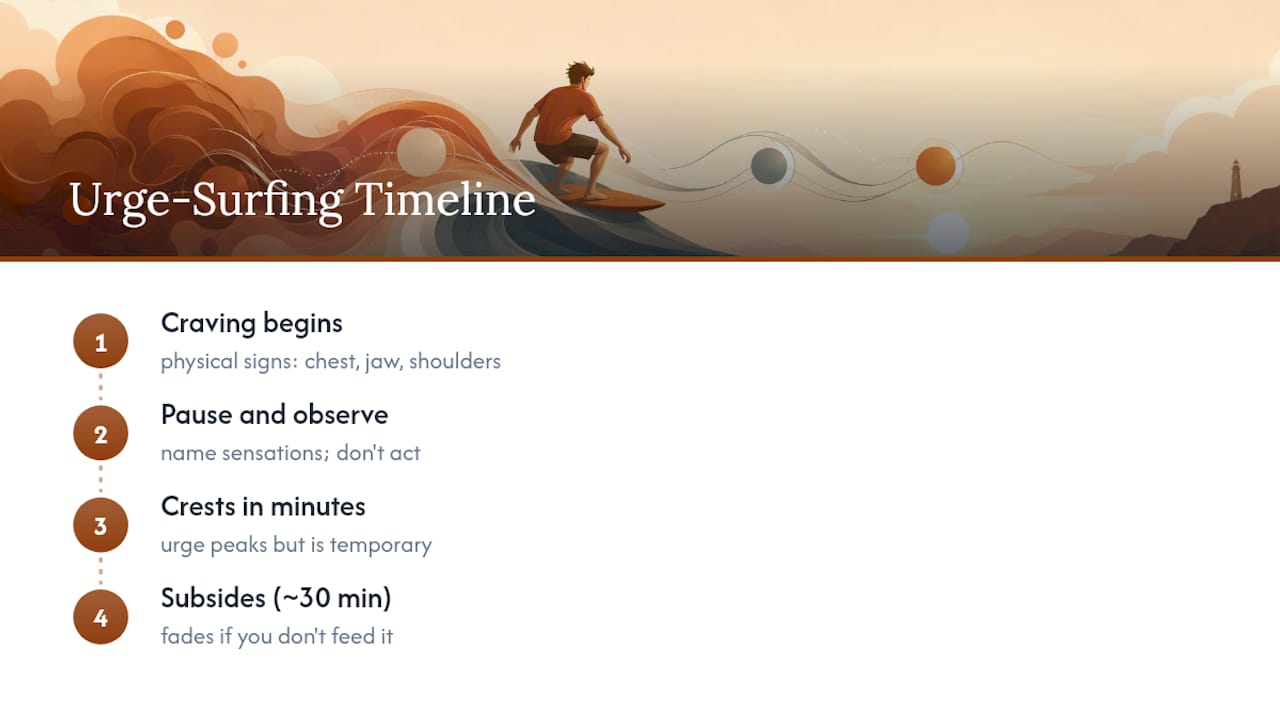
Urge surfing treats a smoking craving like a wave in open water. You don’t fight it, and you don’t paddle away from it. You notice it rise, hold your position, and let it roll under you until it flattens out on its own. The term comes from relapse-prevention work in addiction treatment, and it applies directly to nicotine: instead of automatically reaching for a cigarette the second a craving shows up, you pause and observe what’s actually happening in your body.
That pause matters more than it sounds like it should. Every time you smoke in response to a craving, you reinforce the wiring that says “urge equals cigarette.” Every time you notice the urge and let it pass without acting, you weaken that wiring a little. Clinical guides describe this as changing your relationship to the urge rather than eliminating the urge itself, and that distinction shows up again and again in the research on why mindfulness helps ex-smokers stay smoke-free.
Physically, a craving usually announces itself before you consciously register it as “I want a cigarette.” Watch for a tightening in the chest, a restless jaw, tension across the shoulders, a jittery feeling in the hands, or a mental itch that keeps circling back to smoking. Naming these sensations, even silently, gives your attention something concrete to hold onto instead of the vague, urgent pull to act.
Timing helps too. Behavioral guides on craving management note that an unfed urge tends to crest and subside within roughly half an hour, often much sooner. Knowing that ceiling exists changes how the craving feels. A wave that you know will break is easier to sit through than one that feels endless, and that’s really the whole mechanism behind what a nicotine craving actually is and why it eventually loses steam if you don’t feed it.
How Do You Actually Practice Urge Surfing When a Craving Hits?
The technique works because it’s simple enough to run under pressure, when your patience is short and your hands want something to do. Here’s the sequence:
- Stop and name it. The instant you notice the pull to smoke, say to yourself, silently or out loud, “This is a craving.” Naming interrupts the autopilot reach for a cigarette.
- Take three slow breaths. Inhale for a count of four, hold briefly, exhale for a count of six. Slower exhales calm the nervous system faster than rapid breathing.
- Scan your body for sensations. Where is the craving actually located? Chest, throat, hands, jaw? Describe it in physical terms (“tight,” “buzzing,” “hot”) instead of emotional ones (“desperate,” “unbearable”).
- Watch the wave for five breath cycles, or about 30 to 60 seconds. Don’t try to make the sensation go away. Just track whether it’s rising, holding steady, or starting to ease.
- Pair it with a safe action. Sip water, walk to another room, hold something in your hands, or do a slow stretch while you keep observing.
- Check in again. Most urges noticeably soften within a few minutes. If it hasn’t, repeat the breath cycle rather than abandoning the practice.
The oral substitute in step five isn’t a throwaway detail. Holding and mouthing a nicotine-free object, like a resistance necklace or a textured chew, gives your hands and mouth something to do while your mind stays focused on riding the wave instead of scrambling for a distraction. That’s a different use case than a compulsive habit, and pairing it deliberately with the breath count keeps it mindful instead of automatic. The Immediate Oral Substitutes Explained for Quitters guide breaks down which substitutes work best for that ritualized handling versus mindless fidgeting.
Pro Tip: Run this full sequence at least once a day even when you don’t have a craving. Treat it like a rehearsal. People who practice on calm days respond faster and more calmly during the sharp withdrawal peaks that hit around day two or three of quitting.
Scale up frequency, not intensity, when withdrawal gets rough. Three or four short rounds during a bad afternoon beat one long session you’re too rattled to finish.
Does Urge Surfing Actually Work? What the Research Shows
The honest answer: it changes how you respond to cravings more reliably than it stops you from wanting a cigarette in the first place, and the size of that effect tracks with how much you practice.
The original urge-surfing trial with college smokers found something worth sitting with. The mindfulness group didn’t report lower urge intensity in the moment compared to controls, but over a 7-day follow-up, they smoked significantly fewer cigarettes. The craving didn’t necessarily feel weaker. The behavior it produced still changed.
A larger, more recent test backs that pattern up at scale. The Craving to Quit smartphone trial put mindfulness training against a standard program in a full randomized controlled trial. Six-month abstinence rates didn’t differ significantly between groups; overall abstinence landed at 11.1% across both arms. But mindfulness training measurably reduced the association between craving and actual cigarette use, and craving frequency and strength both dropped from baseline. A related randomized trial found the same mechanism at work: mindfulness training reduced reactivity to cue-induced cravings, and people who completed more of the training saw a bigger drop in the link between craving and smoking.
- Mindfulness training doesn’t reliably beat other treatments on quit rates alone.
- It does appear to reduce cue-reactivity and the automatic pull from craving to cigarette.
- Adherence matters: finishing more sessions correlates with a stronger effect.
- Evidence quality is uneven across studies, which limits how confidently anyone can generalize.
A 2022 systematic review put a firm caveat on all of this: evidence that mindfulness-based interventions raise quit rates is mixed and low-certainty. That’s not a reason to skip the technique. It’s a reason to treat urge surfing as one lever among several rather than a standalone cure. Clinical mindfulness work outside smoking cessation, including structured mindfulness in psychotherapy, shows the same core mechanism: attention regulation reduces reactivity, even when it doesn’t erase the underlying urge.
What Else Should You Pair With Urge Surfing?
Urge surfing works best inside a small stack of supports, not on its own. Different tools solve different problems, and knowing which one to reach for saves you from fumbling mid-craving.
- Oral substitutes: nicotine-free items you can chew, suck, or hold, like a resistance necklace or textured gum, satisfy the hand-to-mouth ritual without reinforcing nicotine dependence.
- Behavioral distractions: a short walk, cold water on your hands, or a two-minute task you can start immediately buys time for the wave to pass.
- Nicotine replacement therapy or medication: patches, gum, or prescribed medications treat the physiological withdrawal side, which mindfulness alone doesn’t fully address.
- Quitlines and apps: free coaching and structured programs, including the quitSTART app and mindfulness challenges, give you a human or digital backup when a craving outpaces what you can manage solo.
The line between a helpful ritual and a compulsive habit comes down to intention. Mindfully handling a substitute while you count breath cycles is different from grabbing it reflexively just to have something in your hand. If cravings are frequent, intense, or paired with heavy withdrawal symptoms like irritability or sleep disruption, that’s the signal to add NRT or a counselor rather than trying to white-knuckle through with breathing alone. Before a quit attempt, run through a quick readiness check: Do you have an oral substitute on hand? Do you know your quitline number? Have you identified your top three trigger situations? The ex-smoker coping guide walks through building that plan in more detail, and switching methods entirely, such as considering electronic alternatives, is worth understanding even if it’s not the path this guide focuses on.
Riding Out a 3 A.M. Craving: What Actually Happened
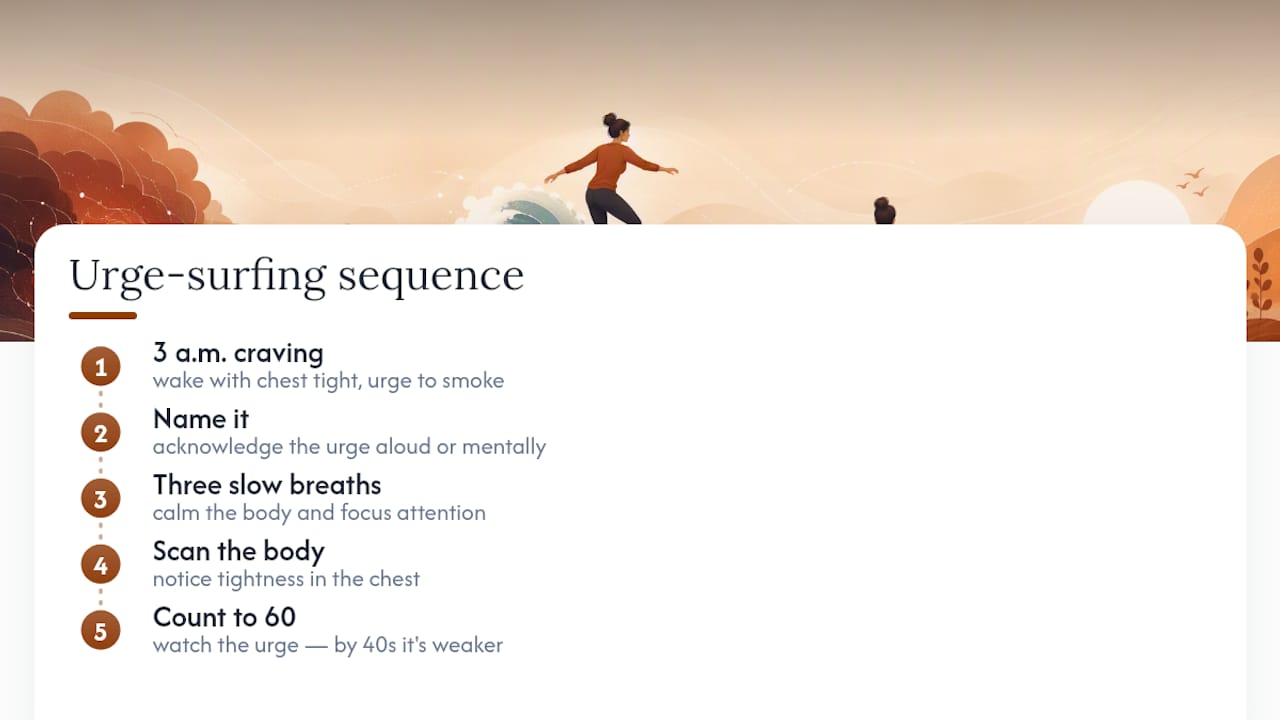
The hardest cravings rarely show up on schedule. One that stands out: waking at 3 a.m. during the first week of quitting, chest tight, mind already halfway to the front porch for a cigarette. Instead, the sequence held: name it, three slow breaths, scan the tightness in the chest, count to sixty while just watching it. By the fortieth second, the urge had lost most of its grip. It didn’t vanish. It just stopped being the loudest thing in the room.
Daily practice, even for sixty seconds on an easy day, is what makes that kind of moment survivable instead of a coin flip. Public-health researchers and cessation counselors consistently describe the same pattern: rehearsal on calm days builds the muscle you need during a spike.
A resistance necklace stayed in a jacket pocket that whole week, not as a crutch, but as something to hold onto while counting breaths. That kind of small, deliberate ritual is part of what BreatheFree’s tools are built around, and it’s a detail worth knowing before the next 3 a.m. moment arrives.
— Tommy
A Nicotine-Free Way to Keep Your Hands and Mouth Busy While You Ride It Out
Breathefree gives you something urge surfing alone can’t: a physical object to hold, twist, or mouth during those sixty seconds when your hands don’t know what to do with themselves. The BreatheFree resistance necklace is built specifically for that oral-fixation gap, with a slight resistance when you draw on it and flavor refills that give you something to focus on besides the craving itself. It’s nicotine-free, so it never restarts the dependence you’re trying to end.

Community reports indicate many people have used this approach to quit, reflecting its popularity among users, and the appeal is straightforward: it’s a ritual, not a substitute cigarette. Pair it with the breathing steps above, and you’ve got a tactile anchor for the exact moment the wave crests. Check the resistance necklace collection for current flavor refills, or browse why people are switching to this method before you place an order.
Where to Go for More Help
For deeper reading or immediate support, lean on the CDC’s tips for quitting, the original urge-surfing trial with college smokers, and the Craving to Quit randomized trial for evidence details. State quitlines and the quitSTART app offer free, real-time coaching when a craving outpaces what you can manage alone.
Sources
- Surfing the urge: Brief mindfulness-based intervention for college student smokers
- Tips for quitting (CDC)