

Coffee and cigarettes travel together because of two overlapping systems: coffee compounds directly interact with the same nicotinic receptors that nicotine binds, and smoking speeds up how fast the body clears caffeine, pushing smokers toward drinking more of it. Layer decades of ritual on top, and coffee becomes a reliable trigger for lighting up. Weakening either link, biochemical or behavioral, measurably reduces cravings.
TL;DR:
- Quitting smoking without addressing coffee rituals can leave the strongest triggers intact, as behavioral cues and sensory habits reinforce cigarette craving.
- Smoking accelerates caffeine metabolism via the CYP1A2 enzyme, causing smokers to drink more coffee, which in turn heightens the urge to smoke during caffeine intake.
- Caffeine’s interaction with the same nicotinic receptors as nicotine suggests that coffee compounds modulate brain pathways involved in reward and craving, but most evidence is from lab models, not humans.
- Quitting caffeine and nicotine together can cause overlapping withdrawal symptoms, such as jitters and anxiety, which may lead to misinterpretation and complicate cessation efforts.
- Changing coffee routines early in quitting, tapering caffeine gradually, and using physical tools like resistance necklaces can help weaken the coffee-cigarette loop and ease cessation.
Table of Contents
- What the research says about the coffee and cigarette habit
- How caffeine and nicotine interact in the brain and body
- Why coffee becomes a trigger for lighting up
- Why quitting caffeine and nicotine together gets complicated
- Step-by-step tactics to break the coffee cigarette link
- What smokers get wrong about their morning ritual
- A tool for the part quitting plans usually skip
- Sources
What the research says about the coffee and cigarette habit
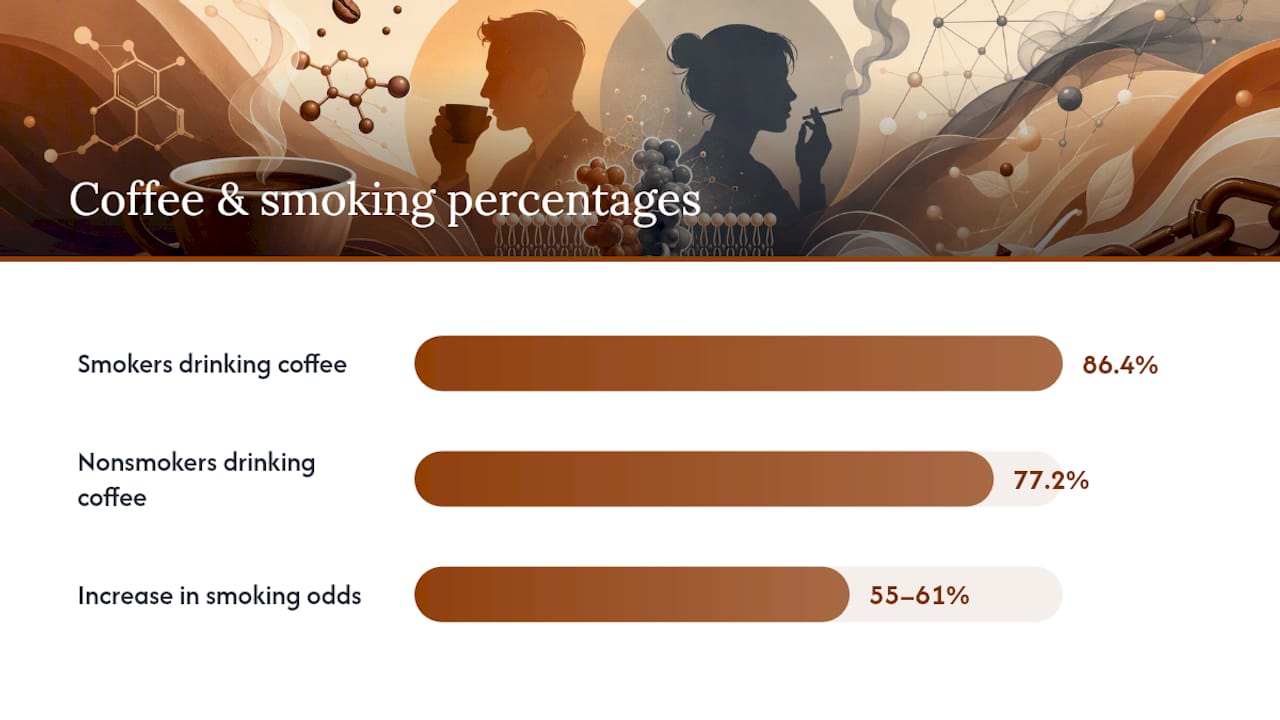
The numbers back up what most smokers already sense: coffee and nicotine are rarely a coincidence. Older clinical literature found roughly 86.4% of smokers drank coffee compared to 77.2% of nonsmokers, a gap wide enough to suggest something beyond shared timing at breakfast.
Genetics play a role too. A twin-register study found a moderate genetic correlation, around 0.47, between current smoking status and coffee use, meaning some of the pull toward both substances is inherited rather than purely learned. That matters for anyone who has felt like quitting one habit “should” be easier than it turns out to be.
Causation runs in a specific direction, too. A Mendelian randomization analysis of more than 240,000 people found that heavier smoking causes increased coffee consumption, not just correlates with it. Each additional cigarette smoked per day was linked to about 0.10 more cups of coffee daily. Part of the explanation is pharmacokinetic: smoking accelerates caffeine metabolism, so the body burns through caffeine faster and asks for more of it.
Real-time tracking data makes the link even more concrete.
The number that stands out: In ecological momentary assessment studies, where participants log behavior on handheld devices throughout the day, caffeine consumption was associated with a 55 to 61% increase in the odds of smoking during that same time interval, along with higher self-reported urge and reward from the cigarette.
That is not a small effect. It suggests the coffee cup itself, not just caffeine in the bloodstream, is doing real work in the moment.
Laboratory research adds a mechanistic layer that human survey data cannot. Coffee extracts and specific roasted-coffee compounds, including one called n-MP, modulate α4β2 and α7 nicotinic acetylcholine receptors, the same receptor families nicotine activates. Some compounds inhibit one receptor subtype while boosting another, a push-pull that may help explain why the first cigarette of the day, paired with coffee, so often feels different from the tenth.
A few things worth separating clearly:
- Epidemiological data (the 86.4% figure, the Mendelian randomization result) shows strong human-level association and even causal direction for coffee intake following smoking intensity.
- EMA diary data shows same-day, same-hour behavioral coupling.
- Receptor-level lab findings show a plausible biological mechanism, but they come mostly from in vitro and animal models, not confirmed human trials.
None of this proves that quitting coffee will make quitting cigarettes easier for everyone. It does show the two habits are locked together at multiple levels: genetic, pharmacological, and situational, which is exactly why treating them as one combined pattern tends to work better than treating them as two separate problems.
How caffeine and nicotine interact in the brain and body
Nicotine’s main targets in the brain are nicotinic acetylcholine receptors, particularly two subtypes: α4β2, which is highly sensitive to nicotine and drives a lot of the reward and craving cycle, and α7, a lower-sensitity subtype involved in attention and some of the stimulant-like alertness smokers report. Chronic nicotine exposure doesn’t just activate these receptors, it remodels them. The brain responds to repeated stimulation by increasing the number of α4β2 receptors available, a process called upregulation, while also desensitizing them so they respond less to a given dose. That combination is a big part of why tolerance builds and why a smoker needs a cigarette regularly just to feel normal, not high.
Coffee enters this picture more directly than most people realize. Roasted coffee contains compounds, including n-MP and choline, that bind to and modulate these same nicotinic receptors. Lab research shows some of these compounds inhibit high-sensitivity α4β2 receptors while potentiating the lower-sensitivity α7 subtype. That is a plausible chemical explanation for why the combination of coffee and a cigarette can feel distinct from smoking alone, and why some smokers describe their first cigarette with coffee as noticeably more satisfying than one smoked later in the day without it.

The metabolic side runs in the other direction. Smoking induces an enzyme called CYP1A2 in the liver, which is the primary enzyme responsible for breaking down caffeine. Smokers metabolize caffeine roughly twice as fast as nonsmokers as a result. Faster clearance means the caffeine “wears off” sooner, which appears to be a real driver behind why habitual smokers tend to drink more coffee across the day, not just at breakfast. This lines up with the Mendelian randomization finding that smoking intensity predicts higher coffee intake rather than the reverse.
A few limits worth stating plainly:
- Most of the receptor-modulation research comes from cell cultures and animal models, not living human brains, so the exact size of the effect in a real morning cup of coffee is not established.
- CYP1A2 induction and faster caffeine metabolism are well documented in humans, which makes that half of the mechanism the stronger, better-supported claim.
- Genetic variation in CYP1A2 itself means some people metabolize caffeine faster or slower regardless of smoking status, adding another layer of individual variability.
Pro Tip: If you notice your coffee “hits different” first thing in the morning compared to later in the day, that is consistent with how nicotine receptor sensitivity resets overnight. Delaying your first cup by even 30 minutes after waking can blunt that spike without cutting caffeine entirely.
Why coffee becomes a trigger for lighting up
Nicotine addiction runs on more than chemistry. Pavlovian conditioning, the same learning process behind Pavlov’s dogs salivating at a bell, means that any cue repeatedly paired with a rewarding drug eventually triggers craving on its own. For most smokers who drink coffee, that pairing happens dozens of times a week for years. The cup becomes the bell.
The EMA data cited earlier isn’t just about caffeine’s chemical effect. It also captures situational overlap: coffee breaks, work breaks, and social smoking windows tend to be the same windows. Smokers in these studies reported not just higher odds of smoking during caffeine intervals but stronger subjective urge and more positive appraisal of the cigarette itself, suggesting the association intensifies the reward, not just the frequency.
Sensory details matter more than most people expect. Research on caffeine’s broader behavioral effects shows that sensory and contextual cues can trigger smoking urges even when caffeine itself isn’t present, meaning decaf, or even just holding a warm mug, can activate the craving loop. The trigger isn’t purely pharmacological. It’s built from a stack of sensory inputs working together:
- Temperature and cup feel. The warmth of a mug in the hand mimics part of the hand-to-mouth ritual of smoking.
- Taste and smell. Coffee’s bitterness and aroma are deeply linked, through repetition, to the anticipation of a cigarette.
- Time of day and location. Morning coffee at a specific spot, a break room, a porch, a car, becomes a location-based trigger independent of the drink itself.
- Social context. Coffee breaks with coworkers or friends who also smoke reinforce the pairing socially, not just chemically.
- Hand occupation. Holding a cup engages the same motor pattern as holding a cigarette, which primes the next action.
The practical implication follows directly from this: changing even one or two of these sensory dimensions, switching mugs, drinking in a different room, adjusting the time, can measurably weaken the automatic urge, because the cue is no longer an exact match for what the brain learned to expect.
Why quitting caffeine and nicotine together gets complicated
Trying to quit smoking and cutting caffeine at the same time creates a confusing overlap most people don’t see coming. Quitting nicotine slows down that same CYP1A2 enzyme that smoking had sped up, so caffeine starts clearing more slowly and blood caffeine levels can rise, sometimes significantly, even if coffee intake stays exactly the same. Someone who quits smoking but keeps drinking their usual three cups a day may end up more caffeinated than they’ve ever been, and the result often feels like jitteriness, a racing heart, or anxiety.
That’s where the real trouble starts: those symptoms are nearly identical to nicotine withdrawal itself. Restlessness, anxiety, irritability, and disrupted sleep show up on both lists, and research on tobacco withdrawal has flagged this overlap between nicotine and caffeine withdrawal symptoms as a real complicating factor in cessation. Someone quitting smoking who feels wired and anxious might interpret that as a nicotine craving getting worse, when it may actually be excess caffeine building up because the body is metabolizing it more slowly than before.
The overlapping symptom list is worth knowing cold:
- Restlessness and jitteriness
- Anxiety or a sense of unease
- Trouble falling or staying asleep
- Irritability
- Difficulty concentrating
Practitioners who work with quitters report that many people misread post-quit jitteriness as a nicotine craving intensifying, when it is often just higher circulating caffeine catching up with a slower metabolism.
The practical recommendation that follows from this is straightforward, even if it runs against instinct: many structured quit plans recommend tapering caffeine down before or alongside quitting nicotine, rather than after, specifically to prevent this false-alarm withdrawal from derailing an otherwise successful quit attempt. Separating the two rituals early, rather than white-knuckling both cold turkey on the same day, tends to produce fewer surprises. If you want a fuller picture of what nicotine withdrawal actually feels like on its own, it’s worth reading through a breakdown of nicotine withdrawal symptoms before you start.
Step-by-step tactics to break the coffee cigarette link
Breaking a habit built on two overlapping systems works best when you attack both at once, in a deliberate order rather than all in one chaotic week. Here’s a sequence that tracks with what the research above actually supports.
- Change the coffee context first, before you touch nicotine. Switch mugs, change rooms, shift your coffee time by 20 to 30 minutes. This alone starts weakening the cue without adding withdrawal stress.
- Delay the first cigarette relative to the first cup. Even a 10-minute gap, extended gradually, breaks the tight temporal pairing the brain has learned to expect.
- Taper caffeine gradually, not abruptly, once nicotine reduction begins. A reasonable example: cut total daily caffeine by roughly 25% per week over three to four weeks rather than stopping outright, which helps avoid the metabolic whiplash described earlier.
- If using nicotine replacement, schedule it away from coffee time. Pairing a nicotine patch or gum with the exact ritual you’re trying to break can accidentally reinforce the same cue loop instead of dismantling it.
- Track your cravings and sleep for two weeks. A simple habit tracker makes it much easier to tell the difference between real nicotine craving and caffeine-driven jitteriness, which matters given how often the two get confused.
- Rehearse your highest-risk moment in advance. For most people that’s the first coffee of the day. Decide beforehand what you’ll do differently, whether that’s a different cup, a walk, or reaching for a replacement tool, so you’re not deciding in the moment when willpower is weakest.
- Bring in outside support. Whether that’s a support group, a quit-plan community, or a structured action plan, external accountability catches the slips that solo willpower misses.
Pro Tip: Don’t quit caffeine and nicotine cold on the same morning. Stagger it: start the caffeine taper about a week before your quit date so your body has already adjusted by the time nicotine withdrawal begins, which prevents the two symptom sets from stacking on top of each other.
One more note on sequencing: research on caffeine’s broader effects on the body, including its interaction with bone density over long-term heavy use, is a reminder that caffeine isn’t a “safe” substance to ignore just because it’s legal and everywhere. Moderation matters on both sides of this equation, not just the nicotine side.
What smokers get wrong about their morning ritual
Most people trying to quit smoking treat coffee as background noise. It isn’t. The research on same-hour smoking odds during caffeine windows should reframe how anyone thinks about a quit date: if you don’t touch the coffee ritual, you’re leaving one of the strongest triggers in your entire day fully intact.
What surprises me most in this research isn’t the receptor chemistry, interesting as it is. It’s how much of the “craving” people report during a quit attempt is actually caffeine rebound wearing a nicotine costume. Slower metabolism after quitting smoking means more caffeine sitting in the bloodstream longer, and that mimics the exact anxiety and restlessness people expect from nicotine withdrawal. Miss that distinction and you’ll fight the wrong battle.
Breathefree built its resistance necklace around the part of this puzzle that pure willpower can’t solve: the hand-to-mouth motion itself. Oral fixation isn’t a minor detail, it’s baked into why the coffee cup and the cigarette pair so well in the first place, and over 75,000 people have used the tool as part of quitting. That said, no device replaces a real plan. If the science here points anywhere, it’s toward separating the rituals early and getting real support, not toward any single product doing the work alone. When in doubt about withdrawal symptoms that feel severe or unusual, talk to a doctor rather than guessing.
— Tommy
A tool for the part quitting plans usually skip
Most quit-smoking advice focuses on nicotine and forgets the hand. That’s the gap Breathefree’s resistance necklace is built to close: it gives you something physical to hold, breathe through, and manipulate during exactly the coffee windows where cravings spike hardest, without putting any nicotine back into your system.

Pairing it with the sequencing above works well in practice: wear it during your coffee ritual specifically, since that’s the highest-risk window this article just walked through, rather than only reaching for it when a craving already feels unbearable. The resistance necklace collection includes flavor refill options if plain resistance breathing isn’t enough sensory replacement on its own, and pairing it with a structured Nicotine Detox eBook and Habit Tracker gives you a way to log exactly when cravings hit and whether caffeine timing is playing a role, which the science above suggests it often is.
This is an adjunct, not a cure on its own. It works best combined with the caffeine tapering, ritual changes, and support structure covered earlier. If you’re ready to build a real plan around it, start with the necklace collection and track your first two weeks closely.
This article is general information, not a substitute for advice from a qualified doctor. Consult a qualified healthcare professional about your own circumstances before acting on anything here.
Sources
- Heavier smoking increases coffee consumption: findings from a Mendelian randomization analysis
- Caffeine and nicotine: a review of their joint use and possible interactive effects in tobacco withdrawal