

Yes, you can quit smoking without medication, but the evidence is blunt: people who quit unaided tend to face rougher withdrawal and lower success rates than those who use nicotine replacement therapy or prescription aids, especially if they smoke a half a pack a day or more, according to the CDC. That doesn’t mean it’s a bad plan. It means it’s a plan that needs structure.
If you’re set on going medication-free, three things matter before your quit date. First, pick a specific day and write down your top three triggers. Second, line up behavioral support, whether that’s Smokefree’s text programs, a quitline, or a friend who’ll answer the phone at 2 a.m. Third, stock a non-nicotine replacement for the habit itself, like the Breathefree resistance necklace, so your hands and mouth have somewhere to go when the urge hits.

Key Takeaways
Quitting without medication is achievable, but it works best when paired with a written plan, a replacement ritual, and support, since going in unstructured is what actually drives relapse.
| Point | Details |
|---|---|
| Medication isn’t mandatory | You can quit unaided, but expect stronger withdrawal, especially if you smoke a half a pack a day or more. |
| NRT roughly doubles success odds | Nicotine replacement and certain medications significantly raise per-attempt quit rates versus willpower alone. |
| The first 72 hours are critical | Withdrawal symptoms typically peak between 48 and 72 hours, so plan activities for that window in advance. |
| Replace the ritual, not just the nicotine | Tools like the Breathefree resistance necklace give your hands and mouth a nicotine-free outlet during cravings. |
Table of Contents
- Common Myths About Quitting Without Medication
- What Happens When You Quit Without Medication
- How Effective Are Medications and NRT Compared to Going It Alone?
- How to Quit Without Medication: A Practical Plan
- Why Some People Choose to Quit Without Help
- The Real Gap Isn’t Willpower vs. Medication
- Where a Non-Nicotine Necklace Fits Into a Medication-Free Plan
- Sources
Common Myths About Quitting Without Medication
Bad information kills more quit attempts than nicotine cravings do. Here are the myths that trip people up most, and what the evidence actually shows.
- “Quitting is just willpower.” Nicotine dependence changes brain chemistry, so treating it as a pure discipline problem ignores the biology. Recovery is achievable at any point, but it’s a brain-based process, not a character test, according to a federal review of substance use treatment.
- “Smoking relieves stress.” Smoking temporarily masks the irritability that nicotine withdrawal itself causes. Most people report better mood stability within weeks of quitting.
- “It’s too late for my body to benefit.” Lung function and cardiovascular risk improve at every age you quit. There’s no cutoff point where quitting stops paying off.
- “Medications are for people who can’t quit on their own.” Clinicians frame stop-smoking aids as tools, not crutches. Using one is a pragmatic decision, similar to using a calculator instead of doing long division by hand, not a sign of weakness, according to Vanderbilt Health.
- “I’ll definitely gain significant weight.” Some weight gain is common, but it’s often modest and manageable with basic diet awareness. It’s not a guaranteed, drastic outcome for everyone.
- “I tried medication once and it didn’t work, so none will.” Different products (patch, gum, lozenge, prescription options) work differently for different people, and combinations often outperform a single product.
- “Cold turkey is the ‘real’ way to quit.” Cold turkey is common, but it’s often physiologically harder because it ignores the dependence itself, per NHS guidance.
- “NRT just swaps one addiction for another.” NRT delivers controlled, gradually reduced doses without the thousands of other chemicals in smoke, and it’s designed to be temporary.
Statistic to know: Nicotine replacement therapy and certain medications can roughly double a smoker’s chances of quitting successfully compared to trying alone, according to Smokefree. That single number is worth sitting with if you’ve written off medication entirely.
What Happens When You Quit Without Medication
Withdrawal without pharmacological support tends to hit harder and last longer in the acute phase, especially for people who smoked heavily, per the CDC. Knowing the shape of that curve in advance is half the battle.
- First 24 hours: Nicotine levels drop fast. Irritability, anxiety, and strong cravings usually start within hours.
- 48 to 72 hours: This is typically peak intensity, both physically and mentally.
- First week: Symptoms usually start easing, though sleep disruption and mood swings can linger.
- First month: Cravings become less frequent but can still ambush you in high-risk situations (a bar, a stressful call).
- Three months: Most people report cravings are shorter and far less intense, though occasional urges can resurface for longer.
Pro Tip: Treat hour 48 to 72 like a scheduled event, not a surprise. Block that window with something physically absorbing, a walk, a workout, cleaning a closet, and keep a non-nicotine oral tool within reach so your hands have a job when your brain is screaming for a cigarette.
How Effective Are Medications and NRT Compared to Going It Alone?
Medications and NRT don’t just help, they measurably shift the odds in your favor on any given quit attempt, according to Smokefree.gov. That’s the honest, unglamorous answer to “is quitting without pills effective”: it works for plenty of people, but it starts from a harder baseline.
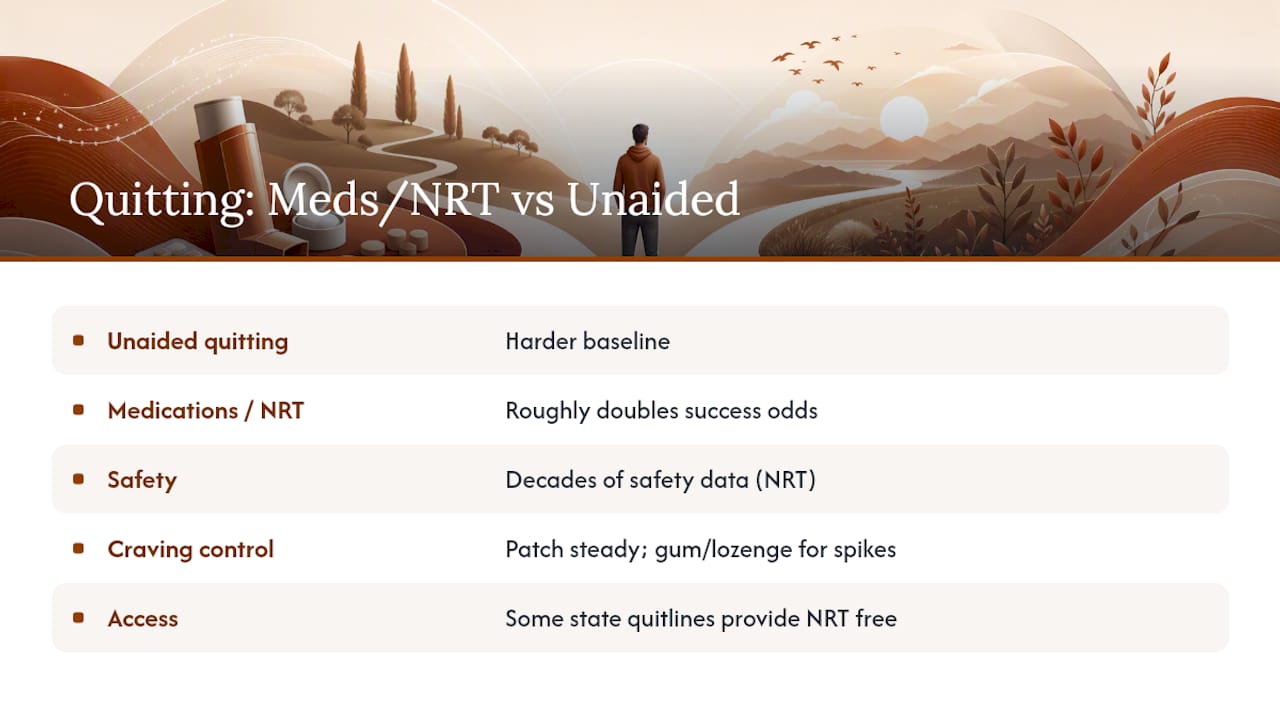
NRT products have decades of safety data behind them, and some people combine a patch (for steady baseline cravings) with gum or a lozenge (for sudden spikes). Some state quitlines even provide NRT for free. None of this is about weakness. It’s a clinical tool, comparable to using a car instead of walking to get where you’re going faster.
Key stat, restated simply: unaided quitting is harder, medication roughly doubles success odds, and the choice between them is personal, not moral.
How to Quit Without Medication: A Practical Plan
Medication-free quitting works best when it’s structured, not just willed into existence. Here’s what actually moves the needle:
- Map your triggers. Write down the three situations most likely to make you crave a cigarette, and plan a specific counter-move for each.
- Use the delay technique. Cravings peak and fade within minutes; putting distance between urge and action defuses most of them.
- Move your body. Short bouts of moderate exercise can blunt craving intensity for a meaningful window, though exercise alone isn’t proven to guarantee long-term abstinence, so pair it with other tactics.
- Try mindfulness or breathing exercises to ride out the mental side of a craving instead of fighting it.
- Lean on quitlines and apps like those listed through Smokefree for free, on-demand coaching.
- Replace the ritual, not just the nicotine. A non-nicotine tool that satisfies oral fixation fills the habitual gap without reintroducing the substance you’re quitting.
- Build a support layer. Peer support measurably improves quit odds, whether it’s a group, a friend, or a text-based coach.
Pro Tip: When a craving hits, commit to a 3, 5, or 10 minute delay paired with an activity, like stepping outside or chewing something. If your hands need something to hold during that window, that’s exactly the gap a tool like the Breathefree resistance necklace is built to fill, no nicotine involved. If cravings start overwhelming your ability to function, or you’ve had several failed attempts in a row, that’s a reasonable signal to loop in a doctor rather than a failure of your approach.
Why Some People Choose to Quit Without Help
Autonomy and identity drive a lot of unassisted quit attempts. People often want to prove to themselves they can do it, and that motivation is real and valid, not something to talk anyone out of.
Qualitative research backs this up directly. Many ex-smokers say they trusted their own knowledge and personal willpower over professional advice when they decided to quit solo, according to a qualitative study of ex-smokers.
“Using a tool to quit is not a sign of weakness. It’s a pragmatic choice, the same logic as using a calculator or a car to reach a goal faster and more reliably.” That framing, echoed by Vanderbilt’s tobacco-treatment guidance, applies just as well to non-pharmacological tools.
The best clinical approach respects that autonomy while still offering scaffolding, structure the person can accept or ignore on their own terms.
The Real Gap Isn’t Willpower vs. Medication
The myth that does the most damage isn’t about pills at all. It’s the idea that choosing to quit unaided means choosing to go in unprepared. The people who succeed without medication almost always have a plan, a replacement ritual, and someone checking in on them. The ones who don’t often relapse right around that 48 to 72 hour mark, then blame themselves instead of the missing plan.

If you’re quitting without meds, treat that decision as a starting point for building structure, not a reason to skip it. Read up on why quit attempts fail without substitutes before your quit date, not after your third relapse.
Where a Non-Nicotine Necklace Fits Into a Medication-Free Plan
If you’re quitting without pharmacological aids, the missing piece is usually the physical habit, not just the nicotine. The Breathefree resistance necklace is built specifically for that gap: a nicotine-free tool that gives your hands and mouth something to do during the exact moments a cigarette used to fill.
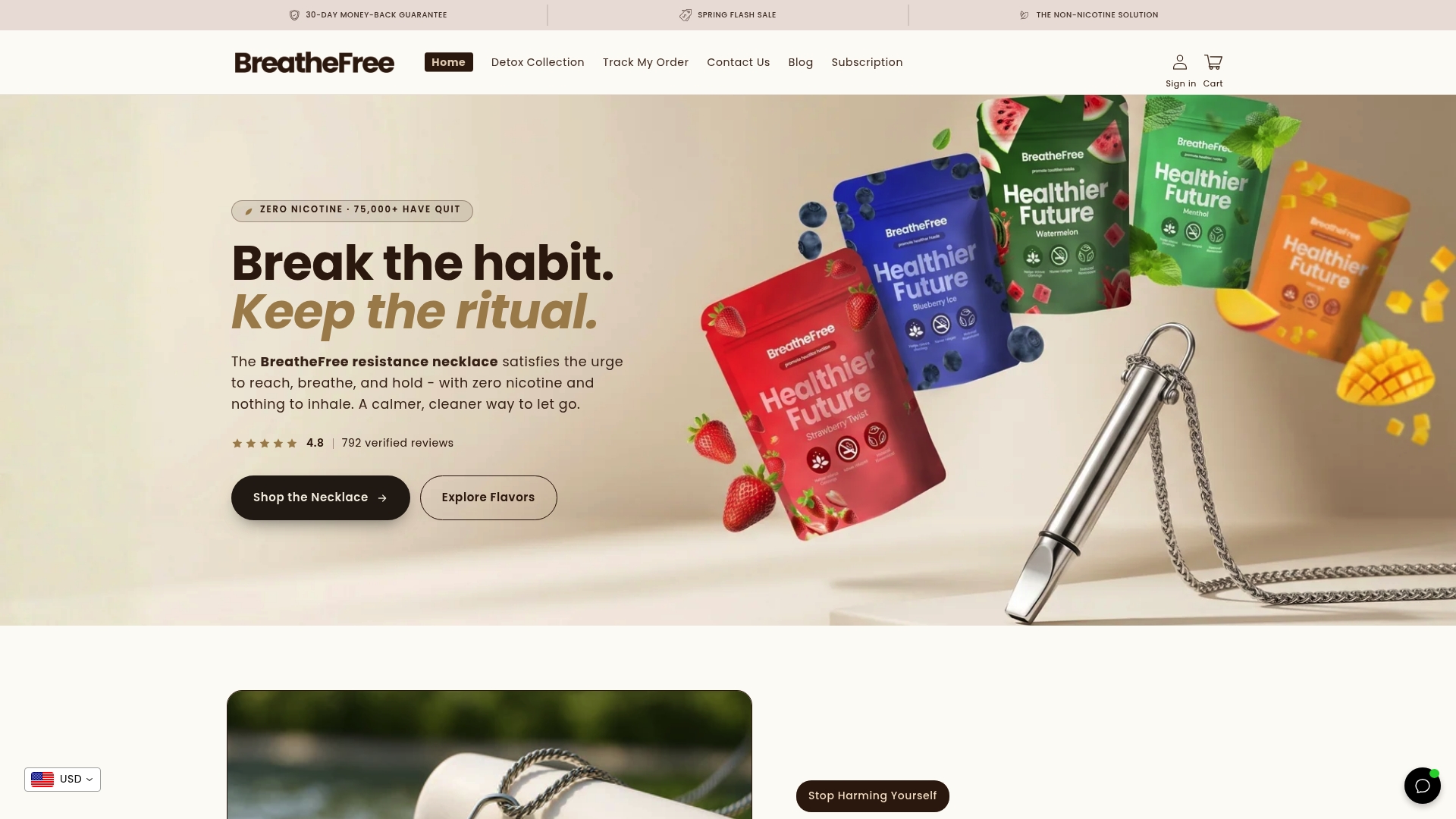
The core necklace addresses oral fixation directly, while complementary pieces in the lineup target other symptoms of withdrawal: fidget spinner rings for restless irritability, essential oil nasal sticks for craving moments, and lung detox gummies as part of a broader wellness routine. None of these replace medical treatment, and they’re not marketed as one, they’re behavioral adjuncts, the same category the CDC and Smokefree.gov describe when they talk about pairing pharmacological options with coping tools. The difference is that Breathefree’s tools work whether or not you’re using NRT at all.
The practical use is simple: keep the necklace on you and reach for it the moment a craving starts, especially during that first 72 hour window when urges hit hardest. Pair it with the delay technique from earlier, and you’ve got a physical anchor for a mental strategy. Many people have used this method as part of their quit attempt. If you’re ready to build your own ritual, check out the resistance necklace collection and pick the option that fits your routine.
Sources
- Quitting without Using a Medicine | Tips From Former Smokers | CDC
- Smokefree
- Why do smokers try to quit without medication or counselling? A qualitative study with ex-smokers - PMC
- Myths about nicotine replacement | My Vanderbilt Health
- Should I quit smoking cold turkey? - NHS
This article is general information, not a substitute for advice from a qualified doctor. Consult a qualified healthcare professional about your own circumstances before acting on anything here.
Recommended
- Why Smokers Struggle Without Substitutes: 2026 Guide – BreatheFree
- 7 reasons your last quit attempt failed, and the one thing that fixes – BreatheFree
- 7 reasons quitting is finally easy — even joyful — with BreatheFree
- 9 reasons quitting finally feels easy — and even joyful — with Breathe – BreatheFree