

Ritualistic objects reduce anxiety because they supply three things a stressed brain desperately wants: predictability, a conditioned cue for calm, and an external scaffold that handles some of the regulatory work your mind would otherwise burn through on its own. This isn’t folk wisdom. Peer-reviewed experiments using EEG and heart-rate variability (HRV) measurements, plus field studies across different cultures, consistently show measurable physiological and psychological effects. The framework that best explains the object’s role comes from extended cognition, a branch of cognitive science arguing that the mind doesn’t stop at the skull — artifacts in the environment actively participate in thought and emotion regulation.
The core mechanisms at work:
- Predictability and control: A fixed sequence of actions restores a sense of agency when circumstances feel chaotic.
- Conditioned cueing: Repeated pairing of an object with calm states trains the nervous system to respond automatically.
- Attention anchoring: Sensorimotor focus on an object narrows attention away from threat-related rumination.
- Neural dampening: Ritual performance reduces the brain’s error-monitoring response, measurable as a smaller error-related negativity (ERN) on EEG.
Key Takeaways
Ritualistic objects reduce anxiety by supplying predictability, conditioned calming cues, and an external cognitive scaffold that offloads emotional regulation from an already-stressed mind.
| Point | Details |
|---|---|
| Core mechanism | Ritual objects reduce anxiety through predictability, conditioned cueing, attention anchoring, and neural dampening of error-monitoring (ERN). |
| Lab and field evidence | Brooks et al. showed ritual labeling reduced anxiety vs. random actions; Lang et al. found higher HRV recovery in ritual performers vs. controls. |
| Labeling amplifies effect | Calling a sequence a “ritual” strengthens its calming effect — expectancy is part of the mechanism, not a confound. |
| Clinical boundary | Ritual objects manage state anxiety; they are not a treatment for anxiety disorders, panic, OCD, or trauma — seek professional care for those. |
| Breathefree application | The Breathefree resistance necklace provides a tactile, breath-focused ritual object designed to anchor calming routines and support habit change. |
Table of Contents
- Why do ritualistic objects reduce anxiety? The mechanisms explained
- What do the key studies actually show?
- How objects act as cognitive extensions that regulate emotion
- How to build a small, effective object-based ritual
- Where ritual objects help and where they fall short
- Ritual objects belong in your self-regulation toolkit
- A physical object built for the ritual you need
- Sources
Why do ritualistic objects reduce anxiety? The mechanisms explained
Predictability and perceived control
Anxiety thrives on uncertainty. When you can’t predict what comes next, the brain’s threat-detection system stays on high alert, burning resources on anticipatory arousal. A ritual object interrupts that loop by anchoring you to a fixed, known sequence. Research synthesized in Scientific American describes rituals as inherently rational tools that provide psychological organization — the effect is less about belief in anything supernatural and more about satisfying the brain’s need for predictability when life feels out of control. Chunked, repeatable actions signal to the nervous system that this moment is structured and manageable.
Conditioned cueing
Every time you use the same object in the same sequence and then feel calmer, you’re building a conditioned association. Over repetitions, the object itself becomes a cue that triggers the calming response before the full ritual even completes. This is classical conditioning applied to emotional regulation: the object carries the learned signal. The effect strengthens with consistent use, which is why a well-worn worry stone or a familiar necklace can settle nerves faster than a breathing exercise you learned last week.
Attention anchoring and sensorimotor focus
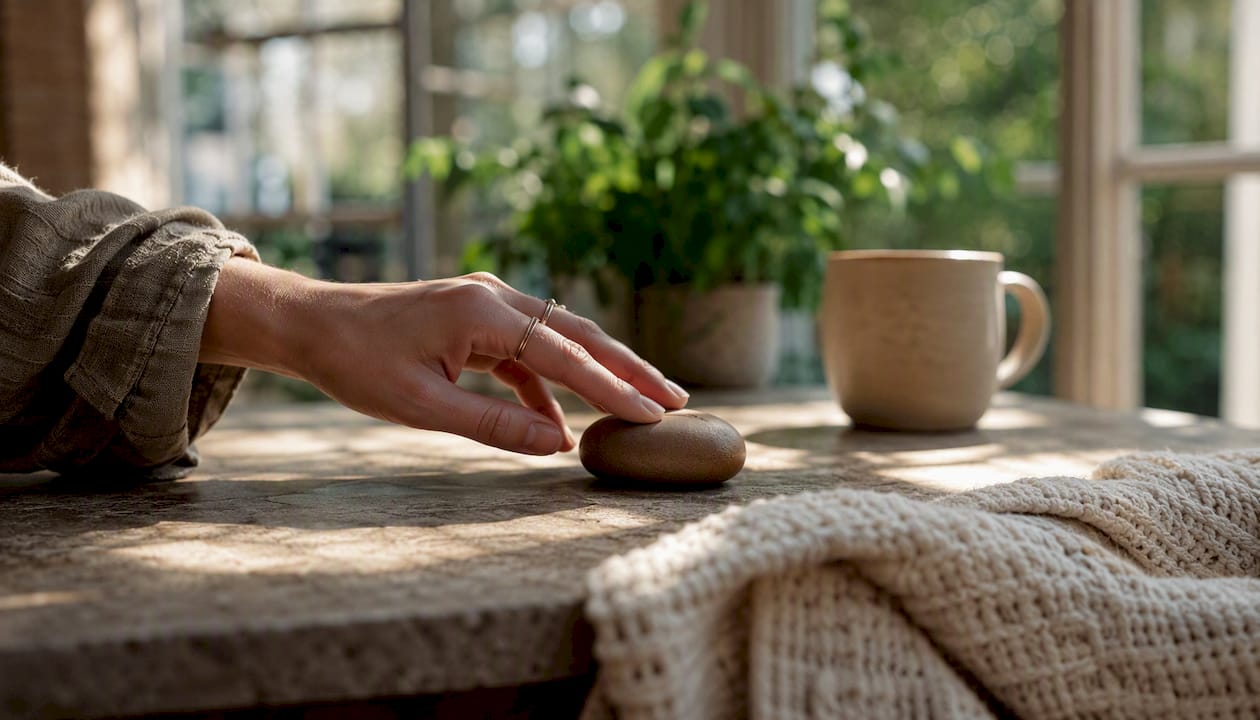
Anxious minds wander toward worst-case scenarios. Physical engagement with an object — turning it over, pressing it, tracing its texture — occupies the sensorimotor system and pulls attentional resources away from threat-focused rumination. This isn’t distraction in the pejorative sense; it’s a deliberate narrowing of cognitive bandwidth that reduces the fuel available for anxious thought loops. Rituals that involve simple physical patterns can soothe the nervous system without requiring the heavy cognitive work of deliberate reappraisal.
Neural dampening: what the ERN tells us
One of the clearest physiological signals comes from EEG. Studies published in PMC show a reduced error-related negativity (ERN) after ritual completion. The ERN is a rapid neural response generated within milliseconds of making an error — it reflects the brain’s performance-monitoring system flagging something as wrong. A smaller ERN after ritual suggests the brain is less reactive to self-generated mistakes, which maps directly onto the subjective experience of feeling less rattled when things don’t go perfectly. The authors note that effects on subjective affect and performance are complex, so this finding should be read as a promising signal rather than a settled conclusion.
The placebo and expectancy effect
Labeling matters more than most people expect. Brooks et al.'s laboratory experiments found that the same sequence of actions reduced anxiety significantly more when participants were told it was a ritual versus when they were told it was random behavior. Expectancy — the belief that this sequence will help — is not a confound to be controlled away; it’s part of the mechanism. Naming your routine a ritual, assigning it meaning, and treating it as purposeful all amplify the calming effect.
Statistic callout: In Brooks et al.'s experiments, participants who performed actions labeled as rituals reported lower anxiety and performed better on subsequent tasks than those who performed identical actions labeled as random behaviors — with the ritual label itself acting as a key moderator of the effect.
What do the key studies actually show?
The evidence base spans lab experiments, field studies, and neuroimaging. Here’s what each line of research contributes and where its limits sit.
| Study / Source | Design | Measure | Headline Finding | Main Limitation |
|---|---|---|---|---|
| Brooks et al. (multiple experiments) | Lab, controlled | Self-report anxiety, task performance | Ritual label reduced anxiety and improved performance vs. random-action control | Lab setting; novel rituals; generalizability to clinical anxiety unclear |
| Lang et al. (Mauritius field study) | Field, naturalistic | Self-report anxiety, HRV | Ritual performers showed lower perceived anxiety and higher HRV during recovery | Habitual religious rituals; degree of ritualization had small, variable additional effects |
| PMC EEG study (Brooks et al. extension) | Lab, EEG | ERN amplitude | Smaller ERN after ritual, suggesting dampened performance-monitoring reactivity | Complex relationship between ERN reduction and subjective/performance outcomes |
The Brooks et al. lab experiments are the most cited evidence for ritual’s direct anxiety-reducing effect. Across multiple studies, participants who performed simple, novel rituals before a stressful task reported lower anxiety than those who performed the same actions framed as random. The key finding: you don’t need a centuries-old tradition. A ritual invented on the spot works, provided the person treats it as a ritual.
The Lang et al. field study in Mauritius, published in the Philosophical Transactions of the Royal Society B, moved the question out of the lab. Participants who performed habitual religious rituals after an anxiety induction showed lower self-reported anxiety and higher HRV during recovery compared with controls. HRV is a physiological marker of autonomic flexibility — higher HRV during recovery indicates the body is returning to a regulated state more efficiently. The authors note that the degree of ritualization produced small and variable additional effects, meaning more elaborate ritual didn’t always mean more relief.
The EEG evidence adds a neural layer. A reduced ERN after ritual completion suggests the brain’s rapid error-monitoring system is less reactive, which aligns with the subjective sense of feeling less self-critical and less wound up after a ritual. This is a preliminary finding — the relationship between ERN reduction and real-world anxiety relief needs more research — but it gives the behavioral data a plausible neural mechanism.
Statistic callout: The Mauritius field study found that ritual performers showed higher heart-rate variability during recovery from an anxiety induction compared with controls, pointing to a physiological, not just self-reported, effect.
Across all three lines of evidence, effect sizes are real but modest. These are not cures. They are reliable, accessible tools for managing state anxiety in the moment.
How objects act as cognitive extensions that regulate emotion
The extended-cognition framework, developed in cognitive science and philosophy of mind, argues that cognitive processes don’t happen exclusively inside the skull. Tools, artifacts, and objects in the environment actively participate in thinking, remembering, and regulating emotion. Research on the cognitive functions of religious artefacts makes this case explicitly: artefacts act as external cognitive resources that store meaning, cue associated behaviours, and reduce the internal processing load required for emotional regulation.
Applied to anxiety, this means a ritual object isn’t just a prop. It’s doing real regulatory work. When you reach for a familiar object before a stressful moment, you’re offloading part of the stabilization task to something outside your head. The object holds the meaning, holds the sequence, holds the association with calm — so your working memory and attentional resources don’t have to. During high-stress moments, that offloading is significant. Internal cognitive resources are already stretched; an external scaffold picks up the slack.
This also explains why simple personal objects can match traditional sacred artifacts in effect. Anthropological and theoretical analyses describe artifacts as “memory mediators” — objects that externalize meaning and trigger associated actions and emotions when encountered. A rosary, a smooth river stone, a necklace worn before every difficult conversation: the object’s history of use is encoded in the ritual, and the ritual is encoded in the object. Neither needs to be ancient or culturally sanctioned to work. What matters is the symbolic meaning the user assigns and the consistency of use.
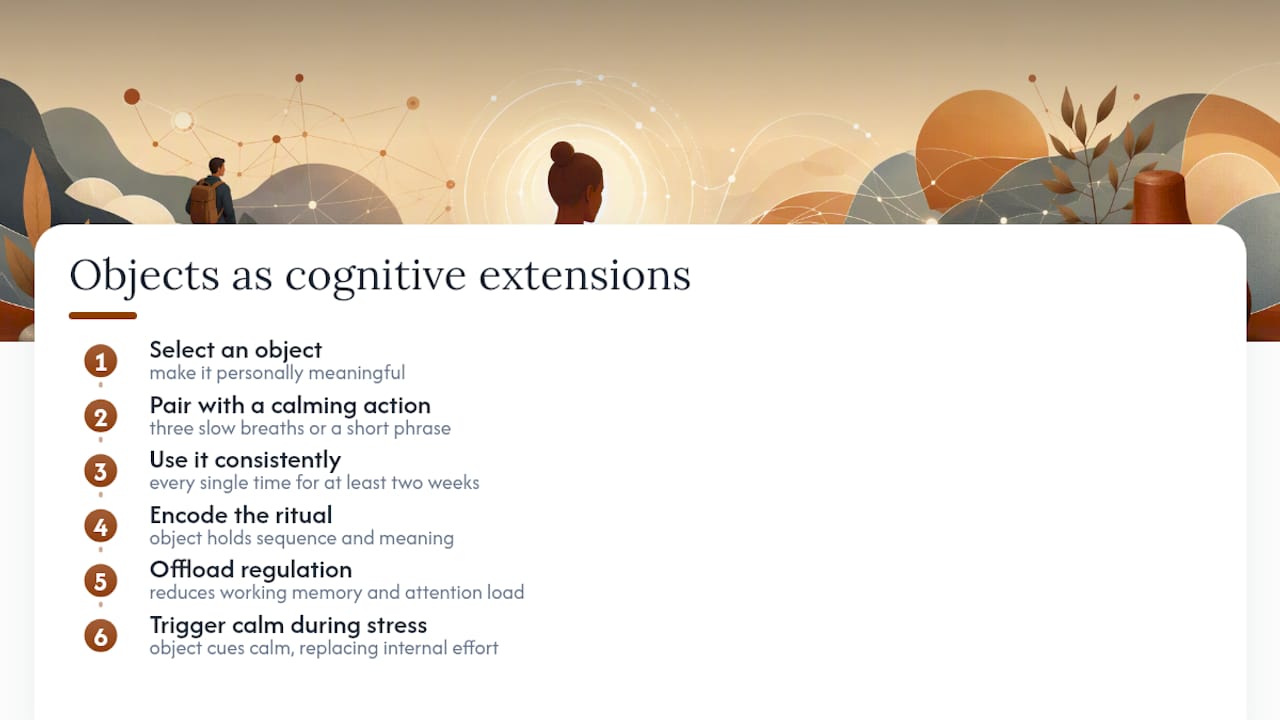
Pro Tip: To make an everyday object reliably cue calm, pair it with a specific, brief calming action (three slow breaths, a short phrase, a deliberate pause) every single time you use it for at least two weeks. Consistency builds the conditioned association faster than intensity. A smooth stone in your pocket, a ring you turn three times, a necklace you hold for thirty seconds — any of these can become a genuine regulatory tool through repetition.
How to build a small, effective object-based ritual
The research is clear that novel, personally created rituals work — you don’t need tradition or ceremony. Here’s a practical sequence drawn from the experimental evidence.
-
Choose your object. Pick something portable, tactile, and personally meaningful (or assign it meaning deliberately). It should be small enough to carry anywhere: a stone, a ring, a necklace, a coin. Portability matters because anxiety doesn’t wait for a convenient location.
-
Assign symbolic meaning. Decide what this object represents to you — calm, control, readiness, safety. Say it aloud or write it down. This step activates the expectancy mechanism: the belief that the object helps is part of why it does.
-
Create three to six short, fixed actions. The sequence should take 30–90 seconds. Examples: hold the object in your left hand, take three slow breaths (linking to the physiology of breath-based calming), say a short phrase silently, set the object down. Or: pick up the object, trace its edges with your thumb, press it once against your sternum, place it back. Keep the steps identical every time.
-
Rehearse in low-stakes moments first. Practice the ritual when you’re not anxious — at your desk, before a meal, before bed. This builds the conditioned association in a calm state, so the cue is already established when you need it under pressure.
-
Label it explicitly as your ritual. Tell yourself (and, if comfortable, others) that this is your pre-performance ritual, your pre-call ritual, your travel ritual. The labeling effect from Brooks et al. is real: naming it a ritual strengthens the effect compared with treating it as a random habit.
-
Troubleshoot when it feels hollow. If the ritual stops working, the conditioned association may have weakened through inconsistent use, or the symbolic meaning may have faded. Recommit to the meaning deliberately: spend 60 seconds reconnecting with what the object represents before using it. Avoid adding steps compulsively — more complexity doesn’t equal more relief.
Example applications:
- Pre-presentation: Hold a smooth stone, breathe in for four counts, out for six, set it on the desk.
- Pre-flight: Turn a ring three times on your finger, press your feet flat on the floor, take one slow breath.
- Pre-difficult phone call: Hold a necklace for 20 seconds, say a grounding phrase silently, begin dialing.
For people replacing a smoking ritual, a physical object that occupies the hands and mouth can serve the same sensorimotor function the cigarette once did — without the nicotine.
Where ritual objects help and where they fall short
Ritual objects are a genuine self-regulation tool, not a treatment. That distinction matters clinically.
Where they reliably help: managing state anxiety before predictable stressors (presentations, flights, difficult conversations), supporting habit change by replacing one ritual with another, and providing a portable, low-cost coping strategy for everyday stress. University of Connecticut coverage of the research notes consistent effects across performance anxiety, grief symptoms, and social stress — even with novel rituals.
Where they don’t: ritual objects are not a standalone treatment for anxiety disorders, panic disorder, PTSD, OCD, or any condition involving significant functional impairment. They address momentary state anxiety, not the underlying neural and psychological patterns that maintain clinical anxiety.
Risks to watch for:
- Ritual as avoidance: If the ritual becomes a reason to avoid the feared situation rather than a tool to enter it, it’s reinforcing avoidance behavior — which maintains anxiety long-term.
- Ritual turning compulsive: If skipping the ritual causes significant distress, or if you feel compelled to repeat it until it “feels right,” that’s a warning sign of OCD-spectrum behavior, not healthy self-regulation.
- Masking a treatable condition: Relying on a ritual object while a diagnosable anxiety disorder goes untreated delays effective care.
Clinical red flags requiring professional contact: panic attacks that feel uncontrollable, anxiety that prevents work, relationships, or basic daily function, intrusive thoughts you can’t dismiss, or any thoughts of self-harm. A ritual object is not the right tool for any of these. Coping strategies for anxiety and depression from clinical sources make clear that professional treatment — CBT, medication, or both — remains the evidence-based standard for clinical-level anxiety.
The evidence base itself has limits worth naming: most lab studies use healthy, non-clinical samples; effect sizes are modest; and the degree of ritualization doesn’t always produce proportionally larger effects. More research is needed on long-term use, clinical populations, and the optimal ritual structure for different anxiety types.
Ritual objects belong in your self-regulation toolkit
The evidence for ritual objects as anxiety-reduction tools is more solid than most people realize, and more limited than enthusiasts sometimes claim. Both things are true at once.
What strikes me most about the research is how democratic it is. You don’t need a sacred object, a cultural tradition, or a therapist’s prescription. Brooks et al.'s finding that a novel ritual invented in a lab reduces anxiety as effectively as a familiar one suggests the mechanism is genuinely accessible. The object is a vehicle; the meaning and consistency are the engine.
Where I’d push back on conventional wellness advice is the tendency to treat ritual objects as inherently spiritual or as a replacement for professional care. The science frames them as cognitive tools — external scaffolds that reduce processing load during stress. That framing is more useful because it tells you exactly how to use them (consistently, with assigned meaning, labeled as ritual) and exactly where they stop working (clinical anxiety, compulsive patterns, avoidance). Breathefree’s approach to physical objects for habit change fits squarely within this framework: a purpose-built object used consistently in a fixed routine, with the sensorimotor engagement doing real regulatory work.
The balance I’d recommend: use ritual objects as a first-line tool for everyday state anxiety, pair them with evidence-based breathing techniques, and treat any sign of compulsivity or functional impairment as a signal to seek professional support rather than a reason to refine the ritual.
A physical object built for the ritual you need
If you’ve read this far, you already understand that the object matters less than the ritual around it — but a purpose-built object makes building that ritual easier.
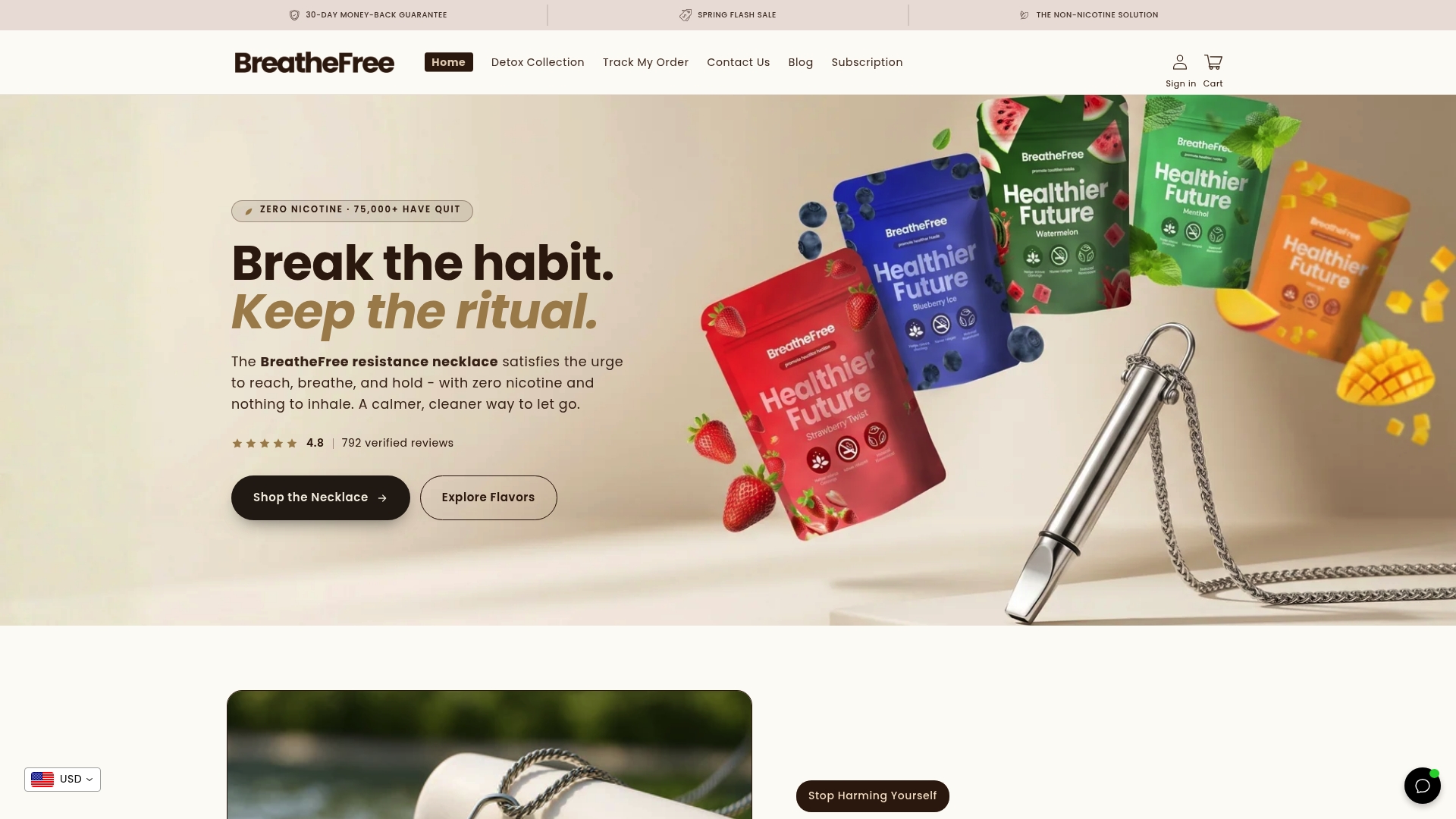
The Breathefree resistance necklace was designed with exactly the mechanisms described in this article in mind. It gives you something tactile to hold, a breath-resistance function that naturally slows your exhale (activating the parasympathetic nervous system), and a portable anchor you can carry into any anxiety-provoking moment. Many people have used it as part of a quit-smoking ritual, but its value as a sensorimotor focus object extends well beyond cessation. Whether you’re building a pre-presentation ritual, a pre-flight routine, or a daily stress-reset habit, a purpose-built resistance necklace gives you a consistent, meaningful object to anchor the sequence. Check out the full collection and find the option that fits your routine.
Sources
- Don’t stop believing: Rituals improve performance by decreasing anxiety
- Don’t stop believing: Rituals improve performance by decreasing anxiety (PMC full text)
- Beyond the Mind: The Cognitive Functions of Religious Artefacts
This article is general information, not a substitute for advice from a qualified doctor. Consult a qualified healthcare professional about your own circumstances before acting on anything here.