

What does quitting cold turkey actually mean?
Quitting cold turkey means stopping an addictive substance or behavior completely and immediately, with no gradual reduction and no replacement therapy. Merriam-Webster defines it as the abrupt, total cessation of a habit or substance. You smoke your last cigarette, drink your last drink, or take your last dose, and then you stop entirely.
The phrase applies to a wide range of substances and habits:
- Nicotine (cigarettes, vaping, chewing tobacco)
- Alcohol (especially relevant for heavy, long-term drinkers)
- Benzodiazepines and prescription sedatives
- Opioids and other controlled substances
- Caffeine
- Other behavioral habits
The appeal is obvious. No patches, no pills, no schedule to manage. Just a decision and a date. The National Cancer Institute recognizes cold turkey as one of the most commonly attempted cessation methods. However, the evidence on its standalone success rate tells a more complicated story.
How effective is cold turkey quitting compared to gradual methods?
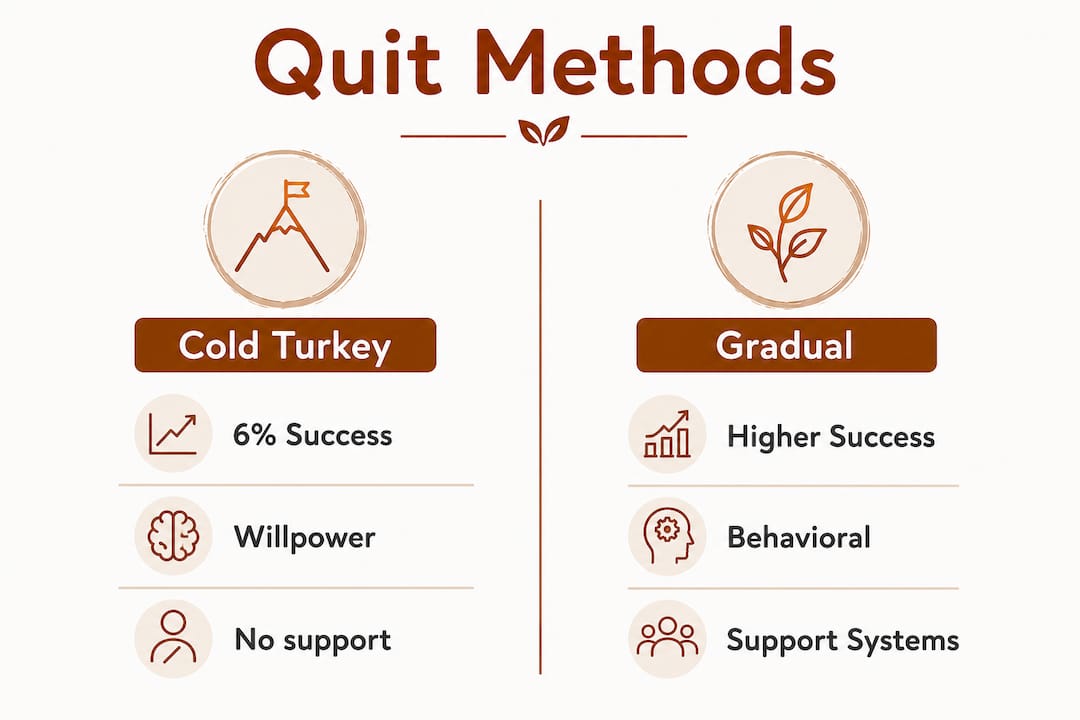
The honest answer: cold turkey works for some people, but the odds are not in your favor without additional support. A 2023 Cochrane review found that cold turkey nicotine cessation achieves about a 6% success rate for long-term abstinence, compared to higher rates when counseling or nicotine replacement therapy is added to the mix.
Stat to know: Research suggests that many people require multiple quit attempts before achieving long-term success, regardless of method.
| Quitting method | Long-term success rate | Key factor |
|---|---|---|
| Cold turkey (no support) | ~6% | Willpower only |
| Gradual reduction alone | Similar to cold turkey | Slower but same challenges |
| Nicotine replacement therapy | Higher than cold turkey | Reduces physical cravings |
| Counseling plus NRT combined | Highest among common approaches | Addresses behavior and biology |
The Truth Initiative points out that cold turkey relies almost entirely on willpower while leaving behavioral habit management unaddressed. That gap is where most quit attempts collapse. For a deeper look at how success rates compare across methods, Breathefree’s cold turkey vs. gradual transition guide breaks down the research clearly.
What are the real risks of stopping cold turkey?
For nicotine, the physical risks of quitting cold turkey are low. Uncomfortable, yes. Dangerous, no. The same cannot be said for alcohol, benzodiazepines, or barbiturates.

Abrupt alcohol cessation in a person with severe dependence can be fatal. Delirium tremens, a severe withdrawal syndrome involving seizures, hallucinations, and cardiovascular instability, is a documented risk for heavy, long-term drinkers who stop without medical supervision. Benzodiazepine withdrawal carries a similar danger profile.
Key warning signs that demand immediate medical attention:
- Seizures or convulsions
- Severe confusion or disorientation
- Rapid heart rate and high fever
- Hallucinations (visual, auditory, or tactile)
- Extreme agitation or tremors
Warning: Anyone with a history of heavy alcohol use, long-term benzodiazepine use, or polydrug dependence should never attempt cold turkey without medical supervision. The risks are not theoretical.
For nicotine specifically, the physical danger is minimal, but the psychological discomfort is real enough to derail most attempts. Understanding how to break the smoking habit cold turkey safely starts with knowing which category your dependency falls into.
What withdrawal symptoms should you expect?
Withdrawal is where cold turkey quitting gets hard fast. The body and brain have adapted to the substance, and removing it abruptly triggers a cascade of physical and psychological responses.
Common withdrawal symptoms include:
- Physical: headaches, sweating, nausea, insomnia, increased appetite, fatigue
- Psychological: intense cravings, irritability, anxiety, difficulty concentrating, low mood
According to the National Cancer Institute, physical nicotine withdrawal symptoms peak around day 3 and typically subside within the first week. The psychological pull, however, lasts considerably longer.
Key milestone: Reaching 28 days nicotine-free marks a turning point. The NHS notes that hitting this milestone significantly improves your odds of permanent cessation, as neurobiological cravings stabilize around this point.
The trickiest part is not the physical symptoms. It is the triggers. Pattern triggers (your morning coffee, a work break), emotional triggers (stress, boredom), and social triggers (being around other smokers) all activate the reward pathways that smoking once satisfied. Research from UCL confirms that the neurobiological reward disruption from abrupt cessation makes psychological habit-breaking just as critical as managing the physical side. For a detailed breakdown of what cravings feel like and how to manage them, Breathefree’s guide on nicotine cravings covers the mechanics well.
What alternatives and strategies actually help?
Cold turkey does not have to mean going it alone. Several evidence-backed tools and strategies meaningfully improve your odds.
Medical and pharmacological options:
- Nicotine replacement therapy (NRT): patches, gum, lozenges, nasal spray. Slow-acting patches provide steady relief; fast-acting gum or lozenges handle sudden cravings.
- Varenicline (Chantix): a prescription medication that blocks nicotine receptors, making smoking less rewarding. The NHS notes that combining varenicline with NRT produces the highest quit rates among common approaches.
- Behavioral counseling: individual or group therapy targeting the habit loops that sustain addiction. The Truth Initiative consistently emphasizes that sustainable quitting requires addressing psychological and social triggers, not just physical dependence.
Practical strategies:
- Remove all smoking paraphernalia before your quit date. Smokefree.gov research shows this environment design step dramatically improves success in the critical first 72 hours.
- Identify your top three triggers and plan a specific substitute response for each.
- Use a quit app or habit tracker to monitor progress and maintain accountability.
- Lean on community support, whether a quit group, a counselor, or an addiction support resource that addresses both the physical and behavioral dimensions.
Pro Tip: Clear your home, car, and workspace of every lighter, ashtray, and cigarette before quit day. Research from Smokefree.gov shows that removing smoking-related items from your environment is one of the highest-impact steps you can take in the first 72 hours.

How Breathefree’s resistance necklace supports cold turkey quitters
One of the least-discussed challenges of quitting cold turkey is the hand-to-mouth ritual. Smokers spend years bringing something to their lips dozens of times a day. When that action disappears overnight, the absence itself becomes a trigger.
Breathefree’s resistance necklace addresses this directly. It is a nicotine-free, inhalation-free tool designed to satisfy the oral fixation that makes cold turkey so difficult for so many people. The act of holding and using the necklace replicates the calming ritual of smoking without any harmful substance involved.
Key features of the Breathefree approach:
- Completely nicotine-free: no dependency transfer, no chemicals
- Targets oral fixation: addresses the behavioral ritual, not just the chemical craving
- Community support built in: Breathefree pairs the product with a support community, which research consistently shows improves quit outcomes
- Over 75,000 people have reportedly used this method to quit successfully
Pro Tip: Pair the Breathefree resistance necklace with a written quit plan and a trigger log. Knowing exactly which moments tempt you most lets you reach for the necklace before the craving peaks, not after.
The behavioral support dimension is what separates tools like this from simple distractions. Addressing the ritual alongside the craving is the kind of dual-track approach that the evidence consistently favors.
Who should avoid quitting cold turkey?
Not everyone is a safe candidate for abrupt cessation. Certain groups face serious medical risks and should pursue a medically supervised taper instead.
High-risk groups who should not quit cold turkey without medical guidance:
- Heavy, long-term alcohol drinkers: risk of delirium tremens, seizures, and death
- Long-term benzodiazepine users: abrupt withdrawal can trigger life-threatening seizures
- Barbiturate-dependent individuals: similar seizure risk to benzodiazepines
- People with severe opioid dependence: withdrawal is rarely fatal but can cause dangerous dehydration and cardiovascular stress
- Pregnant people who smoke heavily: abrupt nicotine cessation can cause stress responses; a supervised plan is safer
- Anyone with a serious cardiovascular condition: withdrawal-related stress and anxiety can strain the heart
The Vanderbilt Health Center notes that clinicians rarely recommend cold turkey as a first-line approach for people with complex dependencies. If you fall into any of these categories, a conversation with your doctor before quit day is not optional.
What does the withdrawal and recovery timeline actually look like?
Recovery from cold turkey quitting follows a fairly predictable arc, though the exact experience varies by substance and individual history.
Nicotine withdrawal timeline:
- Hours 1–24: Cravings begin within a few hours of the last cigarette. Irritability, anxiety, and restlessness set in.
- Days 2–3: Physical symptoms peak. Headaches, insomnia, and intense cravings are at their worst around the 72-hour mark, as confirmed by the National Cancer Institute.
- Days 4–7: Physical symptoms begin to ease. Psychological cravings remain strong, especially around habitual trigger times.
- Weeks 2–4: Cravings become less frequent but can spike sharply when triggered. Mood and sleep gradually stabilize.
- Day 28: A meaningful turning point. The NHS identifies this milestone as the point at which long-term success becomes significantly more likely.
- Months 2–6: Most physical recovery is complete. Behavioral triggers remain the primary relapse risk.
For alcohol and benzodiazepines, the timeline is compressed and more dangerous. Severe withdrawal symptoms can begin within 6–24 hours of the last drink and peak around 24–72 hours, with delirium tremens typically appearing between 48 and 96 hours if it occurs. Medical supervision during this window is not a precaution; it is a necessity.
The benefits of quitting cold turkey accumulate steadily once the acute phase passes. Lung function, cardiovascular health, and mood all improve measurably within weeks for most people who make it past the first month.
Key Takeaways
Cold turkey quitting can work, but a 6% long-term success rate for unaided nicotine cessation shows that willpower alone rarely carries people across the finish line.
| Point | Details |
|---|---|
| Cold turkey defined | Immediate, complete cessation with no tapering, substitution, or replacement therapy. |
| Success rate without support | A 2023 Cochrane review found roughly a 6% long-term abstinence rate for unaided cold turkey nicotine quitting. |
| Dangerous for some substances | Abrupt cessation from alcohol or benzodiazepines can be life-threatening; medical supervision is required. |
| Withdrawal peaks at day 3 | Physical nicotine withdrawal symptoms peak around day 3 and typically ease within the first week. |
| Day 28 milestone | Reaching 28 days nicotine-free significantly improves the odds of permanent cessation, per NHS data. |