

N-acetylcysteine (NAC) is a well-studied mucus-thinning drug that is also sold as a supplement, and small trials have tested it for cutting tobacco cravings. The results are mixed. One 2024 trial found higher quit rates, another found nothing, and no study shows that NAC “detoxes” or repairs a smoker’s lungs. Below we go through what NAC does in the lungs, what the craving research says, where quercetin fits, and what has stronger evidence for quitting.
TL;DR
- NAC thins mucus and is used in lung conditions like COPD, but trial results on flare-ups and lung function are mixed.
- For cravings, one 2024 trial of 90 male smokers reported much higher abstinence with NAC, while a 2017 trial of 48 people found no effect.
- No source we found shows NAC can reverse smoking damage or “cleanse” the lungs. Stopping smoking is what protects them.
- Quercetin has only small, early human data in COPD. Treat it as unproven.
- Counseling plus an approved medication has the best evidence for quitting, and a non-nicotine tool can help with the hand-to-mouth habit.
Table of Contents
- What NAC is and why smokers ask about it
- What NAC does in the lungs
- Can NAC detox or reverse damage from smoking?
- Does NAC help with nicotine cravings?
- What about quercetin for smokers’ lungs?
- Safety: what to check before taking NAC
- What has better evidence for quitting
- Our perspective: the ritual is half the problem
- A non-nicotine tool for the habit side
- Common mistakes smokers make with supplements
- FAQ
- Sources
What NAC is and why smokers ask about it
NAC is a modified form of the amino acid cysteine. Your body uses cysteine to build glutathione, one of its main antioxidants. Cigarette smoke creates oxidative stress in the airways, so the idea that a glutathione precursor might help is easy to follow.
NAC exists in two forms that people confuse. A prescription version is used in hospitals and as an inhaled mucus thinner. The other is the capsule or powder sold as a dietary supplement. Studies on cravings use oral NAC, usually at high doses. Studies on lungs use a range of doses and forms. Neither supports a general claim that a capsule from the supplement aisle will protect a smoker.
What NAC does in the lungs
NAC works as a mucolytic. It breaks the disulfide bonds that make mucus thick and sticky, which thins secretions and helps clear the airways in conditions such as COPD and asthma. That is a real, established action. It is different from repairing tissue.
Whether this translates into fewer flare-ups is less clear:
- A 2023 meta-analysis of randomized trials found that long-term oral NAC in COPD patients did not significantly reduce acute exacerbations or slow the decline in lung volume compared with placebo.
- A separate analysis of 20 studies reported fewer exacerbations with NAC in COPD (incidence rate ratio 0.76) and in chronic bronchitis or pre-COPD (0.81).
- Memorial Sloan Kettering summarizes the field plainly: some trials suggest less inflammation or fewer flare-ups, while others saw no benefit.
Those numbers come from people who already have chronic lung disease and are under medical care. They say little about a healthy-looking smoker who wants a safety net while still smoking.
Can NAC detox or reverse damage from smoking?
No. We found no human trial showing that NAC cleanses a smoker’s lungs or undoes the damage from smoking. “Lung detox” is a marketing phrase, not a medical outcome.
What the evidence supports is narrower. NAC thins mucus. In some people with COPD, it may reduce flare-ups. Animal and lab work on cigarette smoke exists, but one mouse study that tested NAC against smoke exposure found it did not reverse the loss of a bone marrow cell subset caused by smoking. Mouse results are a starting point for research, not advice.
The lungs do begin to recover after you stop. That is why the most useful “lung support” is a quit date, not a capsule. If you cough up mucus daily, get breathless on stairs or wheeze, see a doctor and ask about a spirometry test. Those symptoms can mean COPD, and a supplement should not delay a diagnosis.
Does NAC help with nicotine cravings?
This is the question behind most searches, and the honest answer is: maybe, in some people, and not reliably.
The theory is that long-term nicotine use disturbs glutamate signaling in the brain’s reward circuit, and NAC may help restore balance. That is a plausible mechanism, not proof that it works in practice. The human trials point in different directions:
| Study | Who | Dose | Result |
|---|---|---|---|
| Indonesian randomized trial, 2024 | 90 male smokers | 2400 mg twice daily | Abstinence 37.7% vs 6.6% on placebo, lower craving scores |
| Double-blind trial, 2017 | 48 people | 2400 mg per day | No significant effect on quitting, craving or withdrawal |
| Meta-analysis of 16 trials, 2021 | Mixed substance use | Varied | Craving fell overall (SMD -0.67), but tobacco-only trials showed no consistent effect |
Read that table as a mixed picture. The 2024 trial is encouraging, but it was small, included only men and used a high dose paired with motivational support. The 2021 review suggests the broad craving benefit does not hold up well when you look only at tobacco. A larger trial is registered, and results may change the picture, so a fresh look at the evidence is worthwhile before you decide.
The bottom line: NAC is a reasonable thing to ask your doctor about, not a proven quit aid. Do not treat it as a replacement for approved treatments.
What about quercetin for smokers’ lungs?
Quercetin is a plant flavonoid found in onions, apples and capers, and it is sold as a supplement. It shows up in lung searches because lab and animal work looks interesting.
- In mice exposed to cigarette smoke for 60 days, quercetin was linked to less inflammation, fewer cells flooding the airways and less emphysema.
- In a small U.S. pilot trial in COPD, 2000 mg per day for six months was safely tolerated, with no adverse events attributed to the study drug. The authors say further prospective studies are needed to confirm any benefit.
- In the same research program, quercetin raised markers tied to airway lining regeneration, and in 3 of 7 patients it lowered inflammatory signals TGF-β and IL-8.
Seven patients is a tiny group, and a pilot study is built to check safety, not to prove benefit. Nothing here shows quercetin protects smokers or heals lungs. If you want it for the antioxidants, eating onions and apples is a low-risk start.
Safety: what to check before taking NAC
NAC is widely used, but a few points deserve a conversation with a pharmacist or doctor, especially if you take regular medication or have asthma.
- Inhaled forms are not the same as capsules. MedlinePlus lists nausea, vomiting, fever, throat irritation, wheezing or difficulty breathing as possible effects of inhaled acetylcysteine. If you have asthma, do not try a nebulized version without a prescriber.
- High trial doses are not a starting point. The craving studies used 2400 mg per day or more. Do not copy a trial dose from the internet. Ask your clinician what is appropriate for you.
- Tell your doctor about all supplements if you are pregnant, take blood thinners, heart or blood pressure drugs, or are being treated for a chronic condition.
- Do not stack supplements for “detox.” More products means more unknowns and no added evidence.
If you notice a rash, swelling of the face or throat, or trouble breathing after any supplement, stop it and seek urgent care.
What has better evidence for quitting
The CDC states that counseling and medication together can more than double the chances of quitting. It lists seven FDA-approved medications, including nicotine replacement therapy, varenicline and bupropion. It also describes tobacco dependence as a chronic, relapsing condition that often needs repeated attempts and long-term support.
That last point matters. If you have tried to quit before and failed, you have not shown that you lack willpower. You have shown the pattern the CDC describes. Looking at treatments for addiction recovery and talking to a clinician about the combination that fits you is the step with the strongest track record.
A practical order for most people:
- Pick a quit date within the next two weeks and tell one person.
- Ask your doctor or pharmacist about approved medication. You can also call the national quitline at 1-800-QUIT-NOW.
- Add behavioral support: counseling, a text program, or a community. Our guide to why ex-smokers need behavioral support explains why this part is not optional.
- Plan for the hands and mouth, because the ritual outlasts the nicotine craving.
- Treat NAC or other supplements as optional extras to discuss with your clinician, never as the plan.
If you want a written plan, see how to create a quitting smoking action plan. Heavier smokers may prefer a 12-week structured quit plan.
Our perspective: the ritual is half the problem
When people ask us about NAC, we hear the same hope underneath: is there something I can swallow that makes this easier? We understand it. We also see why a capsule alone rarely feels like enough.
Smoking is two habits stacked together. One is the chemical pull of nicotine. The other is a set of rituals: the break at work, the coffee, the drive home, the hand going to the mouth, the deep pull of air. Medication and supplements aim at the first. Nothing in a bottle gives your hands and mouth something to do at 3 p.m. when the old trigger hits.

That is the gap we built BreatheFree around. Our approach is nicotine-free, chemical-free and inhalation-free. It is based on oral fixation and ritual, not on substituting one substance for another. We say that more than 75,000 people have used the method to quit, and we pair it with a community so you are not doing this alone. We do not claim it detoxes your lungs or replaces medical care. If you are using approved medication or talking with a doctor about NAC, our tools are meant to sit alongside that, covering the habit side.
Our advice: be skeptical of anyone promising a lung cleanse, choose the options with real trial support, and give the ritual a replacement so it doesn’t pull you back. Our piece on how to replace your smoking ritual healthily goes deeper.
— Tommy
A non-nicotine tool for the habit side
The BreatheFree Resistance Necklace is $39.95 as a one-off purchase. It gives you something to hold and draw on when a craving hits, with no nicotine and no smoke. Flavor refills are $29.95 and come in a variety of natural flavors. The products are solid and plant-fiber based, so you can use them in an office or on a flight. Orders are backed by a 30-day money-back guarantee.
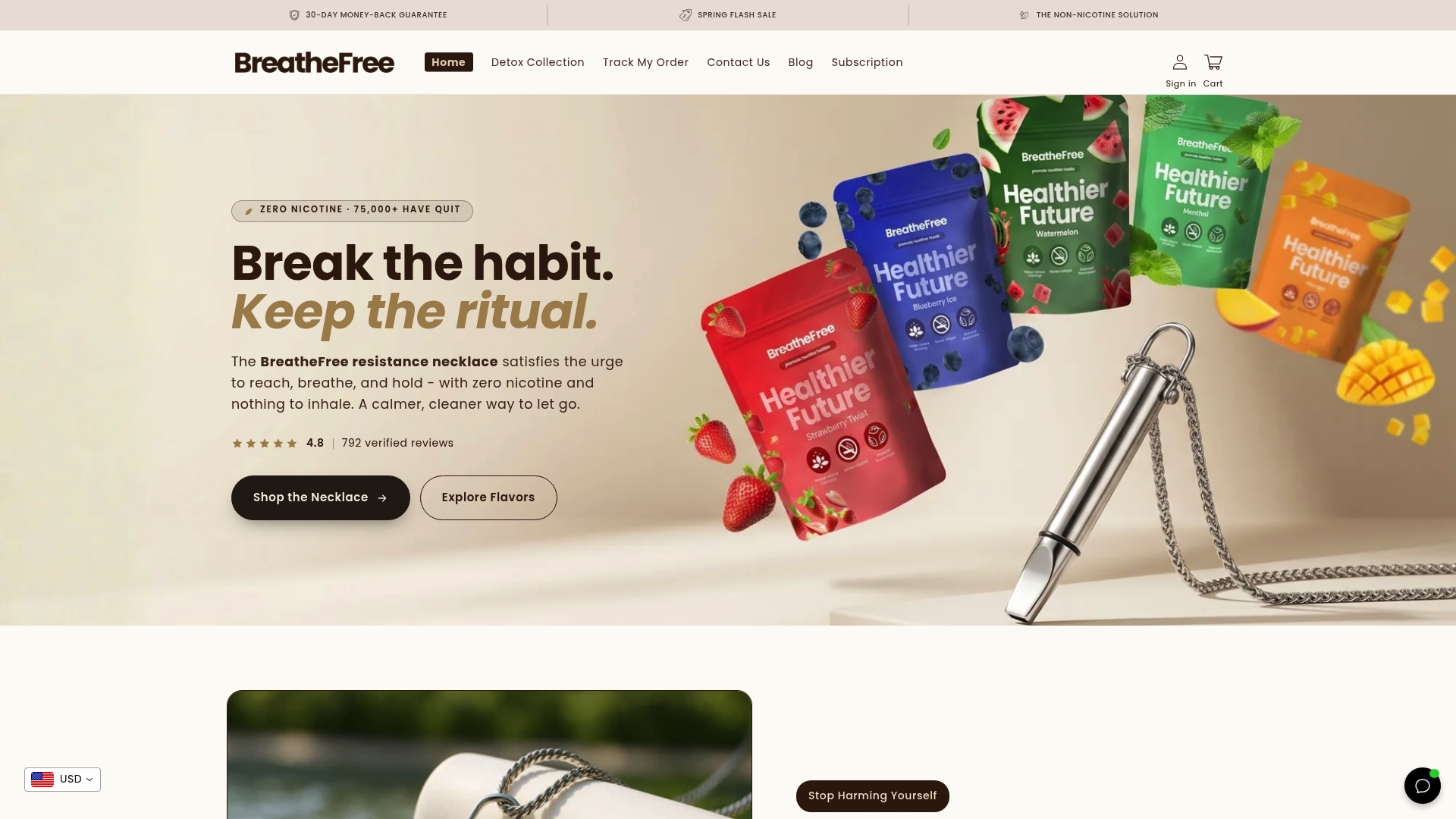
You can see the full range, including refills, on our shop page. If you want a simple way to log cravings and progress, there is also a habit tracker.
Common mistakes smokers make with supplements
A few patterns come up again and again:
- Using NAC to keep smoking more safely. No trial shows a supplement cancels out the harm of continued smoking.
- Skipping approved medication because a supplement feels more “natural.” The CDC evidence is for the approved options.
- Expecting a fast result. The 2024 trial ran for weeks and paired the capsules with motivational support. It was not a pill-only fix.
- Ignoring symptoms. Persistent cough, mucus, wheeze or breathlessness deserve a doctor visit, not a new supplement.
- Dropping the plan after one slip. Given that dependence is chronic and relapsing, a slip is information. Adjust the plan and keep going.
If alcohol is a trigger for you, read our note on protecting week one of a quit. For a wider look at options, our guide to smoke-free tools for beginners lays them out side by side.
FAQ
Does NAC help smokers quit?
It might help some people, but the evidence is inconsistent. A 2024 trial of 90 male smokers reported higher abstinence on 2400 mg twice daily than placebo, while a 2017 trial of 48 people found no effect on quitting or craving. Approved medications and counseling have stronger support.
What does NAC do for your lungs?
NAC thins mucus by breaking its disulfide bonds, which helps clear the airways in conditions like COPD. Studies on whether it prevents flare-ups disagree. It does not rebuild damaged lung tissue.
Can NAC detox your lungs after smoking?
There is no evidence that it does. The idea of a lung detox is not backed by human trials. The lungs begin recovering when you stop smoking, and a doctor can check your lung function if you have symptoms.
Does NAC help with nicotine withdrawal?
The research is split. One trial found lower craving scores with NAC, and another found no reduction in craving or withdrawal symptoms. A 2021 review found no consistent effect on withdrawal in tobacco-only trials.
Is quercetin good for smokers’ lungs?
It is not proven. Animal studies are promising, and a small COPD pilot found 2000 mg per day tolerable for six months, but the researchers say larger studies are needed. Ask your doctor before taking it, especially alongside other medicines.
Sources
- Advances in the Use of N-Acetylcysteine in Chronic Respiratory Diseases
- Efficacy of N-acetylcysteine in chronic obstructive pulmonary disease (2023 meta-analysis)
- N-acetylcysteine treatment in chronic obstructive pulmonary disease (Papi, 2024)
- N-Acetylcysteine, Memorial Sloan Kettering Cancer Center
- N-Acetylcysteine and bone marrow pro-B/pre-B cells in smoke-exposed mice
- Twice-daily NAC 2400 mg in smokers (2024 trial)
- Effect of NAC on brain glutamate and smoking cessation (2017)
- Effectiveness of N-acetylcysteine in treating clinical symptoms of substance use disorders (2021 meta-analysis)
- Quercetin improves epithelial regeneration from airway basal cells
- Quercetin improves pulmonary function in smoke-exposed mice
- Oral quercetin pilot trial in COPD
- Acetylcysteine oral inhalation, MedlinePlus
- Clinical interventions to treat tobacco use and dependence, CDC
- Can ketamine therapy help with addiction recovery?