

The fastest way to stop a nighttime craving is to buy yourself ten minutes: set a timer, do something with your hands and mouth (gum, a cold glass of water, brushing your teeth), and breathe slowly until the urge fades. Cravings peak hard but pass within minutes, so the goal isn’t to out-muscle the urge, it’s to outlast it. The step-by-step tactics below cover exactly how to do that, plus what to expect over the coming weeks.
TL;DR:
- Up to 85% of night-time smoking urges stem from psychological stress and habit, not just nicotine withdrawal, requiring targeted behavioral strategies.
- Short delays, oral substitutes, breathing exercises, grounding, ritual breaking, and movement can reliably reduce cravings within minutes during middle-of-the-night episodes.
- Maintaining a cool, dark, and nicotine-free bedroom, along with avoiding late caffeine, supports better sleep and reduces triggers for night cravings.
- Night cravings typically diminish within one to two weeks from the peak of withdrawal, but habit-driven urges may persist for several weeks or months.
- Combining medication, counseling, and habit replacement tools increases chances of sustained quitting, especially for strong night-time cravings.
Table of Contents
- Why Do I Crave Cigarettes at Night?
- Immediate Coping Toolkit: 7 Bedside Tactics That Work in Minutes
- How Can You Make Your Bedroom More Quit-Friendly?
- What Triggers Night Smoking Besides Nicotine Withdrawal?
- How Long Do Night Cravings Last After Quitting?
- When Should You Consider Medication or Professional Help?
- A Nicotine-Free Way to Handle the Hand-to-Mouth Urge at Night
- What Actually Moves the Needle on Night Cravings
- Sources
Why Do I Crave Cigarettes at Night?
Night smoking cravings usually come from two different sources tangled together, and telling them apart matters. One is straightforward nicotine withdrawal: your blood nicotine level drops overnight, and your brain notices. The other is psychological, tied to habit and stress rather than the drug itself.
That second category is bigger than most quitters assume, as shown in research on smoking preferences when working night shifts in Australia. Research on nighttime waking to smoke, published in PMC, found that up to 85% of smokers who wake at night to smoke point to psychological distress and stress rather than pure nicotine need. In other words, the 2 AM cigarette is often less about withdrawal and more about a racing mind, a bad dream, or the ritual of stepping outside for a few quiet minutes alone.
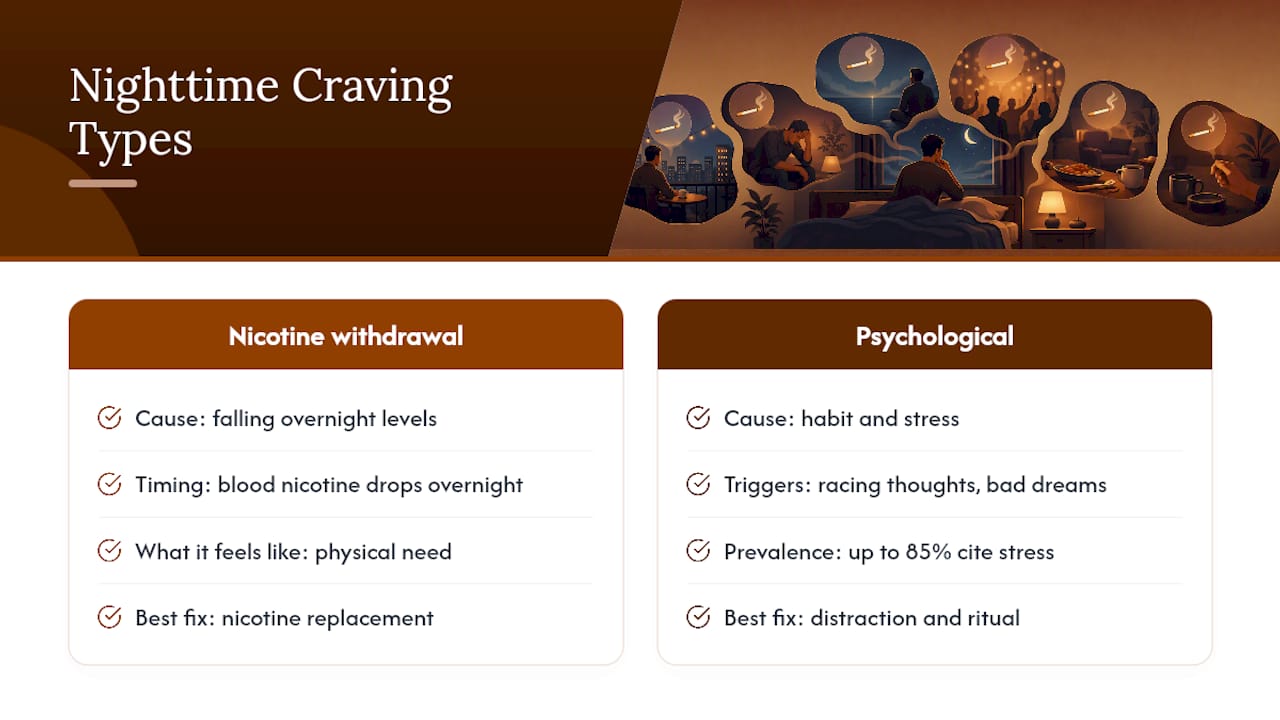
That distinction changes the fix. If your craving is habit-driven, distraction and ritual replacement work better than nicotine alone ever could.
Immediate Coping Toolkit: 7 Bedside Tactics That Work in Minutes
When you’re wide awake at 3 AM and every cell in your body wants a cigarette, you don’t need theory. You need a plan you can execute half asleep.
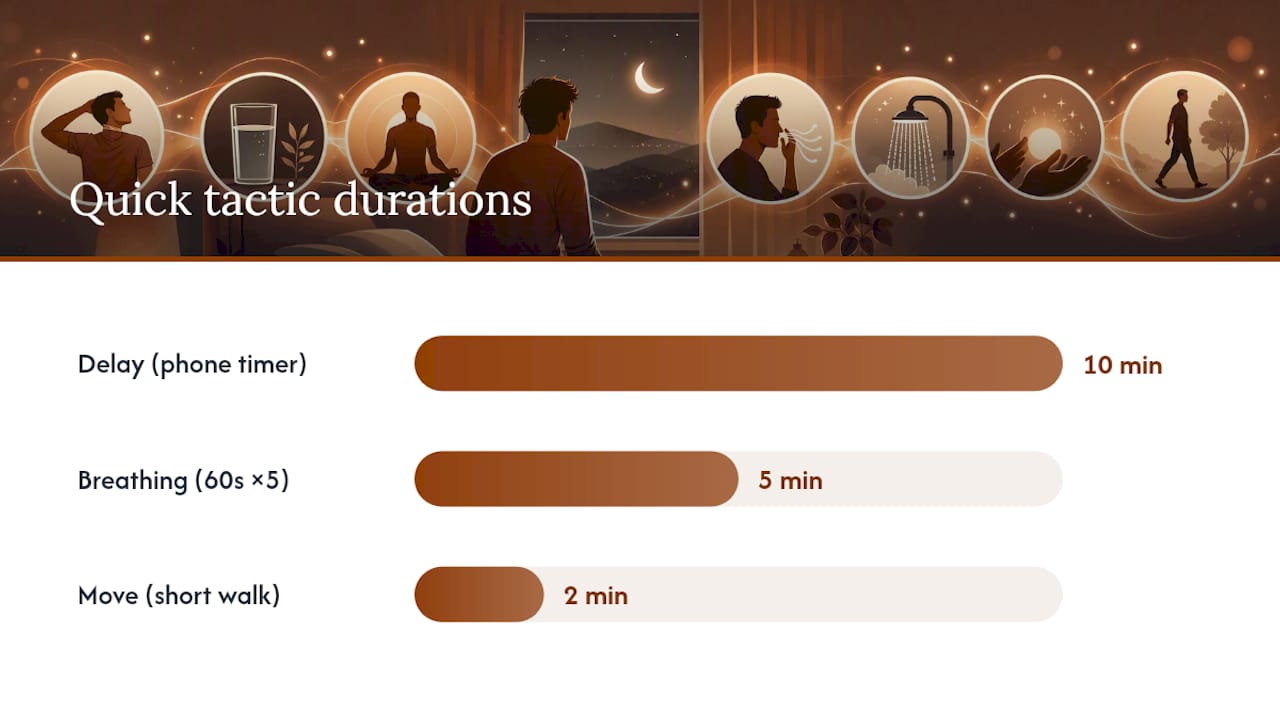
- Delay for 10 minutes. Set a phone timer the second the urge hits. Mayo Clinic notes that short, timed delays reliably reduce craving intensity because urges are short-lived by nature, not permanent states.
- Reach for an oral substitute. Sugar-free gum, a mint, a flavored toothpick, or a glass of ice water satisfies the hand-to-mouth habit without lighting anything.
- Do a 60-second breathing script. Inhale for four counts, hold for four, exhale for six. Repeat five times. This slows your heart rate and gives your brain something else to track.
- Try grounding. Name three things you can see, three you can hear, three you can feel. It interrupts the mental loop that’s feeding the craving.
- Break the ritual with a behavioral swap. Get up, brush your teeth, or change into different sleep clothes. Smoking is tied to specific physical cues, and altering them weakens the pull.
- If you’re using nicotine replacement therapy, use it as directed. A lozenge or piece of nicotine gum can be used at night if your regimen allows it, but check your product label or clinician’s guidance before adding an extra dose outside your normal schedule.
- Move for two minutes. A short walk to the kitchen and back, or a few stretches, burns off restlessness that would otherwise translate into a cigarette.
Pro Tip: Keep everything you need for this list in a small basket next to your bed: gum, a water bottle, a phone charger for the timer. Removing the friction of “getting up to find something” makes the plan actually usable at 3 AM.
If a craving arrives alongside chest pain, severe panic, or thoughts of self-harm, that’s not a craving to manage alone. Call 911 or a crisis line immediately.
How Can You Make Your Bedroom More Quit-Friendly?
Quitting doesn’t just change your mood, it changes how you sleep. Sleep architecture, meaning the balance of REM and deep sleep, gets disrupted for the first several weeks after your last cigarette, according to sleep and smoking cessation research. That’s part of why you’re waking up more in the first place, not a sign that something has gone wrong.
A few adjustments lower the odds you’ll wake up and reach for a cigarette out of habit:
- Cut off caffeine by early afternoon. The CDC specifically recommends avoiding late-day caffeine during the withdrawal window.
- Keep your bedroom nicotine-free and smoke-free, full stop. No ashtray, no lighter, no evidence that smoking is even an option in that room.
- Dim screens an hour before bed. Blue light delays melatonin release, and a wired brain reaches for stimulants, including nicotine, more easily.
- Keep the room cool and dark. Both support the deeper sleep stages that quitting temporarily disrupts.
If you’re on a nicotine patch, talk to your prescriber about timing. Wearing it too late into the evening can interfere with sleep for some people, and a small adjustment, like removing it a few hours before bed instead of leaving it on overnight, sometimes resolves the problem without losing any craving control during the day.
What Triggers Night Smoking Besides Nicotine Withdrawal?
Nighttime smoking triggers are rarely just about the drug. They’re about the environment and the emotional state that surrounds your old smoking ritual.
Common culprits worth naming specifically:
- Alcohol in the evening. It lowers inhibition and is one of the most reliable relapse triggers there is.
- Late caffeine or energy drinks. They keep you wired past your natural wind-down window.
- A partner or roommate who smokes. Secondhand cues are powerful; even smelling smoke can reignite a craving.
- Phone notifications and scrolling in bed. Stress from late-night news or messages often masquerades as a nicotine craving.
- The pre-bed “last cigarette” ritual. If you always smoked before bed, your brain expects it at that exact time, independent of nicotine level.
When you catch a craving forming, try labeling it out loud: “This is a habit urge, not a nicotine need.” Pair that with 3-3-3 grounding (three things you see, hear, feel) or two minutes of slow breathing. Before bed tonight, write a one-line plan: “If I wake up wanting to smoke, I will [substitute] and wait 10 minutes.” Having the answer decided in advance removes the moment of negotiation with yourself, which is where most relapses start.
Pro Tip: Replacing the ritual matters as much as resisting the urge. A resistance necklace or another object you can hold and bring to your mouth gives your hands and lips something to do that isn’t a cigarette, without adding any nicotine to a body that’s already trying to clear it out.
How Long Do Night Cravings Last After Quitting?
The worst nights don’t last forever, even though night three feels like they might. Here’s a realistic breakdown of what the evidence points to.
| Timeframe | What’s happening | What to expect |
|---|---|---|
| Days 1 to 3 | Nicotine withdrawal peaks | Cravings feel intense but each episode passes in minutes |
| Week 1 to 2 | Acute withdrawal window | CDC notes most physical symptoms, including cravings, typically ease within this window |
| Weeks 2 to 4 | Habit-driven urges persist | Even after nicotine symptoms fade, cue-based cravings (stress, ritual) can continue |
| 1 to 3 months | Sleep gradually normalizes | Sleep disruption from early abstinence generally improves over this period |
The habit component is the one people underestimate. Since PMC research shows up to 85% of night-waking smokers attribute the urge to stress and psychological factors rather than nicotine itself, expect some urges to outlast the physical withdrawal timeline. That’s not a sign you’re doing something wrong. It’s a sign the habit needs its own strategy, separate from managing nicotine.
When Should You Consider Medication or Professional Help?
If bedside tactics and sleep fixes aren’t enough on their own, medication and counseling meaningfully raise your odds of staying quit. Mayo Clinic notes that combining medication with counseling improves quit success rates compared with either approach alone.
Options worth discussing with a clinician:
- Nicotine replacement therapy (patches, gum, lozenges) for steady, lower-dose nicotine delivery.
- Varenicline or bupropion, prescription medications that reduce craving intensity and withdrawal severity.
- Behavioral counseling, in person or through a quitline, for the habit and stress side of quitting.
- Combination therapy, often the most effective approach for people with strong night cravings.
Some patients report sleep changes on NRT or varenicline; research on sleep and cessation confirms this happens for a subset of people, and clinicians can often adjust dose or timing to help.
Five questions worth bringing to your next appointment: Is my sleep disruption from quitting or from my medication? Should I adjust patch timing? Am I a candidate for varenicline or bupropion? What counseling or quitline resources do you recommend? What’s a safe way to combine treatments?
A Nicotine-Free Way to Handle the Hand-to-Mouth Urge at Night
Oral fixation, the physical habit of having something in your hands and mouth, drives a lot of nighttime cravings independent of nicotine level. That’s exactly the gap Breathefree’s resistance necklace is built to fill: something to hold, bite down on, and bring to your mouth as a bedtime ritual replacement, with zero nicotine involved.
A simple way to trial an oral fixation tool is to:
- Keep an object on your nightstand, not in a drawer, so it’s the first thing your hand finds.
- Use it the moment you reach for the 10-minute delay tactic from earlier.
- Pair it with a sleep hygiene fix, like cutting evening caffeine, rather than expecting one tool to do everything.
- Consult your clinician if you’re also using NRT or prescription medication, since these tools complement clinical treatment rather than replace it.
| What it addresses | How it helps at night |
|---|---|
| Hand-to-mouth habit | Gives hands something to do without a cigarette |
| Bedtime ritual gap | Replaces the “last cigarette” routine |
| Nicotine-free craving relief | No stimulant added, so it won’t disrupt sleep further |
Over 75,000 people have used this approach to quit according to Breathefree’s own customer data, and pairing it with the nicotine detox eBook and habit tracker gives you a structured way to track which nights are getting easier.
What Actually Moves the Needle on Night Cravings
Most quit-smoking advice treats night cravings like a smaller version of daytime cravings, just resisted in the dark. That’s the wrong model. The research on nighttime waking points somewhere else entirely: for a huge share of people, the 2 AM cigarette is a stress response wearing a nicotine costume.
That reframe matters because it changes where you spend your effort. Sleep hygiene and stress-labeling techniques, the parts of quitting that feel less dramatic than “fighting a craving,” are doing more work than most people give them credit for. Meanwhile, oral-fixation tools get dismissed as gimmicks, when the actual mechanism, occupying the hands and mouth without adding a stimulant, lines up with what disrupted sleep actually needs.
If you take one thing from this article, prioritize the sleep fixes before the willpower fixes. A tired brain at 3 AM has almost no capacity for resisting anything. Fix the environment first, then the habit, and the craving itself gets a lot smaller.
— Tommy
This article is general information, not a substitute for advice from a qualified doctor. Consult a qualified healthcare professional about your own circumstances before acting on anything here.
Sources
- Nighttime Waking to Smoke, Stress, and Nicotine Addiction (PASS) — PMC
- Quitting smoking: 10 ways to resist tobacco cravings — Mayo Clinic