

Goal-setting is the single most reliable predictor of whether a quit attempt succeeds or stalls. Not willpower. Not timing. Not even the method you choose. Research on goal-setting theory by Edwin Locke and Gary Latham shows that specific, challenging goals consistently outperform vague intentions across more than 100 different tasks involving over 40,000 participants. When you apply that same framework to quitting smoking or any addictive behavior, the results hold.
The core advantages of structured goal-setting in cessation efforts include:
- Clarity: A specific quit date with a concrete plan beats “I’ll quit soon” every time.
- Motivation: Goals act as what Locke called the “motivation hub,” converting incentives into action.
- Persistence: Breaking a big quit goal into milestones keeps you moving when cravings hit.
- Self-efficacy: Each small win builds the belief that the next step is achievable.
- Measurability: Tracking progress against a defined goal reveals what is working and what needs adjustment.
The SMART goals framework (Specific, Measurable, Achievable, Relevant, Time-bound) gives those advantages a practical structure. Tools like the Breathefree Resistance Necklace add a physical, nicotine-free anchor that reinforces goal commitment during the hardest withdrawal moments.
Table of Contents
- How goal quality shapes your chances of quitting
- What types of goals actually move the needle on cessation
- Practical strategies for setting goals that stick
- Why goal-setting works: the psychology behind it
- How Breathefree supports quitting through goal-setting and community
- Breathefree gives you the structure and the tool to actually quit
- Key Takeaways
How goal quality shapes your chances of quitting
Not all goals are created equal, and the gap between a well-formed quit goal and a vague one is measurable. A study published in a UK telephone quitline service found that higher quality goal-setting was associated with a marked increase in the likelihood of smokers initiating a planned quit attempt. The two components that drove that result were setting a clear quit date and setting it within an appropriate timeframe, typically one to two weeks out.

That second point surprises most people. A quit date set too far in the future does not build anticipation. It reinforces the habit while you wait, because nothing about your daily behavior changes in the meantime. Proximal goals with specific support plans prevent that drift.
| Feature | High-quality quit goal | Low-quality quit goal |
|---|---|---|
| Specificity | “I will quit on March 14” | “I want to quit soon” |
| Timeframe | 1–2 weeks from now | Months away or undefined |
| Difficulty | Challenging but achievable | Either too easy or unrealistic |
| Support plan | Medication, tool, or accountability partner identified | No plan attached |
| Feedback loop | Weekly check-ins to review progress | No review mechanism |
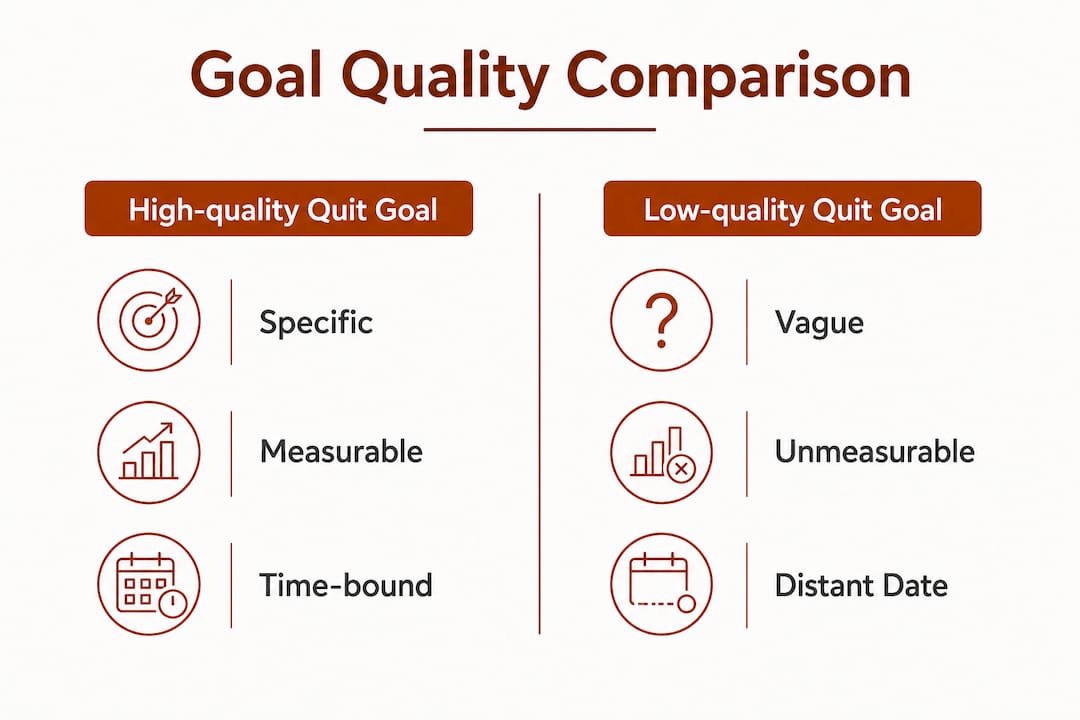
Monitoring matters as much as the initial goal. Control theory frames quitting as a self-regulation loop: you set a goal, measure where you are against it, and revise your approach based on that feedback. Without the revision step, even a well-written goal loses its grip over time. Build in a weekly review, even a five-minute one, and your goal stays alive rather than becoming background noise.
The most common pitfall is setting an unclear goal under the assumption that motivation will fill in the details. It will not. Vague goals produce vague effort. If your goal is “smoke less,” your brain has no threshold to hit and no moment of success to celebrate.
What types of goals actually move the needle on cessation
Goal type matters as much as goal quality. Four categories show up consistently in cessation research, and each plays a different role in the quitting process.
Behavioral goals target the actions you control directly: “I will not smoke before noon,” or “I will use my Breathefree Resistance Necklace every time I feel a craving.” These are the most immediately actionable and the easiest to track day to day.
Outcome goals focus on the end state: “I will be smoke-free by June 1.” They provide direction and a finish line, but they can feel abstract during the early weeks when cravings are strongest. Pairing an outcome goal with behavioral goals closes that gap.
Incremental goals break the quit journey into stages. Week one: reduce to ten cigarettes per day. Week two: five. Week three: zero. Breaking big quit goals into manageable milestones increases the chance of sustained abstinence by triggering positive reinforcement pathways in the brain after each small win. That neurological feedback loop is real and repeatable.
Final quit goals mark the definitive endpoint. They work best when they follow a period of incremental progress rather than arriving cold on day one.
A few distinctions worth keeping in mind:
- Ambitious goals outperform easy ones, but only when you genuinely believe they are reachable. An unrealistic goal collapses self-efficacy faster than no goal at all.
- Public goals, shared with a friend, a group, or an online community, carry built-in accountability. Telling someone your quit date raises the social cost of backing out.
- Milestone goals deserve their own small reward. Acknowledging a smoke-free week reinforces the behavior and signals to your brain that the effort was worth it.
A personalized approach to addiction treatment often combines all four goal types, calibrating the mix to where a person is in their quit attempt rather than applying a single template.
Practical strategies for setting goals that stick
The SMART framework is the most widely used structure for quit goals, and it earns that status. Here is how each element applies specifically to smoking cessation.

Specific: Name the behavior, the context, and the trigger. “I will not smoke during my morning coffee” is specific. “I will cut back” is not.
Measurable: Attach a number. Cigarettes per day, smoke-free hours, days since last cigarette. You cannot track progress on a goal you cannot count.
Achievable: Stretch yourself, but stay honest. Locke and Latham’s research consistently shows that challenging goals drive higher performance than easy ones, but only when the person believes the goal is within reach.
Relevant: The goal has to matter to you personally, not just in theory. Connecting your quit goal to a specific reason, your kids, your health, your finances, keeps motivation internal rather than dependent on external pressure.
Time-bound: Set a quit date within one to two weeks. As the research above shows, that window is specific enough to feel real without being so close that it triggers panic.
Pro Tip: Focus on one primary quit goal at a time. Research shows that multiple conflicting goals deplete cognitive resources and reduce self-control. Pick the single most important behavioral change and protect it.
A practical checklist for setting your quit goal:
- Write the goal down in one sentence, including the specific date and behavior.
- Identify your top three smoking triggers and plan a substitute response for each.
- Tell at least one person your quit date.
- Schedule a weekly five-minute review to assess progress and adjust if needed.
- Pair your goal with a physical cue or tool that reinforces the new behavior.
Social support amplifies every item on that list. A systematic review on goal-setting found that group goals and external monitoring, without negative feedback, optimize behavioral change. The key word is “without negative feedback.” Accountability works when it is encouraging, not punishing. A quit buddy who checks in with “how are you doing?” outperforms one who says “you failed again.”
Journaling is an underused tool for maintaining goal clarity. Tracking your progress in writing creates a record of what triggered cravings, what helped, and how far you have come, which is exactly the feedback loop that keeps goals functional over time.
Why goal-setting works: the psychology behind it
Locke and Latham’s goal-setting theory identifies the “motivation hub” as the place where external incentives become personal action. That hub has two components: goal commitment and self-efficacy. Neither works without the other.
Self-efficacy, your belief that you can actually quit, is not just a nice-to-have. Higher self-efficacy correlates directly with setting more challenging goals and achieving better quit outcomes. The relationship runs in both directions: believing you can quit leads you to set harder goals, and hitting those goals raises your belief further. That upward spiral is what Locke and Latham called the high-performance cycle.
| Stage | What happens | Effect on quitting |
|---|---|---|
| Set a challenging goal | Raises self-efficacy through implied confidence | Increases commitment to quitting |
| Pursue the goal with effort | Focuses cognitive resources on quit behaviors | Reduces attention to cravings |
| Achieve a milestone | Triggers reward recognition in the brain | Builds motivation for the next step |
| Receive positive feedback | Reinforces self-efficacy | Raises the difficulty of the next goal |
| Set a higher goal | Continues the cycle | Sustains long-term abstinence |
Intrinsic motivation, the kind that comes from personal values rather than external pressure, is more durable than fear-based motivation. Connecting your quit goal to something you genuinely care about, rather than something you are trying to avoid, keeps the motivation alive past the first two weeks when most quit attempts fail.
Cognitive focus is the third mechanism. A specific goal narrows attention onto quit-relevant behaviors and away from the habitual cues that trigger smoking. Without a goal, the brain defaults to its existing patterns. With one, it has a competing directive.
One caveat worth naming: the SMART framework can become a box-checking exercise if you apply it mechanically. Meaningful behavior change requires internalizing why the goal matters to you personally, not just formatting it correctly. The structure is a scaffold, not a substitute for genuine commitment.
How Breathefree supports quitting through goal-setting and community
Breathefree built its approach around the insight that quitting is not just a decision. It is a daily behavioral practice that needs physical, psychological, and social reinforcement.
The Breathefree Resistance Necklace addresses one of the most overlooked barriers to quitting: oral fixation. The urge to have something in your mouth or hands is a conditioned response, and it does not disappear the moment you set a quit date. The necklace provides a nicotine-free physical cue that substitutes for that reflex, reinforcing goal commitment during withdrawal without introducing any new substance.
Breathefree’s approach combines that physical tool with community support and structured rituals that strengthen goal adherence. Over 75,000 people have successfully quit using Breathefree’s method, according to the brand. The community component matters because, as the systematic review cited earlier confirms, external monitoring and group accountability consistently improve behavioral change outcomes.
Key elements of Breathefree’s goal-supporting framework:
- Physical substitution: The resistance necklace replaces the oral fixation reflex with a nicotine-free alternative.
- Community accountability: Shared quit goals within a supportive group raise commitment and reduce relapse risk.
- Behavioral rituals: Consistent use of the necklace during high-risk moments creates a new habit loop to replace the old one.
- Nicotine-free approach: No replacement substances means the goal is clean abstinence, not a managed dependency.
If you are working through the challenge of quitting without a substitute behavior, the research on why smokers struggle without substitutes explains exactly why the physical cue matters as much as the mental commitment. Mindfulness practices also pair well with goal-setting during cessation. Staying present with cravings rather than reacting to them automatically gives your goals time to override the habit.
Breathefree gives you the structure and the tool to actually quit
Most people who want to quit already know what they should do. The gap is between knowing and doing, and that gap is where Breathefree sits.
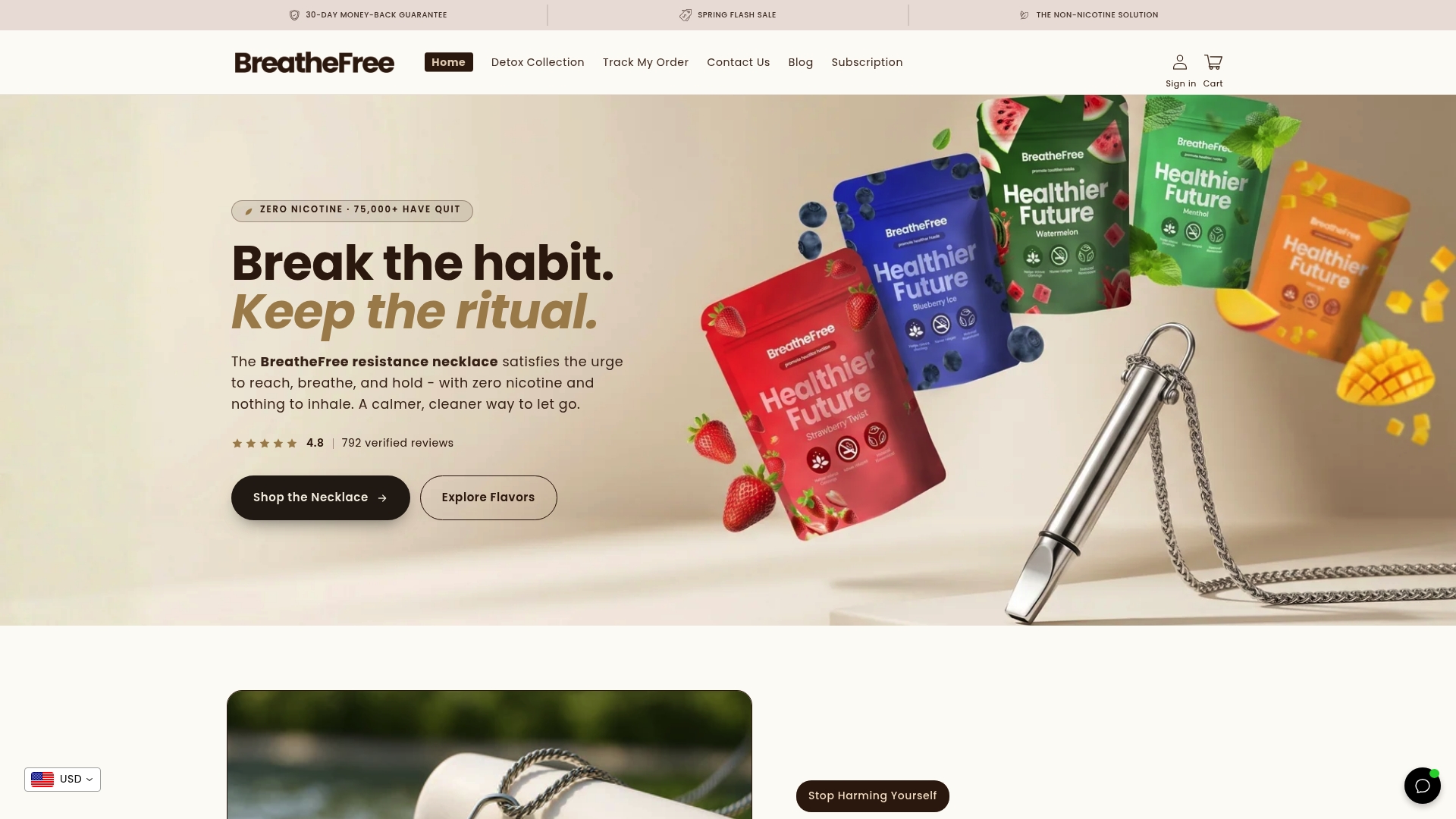
The Breathefree Resistance Necklace is not a patch, a pill, or a replacement habit. It is a physical anchor for the goal you have already set, something to reach for when the craving hits and the goal feels abstract. Pair it with a quitting smoking action plan and you have both the structure and the tool working together. Breathefree also offers a Nicotine Detox eBook and Habit Tracker that walks you through goal-setting, tracks your progress, and keeps the motivation visible day by day. If you are ready to move from intention to action, the Breathefree Resistance Necklace is where to start.
Key Takeaways
Effective goal-setting is the most reliable driver of successful quitting, and the quality of how you set that goal predicts whether you will actually attempt it.
| Point | Details |
|---|---|
| Goal quality predicts quit attempts | Higher quality goal-setting is associated with a nearly three-fold increase in the likelihood of initiating a quit attempt (OR = 2.60). |
| Proximal quit dates outperform distant ones | Setting a quit date shortly ahead prevents habit reinforcement during the waiting period. |
| One goal at a time | Focusing on a single primary quit goal maximizes self-control and avoids cognitive depletion from conflicting priorities. |
| Self-efficacy and goals reinforce each other | Higher self-efficacy leads to more challenging goals, and achieving those goals raises self-efficacy further. |
| Breathefree anchors the goal physically | The Breathefree Resistance Necklace provides a nicotine-free physical cue that reinforces goal commitment during withdrawal. |