

Attach a tiny replacement behavior to something you already do every day, and pair it with a nicotine-free physical aid like the Breathefree resistance necklace. That single structural change, grounded in the Premack principle and the behavioral science of implementation intentions, gives your brain a new cue-routine-reward loop to follow instead of reaching for a cigarette. Research on habit formation suggests the median time to automaticity is about 66 days, though it can vary, which means consistency matters far more than willpower.
TL;DR:
- Pick a reliable daily anchor (morning coffee, brushing teeth, finishing lunch).
- Add a replacement action under two minutes (hold the necklace, take five slow breaths).
- Reward yourself immediately, then track it daily.
Table of Contents
- How do you use habit stacking to quit smoking, step by step?
- Why does habit stacking actually work for smoking cessation?
- How does the Breathefree resistance necklace fit into a habit stack?
- Copy-and-paste habit stacks for your most common smoking triggers
- How do you track progress and fix stacks that stop working?
- When habit stacking alone is not enough
- Key Takeaways
- The Breathefree method gives your habit stacks a physical foundation
- Useful sources and further reading
How do you use habit stacking to quit smoking, step by step?
The five steps below turn the general idea into a plan you can start before your next craving hits.
Step 1: Find your anchor. An anchor is a behavior you already do without thinking. High-frequency routines like toothbrushing or pouring your morning coffee work best because they fire almost every day, at roughly the same time, in the same context. About 40% of daily behaviors are habitual, and personal-hygiene actions can run as high as ~80% habitual, so morning routines give you the most reliable trigger.
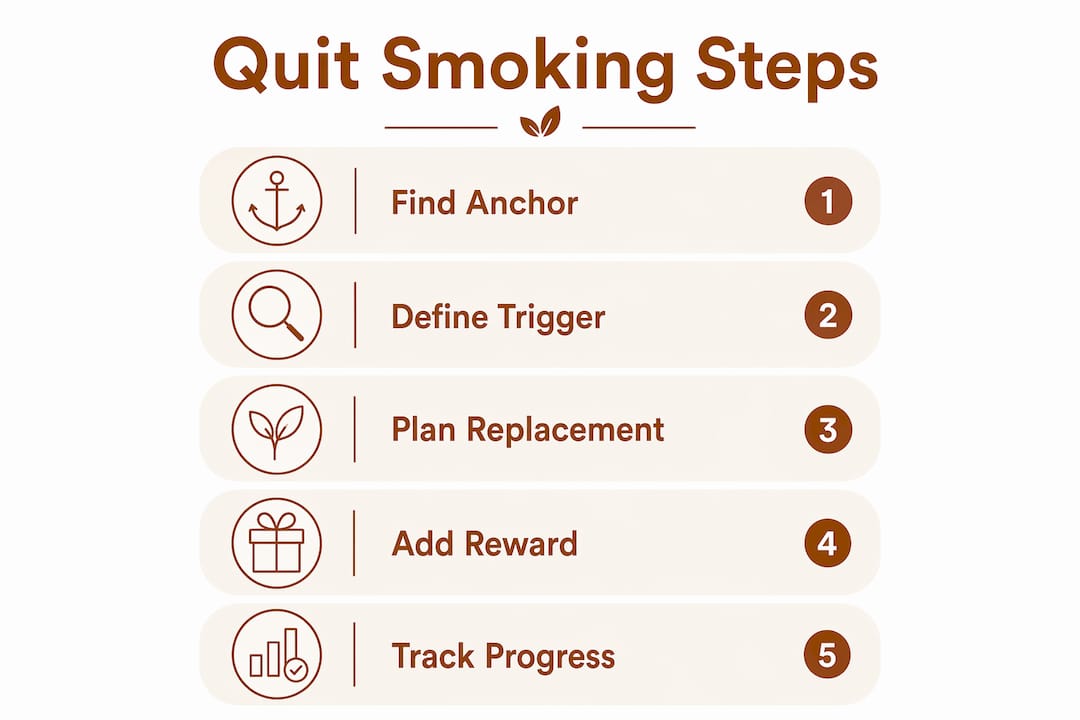
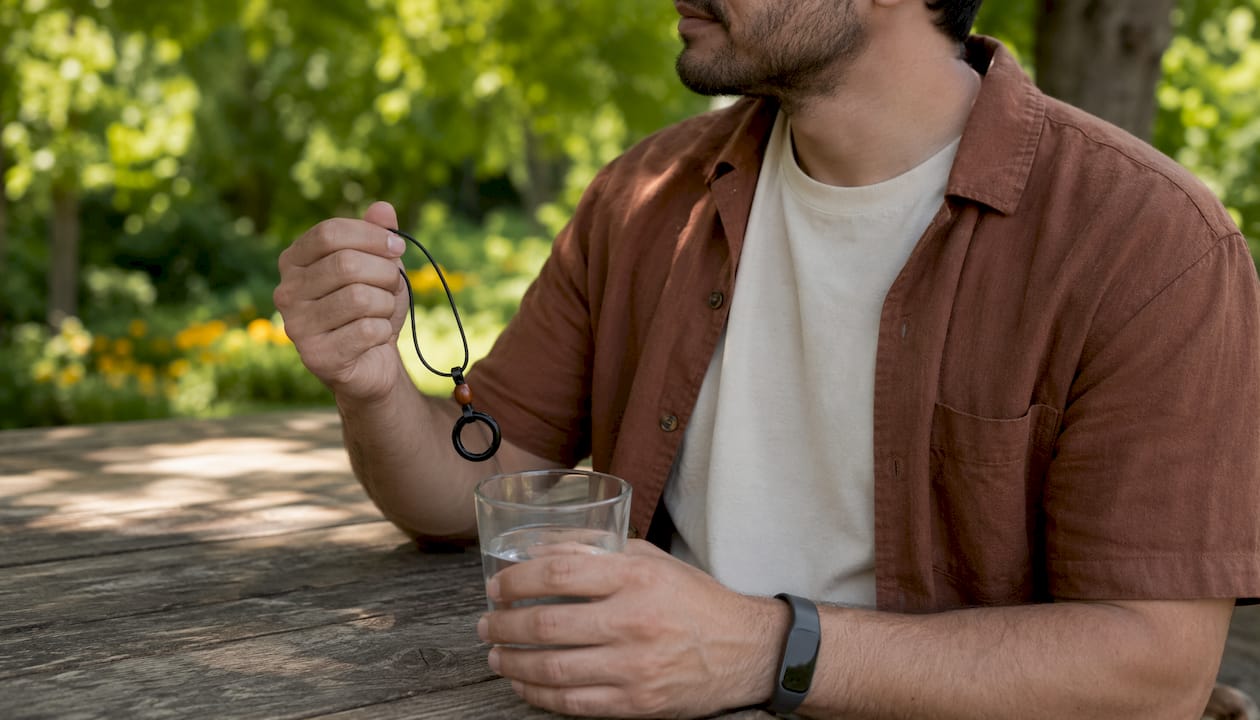
Step 2: Define a tiny replacement. The replacement must take under two minutes at first. Options that address oral fixation or stress: hold and breathe through your Breathefree resistance necklace, chew a piece of sugar-free gum, take five counted breaths, or squeeze a stress ball. Keep it so small that skipping it feels almost embarrassing.
Step 3: Write the implementation intention. Use the formula: “After I [anchor], I will [replacement].” Six ready-to-use scripts:
- “After I pour my morning coffee, I will hold my Breathefree necklace and take five slow breaths.”
- “After I brush my teeth at night, I will do one minute of deep breathing.”
- “After I sit down at my desk, I will chew a piece of sugar-free gum.”
- “After I finish lunch, I will step outside and take a short walk.”
- “After I start the car, I will fasten my necklace and breathe through it for two minutes.”
- “After I feel a stress spike at work, I will squeeze a stress ball for 60 seconds.”
Precise “after/when” phrasing can double or triple follow-through compared with vague intentions like “I’ll try to smoke less.”
Step 4: Add an immediate reward. The Premack principle says the brain needs the new routine to feel at least as satisfying as the old one. Pair the replacement with something you genuinely enjoy: a sip of your favorite tea, a short song, a piece of dark chocolate. The reward does not need to be elaborate; it needs to be immediate.
Step 5: Track daily and protect your streak. A simple binary tracker is enough.
| Day | Anchor fired? | Replacement done? | Notes |
|---|---|---|---|
| Mon | ✓ | ✓ | Felt strong urge at 3 PM |
| Tue | ✓ | ✓ | |
| Wed | ✓ | ✗ | Skipped — add reward next time |
Pro Tip: Start with one stack only. Adding a second before the first feels automatic (roughly 6–12 weeks in) is the fastest way to abandon both.
Why does habit stacking actually work for smoking cessation?
Smoking is not just a nicotine habit. It is a cue-routine-reward loop: a trigger fires, the cigarette is the routine, and relief or pleasure is the reward. Habit stacking works by keeping the cue and the reward intact while swapping in a new routine, which is far easier neurologically than trying to eliminate the loop entirely.
Two behavioral mechanisms do the heavy lifting. First, implementation intentions (the “after X, I will Y” formula) reduce decision fatigue by pre-loading the response. Second, the Premack principle ensures the replacement feels worth doing: pairing a new habit with an immediate reward strengthens follow-through because the brain gets its dopamine hit from the new routine instead of the cigarette.
Structured, consistent behavioral plans show a dose–response effect for cessation success: the more systematically a plan is followed, the better the long-term quit odds. (NCBI behavioral therapy resource)
Habit formation can take between 18 and 254 days depending on the person and complexity, with an average around 66 days. That spread matters for setting expectations: a missed day at week three does not reset the clock.
How does the Breathefree resistance necklace fit into a habit stack?
A nicotine-free physical aid solves a specific problem: the hand-to-mouth ritual. When you quit smoking, the craving is often as much about what to do with your hands and mouth as it is about nicotine. A resistance necklace gives you a wearable, tactile object that satisfies that sensory need without any substance.
Here is what makes it work inside a stack:
- Oral fixation substitute: Breathing through the necklace mimics the draw of a cigarette without inhalation or nicotine.
- Hand occupation: Holding and fastening it gives your hands a job during the craving window.
- Discreet and portable: It works at a desk, in a car, or in a social setting without drawing attention.
- No nicotine, no inhalation: It addresses the behavioral side of the habit, not the chemical dependency. For readers exploring why substitutes matter, the hand-to-mouth craving is often the last to fade.
Breathefree pairs the necklace with a habit-tracking system and community support. Over 75,000 users have used the Breathefree method, which positions it as one of the more tested nicotine-free physical approaches available.
“The replacement behavior has to feel satisfying in the moment, not just virtuous in theory. A physical object that occupies both the hands and the breath gives the brain something real to latch onto.” — Behavioral science rationale behind oral-fixation substitution
Where to insert the necklace into your stacks: after your morning coffee, during work breaks, while driving, and in any social situation where you would normally step outside to smoke. The Breathefree blog has additional guidance on building replacement rituals around the necklace.
Copy-and-paste habit stacks for your most common smoking triggers
Each stack below follows the same structure: anchor → replacement → reward → expansion note.
- Morning coffee: After I pour my coffee, I will hold my Breathefree necklace and breathe through it for two minutes. Reward: first sip of coffee. Expand at week 6: add a five-minute walk.
- After meals: After I finish eating, I will chew sugar-free gum for three minutes. Reward: a piece of dark chocolate. Expand: add a short breathing exercise.
- Work stress spike: When I feel tension rising at my desk, I will squeeze a stress ball for 60 seconds. Reward: a two-minute break from the screen.
- Driving: After I start the car, I will fasten my necklace and breathe through it until I reach the first stoplight. Reward: favorite playlist.
- Social situations: Before joining a group outside, I will hold my necklace in my pocket and take three slow breaths. Reward: a sparkling water or favorite drink.
- Waking up: After my alarm goes off, I will take five deep breaths before getting out of bed. Reward: five minutes of a podcast I enjoy.
- Pre-sleep routine: After I brush my teeth at night, I will do one minute of slow breathing with the necklace. Reward: reading for ten minutes.
- Mid-afternoon slump: After the 3 PM clock chime, I will stand up and take a two-minute walk. Reward: a piece of fruit or a cold drink.
- After a phone call: After I hang up, I will take three counted breaths before moving to the next task. Reward: a short stretch.
- Weekend downtime: After I sit on the couch in the evening, I will hold the necklace and listen to one song. Reward: the show I was already planning to watch.
For building a smoke-free daily routine, start with stacks 1 and 4, which cover the two highest-frequency triggers for most people.
How do you track progress and fix stacks that stop working?
Consistent daily tracking beats willpower every time. A simple check-in takes 30 seconds and gives you data to diagnose problems instead of guessing.
| Week | Typical expectation | Watch for |
|---|---|---|
| 1–2 | Stacks feel effortful; some misses | Wrong anchor or reward too small |
| 3–4 | Anchor fires reliably; replacement still requires effort | Stress spikes disrupting stacks |
| 5–8 | Replacement starts feeling automatic | Urge to over-stack too early |
| 9–12 | Ready to add a second stack | Complacency; drop the tracker |
Common failure modes and fixes:
- Wrong anchor: If the anchor does not fire daily, swap it for something more consistent, like toothbrushing or a morning alarm.
- Replacement not satisfying: The reward is too delayed or too small. Make it immediate and genuinely enjoyable.
- Over-stacking: Stick to one or two habits for several months before adding more. Trying to replace every smoking trigger at once is the most common reason stacks collapse.
- Stress spike: Have a pre-planned “emergency stack” for high-stress moments: one specific anchor (phone rings, meeting ends) and one specific action (necklace + three breaths).
- Streak broken: A single missed day is not a failure. Resume the next morning without penalty. Visual streak trackers and an accountability partner both help protect consistency.
When habit stacking alone is not enough
Habit stacking plus a nicotine-free physical aid helps many people reduce and quit smoking, but it is not a substitute for medical treatment when dependence is heavy.
- Consult a clinician if you experience severe withdrawal symptoms (intense anxiety, insomnia, significant mood disruption).
- Seek medical advice if you are pregnant, managing another substance use issue, or have a cardiovascular or respiratory condition.
- The CDC’s quit-smoking resources and the free quitline at 1-800-QUIT-NOW connect you with behavioral coaches at no cost.
- Combining habit stacks with professional behavioral counseling produces better long-term outcomes than either approach alone.
Pro Tip: If cravings feel unmanageable after four weeks of consistent stacking, that is a signal to add a clinical layer, not to abandon the behavioral plan. The two approaches work together.
Timelines vary widely: habit formation research puts the range at 18–254 days, with an average of 66 days. Slip-ups are normal and expected. Success is measured by consistent reductions and regained control, not perfect abstinence from day one. Over-the-counter support options are also worth exploring; mybestpharmacy.net has a useful overview of OTC quitting aids that can complement a behavioral plan.
Key Takeaways
Using habit stacking to quit smoking works best when you anchor a tiny, satisfying replacement behavior to a reliable daily cue and track it every day until it becomes automatic.
| Point | Details |
|---|---|
| Start with one anchor | Pick a near-daily cue (morning coffee, toothbrushing) and attach one replacement under two minutes. |
| Reward immediately | Apply the Premack principle: pair the replacement with something enjoyable right away to build the new loop. |
| Track daily | A binary daily check-in beats willpower; protect streaks and diagnose failures early. |
| Timelines are long | Habit formation averages about 66 days and can run 18–254 days; slip-ups are normal, not resets. |
| Breathefree necklace | The Breathefree resistance necklace provides a nicotine-free, hand-to-mouth substitute that integrates directly into each stack. |
What habit stacking taught me about quitting that most advice misses
Most quit-smoking advice focuses on what to stop doing. Habit stacking flips that entirely, and the difference in how it feels is significant. You are not white-knuckling through a craving; you are executing a plan you already wrote down. The anchor fires, you do the thing, you get the reward. The cigarette becomes the option that requires more effort, not less.
The piece most people underestimate is the physical substitute. Deep breathing alone is abstract. Holding something, breathing through something, occupying your hands with something specific, that is what makes the replacement feel real in the moment a craving peaks. The behavioral science backs this up, and it is why a tool like the Breathefree resistance necklace fits the method so naturally. It is not a gimmick; it is a physical anchor for a behavioral plan.
The Breathefree method gives your habit stacks a physical foundation
Breathefree’s resistance necklace is the nicotine-free, non-inhalation tool built for exactly the replacement behaviors described in this plan. You wear it, hold it, and breathe through it at the moment a craving fires, which gives the habit stack a concrete, satisfying action instead of an abstract instruction.
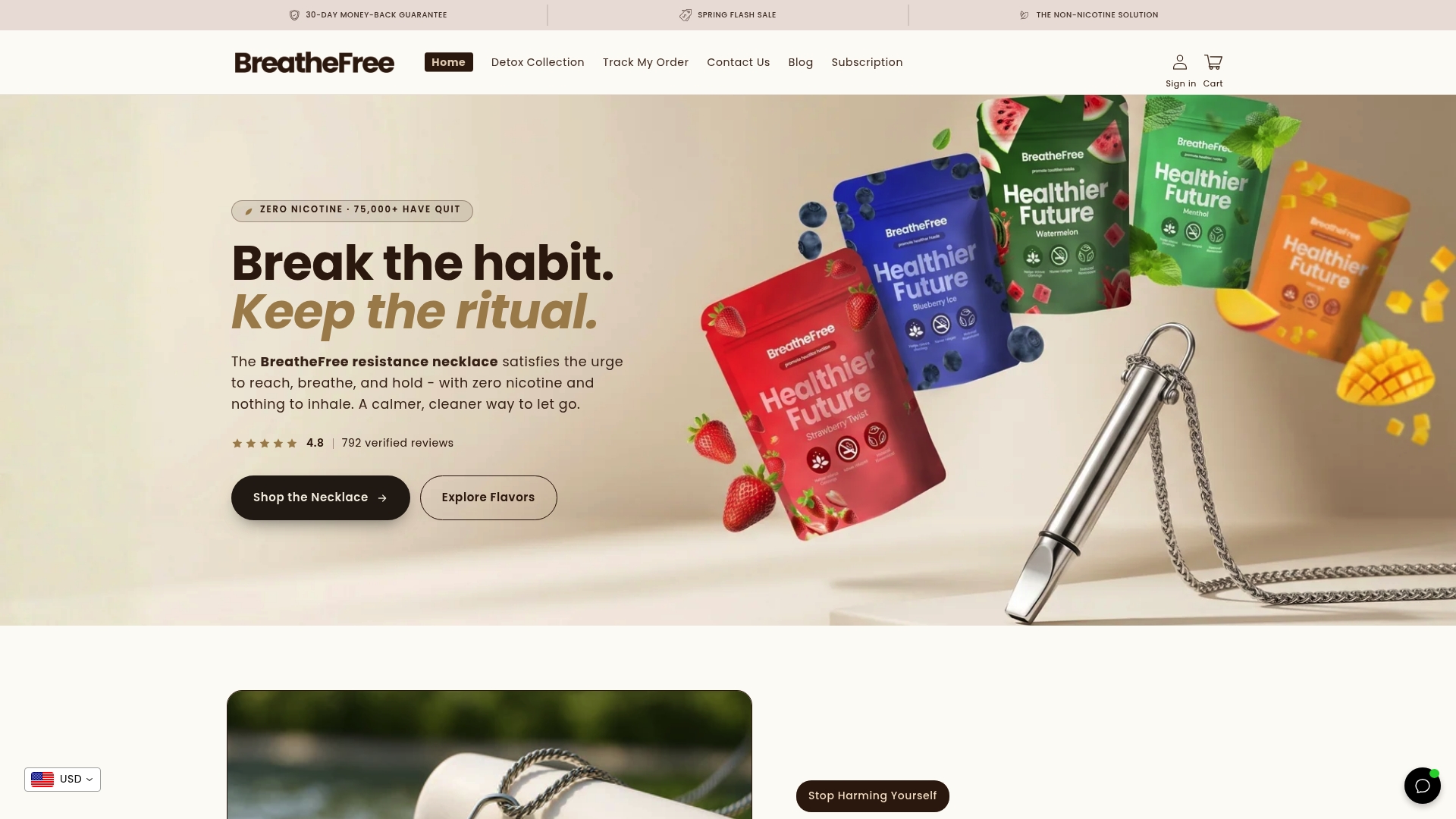
The Nicotine Detox eBook & Habit Tracker pairs with the necklace to give you the tracking template, the step-by-step plan, and the community layer that makes stacks stick. More than 75,000 people have used the Breathefree method to quit without nicotine or inhalation. The eBook maps directly to the five-step plan above, and the habit tracker handles the daily check-in so you are not improvising.
If you are ready to build your first stack today, start with the necklace and the tracker. The plan is already written; you just need the tools to run it.
Useful sources and further reading
- CDC: How to Quit Smoking — overview of counseling, medications, and quitline resources
- Cleveland Clinic: What Is Habit Stacking? — Premack principle and anchor selection
- Good Housekeeping: Habit Stacking How-To — practical guidance on pacing and anchor choice
- NCBI: Behavioral Therapy for Tobacco Cessation — dose–response evidence for structured behavioral plans
- QuitNic: How to Break the Habit Loop — implementation-intention scripts and habit-loop framing
- 10000Hours Blog: Habit Stacking Science — 66-day median and the two-minute rule
- American Heart Association: Habit Stacking for Success — real-world habit-stacking examples
This article is general information, not medical advice. If you are experiencing severe withdrawal or have a health condition, consult a qualified healthcare provider or call 1-800-QUIT-NOW before relying on behavioral methods alone.