

Create a short, escalating milestone schedule that pairs quickly-delivered rewards with visible tracking — that’s the core of any reward system that actually sticks. The research backs it up: incentives improve quit rates at longer-term follow-up, and the effects often persist even after the rewards stop.
Your system needs five things to work:
- Clear milestones (24 hours, 1 week, 1 month, 3 months, 6 months, 12 months)
- Matched rewards (small and immediate for early wins; larger and experiential for long-term ones)
- Verification (a photo, a receipt, or a trusted accountability partner who confirms the milestone)
- Visible tracking (a calendar, a savings jar, or a habit-tracker app you check daily)
- Reset rules (agreed in advance, compassionate, and written down before you need them)
Three things you can do in the next 24 hours: pick your quit date and write it somewhere physical; choose your first three milestones (24 hours, 1 week, 1 month); and set up a savings jar or a paper calendar you’ll mark each smoke-free day.
Pro Tip: Front-load your reward schedule. Give yourself something small and immediate at 24 hours — a favorite meal, a new playlist, anything that feels like a treat. Early wins build the neural groove that makes later milestones feel achievable, not distant.
Key Takeaways
A reward system for quitting milestones works when it pairs verified, escalating rewards with visible daily tracking and a compassionate, pre-agreed reset policy.
| Point | Details |
|---|---|
| Start with six core milestones | Use 24 hours, 1 week, 1 month, 3 months, 6 months, and 12 months as your baseline schedule. |
| Match reward size to milestone | Small, immediate rewards for early milestones; larger, experiential rewards for 6 and 12 months. |
| Make progress visible | A savings jar, paper calendar, or habit-tracker app turns abstract progress into tangible proof. |
| Set reset rules in advance | Agree before your quit date: a slip triggers a partial reset; a full relapse restarts the short-term schedule. |
| Breathefree fits the system | The Breathefree resistance necklace and habit-tracker ebook work as both daily coping tools and milestone rewards. |
Table of Contents
- Why do milestone rewards actually help you quit?
- How do you pick the right quitting milestones?
- How do you match the right reward to each milestone?
- Ready-to-use reward system templates
- What are the best ways to track your progress visibly?
- How should you handle slips and resets?
- Safety, ethics, and special-population notes
- How does a Breathefree necklace fit into your reward system?
- Breathefree supports your quit milestones
- Sources
Why do milestone rewards actually help you quit?
Rewards work because quitting is a behavior, and behaviors respond to consequences. That’s operant conditioning in plain English: when a positive outcome follows a difficult action quickly, the brain encodes that action as worth repeating. The problem with quitting is that the biggest reward (better health, more money, longer life) arrives years later. Milestone rewards solve that by manufacturing an immediate payoff.
Contingency management takes this further. It’s a structured clinical approach where verified abstinence triggers a guaranteed reward, usually financial. Decades of trials show it works across substances, not just tobacco. The key word is verified — rewards tied to confirmed behavior change outperform vague self-promises every time.
Delay discounting explains why. Humans systematically undervalue future rewards compared to present ones. A $500 health benefit five years from now feels abstract. A $20 gift card today feels real. Building a reward system means deliberately engineering present-tense wins to compete with present-tense cravings.
Incentives improve smoking cessation rates at six months or longer, and the effects can continue after the incentives end — high-certainty evidence from a Cochrane systematic review covering mixed-population studies.
A meta-analysis of 31 randomized trials found a pooled risk ratio of 1.49 (95% CI 1.28 to 1.73) for quitting with incentives at longest follow-up.
The evidence is strongest for structured, verified schedules. It’s also particularly robust for specific populations: pregnant people, workplace programs, and socioeconomically disadvantaged adults. A large randomized workplace trial published in the NEJM found that financial incentives and redeemable deposit contracts substantially increased sustained abstinence compared to usual care.
Pro Tip: Don’t wait until you feel motivated to set up your reward system. Build it before your quit date, the same way you’d set up a gym bag the night before a morning workout. The structure creates the motivation, not the other way around.
For a deeper look at the behavioral support mechanisms behind quitting, Breathefree’s guide on why ex-smokers need behavioral support covers the science in practical terms.
How do you pick the right quitting milestones?
The standard milestone set works for most people: 24 hours, 1 week, 1 month, 3 months, 6 months, 12 months. UCSF’s Smoking Cessation Leadership Center recommends planning rewards specifically for the 24-hour, one-week, and one-month marks — the periods when withdrawal is sharpest and relapse risk is highest.
Each milestone corresponds to a real physiological or behavioral shift:
- 24 hours: Carbon monoxide clears your blood. Nicotine withdrawal peaks. This is the hardest single day.
- 1 week: The acute physical withdrawal window closes for most people. Cravings shift from physical to psychological.
- 1 month: Habit loops start to weaken. The automatic reach for a cigarette begins to fade.
- 3 months: Lung function measurably improves. Social triggers (bars, stress, coffee) are the main remaining risk.
- 6 months: Most people who reach this point stay quit. Relapse risk drops significantly.
- 12 months: One full year of habit-replacement. Celebrate big.
For vaping cessation, the same timeline applies, though the 1-week and 1-month milestones often feel harder because vaping’s higher nicotine delivery creates steeper withdrawal. For alcohol, the 90-day mark carries extra clinical weight — many recovery programs treat it as the first major stability point. If you’re quitting multiple substances simultaneously, space your milestones more tightly in the first month and reward each substance separately.
Here’s a compact template you can adapt:
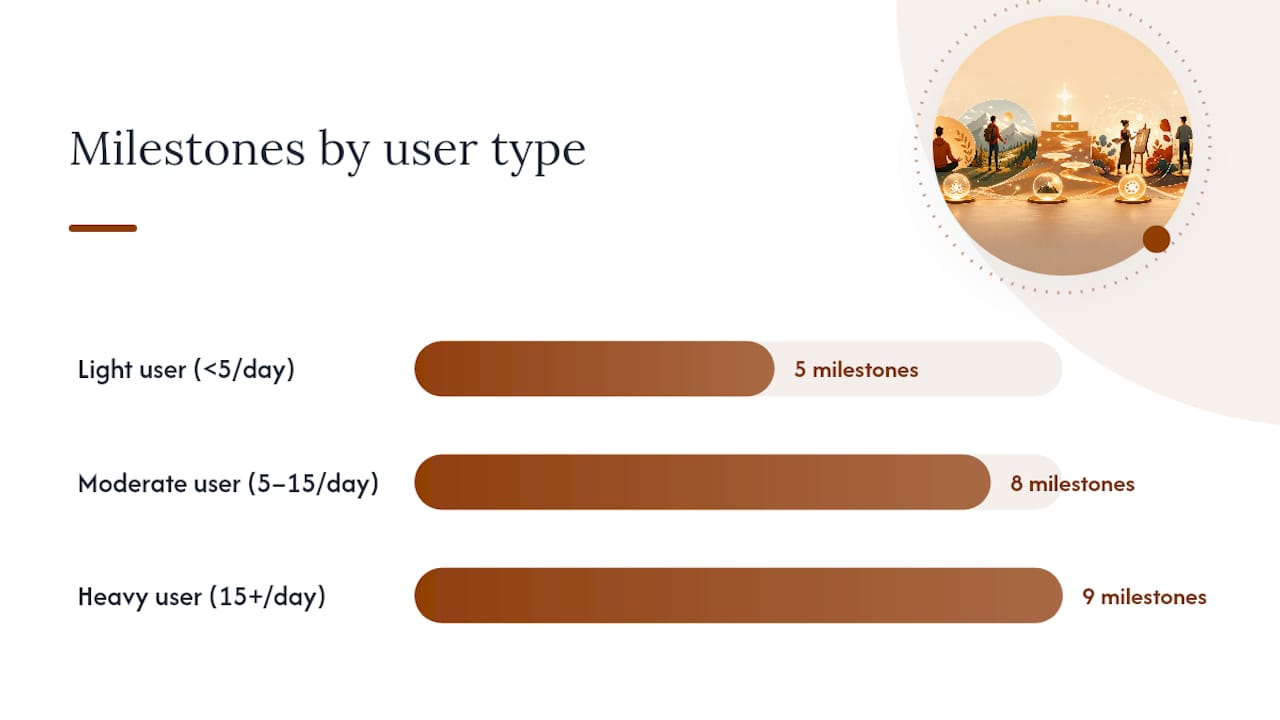
- Light user (under 5 cigarettes/day): 24 hours, 1 week, 1 month, 6 months, 12 months
- Moderate user (5–15/day): 24 hours, 3 days, 1 week, 2 weeks, 1 month, 3 months, 6 months, 12 months
- Heavy user (15+/day): 24 hours, 48 hours, 3 days, 1 week, 2 weeks, 1 month, 3 months, 6 months, 12 months
Adjust milestones if any of these apply:
- You’re pregnant (tighter early milestones; consult your OB for reward guidance)
- You’re on cessation medication like varenicline (align milestones with your prescription schedule)
- You’re quitting two substances at once (add substance-specific milestones rather than combining them)
- You’ve had multiple previous quit attempts (add a “longest streak ever” milestone to mark new personal records)
How do you match the right reward to each milestone?
The rule of thumb: small, immediate, non-triggering rewards for short milestones; larger, experiential rewards for long ones. A $5 treat at 24 hours is more motivating than a $100 promise at 6 months, because the brain responds to proximity. Scale up as the milestones grow.
Reward categories with examples:
- Monetary: Gift cards (restaurants, bookstores, streaming services), a dedicated savings account where you deposit what you would have spent on cigarettes, or a “quit fund” envelope you fill weekly
- Experiential: A day trip, a spa visit, a cooking class, concert tickets, a weekend away at 12 months
- Symbolic: Milestone jewelry (a bracelet or charm added at each stage), a framed photo from your quit date, a custom journal
- Social: A celebratory dinner with people who supported you, a public post marking your milestone, a group activity you’ve been putting off
- Health-focused: A new workout class, a massage, a dental cleaning (your teeth will thank you), a new piece of athletic gear
Some rewards actively undermine recovery. Avoid anything alcohol-related (a “celebratory drink” is a relapse risk for many people), anything that mimics the smoking ritual without replacing it healthily, and anything that creates a new dependency. A vape pen is not a quit reward.
Personalization matters more than dollar amounts. Research on quit coaching consistently shows that experimenting with small rewards first and scaling to what actually motivates you outperforms any standardized reward schedule. If you hate spa days, don’t use them as rewards. If you love live music, build your 6-month milestone around a concert.
Pro Tip: Pair an extrinsic reward (a gift card, a treat) with an intrinsic ritual (a gratitude note, five minutes of reflection on why you quit). The intrinsic piece builds identity — “I’m someone who doesn’t smoke” — which is what sustains quitting after the external rewards stop.
For ideas on replacing the smoking ritual with healthier habits, Breathefree’s guide covers practical substitutions that pair well with reward planning.
Ready-to-use reward system templates
The right template depends on your situation. A solo quitter on a tight budget needs something different from someone with an employer-sponsored program or a group of friends quitting together.
Savings jar setup:
- Label a jar “Quit Fund” and place it somewhere visible.
- Each day you don’t smoke, deposit the amount you would have spent on cigarettes.
- At each milestone, count the jar and spend a portion on a planned reward.
- Leave the rest to accumulate toward a larger milestone reward.
Escalating gift-card schedule:
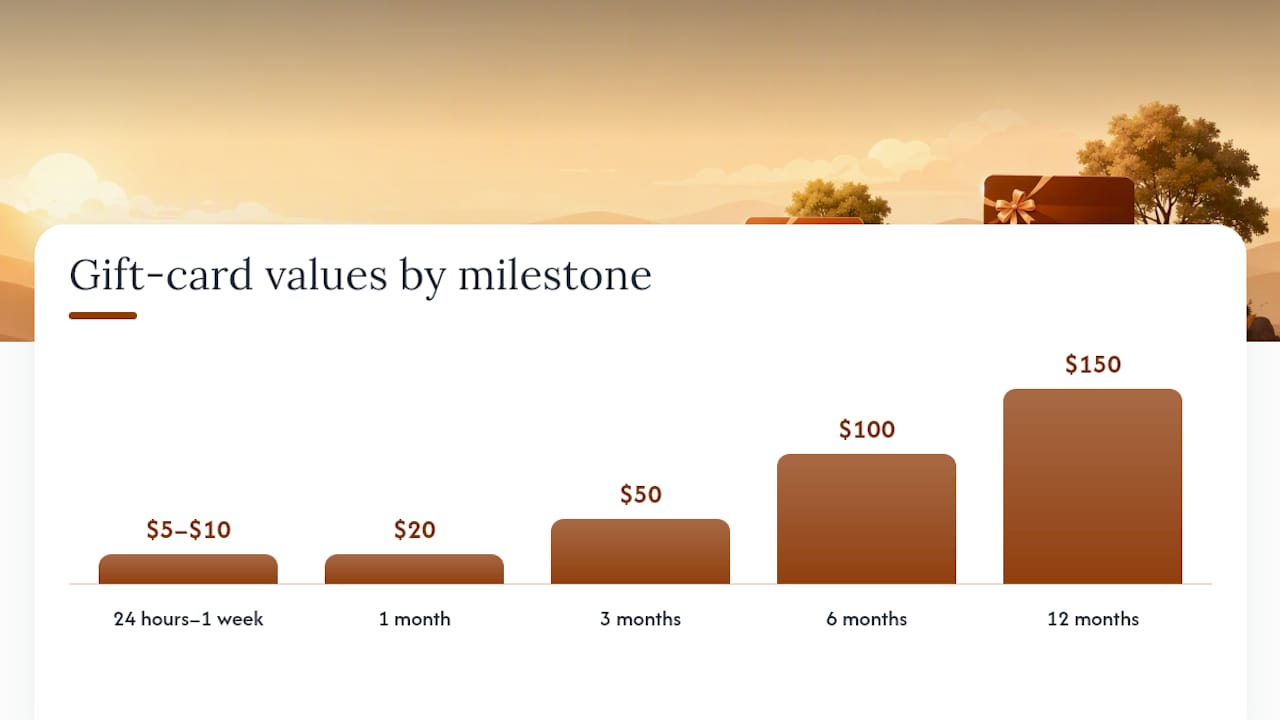
- Choose gift-card values for each milestone: $5 at 24 hours, $10 at 1 week, $20 at 1 month, $50 at 3 months, $100 at 6 months, $150 at 12 months.
- Buy the first card in advance and give it to an accountability partner to hold.
- Verify the milestone (a photo, a check-in call), then receive the card within 24 hours.
- If you slip, the next milestone resets to the previous tier’s value.
Deposit contract:
- Deposit $50–$150 into a separate account or give it to a trusted person.
- Agree on verified milestones and what constitutes a slip vs. a full relapse.
- Earn back portions of the deposit at each milestone.
- A slip forfeits a portion; a full relapse forfeits the remainder. The NEJM workplace trial showed deposit contracts increased sustained abstinence compared to usual care, though acceptability varies — only use this if loss-framing motivates rather than demoralizes you.
Experience ladder:
- List five experiences you’ve been wanting (a day trip, a concert, a cooking class, a weekend away, a major trip).
- Assign one to each milestone from 1 month through 12 months.
- Book the experience as soon as you hit the milestone — don’t wait.
- If you slip before a planned experience, delay it by two weeks rather than canceling it.
A JAMA Network Open trial found that small, frequent incentives during the first 12 weeks increased engagement and short-term abstinence, especially among people with fewer resources. That supports the savings-jar and escalating-schedule approaches for early milestones.
Pro Tip: Deliver rewards within 24 hours of hitting a milestone. The closer the reward is to the verified behavior, the stronger the reinforcement. A gift card that arrives three weeks late teaches your brain almost nothing.
For heavier users who need more structure, Breathefree’s 12-week quit plan for heavy smokers pairs well with the escalating schedule template.
What are the best ways to track your progress visibly?
A primary visual tracker plus a backup verification method is the combination that works. The visual tracker keeps you motivated daily; the backup keeps you honest.
Visual, accumulating rewards transform abstract progress into tangible proof and reduce delay discounting — you can see the streak, the jar filling, the charm added to the bracelet. That visibility is an early deterrent to relapse in a way that a mental note never is.
Five accessible options:
- Paper calendar: Mark each smoke-free day with a bold X. The chain of X’s becomes its own reward — you won’t want to break it. Hang it somewhere you see every morning.
- Habit-tracker app: Apps like Streaks or Habitica let you log daily smoke-free status, set milestone reminders, and share progress with an accountability partner.
- Savings jar: Already covered in templates, but worth repeating here as a tracking tool. Watching money accumulate is viscerally motivating in a way a spreadsheet isn’t.
- Milestone jewelry: Add a charm, a bead, or a new piece at each milestone. Breathefree’s guide on using physical objects to quit smoking covers how tangible cues reinforce the quit identity.
- Habit-tracker spreadsheet: A simple Google Sheet with dates, smoke-free status, and a running savings total. Share it with one person for accountability.
Social sharing amplifies all of these. Posting a milestone publicly (even to a small group) adds social accountability and often generates encouragement that reinforces the behavior. You don’t need a large audience — one person who checks in on you is enough.
How should you handle slips and resets?
Agree on your reset policy before you need it. A slip is not a failure; it’s data. The reset rule you set in advance is what determines whether a slip becomes a learning checkpoint or a full relapse.
Recommended approach: small setback (one or two cigarettes) triggers a partial reset; full relapse (return to daily smoking) triggers a restart of the short-term milestone schedule. Keep the compassion built in — the goal is to get back on track, not to punish yourself into quitting.
Loss-framing through deposit contracts can increase motivation for some people, but it’s not for everyone. The NEJM workplace trial showed deposits increased sustained abstinence, but acceptability varied. If the idea of losing money makes you anxious rather than motivated, skip the deposit contract and use an escalating schedule instead.
Here’s a simple decision flow for when a slip happens:
- Acknowledge it without shame. One cigarette does not erase your progress.
- Identify the trigger. Stress? Social situation? Boredom? Write it down.
- Decide: partial reset or full restart? One or two cigarettes in a moment of weakness = partial reset (return to the previous milestone tier). Return to daily smoking = full restart from the 24-hour milestone.
- Tell your accountability partner the same day. Don’t wait. The longer you wait, the harder it gets.
- Adjust the reward schedule if needed. If the same trigger keeps causing slips, add a milestone specifically for navigating that trigger successfully.
Pro Tip: Use slips as a scheduled check-in prompt. When a slip happens, call or text your accountability partner and frame it as a debrief: “Here’s what happened, here’s what I’ll do differently.” That reframe converts shame into strategy, which is what actually prevents the next slip.
For more coping strategies around cravings and relapse prevention, Breathefree’s ex-smoker coping mechanisms guide covers the full toolkit.
Safety, ethics, and special-population notes
Four rules that apply to every reward system, no exceptions:
- No substance-related rewards. Alcohol, cannabis, or anything that mimics the substance you’re quitting is not a reward — it’s a risk.
- Pregnant people should consult their OB or midwife before using financial incentive structures, since some clinical programs have specific guidance for pregnancy-related cessation.
- Anyone with a serious mental-health condition (depression, anxiety disorder, PTSD) should involve a clinician before relying on financial incentives alone. Incentives work best as an adjunct to care, not a replacement for it.
- Employer-run programs must be voluntary, use reasonable verification, and protect participant privacy. Coercive or punitive workplace programs undermine trust and reduce participation.
A reward system that pressures, shames, or creates new dependencies has failed its purpose. The goal is to make quitting feel worth it — not to make failure feel catastrophic.
For employer programs specifically: verification should be simple and non-invasive (self-report plus a witnessed check-in is usually sufficient for lower-stakes programs), participation must be genuinely optional, and rewards must be accessible to all employees regardless of income level.
How does a Breathefree necklace fit into your reward system?
A non-nicotine oral-fixation tool serves two roles in a reward system: a daily coping aid that replaces the smoking ritual, and a meaningful symbolic reward when paired with a milestone. Those aren’t the same thing, and using it for both is where it gets interesting.
The Breathefree resistance necklace is nicotine-free and addresses one of the most underestimated parts of quitting: the oral fixation and the calming ritual of having something to hold and use. Nicotine patches address the chemical dependency; they don’t address the habit of reaching for something. That gap is where most relapses live.
Concrete ways to integrate it into your reward system:
- At the 24-hour milestone: Give yourself a new flavor refill as a small, immediate reward. It’s low-cost, recovery-safe, and reinforces the replacement behavior.
- At the 1-week milestone: Use the necklace itself as the symbolic reward — something you wear that marks your first week.
- As a daily coping tool: Keep it accessible during high-risk moments (after meals, during stress, in social situations where others smoke). It satisfies the oral fixation without nicotine.
- Paired with a savings jar: The money you save from not buying cigarettes funds the necklace and refills. The jar makes the financial benefit visible; the necklace makes the behavioral replacement tangible.
For more on why physical substitutes matter, Breathefree’s piece on why smokers struggle without substitutes explains the oral fixation mechanics in detail.
Pro Tip: Don’t make the necklace your only reward. Pair it with one experiential or savings-based reward at each milestone so your system has variety. A single-product reward schedule gets stale; a layered one stays motivating.
A note on what actually works
Rewards help when they’re structured and recovery-focused. That’s the short version of everything above. The longer version is that most people who fail at quitting don’t fail because they lack willpower — they fail because they have no system. They white-knuckle through the first week, hit a craving at week three, and have nothing in place to catch them.
A reward system is that catch. It doesn’t have to be elaborate. A savings jar, a paper calendar, and one person who checks in on you is enough to start. The research supports it; the templates above make it concrete. What matters most is that you build it before your quit date, not after.
Breathefree supports your quit milestones
The Breathefree Nicotine Detox eBook and Habit Tracker is built to work alongside the templates in this article. It includes a structured habit-tracker you can use to log daily smoke-free status, record milestone rewards, and visualize your progress over time — the same visible-accumulation principle the research supports.
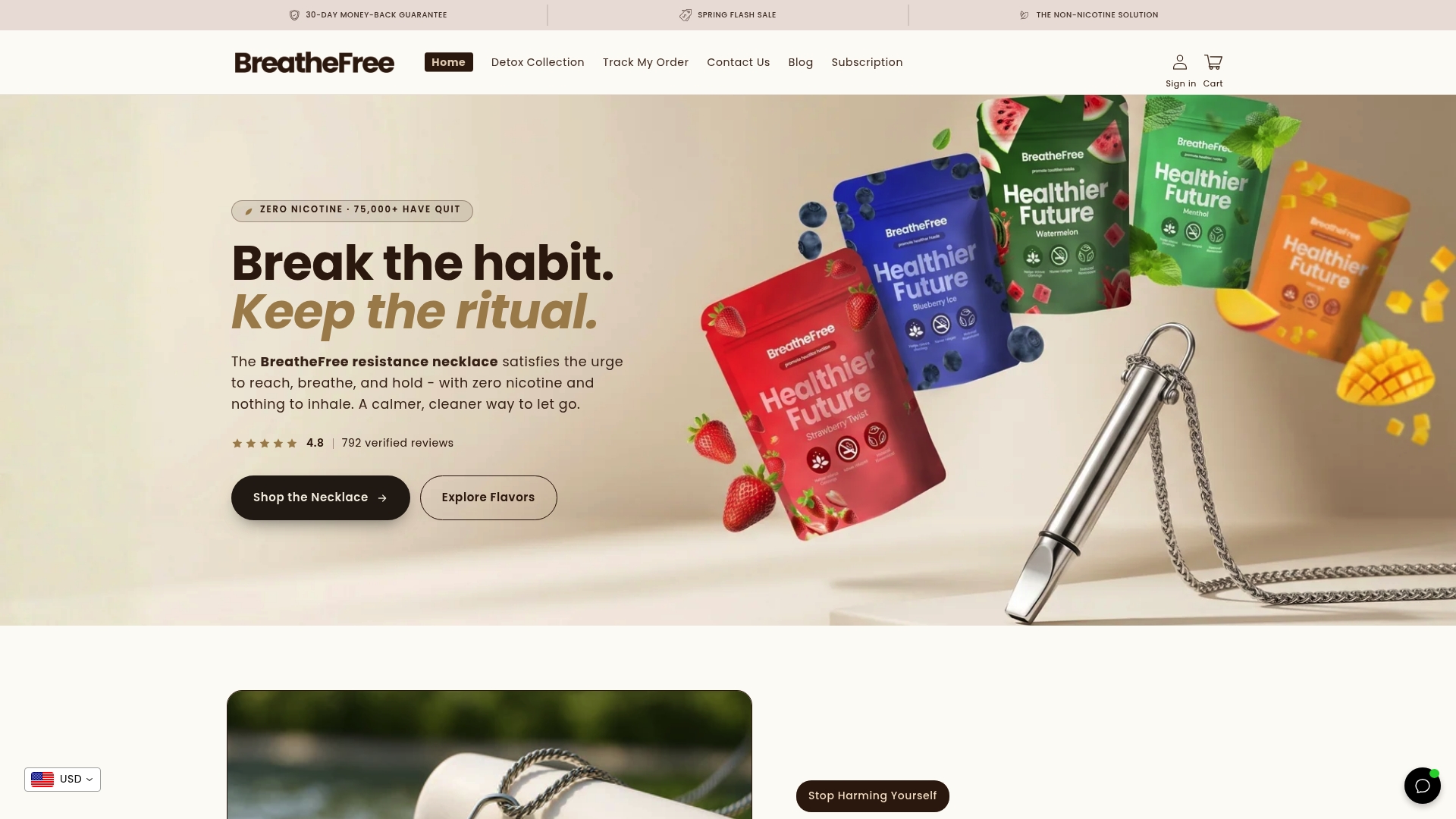
The Breathefree resistance necklace pairs with the tracker as both a daily coping tool and a milestone reward. Use the necklace to replace the smoking ritual; use the tracker to document every day you succeed. Together, they cover the two biggest gaps in most solo quit attempts: the oral fixation that patches don’t address, and the visible progress record that keeps motivation from fading. Pick up the habit tracker and start your milestone schedule today.
Sources
- Can rewards help people quit smoking, and do they work in the long term? | Cochrane
- Incentives for smoking cessation - PMC
- Randomized workplace smoking-cessation trial | NEJM
- Incentives plus usual care randomized trial (JAMA Network Open)
- Set up rewards for quit milestones | UCSF Smoking Cessation Leadership Center
This article is general information, not a substitute for advice from a qualified doctor. Consult a qualified healthcare professional about your own circumstances before acting on anything here.