

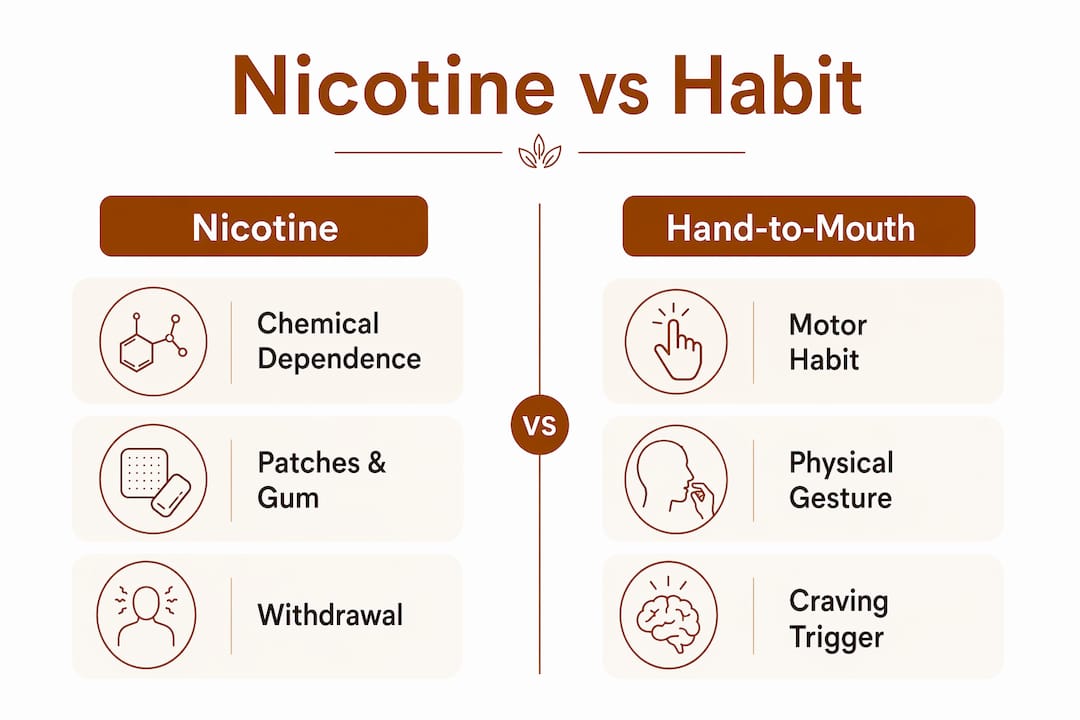
The hand-to-mouth action is a conditioned motor-sensory ritual that reinforces smoking behavior independently of nicotine. Researchers classify this pattern as a form of behavioral dependency, where the physical gesture itself triggers dopamine and serotonin release within seconds. Understanding why smokers need hand-to-mouth action explains why patches and gum alone leave so many people vulnerable to relapse. The brain does not just crave nicotine. It craves the movement, the weight of the cigarette, and the predictable sequence of raising hand to mouth. Public health bodies increasingly recommend behavioral replacement strategies alongside pharmacological therapy for exactly this reason.
Why smokers need hand-to-mouth action: the neurological basis
The hand-to-mouth gesture becomes automatic through a process called habit formation, governed by the basal ganglia. This brain region stores repeated sequences as compressed routines, making them resistant to conscious override. Smoking is maintained not only by nicotine but by conditioned inhalation rituals that act as powerful stimuli reinforcing the habit. That means the gesture itself carries addictive weight, separate from the drug.
The habit loop has three stages: a cue, a routine, and a reward. For smokers, the cue might be finishing a meal, stepping outside, or feeling stressed. The routine is the hand-to-mouth motion. The reward is immediate psychological relief delivered through dopamine and serotonin release within 10–20 seconds. Nicotine itself peaks in the blood after 20 minutes, which means the brain’s fast relief comes from the ritual, not the drug.

Repeated reinforcement converts this conscious choice into a subconscious reflex controlled by basal ganglia circuits. Once that shift happens, the smoker does not decide to reach for a cigarette. The brain simply executes the sequence. This is why willpower alone rarely works.
Key neurological facts about the hand-to-mouth habit:
- The basal ganglia encodes habit loops as muscle memory, making them autonomous.
- Sensory cues like smell, texture, and weight reinforce the loop each time.
- The psychological reward arrives before nicotine enters the bloodstream.
- After nicotine withdrawal fades, the motor-sensory craving often remains.
Pro Tip: Track your three most common smoking cues for one week. Identifying the specific trigger helps you interrupt the loop before the routine fires.
Why nicotine replacement therapies alone often fail
Nicotine patches and gum address chemical dependence effectively. They do not replicate the mechanical hand-to-mouth behavior. That gap matters more than most cessation programs acknowledge.
After physical nicotine withdrawal fades, cravings often reflect the desire for the habitual motor-sensory loop, not nicotine itself. The brain expects a specific physical sequence. When that sequence is absent, the unmet expectation intensifies craving. Smokers who use cessation methods replacing physical routines alongside nicotine management are about twice as likely to quit successfully. That statistic reflects a structural problem with single-method approaches.
Cessation method comparison by approach type:
| Approach | Addresses nicotine | Addresses hand-to-mouth behavior | Relapse risk |
|---|---|---|---|
| Nicotine patch | Yes | No | Higher |
| Nicotine gum | Yes | Partial (oral only) | Moderate |
| Behavioral substitution only | No | Yes | Moderate |
| Combined behavioral and pharmacological | Yes | Yes | Lower |
The table shows a clear pattern. Addressing only one dimension of the habit leaves the other dimension active and capable of driving relapse. Structured interventions integrating cognitive behavioral therapy and sensory substitutes consistently outperform nicotine-only methods.
What patches and gum miss:
- The weight and resistance of holding an object.
- The repetitive arm movement from lap to mouth.
- The oral sensation of something between the lips.
- The social and timing cues tied to the physical act.
Pro Tip: If you use a patch, pair it with a physical substitute that mimics the hand-to-mouth motion. The patch handles chemistry. The substitute handles behavior. You need both.
What triggers the craving for the physical gesture?
The hand-to-mouth behavior does not fire randomly. Specific psychological and environmental cues activate it with near-clockwork reliability. Recognizing these triggers is the first step toward replacing the routine rather than fighting it.
The smoking ritual provides structure, predictability, and emotional regulation, offering smokers a sense of control in chaotic daily life. This is why the gesture spikes during stress, not just during nicotine withdrawal. The ritual is a coping mechanism. It signals to the brain: “This situation is manageable. I have a procedure.”
Common psychological triggers for the hand-to-mouth craving:
- Stress and anxiety. The gesture delivers fast sensory grounding when emotions feel out of control.
- Boredom. The hands seek stimulation. The mouth seeks engagement. Smoking satisfies both simultaneously.
- Habit timing. After meals, during breaks, and while driving are deeply conditioned cue moments.
- Social contexts. Seeing others smoke, smelling cigarette smoke, or being in familiar smoking locations reactivates the loop.
- Emotional transitions. Moving from one task to another often triggers the gesture as a reset ritual.
Oral fixation in smokers also carries a sensory dimension that goes beyond stress relief. The lips, tongue, and fingertips all receive tactile feedback during the smoking ritual. That sensory satisfaction functions as a micro-reward that reinforces the behavior independently of nicotine. Body-focused repetitive behaviors share this sensory reinforcement pattern, as seen in nail biting and hair twirling, which activate similar tactile reward pathways. Understanding this helps explain why smokers often describe the ritual as calming even when they know it is harmful.
Effective strategies for replacing the hand-to-mouth motion
Replacing the hand-to-mouth action requires mimicking the physical ritual, not just distracting from it. Total distraction is less effective because it leaves the habit loop open. The brain expects a routine after a cue. Providing a substitute closes the loop and delivers a reward, which reduces the intensity of the craving.
Successful oral fixation replacements involve mimicry of specific physical rituals, giving a sense of agency and sensory satisfaction. The substitute must provide similar weight, resistance, or oral sensation to satisfy the brain’s reward pathway. Generic distractions like scrolling a phone do not meet that threshold.
Practical substitutes that work:
- Chewable vegetables. Celery and carrots provide oral resistance and repetitive hand-to-mouth motion. They also occupy the hands.
- Toothpicks and cinnamon sticks. These replicate the oral sensation of holding something between the lips.
- Flavored pouches. Nicotine-free oral pouches deliver taste and oral stimulation without inhalation.
- Chewable jewelry or textured objects. These satisfy the tactile and hand-to-mouth components simultaneously.
- Breathefree resistance necklace. Breathefree’s product combines the calming ritual of holding and using a physical object with community support, addressing oral fixation without nicotine or inhalation. Over 75,000 people have reportedly used this method to quit.
The quit smoking using physical objects approach works because it respects the brain’s need for a complete habit loop. Cue fires. Substitute routine executes. Reward arrives. The loop closes without a cigarette.
Substitute comparison by feature:
| Substitute | Hand motion | Oral sensation | Nicotine-free | Portable |
|---|---|---|---|---|
| Celery or carrots | Yes | Yes | Yes | Partial |
| Toothpick | Partial | Yes | Yes | Yes |
| Flavored pouch | No | Yes | Yes | Yes |
| Breathefree necklace | Yes | Yes | Yes | Yes |
Pro Tip: Choose a substitute that matches the specific sensory feature you miss most. If it is the oral sensation, pouches or toothpicks work well. If it is the hand movement, a physical object you can hold and raise to your mouth is more effective.
Key Takeaways
The hand-to-mouth action is a behavioral dependency encoded in the basal ganglia, and replacing it with a sensory-matched substitute is the most reliable way to close the habit loop during cessation.
| Point | Details |
|---|---|
| Behavioral dependency is real | The hand-to-mouth gesture triggers dopamine release independently of nicotine. |
| Patches alone leave a gap | Nicotine therapies address chemistry but not the physical ritual, raising relapse risk. |
| Triggers are predictable | Stress, boredom, meals, and social cues reliably activate the hand-to-mouth craving. |
| Mimicry beats distraction | Substitutes that replicate the gesture’s sensory features close the habit loop more effectively. |
| Combined approaches win | Behavioral substitution paired with pharmacological support produces the best quit outcomes. |
The part of quitting nobody talks about honestly
Most cessation advice focuses on nicotine. Count the milligrams. Taper the dose. Wait out the withdrawal. That framework is not wrong, but it is incomplete in a way that costs people their quit attempts.
What I have observed is that the smokers who relapse after two or three weeks are rarely craving nicotine at that point. They are craving the gesture. They miss having something to do with their hands during a stressful meeting. They miss the ritual of stepping outside and going through a familiar sequence. The chemical dependency is gone. The behavioral one is still running.
The uncomfortable truth is that quitting smoking is not one problem. It is two problems that happen to share a cigarette. Treating them as one is why so many people succeed for a few weeks and then quietly return to the habit. The brain does not forget a loop it has run thousands of times. It waits for the right cue and then fires the routine automatically.
What actually works is treating the behavioral loop with the same seriousness as the chemical one. That means choosing a substitute deliberately, not grabbing whatever is nearby. It means replacing your smoking ritual with something that provides genuine sensory feedback, not just a distraction. And it means being patient with yourself when the craving fires, because the brain is not being irrational. It is doing exactly what it was trained to do.
Cessation is behavioral rewiring. That takes repetition, not just resolve.
— Tommy
A practical tool for managing both sides of the habit
Breaking the hand-to-mouth cycle requires a plan that addresses behavior, not just chemistry. Breathefree’s Nicotine Detox eBook & Habit Tracker is built for exactly that. It explains the psychology behind the hand-to-mouth habit in plain language and walks you through replacement strategies that match your specific triggers and routines.

The habit tracker inside the program helps you build new routines that replace the smoking gesture day by day, so the brain gets the loop it expects without the cigarette. The eBook covers both the nicotine side and the behavioral side, which is the combination that research consistently links to better quit outcomes. If you have tried patches or gum and found yourself still reaching for a cigarette weeks later, this is the missing piece.
FAQ
What is the hand-to-mouth action in smoking?
The hand-to-mouth action is a conditioned motor-sensory ritual where smokers repeatedly raise a cigarette to their lips. The brain encodes this gesture as a habit loop that delivers psychological reward independently of nicotine.
Why do smokers crave the gesture even after nicotine withdrawal?
After physical nicotine withdrawal fades, the basal ganglia continues to fire the stored habit loop in response to familiar cues. The craving reflects the brain’s expectation for the motor-sensory routine, not the drug.
Do nicotine patches address the hand-to-mouth habit?
Nicotine patches deliver the chemical but do not replicate the physical gesture. That gap leaves the behavioral loop active, which is why patches alone produce higher relapse rates than combined approaches.
What is the most effective substitute for the hand-to-mouth motion?
Substitutes that mimic the specific sensory features of the gesture, such as weight, oral resistance, and hand movement, are most effective. Options include toothpicks, chewable vegetables, flavored pouches, and physical objects like the Breathefree resistance necklace.
How long does the hand-to-mouth craving last after quitting?
The craving duration varies by individual and depends on how consistently the habit loop is replaced rather than suppressed. Behavioral substitution shortens the timeline by giving the brain a new routine to encode in place of the old one.