

Nicotine addiction is defined as a compulsive need to use tobacco driven by the brain’s rapid chemical response to nicotine. Understanding why smokers reach for cigarettes requires looking at two forces working together: a neurochemical hook that forms in seconds, and a web of emotional, behavioral, and social patterns that reinforce the habit for years. Nicotine reaches the brain in 10–20 seconds, triggering a dopamine surge that the brain quickly learns to crave again. Approximately 90% of adult smokers started before age 18, which means the habit takes root before the brain’s impulse control is fully developed. That timing matters enormously when trying to understand the grip smoking holds.
Why smokers reach for cigarettes: the neurochemical foundation
The brain’s reward system is the engine behind cigarette cravings. When nicotine enters the bloodstream, it travels to the brain faster than almost any other substance a person can inhale. That speed is not incidental. It is the core reason the addiction forms so quickly and feels so hard to resist.
Dopamine is the brain’s primary reinforcer. When nicotine triggers a dopamine peak, the brain registers the act of smoking as something worth repeating. That signal is powerful enough to override rational thought, especially under stress or fatigue. The brain does not ask whether smoking is healthy. It asks whether smoking felt good last time, and the answer is always yes.
The cycle tightens fast. Withdrawal symptoms begin within 30 minutes of the last cigarette, which means most smokers are not chasing pleasure. They are chasing relief. That distinction changes everything about how cravings feel and why they are so hard to ignore.
Here is what makes the nicotine craving cycle particularly difficult to escape:
- Nicotine reaches the brain in 10–20 seconds, faster than most drugs
- Dopamine release is immediate and intense, creating a strong memory of reward
- Withdrawal begins within 30 minutes, creating urgency before the previous cigarette is even forgotten
- Smoking damages the brain’s reward pathways, making normal daily feelings harder to sustain without nicotine
- Each cigarette temporarily restores a baseline that smoking itself destroyed
Pro Tip: The addictive effect of nicotine is both immediate and short-lived. The dopamine peak fades in minutes, which is exactly why the next craving arrives so quickly. Recognizing this pattern, rather than fighting the craving blindly, is the first step toward breaking it.
What emotional reasons make smokers light up again and again?
Stress is the most common trigger for cigarette cravings, and the relationship between stress and smoking is more complicated than most people realize. Acute stress disrupts the brain’s self-control centers, increasing nicotine-seeking behavior. Smokers reach for cigarettes to regulate anxiety, but the relief is temporary and the underlying stress often worsens over time.
This is the central paradox of smoking as an emotional coping tool. The cigarette feels like it is solving the problem. In reality, it is creating a second problem: a chemical dependency that makes the original stress harder to manage without nicotine. The brain learns to associate stress relief with smoking, not with the actual resolution of whatever caused the stress.
“Psychology says your cigarette cravings may have less to do with nicotine than you think. Emotional regulation, not chemical dependency alone, drives many smoking urges. Smokers often light up in response to boredom, loneliness, anxiety, or social pressure, not just withdrawal.”
The emotional reasons smokers light up include a wide set of triggers:
- Stress and anxiety: The most reported trigger. Smoking feels like a pause button on overwhelming feelings.
- Boredom: Cigarettes fill idle time and give the hands and mouth something to do.
- Loneliness: Smoking can feel like company, especially for people who smoke alone as a ritual.
- Social pressure: Being around other smokers activates learned associations and makes the urge feel almost automatic.
- Negative emotions: Anger, frustration, and sadness all increase the likelihood of reaching for a cigarette as a coping response.
The psychology of smoking shows that emotional triggers are often more immediate than chemical ones. A smoker who has gone several hours without a cigarette may not crave one until a stressful phone call arrives. That call does not change the nicotine level in their blood. It changes their emotional state, and that is enough.
How rituals and environmental anchors keep the habit alive

Behavioral conditioning is the third layer of cigarette addiction, and it is often the hardest to break. Environmental cues like meals, driving, and social settings provoke strong urges even after the physical withdrawal from nicotine has ended. The brain has linked specific situations to smoking so thoroughly that the situation itself becomes a trigger.
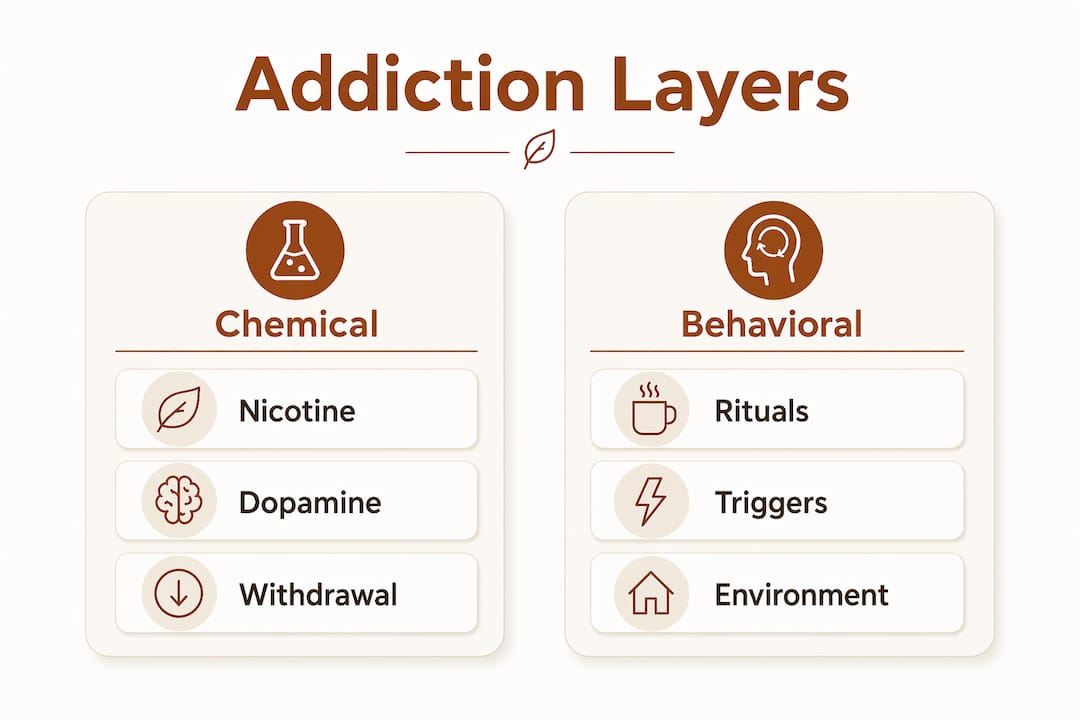
This is reinforcement learning in action. Every time a smoker lights up after dinner, the brain strengthens the connection between finishing a meal and reaching for a cigarette. Over time, the meal does not just precede the cigarette. It predicts it. The urge arrives automatically, without conscious thought.
Nicotine addiction involves conditioned stimuli that maintain smoking behavior well beyond the chemical dependency. The inhalation ritual, the feel of the cigarette between the fingers, the act of stepping outside, all become part of what the brain craves. This is why nicotine replacement therapies often fall short: they address the chemical but leave the ritual completely intact.
| Component | Chemical addiction | Behavioral addiction |
|---|---|---|
| Primary driver | Nicotine and dopamine | Conditioned cues and rituals |
| Onset | Within seconds of first puff | Builds over weeks and months |
| Withdrawal trigger | Drop in nicotine blood level | Environmental or emotional cue |
| Duration after quitting | Days to weeks | Months to years |
| Treatment approach | Nicotine replacement or medication | Habit replacement and behavioral therapy |
Many smokers fail quitting attempts because they address the chemical addiction while ignoring the oral fixation and hand-to-mouth rituals that keep the habit running. Successful quitting requires replacing the ritual, not just removing the substance.
Pro Tip: Keep a trigger log for one week before attempting to quit. Write down every time you want a cigarette and what you were doing, feeling, or seeing at that moment. Patterns will emerge quickly, and those patterns are your real targets.
Why do people smoke even when they know the risks?
Knowledge of health risks does not stop smoking. This is one of the most documented and least understood facts about tobacco addiction. Smokers are not uninformed. They are caught in a system of identity, social belonging, and self-concept that makes quitting feel like losing part of who they are.
Smoking identity is a real psychological construct. For many long-term smokers, cigarettes are woven into how they see themselves: as someone who takes breaks, who has a ritual, who belongs to a particular social group. Quitting does not just mean stopping a behavior. It means redefining a self-image, which is psychologically costly.
Social environment shapes what smokers perceive as normal, reinforcing both the habit and the identity around it. People who grew up in households where smoking was common are more likely to see it as a natural part of adult life. Peer groups that smoke create ongoing social pressure, even when no one is explicitly encouraging the behavior.
Research on aspirational future selves shows that identity-based interventions work best for smokers who have not yet considered quitting. Helping someone picture a vivid, specific version of their non-smoking future self increases quitting intentions more effectively than health warnings alone. The brain responds to identity more than it responds to statistics.
The social and identity factors that sustain smoking include:
- Smoking as self-image: “I am a smoker” becomes a core identity label that feels threatening to remove.
- Social belonging: Smoking breaks create community. Quitting can feel like opting out of a group.
- Modeling from early life: Seeing parents or older siblings smoke normalizes the behavior before adulthood.
- Perceived stress management: Many smokers genuinely believe cigarettes help them cope, even when evidence says otherwise.
Key Takeaways
Smokers reach for cigarettes because nicotine, emotional triggers, conditioned rituals, and social identity all reinforce the habit simultaneously, making any single-strategy approach to quitting insufficient.
| Point | Details |
|---|---|
| Nicotine acts in seconds | Dopamine release within 10–20 seconds creates a powerful reward memory that drives repeated use. |
| Withdrawal starts fast | Cravings begin within 30 minutes of the last cigarette, so smokers chase relief, not pleasure. |
| Emotions drive cravings | Stress, boredom, and anxiety trigger urges independent of nicotine blood levels. |
| Rituals outlast withdrawal | Behavioral cues like post-meal smoking persist long after chemical dependency ends. |
| Identity sustains the habit | Smokers who see cigarettes as part of their self-image need identity-based strategies, not just willpower. |
What I’ve learned from looking at addiction from the inside out
Most conversations about smoking focus on the chemical. Nicotine gets the headline, and everything else gets treated as secondary. That framing is wrong, and I think it is one of the main reasons so many quit attempts fail.
The people I have seen struggle most with quitting are not the ones with the strongest physical dependency. They are the ones whose smoking is most tightly woven into their daily rhythm and their sense of self. The person who smokes after every meal, on every work break, and whenever they feel anxious has not just a nicotine habit. They have a coping architecture built around cigarettes.
What actually helps is treating the ritual and the emotion with the same seriousness as the chemistry. Recognizing that a craving after dinner is a conditioned response, not a physical need, changes how you relate to it. You can observe it instead of obeying it. That shift in perspective is not easy, but it is available to anyone who understands what is actually happening in their brain and their behavior.
Compassion matters here too. Smokers are not weak or irrational. They are responding to a system that was designed, at the neurochemical level, to be hard to escape. Understanding that system is not just reassuring. It is the foundation of any real change.
— Tommy
A practical tool for understanding and managing your cravings
Knowing why the urge hits is one thing. Having a structured way to track it, respond to it, and replace it is another.

Breathefree’s Nicotine Detox eBook and Habit Tracker was built specifically for this gap. It addresses both the chemical and behavioral layers of addiction, giving you a clear framework for identifying your personal triggers, understanding the craving cycle, and building replacement habits that actually stick. Over 75,000 people have used Breathefree’s approach to quit without relying on nicotine substitutes or inhalation methods. The eBook pairs with a habit tracker so you can see your patterns in real time, not just in theory. If you are ready to understand your cravings rather than just endure them, this is a concrete place to start.
FAQ
Why do smokers crave cigarettes so quickly after finishing one?
Nicotine withdrawal begins within 30 minutes of the last cigarette, so the brain starts signaling for relief before the previous one is even a memory. Smokers are primarily chasing the end of discomfort, not the start of pleasure.
Can stress alone trigger a cigarette craving without physical withdrawal?
Yes. Acute stress disrupts brain self-control and activates nicotine-seeking behavior independently of blood nicotine levels. Emotional triggers can produce cravings even in people who have been abstinent for weeks.
Why do cravings return after someone has already quit?
Environmental and habitual cues like finishing a meal or sitting in a car create conditioned responses that outlast the physical addiction by months or years. The brain has linked those situations to smoking so strongly that the cue alone restores the urge.
Does knowing the health risks help smokers quit?
Health warnings alone are rarely enough. Identity-based interventions that help smokers picture a specific non-smoking future self are more effective, especially for people who have not yet decided to quit.
What makes the hand-to-mouth ritual so hard to give up?
The oral fixation and hand-to-mouth habit become conditioned behaviors reinforced thousands of times over years of smoking. Nicotine replacement addresses the chemical dependency but leaves this ritual completely intact, which is why many quit attempts stall even after withdrawal ends.