

Stress shifts control away from your prefrontal cortex (PFC), the brain’s deliberate decision-making center, and hands it to the basal ganglia, where automatic routines live. That’s why old habits resurface under pressure: your brain isn’t failing you, it’s running a faster, lower-cost program. Research by Schwabe & Wolf and later replications confirms that acute stress can favor habitual responding over goal-directed action. One thing you can do right now: put a physical barrier between yourself and the habit cue (move the cigarettes to another room, close the app, put the snacks out of sight).
- Buying yourself a short amount of distance from the cue reduces the automatic chain before it completes
- A substitute object in your hand (a necklace, a pen, a stress ball) gives the basal ganglia something to do
- A single slow breath activates the parasympathetic system and partially restores PFC function
Key Takeaways
Stress triggers old habits because cortisol suppresses prefrontal control and hands behavioral authority to the basal ganglia, making automatic routines run faster than conscious decisions can stop them.
| Point | Details |
|---|---|
| Stress shifts brain control | Cortisol suppresses the PFC and activates basal ganglia habit circuits, making old behaviors automatic. |
| The effect has limits | Replications show the stress-to-habit link depends on habit strength, cortisol reactivity, and working memory load. |
| Stress boosts all habits | Reduced self-control under stress amplifies both harmful and beneficial habits, so building good habits in calm periods pays off under pressure. |
| Prepare before stress hits | Implementation intentions and environmental friction work better than in-the-moment willpower when the PFC is suppressed. |
| Breathefree as an adjunct | The Breathefree resistance necklace provides a non-nicotine oral substitute; pair it with a written plan and tracking for best results. |
Table of Contents
- What the research actually shows about stress and habit relapse
- How stress rewires your brain in the moment
- What this looks like in your actual day
- How to prevent relapse when stress hits
- Tools and substitutes that actually interrupt the chain
- When to get professional help
- The timeline of how stress shifts your behavior control
- How memory and cognitive load make relapse more likely
- Emotional stress vs. physical stress: different triggers, same habit circuit
- What behavioral economics says about stress and decision-making
- Interventions matched to stress intensity
- Relapse is a brain event, not a character flaw
- Breathefree offers a non-nicotine option worth considering
- Sources
What the research actually shows about stress and habit relapse
The most-cited work comes from Lars Schwabe and Oliver Wolf, who ran a series of experiments in the late 2000s and early 2010s using an outcome-devaluation paradigm. The basic design: participants learn to perform actions to earn food rewards, then one food is made unappealing (devalued). Goal-directed people stop choosing the devalued option. Stressed participants keep choosing it anyway, acting on the learned habit rather than the updated outcome. That pattern, repeated across several studies, became the foundation for the claim that acute stress promotes habitual responding.
The picture is more complicated than that headline suggests. A high-quality replication study ran two exact replications of the selective-satiation paradigm and found no clear evidence that acute stress reliably prompted habitual responding in the same way. The authors concluded the effect is conditional on task design, individual cortisol reactivity, and working memory capacity. That doesn’t kill the core idea; it refines it.
A separate multi-experiment study found something practically important: stress boosts both good and bad habits, not just harmful ones. Reduced self-control under stress makes whichever habit is strongest more likely to run. If your strongest habit is a morning workout, stress may actually help you keep it. If it’s smoking, stress pulls you back there.
| Study | Design | Main finding | Boundary conditions |
|---|---|---|---|
| Schwabe & Wolf (2009/2010) | Outcome-devaluation, acute stress induction | Stressed participants showed more habit-based responding | Lab paradigm; cortisol reactivity varied |
| Replication study (PMC, 2023) | Two exact replications, selective satiation | No reliable stress→habit effect found | Task design, individual differences |
| Neal et al. (NAMI-cited) | Five experiments, self-control depletion | Stress increases performance of all established habits | Effect depends on habit strength |
| Preclinical chronic stress (bioRxiv) | Mouse models, amygdala–striatal pathways | Chronic stress promotes rigid, habit-like learning | Animal model; chronic, not acute, stress |
The practical takeaway: the stress→habit link is real but not universal. It’s strongest when the habit is well-practiced, when cortisol reactivity is high, and when working memory is taxed. Chronic stress appears to create deeper structural changes than a single acute stressor.
How stress rewires your brain in the moment
The HPA axis is the body’s stress-response highway. A perceived threat triggers the hypothalamus, which signals the pituitary, which tells the adrenal glands to release cortisol. Cortisol is useful in short bursts. The problem is what it does to the prefrontal cortex: it suppresses PFC activity, reducing your capacity for deliberate reasoning, impulse control, and flexible decision-making.
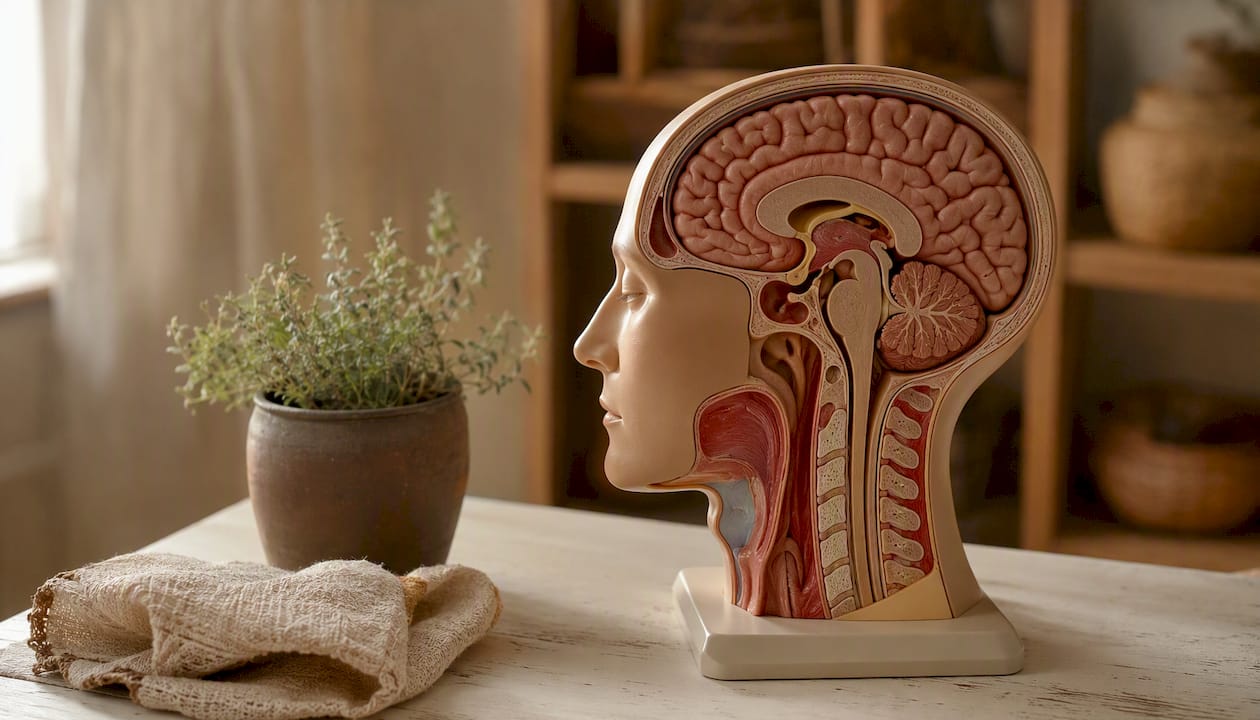
That suppression matters because the PFC and basal ganglia are in constant competition for behavioral control. The PFC runs goal-directed behavior: “I want X, action A leads to X, so I’ll do A.” The basal ganglia runs automatic routines: “Cue detected, run program.” Under normal conditions, the PFC can override a habit. Under stress, cortisol tips the balance toward the basal ganglia.
Neuroscience reviews describe this as a circuit-level shift: behaviors that were once deliberate become chunked into automatic sequences stored in the striatum. Once chunked, they’re fast, efficient, and largely invisible to conscious awareness. That’s why telling yourself “just don’t do it” rarely works when you’re already stressed.
Dopamine adds another layer. When a habit relieves stress, even briefly, the brain registers a reward-prediction signal. That signal strengthens the cue-to-routine link. Over time, repeated stress-triggered relief behavior makes the habit loop tighter and faster. The cigarette that calmed you down once becomes the cigarette your brain expects every time cortisol spikes.
The causal chain, simplified:
- Stressor detected → HPA axis activates → cortisol rises
- Cortisol suppresses PFC → executive control weakens
- Basal ganglia gains relative dominance → automatic routines activate
- Habit runs → short-term relief → dopamine reinforces the loop
- Next stress episode: the loop runs faster
Willpower alone can’t reliably interrupt this chain because willpower is a PFC function, and the PFC is exactly what stress degrades.
What this looks like in your actual day
Work deadline, anxious chewing, cigarette. The cue is the pressure of an unfinished task. The routine is reaching for a cigarette. The reward is a 5-minute break plus the oral and nicotine hit that briefly lowers cortisol. If you’ve smoked for years, that chain runs before you’ve consciously decided anything. The intercept: keep something else in your hand at your desk, a resistance necklace or a pen, so the reaching motion lands on a different object.

Argument with a partner, straight to the fridge. Emotional stress activates the same HPA pathway as physical threat. The cue is the unresolved tension. The routine is eating something dense and sweet, which genuinely does blunt cortisol temporarily. The intercept: a glass of cold water first, then a 10-minute walk. The delay alone is often enough for PFC function to partially recover.
Doomscrolling after bad news. The cue is ambient anxiety. The routine is picking up the phone. The reward is distraction, which feels like relief. The intercept: charge your phone in a different room at night, so the physical barrier adds friction to the automatic reach.
End-of-day procrastination. Cognitive fatigue accumulates across the day. Willpower and executive function decline as the hours pass, which is why the habits you’ve been resisting all day tend to win after 8 PM. Schedule your hardest behavior-change tasks for morning or immediately after a rest period, not at the end of a long day.
Social anxiety, vaping in the parking lot. The cue is the anticipation of a social situation. The routine is a quick vape before going in. The reward is reduced arousal. Understanding why vaping habits feel impossible to break often comes down to exactly this: the ritual is doing real anxiety management work, and removing it without a substitute leaves a gap the brain will fill with the original behavior.
How to prevent relapse when stress hits
The goal isn’t to eliminate stress. It’s to build a system that works even when your PFC is running at half capacity.
-
Prepare before the stress arrives. Write implementation intentions: “If I feel the urge to smoke when my boss calls, then I will pick up my necklace and take three slow breaths.” The if-then format works because it pre-loads the decision into a cue-response structure the basal ganglia can actually run. Behavior-change research consistently supports implementation intentions as one of the most reliable tactics for maintaining new habits under pressure. Also redesign your environment: remove cues, add friction to the unwanted habit, and make the desired substitute easy to reach.
-
Intercept the chain early. The moment you notice the cue, insert a brief delay. Even 30 seconds of urge-surfing (observing the urge without acting on it, the way a surfer watches a wave) can reduce its intensity enough for the PFC to re-engage. Physical friction helps: if the cigarettes are in the car, you have to walk outside to get them. That walk is often enough of a pause.
-
Replace, don’t just resist. The basal ganglia needs something to do. A substitute that satisfies the same sensory channel as the habit (oral, tactile, respiratory) works better than pure abstinence. Mindfulness techniques can also interrupt the automatic chain by shifting attention to the present moment rather than the anticipated reward.
-
Follow up and track. After a high-stress episode, note what triggered the urge, whether you acted on it, and what helped. Patterns become visible over two to three weeks of tracking. Social support matters here too: people who have a specific person to call during high-urge moments show better outcomes than those relying on solo willpower. Build that contact into your phone’s favorites before the next stress episode, not during it.
Pro Tip: When an urge peaks, try a sensory substitution plus a timed delay: hold something textured in your dominant hand and set a 3-minute timer. Most urges peak and begin to subside within that window, and the tactile input gives the habit circuit a low-harm output.
Tools and substitutes that actually interrupt the chain
Environmental and tool-based interventions reduce reliance on depleted cognitive control under stress. They work by adding friction to the unwanted behavior or providing a substitute reward that satisfies the same sensory need without the harm.
- Non-nicotine oral devices. Resistance necklaces, silicone mouthpieces, and flavored chew tools address oral fixation directly. They give the mouth and hands something to do, which interrupts the cue-to-cigarette chain without introducing nicotine or other substances.
- Fidget tools. Spinner rings and textured objects redirect the tactile component of a habit. Particularly useful when the habit involves hand-to-mouth motion.
- Diaphragmatic breathing devices. Resistance-breathing tools slow the exhale and activate the vagus nerve, producing a measurable calming effect. They also mimic the respiratory ritual of smoking without any inhalation of harmful substances.
- Micro-break techniques. A structured 2-minute pause (box breathing, cold water on the wrists, a brief walk) can partially restore PFC function during an acute stress spike.
- Habit tracking apps. Tools like Streaks or a simple paper log make relapse visible and non-catastrophic. Seeing a pattern removes the shame and replaces it with data.
Safety note: oral substitutes and fidget tools are adjuncts, not medical treatments. If you’re managing physical nicotine dependence, alcohol withdrawal, or a mood disorder, a clinician should be part of your plan. DIY substitutes alone are not appropriate for managing withdrawal symptoms.
When to get professional help
A stress-triggered lapse is normal. A pattern that keeps repeating despite genuine effort, or one that’s causing real harm, is a different situation.
Seek professional support if you notice:
- Loss of control: you intend to use once and can’t stop
- Continued use despite clear harm to health, relationships, or work
- Physical withdrawal symptoms (shaking, sweating, nausea, insomnia) when you try to stop
- Persistent low mood, anxiety, or hopelessness that doesn’t lift after the stressor resolves
- Thoughts of self-harm or suicide
US resources:
- SAMHSA National Helpline: 1-800-662-4357, free, confidential, 24/7. Connects you to local treatment facilities and support groups.
- National Quitline: 1-800-QUIT-NOW (1-800-784-8669). Free coaching for tobacco cessation, available in every US state.
- NAMI Helpline: 1-800-950-6264. Mental health navigation, including guidance on stress-related mood disorders.
Medication-assisted treatment (varenicline, bupropion for nicotine; naltrexone for alcohol) is clinically indicated for moderate-to-severe dependence and significantly improves outcomes compared to behavioral strategies alone. A primary care clinician can assess whether medication is appropriate for your situation.
The timeline of how stress shifts your behavior control
The shift from goal-directed to habitual responding happens faster than most people expect.
0–2 minutes: A stressor is perceived. The amygdala fires. The HPA axis activates. Adrenaline (epinephrine) is released within seconds, producing the immediate physical stress response: elevated heart rate, muscle tension, narrowed attention.
2–10 minutes: Cortisol begins rising. PFC activity starts to decrease. Working memory capacity drops. Decisions that require holding multiple options in mind become harder. This is the window where habit cues become most dangerous: the brain is looking for a fast solution.
10–20 minutes: Cortisol peaks. Basal ganglia dominance is at its highest relative to PFC control. Well-practiced habits are most likely to run automatically during this window. This is when the cigarette gets lit, the app gets opened, or the fridge gets raided, often without a conscious decision point.
20–60 minutes: Cortisol begins to clear. PFC function gradually recovers. Goal-directed reasoning becomes more available again. This is the window where reflection and planning are possible.
Chronic exposure: Preclinical research shows that repeated stress exposure alters amygdala-to-striatal pathways in ways that accelerate habit formation and make behaviors more rigid and compulsive over time. Chronic stress doesn’t just trigger old habits in the moment; it structurally biases the brain toward habitual responding across all situations.
Understanding this timeline helps you place your interventions correctly. The 2–10 minute window is where friction and substitutes matter most. The 20–60 minute window is where reflection, journaling, and planning are most productive.
How memory and cognitive load make relapse more likely
Working memory is the mental workspace where you hold information and use it to make decisions. It’s also a PFC function, which means stress degrades it directly. When working memory is taxed, the brain defaults to stored routines because they require almost no working memory to execute.
This is why relapse is more likely when you’re simultaneously stressed and cognitively busy. A difficult phone call while you’re already behind on a deadline doesn’t just double the stress; it compounds the working memory load in a way that leaves almost no cognitive resources for deliberate habit suppression.
Emotional memory adds another dimension. Habits formed during emotionally intense periods (a breakup, a job loss, a period of grief) are encoded with stronger contextual tags. When a similar emotional state recurs, those memories and their associated behaviors become more accessible. The brain isn’t just running a habit; it’s pattern-matching to a past solution that worked.
For ex-smokers navigating relapse, this explains why a specific smell, a particular song, or even a time of year can trigger a craving years after quitting. The cue reactivates the emotional memory, which reactivates the habit circuit, before the PFC has a chance to intervene.
The practical implication: reduce cognitive load during high-stress periods. Simplify decisions, use checklists, and pre-commit to substitute behaviors before the stress hits rather than trying to reason your way through it in the moment.
Emotional stress vs. physical stress: different triggers, same habit circuit
Not all stress activates the habit circuit in the same way. The distinction between emotional and physical stress matters for understanding when relapse risk is highest.
Physical stress (cold exposure, pain, intense exercise, sleep deprivation) activates the HPA axis and produces cortisol, but it tends to be time-limited and context-specific. The habit activation it produces is often tied to physical relief-seeking: eating, resting, or using a substance that blunts physical discomfort.
Emotional stress (social rejection, conflict, uncertainty, anticipatory anxiety) activates both the HPA axis and the amygdala’s threat-detection system. Because the amygdala is deeply connected to memory and emotional learning, emotional stress tends to produce stronger and more specific habit cues. A fight with a family member doesn’t just raise cortisol; it activates the specific emotional memory of every previous time you used a habit to cope with that feeling.
Research on chronic stress and care modalities suggests that emotional stress is harder to manage with purely physical interventions (exercise, breathing) alone, and often benefits from cognitive approaches like CBT or acceptance-based therapy that address the emotional memory component directly.
The practical split: for physical stress triggers, sensory substitution and friction-based tools tend to work well. For emotional stress triggers, combining those tools with a cognitive reframe or a brief mindfulness practice addresses the emotional memory layer that physical tools alone can’t reach.
What behavioral economics says about stress and decision-making
Behavioral economics frames the stress-to-habit shift as a predictable failure of deliberative reasoning under cognitive load. Daniel Kahneman’s System 1 (fast, automatic, intuitive) and System 2 (slow, deliberate, effortful) map almost directly onto the basal ganglia and PFC distinction in neuroscience.
Under stress, System 2 is expensive to run. The brain, operating under resource constraints, defaults to System 1: heuristics, habits, and the path of least resistance. This isn’t irrationality; it’s efficiency. The problem is that the “efficient” choice was encoded during a period when the habit was reinforced, not during a period when you’d consciously chosen to change.
Loss aversion compounds this. Under stress, the anticipated discomfort of not performing the habit (the craving, the anxiety, the irritability) feels more immediate and certain than the long-term benefit of abstaining. The brain overweights the near-term cost of resistance and underweights the long-term cost of relapse.
Stress management strategies that work from a behavioral economics lens focus on changing the choice architecture rather than the person’s willpower. Pre-commitment devices (telling someone your plan, removing the substance from the house, scheduling a substitute activity) shift the default option before stress degrades deliberative capacity. The goal is to make the desired behavior the path of least resistance, not the hardest choice.
Interventions matched to stress intensity
Not every stress episode calls for the same response. Matching the intervention to the intensity of the stressor improves outcomes.
Low-intensity stress (mild deadline pressure, minor social friction): Implementation intentions and environmental design are usually sufficient. A pre-written if-then plan, a substitute object within reach, and a brief delay are enough to interrupt the habit chain before it completes.
Moderate-intensity stress (significant conflict, unexpected bad news, a difficult workday): Add a physiological regulation step before attempting cognitive strategies. Box breathing (4 counts in, 4 hold, 4 out, 4 hold) or a 5-minute walk lowers cortisol enough to partially restore PFC function. Then use the if-then plan. Structured quit plans that build these regulation steps into a daily routine show better adherence than plans that rely on in-the-moment decision-making alone.
High-intensity stress (acute crisis, trauma, severe anxiety): Cognitive strategies are largely unavailable because PFC function is severely suppressed. The priority is physiological safety and harm reduction, not habit change. Use the simplest possible substitute (hold something, drink water, call someone), remove yourself from the trigger environment if possible, and defer the habit-change work until the acute stress has passed. This is also the threshold at which professional support becomes most important.
Chronic stress (ongoing work pressure, relationship strain, financial hardship): Requires structural intervention, not just tactical tools. Sleep, exercise, and social connection are the three most evidence-supported buffers for chronic stress. Without addressing the underlying stressor or building genuine recovery capacity, tactical tools will keep getting overwhelmed.
Relapse is a brain event, not a character flaw
Here’s what I keep coming back to when I think about why people struggle with this: the shame of relapsing under stress is often worse than the relapse itself. Someone quits smoking for three months, has a brutal week at work, and lights up once. Then they spend two days telling themselves they have no willpower, no discipline, no real commitment. That story is both wrong and counterproductive.
What actually happened is that cortisol suppressed their PFC, the basal ganglia ran a well-practiced program, and a habit that had been encoded over years executed in seconds. That’s not a moral failure. It’s a predictable neurological event. The research makes that clear, and understanding it changes how you respond to a lapse.
The more useful question after a relapse isn’t “what’s wrong with me?” It’s “what was the cue, and what can I put between me and that cue next time?” That reframe shifts the work from self-criticism to system design, which is where the actual leverage is. Combining a physical substitute tool with a written plan and at least one person who knows your goal gives you three layers of protection the next time stress spikes.
Breathefree offers a non-nicotine option worth considering
If oral fixation is part of your habit loop, a physical substitute that satisfies that need without nicotine is worth adding to your plan. The Breathefree resistance necklace is designed for exactly that: it gives your mouth and hands something to do during high-urge moments, with no nicotine, no inhalation, and no harmful substances.
Products like this work best as part of a broader plan, not as a standalone fix. Before purchasing any oral substitute, run through this checklist:
- Material safety: Is it food-grade silicone or a certified safe material?
- Nicotine-free: Confirmed zero nicotine content?
- Easy to clean: Can it be sanitized between uses?
- Return policy: Does the brand offer a trial period?
- Recommended use case: Does it match your specific habit trigger (oral, tactile, respiratory)?
- Clinical fit: If you have physical dependence or a mood disorder, have you discussed this with a clinician?
Breathefree also offers a Nicotine Detox eBook and Habit Tracker that pairs structured planning with daily tracking, which addresses the follow-up and monitoring step that most people skip. A product alone won’t override a stressed brain; a product plus a written plan plus a tracking system gives you a real system. Visit Breathefree to see the full range and find the option that fits your quit stage.
Sources
- Stress boosts good and bad habits, study finds (NAMI)
- How the brain makes and breaks habits (Scientific American)
- A dual-pathway architecture enables chronic stress to promote habit formation (bioRxiv)
This article is general information, not a substitute for advice from a qualified doctor. Consult a qualified healthcare professional about your own circumstances before acting on anything here.