

Quitting smoking will improve your asthma. Symptoms ease, lung function climbs, and your medication starts working the way it’s supposed to. That’s not a maybe. The immediate next step is simple: tell your clinician you’re quitting and pick a combined approach, behavioral counseling plus an FDA-approved medication or nicotine replacement, rather than trying to white-knuckle it alone.
The CDC treats tobacco use as part of respiratory care, not a separate habit to deal with later. That matters because your asthma plan and your quit plan are the same conversation.
Three things to line up this week:
- Book an appointment specifically to discuss quitting and your asthma control together.
- Choose one behavioral support (quitline, counseling, or app) and one medication option.
- Consider a nicotine-free tool like the Breathefree resistance necklace if oral fixation is a big part of your smoking habit.
Key Takeaways
Quitting smoking improves asthma symptoms, lung function, and medication response, and pairing behavioral counseling with an approved cessation aid produces the best results.
| Point | Details |
|---|---|
| Quitting works fast | Airway irritation and trigger sensitivity drop within days to weeks of quitting. |
| Combine, don’t choose one | Behavioral counseling plus medication (NRT, varenicline, or bupropion) beats either approach alone. |
| Expect temporary changes | Coughing or mucus may increase briefly as airways clear; don’t stop controller medication without asking. |
| Household exposure counts | Secondhand and thirdhand smoke residue can trigger symptoms even in small amounts. |
| Nicotine-free support helps | Breathefree’s resistance necklace addresses oral fixation as a complement to clinician-directed treatment. |
This article is general information, not a substitute for advice from a qualified doctor. Consult a qualified healthcare professional about your own circumstances before acting on anything here.
Table of Contents
- Why Quitting Helps Asthma and What to Expect, Week by Week
- What Actually Works: Medication and Counseling Options for Asthmatic Smokers
- Your Asthma-Friendly Quit Plan: A Step-by-Step Checklist
- Withdrawal and Temporary Asthma Changes: What’s Normal
- A Nicotine-Free Tool That Supports Your Quit Plan
- Sources
Why Quitting Helps Asthma and What to Expect, Week by Week
Your airways start responding almost immediately. Within days to a couple of weeks of quitting, the direct irritation from smoke exposure drops, so you get fewer coughing fits and less of that tight, reactive feeling that sends you reaching for a rescue inhaler.
The longer payoff is bigger. Research on smokers with asthma identifies them as a distinct phenotype, meaning smoking doesn’t just make asthma worse in a general sense, it changes how the disease behaves and how well standard treatment works. Peer-reviewed evidence on asthma and tobacco smoking points to fewer exacerbations after quitting, along with the possibility that some patients eventually need lower doses of inhaled corticosteroids once their airways stop fighting daily smoke exposure.
Here’s the timeline in plain terms:
- Days 1 to 14: Airway irritation drops, cilia (the tiny hairs that clear mucus) start recovering function, and triggers you used to tolerate may suddenly feel more noticeable.
- 1 to 3 months: Lung function measurements typically improve, and airway hyperresponsiveness, the tendency of your airways to overreact to cold air, exercise, or allergens, starts to settle.
- 6 months and beyond: Quality of life scores improve, exacerbation frequency tends to drop, and your risk of developing overlapping COPD alongside asthma goes down.
None of this happens on a fixed schedule for everyone. But the direction is consistent across the clinical literature, and the American Lung Association confirms that quitting reduces both asthma symptoms and the risk of further lung disease. That’s the case for sticking with it even when week one feels rough.
What Actually Works: Medication and Counseling Options for Asthmatic Smokers
Quitting cold turkey works for some people. It fails for most. Clinical guidelines on managing asthmatic smokers recommend combining behavioral counseling with pharmacotherapy specifically because smokers with asthma face extra barriers, including a blunted response to standard corticosteroid treatment while they’re still smoking.
Behavioral counseling and quitlines aren’t just a formality before the “real” treatment. Structured support measurably raises quit rates on its own, and it raises them further when stacked with medication. If you haven’t tried a quitline or structured behavioral program, that’s the first box to check, not an afterthought.
On the medication side, three FDA-approved options dominate the evidence base:
- Nicotine replacement therapy (NRT): patches, gum, or lozenges reduce withdrawal cravings; inhaled forms can occasionally irritate sensitive airways, so patch or oral forms are often the more comfortable starting point for asthmatics.
- Varenicline: shows the strongest relative efficacy against placebo in pooled analyses of quitting aids, though it requires a prescription and a conversation about side effects like sleep disturbance or nausea.
- Bupropion: an antidepressant also approved for smoking cessation, useful if you have co-occurring depression or anxiety, but not appropriate if you have a seizure disorder.
Reviews of combined cessation approaches consistently show higher quit rates when counseling and medication are paired rather than used alone.
One caution worth flagging early: e-cigarettes are not a recommended substitute here. Clinical reviews on cigarette smoking and asthma note limited evidence of effectiveness and real concern that vapor aerosol can trigger symptoms in asthmatic airways.
Pro Tip: Ask your clinician specifically whether your asthma controller dose might need adjusting once you quit. Some people need less medication after a few smoke-free months, and finding that out saves you from over-treating a lung that’s already healing.
Your Asthma-Friendly Quit Plan: A Step-by-Step Checklist
A quit date without a plan behind it usually turns into a delayed relapse. Build the plan first.
- Pick a quit date within the next two weeks. Waiting longer tends to dilute motivation; sooner gives you less time to second-guess.
- See your clinician before that date. Review your current asthma control, get any needed prescriptions (NRT, varenicline, or bupropion), and ask about temporary controller adjustments.
- Enroll in one behavioral support channel. A quitline, in-person group, or digital coaching program works; the format matters less than actually using it consistently.
- Clear your home of tobacco and triggers. Remove ashtrays, lighters, and leftover packs. Wash curtains and upholstery that carry smoke residue.
- Set smoke-free household rules now, before quit day. Anyone who smokes does it outside, period, and visitors follow the same rule.
- Line up a craving response you can use in under 60 seconds. That might mean a resistance necklace for oral fixation, a short breathing exercise, or texting a peer support contact.
- Write a one-page relapse plan. Note your top three triggers and exactly what you’ll do instead of smoking when each one hits.
Quick reference for quit-day supplies:
- Rescue inhaler, refilled and accessible
- NRT or prescribed medication, already picked up from the pharmacy
- A non-nicotine oral substitute for hand-to-mouth cravings
- Quitline number saved in your phone
- A support person who knows your quit date
Withdrawal and Temporary Asthma Changes: What’s Normal
Nicotine withdrawal itself typically peaks in the first three days and fades over two to four weeks. Expect irritability, restlessness, trouble concentrating, and stronger cravings than you’d like to admit to anyone. None of that is dangerous, and it’s temporary.

What surprises people is the lung side. As your airways start clearing years of smoke residue, you may notice a temporary uptick in coughing or mucus production. Research on managing asthmatic smokers notes that some patients experience short-term symptom shifts as airway clearance resumes, and clinicians sometimes bump up controller therapy briefly to cover that window. This is your body doing cleanup work, not a sign quitting was the wrong call.
A few ground rules for this stretch:
- Don’t stop your controller inhaler on your own, even if you feel like quitting “cured” everything.
- Call your clinician if increased mucus comes with wheezing, chest tightness, or a drop in your peak flow readings.
- Lean on non-nicotine coping tools, oral substitutes, paced breathing, or a quick call to a peer, instead of riding out cravings white-knuckled.
Pro Tip: Keep a simple daily log of your peak flow and symptoms for the first month after quitting. It’s the fastest way to tell the difference between normal airway clearance and something that needs a same-week appointment.
Cutting Secondhand and Thirdhand Smoke at Home
Secondhand smoke triggers asthma directly, and thirdhand smoke, the residue that clings to fabric, walls, and hair long after the cigarette is out, does too. Research on secondhand and thirdhand smoke exposure shows even small, repeated exposures can set off symptoms, which is a particular problem for kids in the household.
The fix is mostly logistics, not willpower:
- Make the home and car 100% smoke-free, no exceptions for weather or guests.
- Launder smoker’s clothing separately and wash soft surfaces that absorb residue.
- Ventilate rooms regularly and consider an air purifier for lingering particles.
- Ask visitors to smoke outside, away from doors and windows.
If another household member smokes, especially a parent or caregiver, gently raising the idea of quitting together tends to work better than a lecture. Household-level exposure guidance from WHO backs this up as a real intervention point, not just a courtesy.
Why an Asthma-First Perspective on Quitting Actually Matters
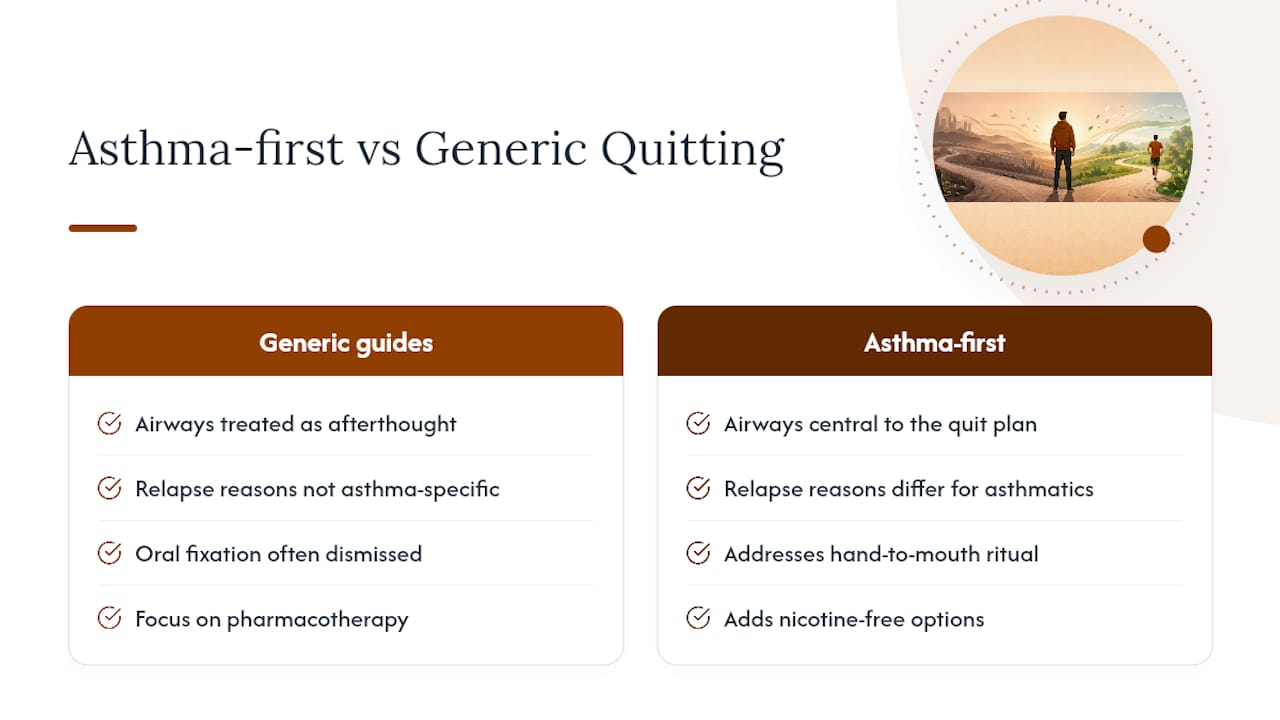
Most quitting advice treats asthma as an afterthought, a footnote about “irritated airways” tucked into generic cessation guides. That’s backward. Asthmatic smokers respond differently to standard treatment, relapse for different reasons, and need a quit plan built around their actual airway behavior, not a one-size template borrowed from smokers without lung disease.
The oral fixation piece gets dismissed too often as a minor detail. It isn’t. The hand-to-mouth ritual is often as habit-forming as the nicotine itself, which is why Breathefree built its resistance necklace as a nicotine-free stand-in for that exact motion, reporting more than 75,000 users who’ve used the method to quit. It’s not a replacement for your inhaler or your clinician’s guidance. It’s a tool that handles the behavioral itch pharmacotherapy doesn’t touch.
— Tommy
A Nicotine-Free Tool That Supports Your Quit Plan
Your clinician handles the medical side: medication, controller adjustments, monitoring your lungs. What often gets left unaddressed is the physical habit, the hand reaching for something, the mouth wanting a cigarette between your lips. That’s the gap Breathefree’s resistance necklace is built to fill, giving you a nicotine-free way to satisfy oral fixation without smoke, vapor, or any airway irritant.

Pair it with a structured plan rather than treating it as a standalone fix. The Nicotine Detox eBook & Habit Tracker walks you through the same step-by-step approach outlined above, with a tracker to log cravings, triggers, and progress day by day. If you’re ready to move past the planning stage, that’s the page to start on.
Sources
- The management of asthmatic smokers - PMC
- Tobacco and respiratory health – CDC
- Tobacco and asthma: presenting the world health organization (WHO) tobacco knowledge summary
- The Health Effects of Smoking with Asthma | American Lung Association