

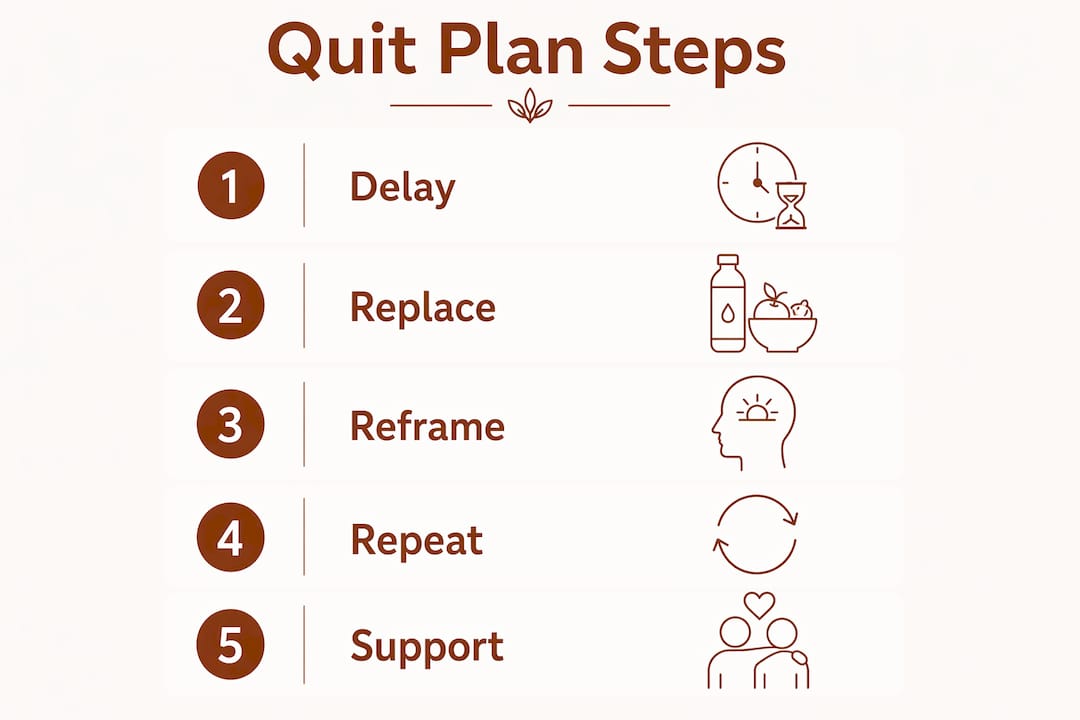
The fastest way to overcome emotional dependence on smoking is a three-step nicotine-free ritual you can start right now: Delay → Replace → Reframe. When a craving hits, postpone it for 5–10 minutes (the acute intensity drops as your brain shifts from reactive to problem-solving mode), reach for a pre-chosen oral aid, then name the need behind the urge and meet it directly. That sequence is the whole plan. Everything below builds it out.
Your 3-step quick start:
- Delay: Set a 5–10 minute timer. Do not act on the craving yet.
- Replace: Use a pre-chosen oral aid, such as the Breathefree resistance necklace, a crunchy vegetable, or sugar-free gum.
- Reframe: Ask yourself, “What does this craving need?” Then meet that need directly (comfort, a break, a transition, a reward).
Many people have used Breathefree’s method to quit this way. The behavioral research backs the approach: emotional cravings are learned links, not life sentences.
Pro Tip: Keep your oral aid in the same pocket every day. Automatic access removes the split-second decision that sends most people back to a cigarette.
Table of Contents
- Why does emotional dependence on smoking form in the first place?
- How do you reframe a craving the moment it hits?
- How to build a 5-minute replacement kit for common craving moments
- What nicotine-free oral aids actually work, and are they safe?
- How does the Breathefree resistance necklace work?
- What does a realistic 30-day quit plan look like?
- When should you get extra help?
- Key Takeaways
- A note on patience and small wins
- Breathefree: a ready-made oral aid for your replacement ritual
- Suggested reading and sources
Why does emotional dependence on smoking form in the first place?
Cigarettes become comfort objects through a process behavioral researchers call affiliative attachment. Every time you lit up during stress, boredom, or loneliness, your brain logged the cigarette as the solution. Over months and years, the cigarette stopped being just nicotine and became a companion, a ritual, and a coping tool rolled into one.
A PMC study on smokers’ brand relationships found that positive feelings about smoking are strongly tied to relief from craving, not just the chemical hit. The brand, the pack, the hand-to-mouth motion — all of it gets woven into the emotional script. That is why quitting feels like losing a friend, not just a habit.
The three most common emotional triggers that sustain this attachment:
- Stress: Nicotine temporarily lowers cortisol, so the brain learns “cigarette = calm.”
- Boredom: The ritual fills empty time and provides sensory stimulation.
- Loneliness or social transition: Smoking gives you something to do with your hands and a reason to step away.
Physical withdrawal fades within weeks. The emotional attachment to smoking can linger for months unless you actively replace the script.
Stat: Behavioral programs consistently report that emotional cues — stress, boredom, loneliness — create learned links that outlast physical nicotine withdrawal, making the mental side of quitting the longer battle for most people.
How do you reframe a craving the moment it hits?
Shift the internal question. Instead of “How do I stop this urge?” ask: “What is this craving trying to get me?” That one pivot converts a reactive moment into a solvable task, as behavioral frameworks for distinguishing emotional from physical cravings confirm.
The micro-script (use it in real time):
- Pause. Stop what you are doing for 10 seconds.
- Label. Name the feeling: stressed, bored, lonely, transitioning between tasks?
- Choose a matched action. Pick the response that fits the need, not just the craving.
Three quick examples of how this mapping works:
- Stress craving → 2-minute box breathing (4 counts in, hold 4, out 4, hold 4)
- Boredom craving → Grab a crunchy snack and take a short walk
- Social awkwardness → Send a 30-second voice note or text to a friend
Pro Tip: Delaying a craving by just 5–10 minutes is often enough to let its peak intensity pass. Set a phone timer and commit to doing one replacement action before it goes off.
How to build a 5-minute replacement kit for common craving moments
Pre-planning your replacement ritual removes the need for a high-pressure, split-second decision. Build a kit for each of your three highest-risk moments.
Work break kit:
- Pull out your Breathefree resistance necklace or a flavored toothpick.
- Step outside or to a window — keep the location change.
- Do a slow 4-5-6 breath (in 4, hold 5, out 6) while using the oral aid.
- Finish with one full minute of quiet before returning to your desk.
After-meal kit:
- Immediately after eating, chew sugar-free gum or a crunchy vegetable.
- Take a 5-minute walk, even just around the block.
- Brush your teeth — the mint sensation closes the meal ritual cleanly.
Stressful-moment kit:
- Grip your oral aid and take three slow breaths before responding to the stressor.
- Drink a full glass of cold water.
- Write one sentence about what is stressing you, then set it aside.
| Oral aid | Cost (approx.) | Portability | Best for |
|---|---|---|---|
| Resistance necklace | $20 | Wearable, always on you | Hand-to-mouth ritual replacement |
| Sugar-free gum | Under $5/pack | Pocket-sized | After meals, boredom |
| Crunchy vegetables | Under $3/serving | Needs prep | Home or desk use |
| Flavored toothpick | Under $5/pack | Pocket-sized | Social situations, on the go |
| Drinking straw | Under $2 | Flat, fits anywhere | Stress breathing, car triggers |
What nicotine-free oral aids actually work, and are they safe?
The hand-to-mouth loop is a distinct behavioral mechanism, separate from chemical withdrawal. Satisfying it with a physical replacement is not a workaround — it is the mechanism. Public health resources including Smokefree.gov and the NCI specifically recommend oral replacements like straws, gum, and crunchy foods for this reason.
Effective nicotine-free oral aids and how to use them:
- Resistance necklace: Hold and pull gently during a craving; pair with slow breathing. Replace if worn or cracked.
- Sugar-free gum: Chew for up to 20–30 minutes per session; switch flavors to prevent palate fatigue.
- Crunchy vegetables (celery, carrots): Eat slowly and deliberately; prep portions in advance so they are grab-ready.
- Flavored toothpicks: Hold in the corner of the mouth; replace every 20–30 minutes or when flavor fades.
- Drinking straw: Breathe through it slowly during stress spikes; discard after each use for hygiene.
- Edible toothpick alternatives (cinnamon sticks, licorice root): Use as a flavor-forward oral aid; limit to 1–2 per session.
Safety notes: Toothpicks and hard items carry a choking risk — never use them while driving or distracted. Frequent gum use can affect dental enamel; choose xylitol-based options. Crunchy snacks add calories, so account for that if weight is a concern. If you are pregnant, have dental work in progress, or manage a chronic condition, check with a clinician before starting any new oral-fixation replacement routine.
Pro Tip: Rotate two or three oral aids rather than relying on one. Variety prevents the replacement itself from becoming a rigid dependency.

How does the Breathefree resistance necklace work?
The Breathefree resistance necklace satisfies both the hand-to-mouth ritual and the oral-fixation loop without nicotine, inhalation, or chemicals. You hold it, pull against the resistance, and breathe through it in a slow, controlled pattern. That sequence mimics the physical act of smoking closely enough that the brain registers a completed routine.
How to use it during a craving:
- Hold the necklace and take one slow breath in through your nose.
- Apply gentle resistance as you exhale slowly through the necklace.
- Repeat for 3–5 breath cycles, focusing on the sensation.
- Set it down deliberately — this closing action signals to your brain that the ritual is complete.
Key features worth knowing: the necklace is wearable and always accessible, made for repeated daily use, and easy to clean. Tommy’s coping mechanisms guide goes deeper on pairing it with stress-regulation techniques.
Pro Tip: Use the necklace at the same time each day — even when you do not have a craving. Repetition in a fixed context is what teaches the brain a new default.
What does a realistic 30-day quit plan look like?
Gradual, trigger-by-trigger work outperforms trying to change everything at once. Here is how to sequence it.
Week-by-week milestones:
- Week 1: Map your top five triggers. Practice the Delay → Replace → Reframe sequence for each one. Track how many cravings you manage without smoking.
- Week 2: Automate your two highest-risk rituals (work break, after meals). Use your oral aid at those times every day, craving or not.
- Week 3: Stress-test social and transition triggers. Bring your kit to situations where you used to smoke socially.
- Week 4: Shift focus to maintenance. Build a short relapse plan: if you slip, note the trigger, adjust the kit, and restart the next morning.
Daily checklist:
- Morning: Set your oral aid in your pocket before you leave the house.
- Midday: Log craving-managed moments (even a tally mark counts).
- Evening: Note one trigger you handled and one that caught you off guard.
| Week | Focus | Daily habit |
|---|---|---|
| 1 | Trigger mapping | Practice Delay → Replace → Reframe |
| 2 | Ritual automation | Use oral aid at fixed high-risk times |
| 3 | Social stress-testing | Bring kit to social/transition moments |
| 4 | Maintenance | Run relapse plan if needed; adjust kit |
A slip is not a relapse. One cigarette after two weeks of progress does not erase the rewiring you have done. Measure managed cravings, not perfect days.
When should you get extra help?
Some situations call for professional support alongside behavioral strategies. Seek it promptly if you notice:
- Severe or worsening depression, or thoughts of self-harm
- Anxiety that does not ease after two weeks of quitting
- Pregnancy (nicotine-free aids may still need clinical clearance)
- Uncontrolled medical conditions affected by stress or withdrawal
- Heavy use of alcohol or other substances alongside smoking
FDA-approved cessation aids (varenicline, bupropion, nicotine replacement therapy) are worth discussing with a doctor when behavioral strategies alone are not enough. The NCI’s quitline at 1-877-44U-QUIT connects you to free counseling. Behavioral support, including online hypnotherapy for quitting, can also complement a nicotine-free ritual plan.
This article is general information, not medical advice. Confirm the right approach for your situation with a qualified clinician.
Key Takeaways
Overcoming emotional dependence on smoking works best when you replace the cigarette’s comfort ritual with a pre-planned, nicotine-free oral-fixation system practiced consistently over 30 days.
| Point | Details |
|---|---|
| Use the 3-step sequence | Delay 5–10 minutes, replace with an oral aid, then reframe the craving’s underlying need. |
| Build trigger-specific kits | Pre-plan a 5-minute kit for work breaks, after meals, and stressful moments before cravings hit. |
| Follow the 30-day roadmap | Sequence habit changes weekly: map triggers, automate rituals, stress-test social situations, then maintain. |
| Seek help for red flags | Severe mood changes, pregnancy, or uncontrolled conditions warrant professional support alongside behavioral tools. |
| Breathefree resistance necklace | A wearable, nicotine-free oral aid that satisfies the hand-to-mouth ritual without inhalation. |
A note on patience and small wins
The hardest part of quitting is not the first week. It is the third or fourth week, when the physical withdrawal is gone but the emotional grief is still fresh. Cigarettes played a real role in your daily life — as a break, a reward, a social cue, a way to mark transitions. When you remove them, you feel that absence. That is not weakness; it is the normal emotional recovery phase that cessation literature has documented for decades.
What actually works is not waiting for the grief to pass. It is replacing the script, one craving at a time, until the new ritual feels as automatic as the old one did. Small wins matter more than perfect days. A managed craving at 9 AM is progress, even if you slipped at 3 PM. Measure those managed moments. They add up faster than you expect.
Breathefree: a ready-made oral aid for your replacement ritual
If you want a nicotine-free oral aid that is already designed for this exact purpose, the Breathefree resistance necklace is worth a look. It is wearable, chemical-free, and built to satisfy the hand-to-mouth ritual that keeps so many people stuck. Pair it with the 5-minute kits and the 30-day plan above, and you have a complete behavioral system rather than a single product.
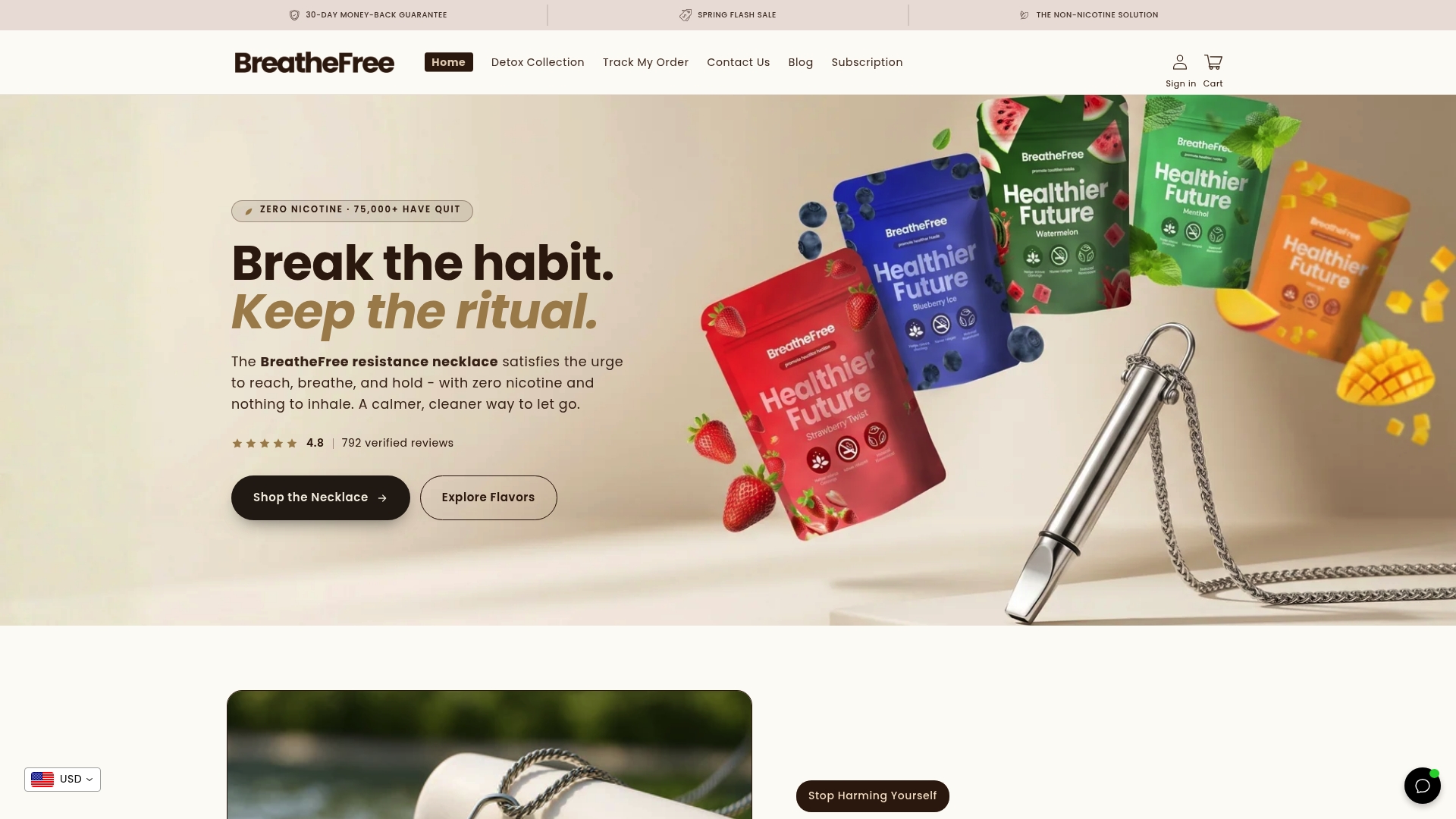
For structured support beyond the necklace, Breathefree’s Nicotine Detox eBook and Habit Tracker walks you through the same 30-day framework with daily prompts and a built-in tracker. Pick up the necklace, download the guide, and start the plan today.
Suggested reading and sources
- Emotional vs Physical Smoking Cravings — QuitAndBreathe: Explains the behavioral distinction between emotional and physical cravings and supports the Delay → Replace → Reframe framework used throughout this article.
- Understanding the Emotional Attachment to Smoking — QuitSure: Covers affiliative attachment and how cigarettes become comfort objects tied to identity and routine.
- It’s Complicated: Smokers’ Relationships With Their Cigarette Brands — PMC: Peer-reviewed study on brand attachment and the psychological mechanisms that sustain smoking behavior.
- Getting Help With the Mental Part of Tobacco Addiction — American Cancer Society: Supports the replacement-ritual approach and the value of pre-planning for high-risk moments.
- Know Your Smoking Triggers — Smokefree.gov: Public health resource recommending oral replacements (straws, gum) and behavioral tactics for quit smoking emotional triggers.
- Tips for Coping With Nicotine Withdrawal and Triggers — NCI: NCI guidance on managing withdrawal symptoms and emotional triggers, including oral substitutes and breathing exercises.
- Smart Turkey: Breaking Emotional Ties — WhyQuit: Describes the grief-like emotional recovery phases after quitting and why preparing for them reduces relapse risk.
- Know Your Smoking Triggers and Beat Them — Franciscan Health: Supports gradual, trigger-by-trigger habit replacement as used in the 30-day plan.