

A road trip without smoking is doable when you plan for the three things that pull smokers back: the car itself, the long stretches of idle time, and the hands-and-mouth habit. Clear the car, line up things to hold and chew, and know exactly what you will do when an urge hits at mile 140. Our nicotine-free resistance necklace is built for the hold-and-draw ritual, and the rest of this guide gives you the routine around it.
TL;DR
- Remove every cigarette, lighter and ashtray from the car before you leave, and clean the interior so it no longer smells like smoke.
- Pack things for your hands and mouth: sugar-free gum, cinnamon sticks, straws, toothpicks, nuts, and a tool that mimics the draw ritual.
- Plan stops every one to two hours. Cravings pass in a few minutes, so a short walk or ten slow breaths is often enough.
- Tell your passengers the car is smoke-free, and book nonsmoking rooms.
- If you slip, stop again right away. One cigarette does not erase your progress.
Table of Contents
- Why a road trip is a trigger
- Before you leave: reset the car
- Set the rules with your passengers
- Pack the hands-and-mouth kit
- Build the route around your cravings
- When a craving hits at the wheel
- Support when you are far from home
- If you slip on the road
- What to bring from BreatheFree
- Our perspective
- FAQ
- Sources
Why a road trip is a trigger
The National Cancer Institute (NCI) groups triggers into three types: social, emotional, and pattern or activity triggers. Being in a car is named as a pattern trigger, alongside coffee and meals. A road trip stacks several at once: hours in the driver’s seat, gas-station coffee, a meal at a roadside diner, and stress when traffic stops.
The same fact sheet says that on long trips the desire to smoke may be stronger and more frequent. That is not a sign you are failing. It is a reason to prepare more than you would for a normal day.
Cravings also have a physical side and a psychological side. The body wants nicotine, and the brain reacts to cues such as the sight of a lit cigarette. Nicotine-free tools cover the psychological side well: they give your hands and mouth something to do when the cue shows up.
Before you leave: reset the car
The car is where you have probably smoked the most, so start there. The CDC’s quitting advice says to get rid of all cigarettes, lighters, matches and ashtrays in your home, car and workplace before you quit, and to wash clothes that smell of tobacco.
A practical checklist for the day before departure:
- Empty the ashtray and remove it, along with every lighter and any loose cigarettes in door pockets, the glove box and the console.
- Clean or detail the interior and use a deodorizer. The NCI recommends it, and a fresh, clean car is harder to smoke in. Wash the seat covers or floor mats if they hold the smell.
- Tape a short list of your reasons for quitting to the dashboard. Einstein Medical Center’s driving guide suggests reading one or two at red lights or in traffic.
- Do not light up the moment you sit behind the wheel. Break that automatic start-the-engine, start-the-cigarette link on short drives in the days before the trip.
We cover this step by step in our guide to driving without smoking.
Set the rules with your passengers
The NCI advises you not to allow passengers to smoke in your car. If you are a passenger, it suggests finding something to do with your hands. Say it before the trip, not at the first rest stop. NCI’s Clear Horizons guide suggests telling road-trip companions you appreciate their not smoking in the car.
Also ask a friend to be your text-or-call person for the trip. The CDC lists calling a friend as a way to get through an urge, and a driving partner who knows your plan can take the wheel while you stretch your legs.
Pack the hands-and-mouth kit
Most road trip relapses come from boredom plus a free hand. The CDC recommends finding safe substitutes for your mouth and hands, such as toothpicks, straws or cinnamon sticks that you can hold and bring to your mouth like a cigarette, plus a squeeze ball or paper clips for nervous energy. It specifically names driving as a hard-to-leave situation where these help. The same page advises trying different substitutes in the days before quitting so you know what works.
Here is a packing list drawn from the NCI, CDC, and Einstein Medical Center guidance:
| Need | What to pack |
|---|---|
| Mouth | Sugar-free gum, sugar-free hard candy, mints, cinnamon sticks, flavored toothpicks, straws |
| Crunch | Carrot sticks, celery, apples, pretzel sticks, popcorn, sunflower seeds, nuts, raisins |
| Hands | Squeeze ball, pencil and small notebook for doodling, paper clips |
| Mind | Favorite playlist, audiobook, puzzle book for rest stops |
| Motivation | Index card with your reasons for quitting |
| Hydration | A full water bottle you refill at every stop |
Clear Horizons lists 39 possible substitutes, including ice chips and breath mints, and it also says to carry a small index card with your reasons for quitting. If you use nicotine replacement therapy, pack enough for the whole trip in your carry-on or glove box.
Keep the kit within arm’s reach of the driver’s seat, not in the trunk. An urge lasts a few minutes, and a kit you cannot reach does nothing.

Where a resistance necklace fits
Gum and carrots handle the mouth. They do not copy the ritual of drawing something in slowly and exhaling, which is a large part of what drivers miss. That is the gap our resistance necklace fills. It is nicotine-free and chemical-free, there is nothing to inhale, and it is fully solid and plant-fiber based, so it works anywhere you can wear it, from the driver’s seat to a flight or an office. It comes with flavor refills, so you can change the taste over a long trip. If you want to know how holding and chewing objects works for quitting, see our guide to quitting with physical objects.
Build the route around your cravings
The NCI says cravings can begin within an hour or two of the last tobacco use and come frequently for days or weeks before spreading out. So the first days after quitting are the hardest to drive through. If your quit date and your trip date are close, the first leg of the drive is where you are most exposed.
Use the route to your advantage:
- Stop often. The NCI and Einstein Medical Center both recommend stretch breaks and planned rest stops on long trips. Every one to two hours is a sensible rhythm. Pick stops before you leave, so you are never driving toward a gas station “just to see” while an urge builds.
- Avoid your old buying spots. Einstein Medical Center advises avoiding routes past places where you usually buy cigarettes. On the road, that means skipping the gas-station counter. Pay at the pump, and if you need the restroom, walk in and straight out.
- Eat on a schedule. Bring healthy snacks and eat meals at planned times so you are not tempted to light up out of hunger or fatigue.
- Book smoke-free rooms. Clear Horizons suggests requesting nonsmoking hotel rooms and calling ahead to check restaurant and bar smoking policies.
- Take a 1-minute vacation. That is Clear Horizons’ term for pausing at any stop, closing your eyes and picturing somewhere calm. It fits well at a rest stop.
If you are flying to the start of your trip or at the end of it, we also wrote about airplane cigarette cravings and what to pack for the long no-smoking window.
When a craving hits at the wheel
Keep your eyes on the road and use a short, repeatable routine. The NCI’s advice is to remind yourself that the urge will pass in a few minutes. Its suggested self-talk is: “This urge will go away in a few minutes,” and “I’m a better driver now that I’m not smoking while driving.”
A routine that fits in about three minutes:
- Name it. Say out loud, “That’s a craving.” It is a normal part of quitting, and Smokefree.gov says cravings don’t last forever.
- Fill your mouth and hands. Gum, a cinnamon stick, or your necklace.
- Breathe slowly. The NCI recommends a deep-breath exercise of 10 repetitions. If you want a few more methods, these breathing exercises to calm down fast are quick to learn.
- Drink water. One of Clear Horizons’ Four D’s, along with Distract, Deep Breathe, and Do Something Else.
- Pull over if it is strong. At the next safe stop, walk around the car or climb a flight of stairs. Smokefree.gov lists walking and stairs as craving busters.
For a longer exercise, our guides to urge surfing and a 3-minute CBT technique for cravings show how to ride an urge out without acting on it.
Handling stress and boredom
Emotional triggers include stress, anxiety, boredom, frustration, and even excitement, according to the NCI. Traffic jams and wrong turns supply plenty. The CDC’s Pathways to Freedom notes that deep breathing and exercise are better ways to reduce stress than smoking. Einstein Medical Center suggests radio, music, or audiobooks to stay occupied. Choose a long audiobook or a podcast series for the trip and save it for the drive only.
Turn on music and sing along. The NCI lists it as a driving tip, and it occupies your mouth and breath at once.
Support when you are far from home
You do not need to be at home for help. Smokefree.gov lists these options:
- Text QUIT to 47848 to sign up for SmokefreeTXT.
- Call the NCI Quitline at 1-877-448-7848 (Monday to Friday, 9 a.m. to 9 p.m.).
- Call 1-800-QUIT-NOW (1-800-784-8669) to reach your state quitline.
- Use NCI’s LiveHelp chat.
You can also use our quit smoking support resources guide and the BreatheFree community.
If you want to talk about medication, see your doctor or pharmacist before the trip. The NCI notes that varenicline and bupropion are two non-nicotine prescription medicines that help people quit, and the 2026 VA/DoD guideline synopsis reports that medication roughly doubles to triples abstinence rates compared with placebo. Your doctor can tell you whether either suits you and how long to take it. If you already use nicotine replacement, keep using it on the road.
If you slip on the road
A slip is not a relapse. MedlinePlus says to stop smoking again right away, get rid of any leftover pack, and not beat yourself up. Then:
- Work out what triggered it: a delay, a meal, a passenger, a bad mood.
- Clean the car again and make it a smoke-free zone.
- Post your top three reasons for quitting where you can see them.
- Keep using NRT if you are on it. A temporary slip does not mean you have to stop.
The CDC’s Pathways to Freedom guide adds that one or more slips do not mean failure, and that you should not let guilt lead you back to regular smoking. It also says to spend time away from people who are still smoking and to call a quitline. Rejoin your plan at the next stop, not at the end of the trip.
If you have not built a plan yet, our guide to creating a quitting smoking action plan walks through it.
What to bring from BreatheFree
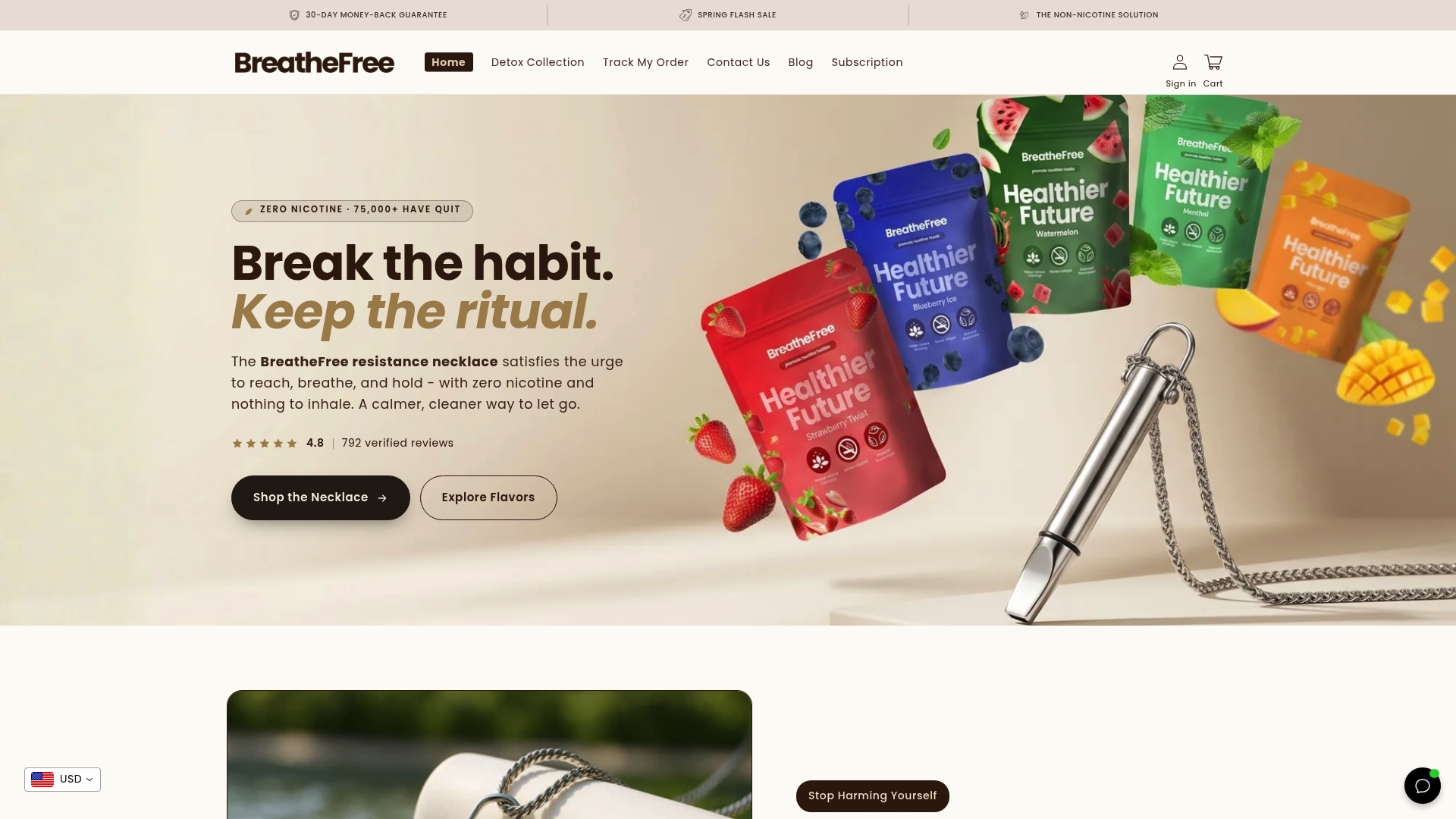
For a trip, the simplest kit is the BreatheFree Resistance Necklace at $39.95 and a pack of Flavor Refills at $29.95, both one-off prices. Together they give you something to hold and draw on in the car, with a choice of natural flavors, and nothing to light, charge, or inhale. Our 30-day money-back guarantee applies. You can see both on our shop page, and our Habit Tracker helps you log the miles and days you have gone without smoking.
If you travel often, we also offer a subscription for refills.
Our perspective
Most advice about road trips tells you to chew gum and be strong. Gum helps, but a smoker’s habit is more than the mouth: it is the reach, the hold, the slow draw and the exhale, repeated dozens of times a day. In a car, that ritual is even more automatic.
We built our resistance necklace around that idea. It is nicotine-free and chemical-free, solid and plant-fiber based, with nothing to inhale. That means you can use it in the driver’s seat, at a rest stop, on a flight, or at your desk without a lighter, a battery, or a smell. The flavor refills make it easy to switch things up on day three of a long drive.
Our advice is to try your kit before you leave. Practice in the car on short drives for a week. By the time the highway opens up, reaching for the necklace should feel as automatic as reaching for a pack once did.
Tommy
FAQ
What can I do instead of smoking while driving?
The CDC suggests holding toothpicks, straws or cinnamon sticks, and chewing sugar-free gum, and the NCI adds mints, nuts and crunchy vegetables. A resistance necklace gives your hands and mouth the hold-and-draw motion without nicotine. Keep everything within reach of the driver’s seat.
How long does a craving last?
The NCI says to remind yourself that an urge goes away in a few minutes. Cravings come often in the first days or weeks and then get farther apart. Plan something to do for those few minutes, such as slow breaths, water, or a rest stop walk.
Should I take a road trip right after quitting?
Cravings tend to be strongest soon after the last cigarette, and the University of Hawaii’s Beat It program suggests avoiding long car trips for a little while if you can, and taking plenty of rest stops if you cannot. If the trip is fixed, prepare the car, pack your kit, and tell your passengers.
What if someone in the car wants to smoke?
The NCI says not to allow passengers to smoke in your car. Tell them before you leave, and plan stops where they can smoke away from the vehicle while you stretch or walk the other way.
Sources
- Tips for Coping with Nicotine Withdrawal and Triggers, National Cancer Institute
- Clear Horizons, Smokefree.gov / NCI
- Tips For Quitting, CDC Tips From Former Smokers
- How to Drive Without Smoking, Einstein Medical Center
- How to Manage Cravings, Smokefree.gov
- Pathways to Freedom, CDC
- Dealing with a slip up, MedlinePlus
- Tobacco Use Treatment: Synopsis of the 2026 VA/DoD Guideline, Annals of Internal Medicine
- Beat It, University of Hawaii
- Breathing exercises to calm down fast