

Craving-trigger mapping is a short, repeatable process where you write down the situation that set off an urge, how your body and mind reacted, and exactly what you plan to do next time it happens. It turns a craving from something that ambushes you into something you can see coming. Instead of white-knuckling through cravings as they hit, you build a record that shows you patterns you’d otherwise miss.
The payoff shows up fast once you start tracking:
- Predictability — you stop getting blindsided by the same three or four situations
- Faster coping — when you’ve already planned a response, you’re not improvising during the hardest 90 seconds of your day
- Fewer surprises for the people supporting you — a written map gives your partner, sponsor, or therapist something concrete to work from instead of vague check-ins
- Less shame spiraling — seeing a trigger on paper as a pattern, not a personal failure, changes how you talk to yourself after a slip
Try this right now: think of the last time you wanted a cigarette, a drink, or a hit badly enough that it scared you a little. Write down where you were, what happened right before, and how intense the urge felt on a scale of 0 to 10. That’s your first map entry. Everything below builds on that single habit.
Key Takeaways
Craving-trigger mapping works because it replaces an automatic reaction with a rehearsed, written plan built from your own tracked patterns.
| Point | Details |
|---|---|
| Start mapping today | Log your very next urge using the eight-field template: when, where, who, thought, sensation, intensity, behavior, need. |
| Rate every entry 0-10 | Urge intensity ratings let you sort your map by real risk instead of memory. |
| Pick one substitution per trigger type | Match oral, sensory, or anxiety triggers to a specific coping action, not a vague intention. |
| Share weekly with support | Hand a sponsor, friend, or clinician one entry a week for accountability and outside perspective. |
| Build an emergency plan | List two to three contacts and a safe location before you need them, and know when to call 911. |
| Use Breathefree for oral-fixation entries | The resistance necklace gives mapped oral triggers a nicotine-free, planned response. |
Table of Contents
- What Are Triggers in Craving-Trigger Mapping?
- Why Trigger Mapping Actually Changes Recovery Outcomes
- How to Create a Craving-Trigger Map, Step by Step
- Turning Your Map Into a Relapse-Prevention Plan
- Sample Trigger Map Entries and a Blank Template
- What Neuroscience Says About Why Mapping Works
- When Mapping Isn’t Enough: Signs You Need Professional Support
- How Breathefree Fits Into a Mapped Coping Plan
- Frequently Asked Questions
- Sources
What Are Triggers in Craving-Trigger Mapping?
A trigger is anything that reliably raises your urge intensity, and they split into two broad categories: external and internal. Getting this distinction right is the difference between a map that actually predicts your cravings and one that’s just a vague diary.
External triggers live outside your head. They’re the people, places, objects, and sensory cues your brain has linked to using. Common examples include:
- A specific friend you used to smoke or drink with
- Your car, especially the drive home from work
- The smell of a lighter, coffee, or a particular restaurant
- Payday, or any moment cash is suddenly in your pocket
- A bar patio, a break room, or any spot tied to old routines
Internal triggers live inside you: emotions, physical states, and thoughts or memories that spike the urge even with nobody and nothing else around. These include:
- Boredom or restlessness, especially in unstructured evening hours
- Anxiety before a difficult conversation or deadline
- Physical fatigue or hunger that lowers your resistance
- A memory surfacing unprompted, like an old argument or a loss
- The thought “just one won’t hurt,” which is often a trigger disguised as logic
There’s a related distinction worth knowing: a cue is a quick, specific trigger, like the smell of smoke. A stressor or high-risk situation is broader and slower building, like a rocky week at work that leaves you depleted by Thursday. Elevate Recovery Homes frames trigger maps as a personal early-warning system precisely because they catch both the sharp cues and the slow-burn situations before they collide.
When you’re not sure whether something counts as a trigger worth logging, run the HALT check: are you Hungry, Angry, Lonely, or Tired? Any yes is worth a map entry, even if nothing “happened.”
Why Trigger Mapping Actually Changes Recovery Outcomes
Mapping works because it interrupts the gap between trigger and reaction. Without a map, a craving fires and your body responds automatically, the way it’s been trained to for months or years. With a map, you’ve already rehearsed the moment on paper, so your brain has a script to fall back on instead of defaulting to old wiring.
The practical benefits stack up quickly once you’ve logged even a handful of entries:
- Pattern spotting — you notice that four of your last six urges happened between 4 and 6 PM, which tells you something about fatigue or transition stress, not willpower
- Prioritized coping — you stop treating every trigger as equally dangerous and put your energy where it matters
- Better conversations with your support system — showing someone a map entry is faster and more honest than trying to explain a feeling after the fact
- Reduced shame — a documented pattern reads as data, not a character flaw, which makes it easier to keep showing up after a rough day
Pro Tip: Track both frequency and intensity for two weeks before changing anything. A trigger that hits often but stays a 3 out of 10 needs a different response than one that hits rarely but spikes to an 8. Your highest-risk entries are usually the ones where both numbers are high, not just one.
How to Create a Craving-Trigger Map, Step by Step
This is the exercise itself. It takes two to four minutes per entry once you’ve done it a handful of times, and you can do it on paper, in a notes app, or in a dedicated habit tracker.
- Note the when and where. Time of day, location, and what you were doing thirty seconds before the urge hit.
- Note who was there. Alone, with a specific person, or in a crowd. Names matter more than “with friends.”
- Capture the preceding thought. What crossed your mind right before the craving? Even something as ordinary as “I need a break” counts.
- Log the body sensation. Tight chest, restless hands, a lump in your throat. Cravings are physical events, not just mental ones.
- Rate the urge intensity from 0 to 10. Zero is no pull at all; 10 is the strongest craving you can imagine. Be honest, not dramatic.
- Record the automatic behavior. What did you almost do, or actually do? Reach for a pack, open an app, pour a drink.
- Identify the underlying need or value. Were you actually craving nicotine, or were you craving a break, connection, or control? This step is the one most people skip, and it’s the one that changes everything.
- Write the planned response as an if-then statement. “If I feel this at my desk after 3 PM, then I take a five-minute walk and use my oral substitute instead of heading to the vending machine.”
That 0 to 10 scale isn’t decoration. A step-by-step guide to trigger mapping recommends rating every entry so you can later sort your map by severity instead of trying to remember which cravings felt worst. Over two or three weeks, the ratings themselves become the most useful column on the page.
Copy this into a notebook or phone note as your starting template:
Date/Time: ___ Location: ___ Who was present: ___ Preceding thought: ___ Body sensation: ___ Urge intensity (0-10): ___ Automatic behavior: ___ Underlying need/value: ___ Planned response (if-then): ___
Share at least one entry a week with a support person, sponsor, or clinician. Phrase it plainly: “Here’s what I logged Tuesday. The trigger was my coworker’s smoke break, my urge hit a 7, and my plan for next time is X.” That single sentence does more for accountability than a vague “I’ve been struggling this week.”
Pro Tip: Most people map the trigger and the craving but skip the step in between: the small ritual behavior, like reaching for something to hold or put in your mouth. Catching that middle “fidget” step is what lets you swap in a substitute action before the automatic behavior takes over. If your hands are the problem, plan for your hands specifically.
Turning Your Map Into a Relapse-Prevention Plan
A map full of entries is only useful once you convert it into decisions. Start by sorting triggers into two piles: ones you can reasonably avoid, and ones you’ll inevitably face and need to prepare for instead.
Frequency and intensity together tell you where to spend your effort. A trigger that’s both frequent and intense, say, the 6 PM drive home that hits an 8 out of 10 most days, deserves a specific, rehearsed plan. A trigger that’s rare and mild might just need a general coping reminder. Fokus Apps’ mapping framework calls this planning for high-risk contexts specifically, rather than treating every craving as an emergency.
Build a coping-strategy bank matched to trigger type:
- For sensory or oral-fixation triggers: a physical substitute you can hold or put in your mouth, like a resistance necklace or a piece of sugar-free gum
- For anxiety-driven triggers: box breathing (four counts in, four hold, four out, four hold) for 60 seconds before deciding anything
- For boredom or restlessness: a five-minute physical task, a short walk, or a fidget ring that keeps your hands occupied
- For social triggers: a scripted exit line you’ve practiced out loud, so you’re not improvising in the moment
Build a short emergency action plan for when an urge escalates past what your usual coping bank can handle. It should list two or three phone numbers (a sponsor, a close friend, a crisis line), a physical location you can go to that isn’t tied to using, and a one-line reminder of why you’re doing this. Reviewing what typically causes relapse after quitting can help you spot which entries on your own map deserve this level of preparation.
If a craving comes with chest pain, severe withdrawal symptoms, thoughts of self-harm, or any sense that you might hurt yourself or someone else, the plan changes entirely. Call 911 or a crisis line immediately. A trigger map is a self-management tool, not a substitute for emergency care.
Sample Trigger Map Entries and a Blank Template
Seeing two filled-out entries makes the whole process click faster than any explanation. Here’s one external-trigger example and one internal-trigger example, side by side.
| Field | External Trigger Example | Internal Trigger Example |
|---|---|---|
| When/where | Friday afternoon, car in the driveway | Sunday evening, on the couch alone |
| Who present | Nobody, but just left a coworker who smokes | Nobody |
| Preceding thought | “I always smoked here after work” | “I’m so bored, nothing to do” |
| Body sensation | Tight jaw, restless hands | Heavy chest, low energy |
| Urge intensity (0-10) | 7 | 5 |
| Automatic behavior | Reached for glove compartment | Scrolled phone for a cigarette-buying app |
| Underlying need | Transition ritual from work to home | Stimulation, structure |
| Planned response | Hold resistance necklace for two minutes before entering the house | Start a 10-minute walk or call a friend |
Copy the blank version below into your phone or a notebook page:
- Date/time:
- Location:
- Who was present:
- Preceding thought:
- Body sensation:
- Urge intensity (0-10):
- Automatic behavior:
- Underlying need/value:
- Planned response (if-then):
A screenshot of this template saved to your phone’s photo album works fine. Some people prefer a single physical notebook they keep in a bag or car glovebox, precisely because writing by hand slows the moment down enough to interrupt the automatic behavior. Either way, review your entries weekly rather than letting them pile up unread.
What Neuroscience Says About Why Mapping Works
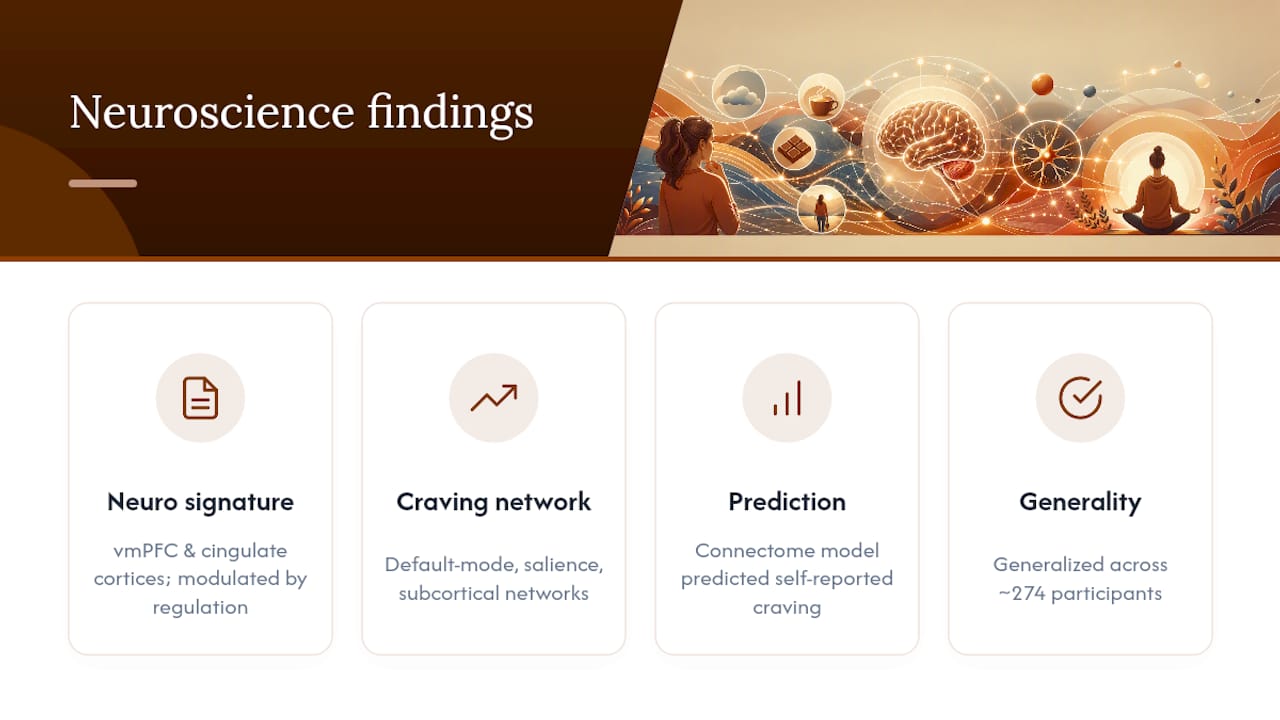
Craving isn’t just a feeling. It has a measurable signature in the brain. Research has identified a Neurobiological Craving Signature involving the ventromedial prefrontal cortex and cingulate cortices, and this signature can be modulated by conscious self-regulation strategies, according to research on neurobiological craving markers. That finding matters for mapping specifically: if craving activity in the brain responds to deliberate regulation, then a rehearsed if-then plan isn’t just a psychological trick, it’s targeting a process that’s already known to be responsive to conscious strategy.
A separate line of research goes further, identifying what’s been called a transdiagnostic “craving network.” Using connectome-based predictive modeling on a sample of roughly 274 people, researchers found that patterns across the default mode, salience, and subcortical brain networks predicted self-reported craving, and the model generalized to independent datasets, per the Transdiagnostic Connectome-Based Prediction of Craving study. In plain terms: craving isn’t random noise. It follows detectable patterns across different people and different substances or behaviors, which is exactly the premise a trigger map operates on at a personal scale.
One statistic worth sitting with: that connectome study’s predictive model generalized across independent samples of roughly 274 participants, meaning the craving network it identified wasn’t a fluke of one dataset. Personalized tracking, like a trigger map, works from the same logic scaled down to an individual.
None of this replaces clinical care. Mapping is a self-awareness and planning tool, not a diagnostic or treatment method, and if cravings are tied to a substance use disorder, professional support matters alongside anything you track on your own.
When Mapping Isn’t Enough: Signs You Need Professional Support
Mapping is powerful, but it has limits, and knowing where those limits are is part of using the tool responsibly. Watch for these warning signs that call for more than a worksheet:
- Cravings that feel completely uncontrollable regardless of coping strategies you’ve rehearsed
- Withdrawal symptoms that involve tremors, seizures, severe nausea, or hallucinations
- Urges accompanied by thoughts of harming yourself or someone else
- A pattern of relapse that keeps repeating despite consistent mapping and planning
- Physical health complications tied to substance use that need medical attention
If any of these apply, bring your map to a clinician rather than trying to work through it alone. Hand over your entries, particularly the frequency and intensity ratings, so your provider can see the pattern instead of reconstructing it from memory during a single appointment. Many people find that combining mapping with structured therapy or, where appropriate, medication-assisted treatment works better than either approach alone. No single pathway fits everyone, and a clinician can help you figure out which combination fits your situation.
One Habit That Made My Own Mapping Stick
The biggest shift in how I think about trigger mapping came from noticing how often the “trigger” people report isn’t really the trigger at all. It’s the ritual sitting between the trigger and the behavior, the thing your hands do while your mind is still deciding. Once you map that middle step specifically, instead of just the broad cause and the outcome, you can swap in almost anything physical and interrupt the chain.

One small addition that’s worth building into a daily routine, separate from mapping itself: pick one low-stakes moment each day, maybe your morning coffee or your commute, and practice your planned oral substitute there before you actually need it under pressure. Rehearsing a coping response when the stakes are low makes it far more available when the stakes are high.
How Breathefree Fits Into a Mapped Coping Plan
If your map keeps surfacing the same underlying need, something to hold, something to put near your mouth, a small ritual to replace the one you’re quitting, that’s not a coincidence. Oral fixation shows up on more trigger maps than almost anything else, and it’s exactly the gap Breathefree was built to fill without reintroducing nicotine into the equation.
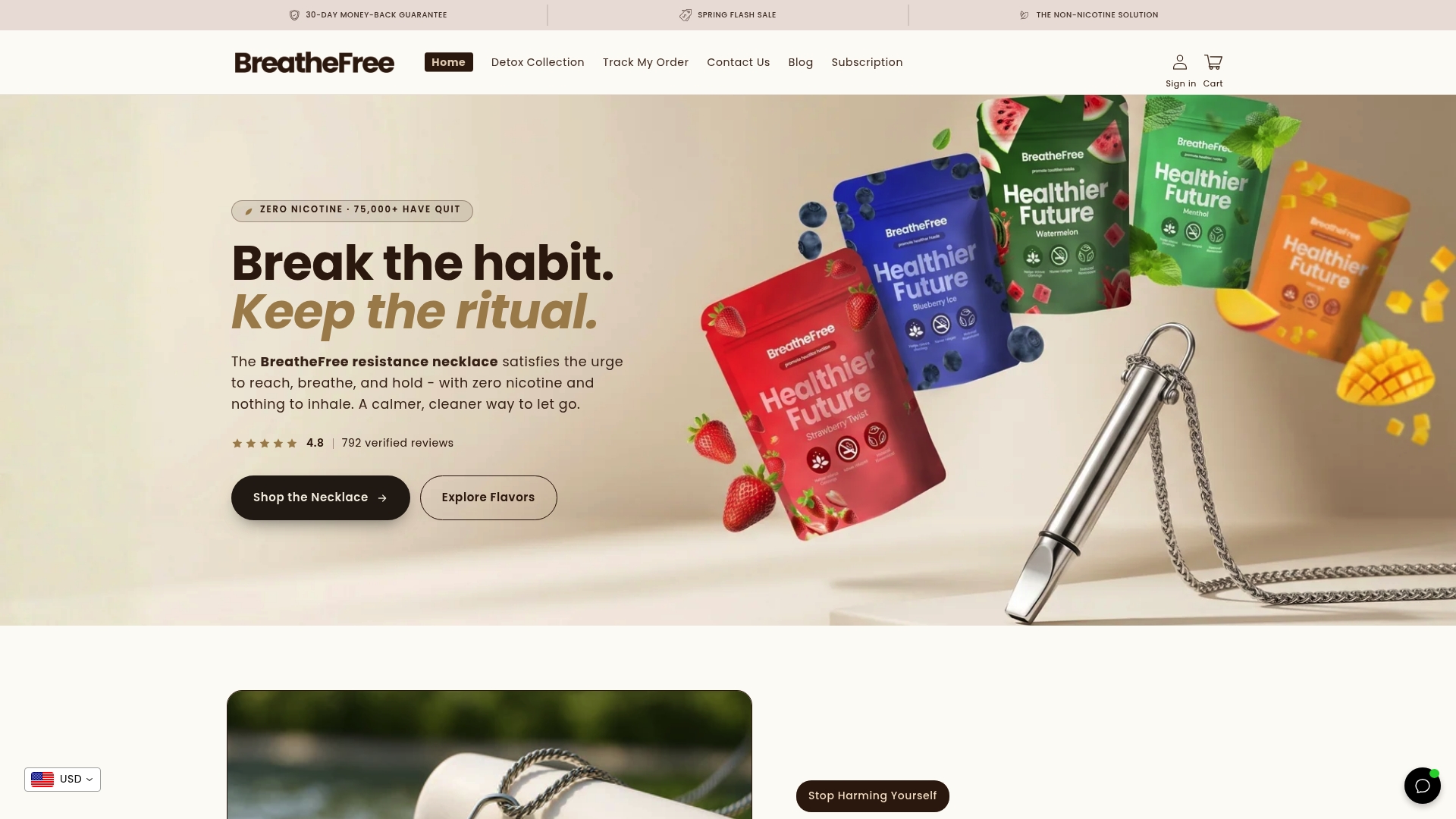
The Breathefree resistance necklace gives your hands and mouth a physical action to replace the one your map just identified as automatic. If your if-then plan reads “if I feel the 6 PM driveway urge, then I reach for my necklace instead of the glovebox,” that’s the plan working exactly as designed, turning a mapped trigger into a rehearsed, nicotine-free substitution. For triggers tied more to restlessness in your hands than your mouth, the fidget spinner ring serves the same function in a different form factor. This is a product recommendation from Breathefree, not independent clinical advice, and it works best as one tool inside a broader plan you build from your own map. Try holding it during your next low-stakes rehearsal moment, then write the result into your map as a new entry.
Frequently Asked Questions
What is craving-trigger mapping in simple terms? It’s a written record of what happens right before an urge hits, how intense it feels, and what you plan to do differently next time. You track the situation, your reaction, and a response, then use the pattern to plan ahead instead of reacting in the moment.
How is trigger mapping different from just journaling about cravings? Journaling tends to be open-ended and reflective. A trigger map is structured: the same fields every time (when, where, who, intensity, behavior, planned response), so entries can be compared and sorted rather than just read back.
How long before a trigger map actually shows useful patterns? Most people start noticing repeat patterns within two to three weeks of consistent tracking, especially once they’ve logged five or more entries with intensity ratings attached.
Can trigger mapping replace therapy or medical treatment? No. It’s a self-awareness and planning tool that works well alongside professional care, not instead of it. If cravings involve severe withdrawal, uncontrollable urges, or thoughts of self-harm, professional support is necessary.
What if I can’t identify an underlying need behind a trigger? That’s common at first. Write your best guess, even if it’s vague like “comfort” or “control,” and revisit it after a few more entries. Patterns across entries often clarify the need faster than trying to nail it down in one sitting.
Sources
These sources go deeper into the neuroscience and practical mechanics behind mapping, though none of them are required reading before you start your own worksheet.
- PubMed entry for research on neurobiological craving markers
- Transdiagnostic Connectome-Based Prediction of Craving
- Trigger Mapping for Urge Control: Step-by-Step Guide | Fokus Apps
- Trigger Mapping: Creating Your Personal Early Warning System | Elevate Recovery Homes